
Freeze-Dried Durian Buyer Checklist for B2B Approval
Freeze-dried durian approval should not depend on a good sample, a clean photo or a certificate logo. Those are only entry points. The buyer still needs to confirm product format, cultivar, moisture, Aw, microbiology, packaging, shelf-life basis, COA, label data, retained sample, lot identity and loading readiness. The final buyer checklist must turn a promising sample into a controlled product file.
This guide is for importers, distributors, QA managers, procurement teams, R&D developers and private label buyers who need a practical approval gate before trial, OEM packing or bulk release. FruitBuys supplies freeze-dried durian through an Integrated Product Supply Model, where Raw Material Sourcing Governance, Quality Control, Documentation, OEM/Private Label Delivery and Export Logistics Coordination are tied to one finished product relationship.
Start with the Product Identity
The buyer should first confirm what product is being approved.
Freeze-dried durian pieces, slices, bites and powder do not carry the same specification or label risk.
A product file is not ready when the name, format, ingredient statement and lot identity are unclear.
Before sample approval, confirm:
| Checklist Item | Required Buyer Answer |
|---|---|
| Product name | Freeze-dried durian |
| Product format | Cubes, bites, slices, broken pieces, granules or powder |
| Ingredient statement | Pure durian or declared formulation |
| Cultivar | Ri6, Monthong/DONA or approved range |
| Intended use | Snack, ingredient, powder, topping, OEM/private label |
| Destination market | U.S., EU, UAE, domestic or other market |
| Lot identity | Sample code, trial batch or bulk lot |
If the buyer has not chosen the application, begin with freeze-dried durian applications for food buyers. If the buyer has not chosen the format, review freeze-dried durian cubes, bites, slices and powder.
Check Cultivar and Raw-Material Control
Cultivar is not decoration. It affects product identity, aroma direction, texture expectation and sample-to-bulk comparison.

The buyer should request:
- Cultivar declaration
- Approved cultivar alternatives
- Growing-region or sourcing-area note where available
- Maturity direction
- Clean-flesh definition
- Defect-removal rule
- Fresh-to-dry mass-balance record where yield claims are used
For cultivar selection, use Ri6 vs Monthong freeze-dried durian. For conversion logic, use fresh-to-dry durian conversion. A supplier should not change cultivar after sample approval unless the specification allows it and the buyer approves the change.
Lock the Format and Physical Grade
Freeze-dried durian must be approved by format. “Pieces” is not enough.
| Format | Must Be Defined |
|---|---|
| Cubes | Dimensions, tolerance, chipped-edge allowance |
| Bites | Size range, broken-piece limit, sensory range |
| Slices | Thickness, partial-slice allowance, breakage limit |
| Broken pieces | Grade definition, particle range, use case |
| Powder | Mesh, carrier status, bulk density, clumping review |
The buyer should request a retained sample for the exact approved format. Without a retained sample, bulk comparison becomes a debate by memory. This gate links to sample-to-bulk consistency for freeze-dried durian.
Verify Moisture and Aw Separately
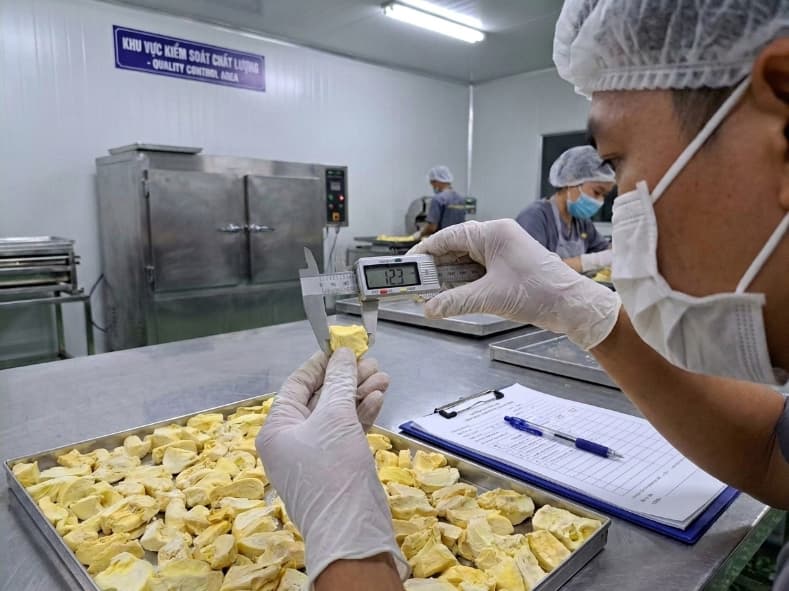
Moisture and Aw are separate technical controls.
Moisture measures total water, while Aw measures water availability under defined conditions.
Buyers should request both values before approving freeze-dried durian for bulk release.
The current FruitBuys working targets are moisture 3–5% and Aw <0.30. These are specification targets until a lot-specific COA confirms the results. FDA describes water activity as a vapor-pressure relationship between food and water under the same conditions, and FDA notes that Aw can change with temperature (U.S. Food and Drug Administration).

ISO 18787:2017 establishes principles and requirements for determining water activity in food products within a 0 to 1 measurement range. (U.S. Food and Drug Administration).
The buyer should verify:
| Control | Required Evidence |
|---|---|
| Moisture target | Approved specification |
| Moisture result | Lot COA |
| Moisture method | Laboratory or approved method |
| Aw target | Approved specification |
| Aw result | Lot COA |
| Aw method | Instrument or method basis |
| Sampling point | Before packing or after packing |
| Packaging condition | Sealed or defined exposure condition |
The technical guide is freeze-dried durian moisture and Aw.
Require COA and Laboratory Testing
A COA should match the exact product, format and lot under approval. It should not be a historical report from another batch.

The buyer should request:
- Lot-specific COA
- Moisture result
- Aw result
- Microbiology panel
- Heavy-metal panel where required
- Pesticide-residue panel where required
- Nutrition data where label work requires it
- Method, unit, result and acceptance limit
- Laboratory or issuer identity
- Sample date and lot number
Low-moisture products still need sanitation and contamination-control review. FDA’s 2025 draft guidance on low-moisture ready-to-eat foods focuses on sanitation programs and corrective actions after pathogen contamination events, which is a clear reminder that dry food still needs preventive control discipline (U.S. Food and Drug Administration). Use freeze-dried durian COA and laboratory testing for the proof gate.
Check Packaging and Shelf-Life Basis
A product that passes moisture and Aw can still fail if the packaging fails. Packaging must protect the low-moisture condition created by processing.

The buyer should review:
| Packaging Field | Approval Question |
|---|---|
| Inner bag or pouch | Does it protect against moisture and aroma loss? |
| Seal condition | Is seal integrity reviewed? |
| Pack size | Does it match the approved product and label? |
| Carton | Does it protect fragile pieces? |
| Storage instruction | Is it practical and product-specific? |
| Shelf-life basis | Is the target supported by product-pack-storage evidence? |
| Retained sample | Is the packed sample available for comparison? |
Do not approve a shelf-life claim because the product is freeze-dried. Approve it only when the product, pack and storage condition support the claim. The full guide is freeze-dried durian packaging and shelf-life controls.
Review Destination Documents
Documentation readiness means every document describes the same product and lot.

For U.S. import review, FDA states that it does not approve, certify, license or otherwise sanction individual food importers, products, labels or shipments before importation. FDA also states that imported foods can enter without prior FDA sanction when required facility registration and prior notice conditions are met (U.S. Food and Drug Administration) .
FDA’s importing-human-foods page identifies prior notice, food facility registration, FSVP and labeling compliance as import topics for human food (U.S. Food and Drug Administration). For EU review, Regulation (EU) No 1169/2011 governs food information to consumers and nutrition declaration requirements for consumer-facing food (Food Safety).
Commission Regulation (EU) 2023/915 sets maximum levels for certain contaminants in food (EUR-Lex). Regulation (EC) No 396/2005 covers maximum residue levels of pesticides in or on food and feed of plant and animal origin (Publications Office of the EU).
The European Commission states that no phytosanitary certificate is needed for fruits of pineapple, coconut, durian, banana or date under the cited plant-health rule, but processed-product classification and destination requirements still need review (Food Safety).
For UAE review, the UAE Government states that food products that are imported, locally produced or modified in label, ingredients or composition must be registered in the electronic ZAD system before being handled in UAE markets (uae). Use freeze-dried durian documentation readiness before approving any market-facing file.
Private Label Approval Gate
Private label approval should follow product evidence.
Artwork cannot fix an undefined formula, unsupported cultivar claim, missing COA or weak packaging file.
Buyers should lock product, label and release evidence before bulk packing.

For private label freeze-dried durian, check:
- Product format
- Pack size
- Ingredient statement
- Carrier declaration for powder
- Nutrition data basis
- Destination label rule
- Storage instruction
- Lot code and best-before code
- Artwork proof
- Certificate scope
- COA and laboratory panel
- Retained sample
- Packaging structure and seal review
The private label route is freeze-dried durian OEM and private label delivery. The label data route is freeze-dried durian Nutrition Facts development.
Carton and Loading Readiness
Freeze-dried durian is often volume-sensitive and fragile. Carton count alone is not shipment readiness.
The buyer should confirm:
| Logistics Item | Required Review |
|---|---|
| Carton dimensions | Final external size |
| Net product per carton | Matches packing list |
| Gross weight | Supports handling review |
| Carton strength | Supports stack planning |
| Inner bag | Protects moisture and aroma |
| Product format | Defines breakage risk |
| Loading pattern | Supports carton count and product protection |
| Lot grouping | Supports traceability |
| Packing list | Matches loaded goods |
| Release approval | Matches COA and retained sample |
For the loading path, use freeze-dried durian carton and container planning.
Application Mapping
| Buyer Type | Application | Required Format | Proof Needed | FruitBuys Delivery |
|---|---|---|---|---|
| Importer | Retail snack pouch | Bites, slices or cubes | COA, moisture, Aw, packaging file, destination documents | Quality Control and Documentation |
| Distributor | Multi-SKU freeze-dried range | Bites, cubes or mixed pieces | Format tolerance, lot code, packing alignment | Export Logistics Coordination |
| QA manager | Supplier and lot approval | Any format | Specification, lab report, certificate scope, retained sample | Quality Control and release review |
| R&D developer | Chocolate, bakery or dairy use | Powder, granules or broken pieces | Mesh, Aw, application trial, ingredient statement | Application-aligned sample control |
| Private label buyer | Branded pouch | Cubes, bites, slices or powder | Artwork data, nutrition basis, pouch spec, COA | OEM/Private Label Delivery |
| Ingredient buyer | Manufacturing input | Powder or broken pieces | Carrier declaration, microbiology, particle size, COA | Specification and document package |
Highest-Risk Error: Approving Without One Matched File
The highest-risk error is approving freeze-dried durian from separate fragments of evidence.
A sample, COA, label, package and packing list must describe the same product and lot.
If they do not match, the buyer has a document pile, not an approval file.
Hold approval when:
- Product format is vague
- Cultivar is undeclared
- Ingredient statement is incomplete
- Powder carrier status is missing
- Moisture result is missing
- Aw result is missing
- Microbiology panel is missing where required
- COA does not show method, unit, result and limit
- Certificate scope is unclear
- Packaging structure is missing
- Shelf-life claim lacks support
- Nutrition data does not match formula
- Label file does not match destination market
- Retained sample is missing
- Bulk lot differs from approved sample
- Packing list and lot code do not match
The buyer’s file should work like a lock: product, sample, test, pack, label and lot all turn together.
Why FruitBuys Delivers This
FruitBuys supplies freeze-dried durian as an export-ready product through an Integrated Product Supply Model. The checklist matters because the buyer needs one accountable product route, not scattered documents and supplier claims.
FruitBuys applies Raw Material Sourcing Governance by aligning cultivar, maturity direction and clean-flesh suitability before sample approval. FruitBuys applies Quality Control by controlling format, moisture, Aw, broken-piece limits, retained samples and release checks. FruitBuys applies Documentation by matching COA, laboratory reports, certificate scope, label inputs, traceability and packing files to the actual lot.
For branded products, FruitBuys applies OEM/Private Label Delivery by aligning product, pouch, artwork data, nutrition basis, coding and final pack review. For trial buyers, FruitBuys applies MOQ Flexibility/Market Trial Support where operationally feasible. For shipment readiness, FruitBuys applies Export Logistics Coordination through carton planning, loading review and document handover. FruitBuys does not release a sample story. FruitBuys releases a controlled product file.
Buyer Checklist
Use this final approval checklist before sample approval, private label packing or bulk release:
| Section | Must Be Confirmed |
|---|---|
| Product identity | Product name, format, ingredient statement, cultivar |
| Application | Snack, ingredient, powder, OEM/private label or R&D use |
| Raw material | Cultivar, maturity direction, clean-flesh definition |
| Format | Size tolerance, mesh, broken pieces, fines |
| Technical control | Moisture, Aw, sampling point, test method |
| Lab evidence | COA, microbiology, contaminants, nutrition where needed |
| Packaging | Pouch, inner bag, seal, carton, shelf-life basis |
| Label | Ingredient statement, nutrition basis, storage, claims |
| Documents | Certificate scope, destination checklist, traceability |
| Sample-to-bulk | Retained sample, bulk comparison, release rule |
| Logistics | Carton dimensions, loading plan, packing list, lot match |
Final release requires one matched file. A strong sample without records is still unfinished.
Summary
Freeze-dried durian buyers should approve the product only after checking application, cultivar, format, moisture, Aw, COA, laboratory evidence, packaging, label data, destination documents, retained sample and carton readiness.
U.S. review should avoid “FDA-approved product” language and check registration, prior notice, FSVP and label questions. EU review should address food information, contaminants, residues and plant-health applicability.
UAE review should confirm product registration through the importer workflow. FruitBuys supplies the product through Quality Control, Documentation, OEM/Private Label Delivery and Export Logistics Coordination.
FAQ
What is the first thing to check before buying freeze-dried durian?
Start with product identity: format, ingredient statement, cultivar, application and destination market. Without those, the sample cannot become a controlled approval reference.
Is a good sample enough for bulk approval?
No. A good sample needs a locked specification, retained sample, moisture and Aw targets, COA, packaging file and sample-to-bulk comparison rule.
What technical values should buyers request?
Request moisture, Aw, microbiology and any contaminant or nutrition data required by the buyer, application or destination market.
Does low Aw replace microbiology testing?
No. Low Aw supports stability control, but microbiology review remains separate where required by buyer specification or risk assessment.
What documents should match before release?
The specification, COA, lab report, packaging file, label file, lot code, packing list and retained sample should all describe the same goods.
What is the biggest private label risk?
Approving artwork before formula, nutrition basis, product format, packaging, COA and destination label review are locked.
Which article should buyers read after this checklist?
Return to how to qualify freeze-dried durian for the qualification pathway, or freeze-dried durian COA and laboratory testing for proof review.
Conclusion
Request the buyer approval pack after confirming product format, destination market, test panel, packaging condition, retained sample and release criteria.
References
- U.S. Food and Drug Administration. “Water Activity (aw) in Foods.” Inspection Technical Guide. (U.S. Food and Drug Administration)
- U.S. Food and Drug Administration. “Draft Guidance for Industry: Establishing Sanitation Programs for Low-Moisture Ready-to-Eat Human Foods and Taking Corrective Actions Following a Pathogen Contamination Event.” January 2025. (U.S. Food and Drug Administration)
- U.S. Food and Drug Administration. “Importing Food Products into the United States.” Current FDA import overview. (U.S. Food and Drug Administration)
- U.S. Food and Drug Administration. “Importing Human Foods.” Current FDA import guidance page. (U.S. Food and Drug Administration)
- European Commission. “Nutrition labelling.” Food information to consumers guidance. (Food Safety)
- European Union. “Commission Regulation (EU) 2023/915 on maximum levels for certain contaminants in food.” EUR-Lex text. (EUR-Lex)
- European Union Publications Office. “Regulation (EC) No 396/2005 on maximum residue levels of pesticides.” (Publications Office of the EU)
- European Commission. “Trade in plants and plant products from non-EU countries.” Plant-health import guidance. (Food Safety)
- The Official Portal of the UAE Government. “National Food Accreditation and Registration System.” UAE ZAD registration overview. (u.ae)