
Freeze-Dried Durian Documentation Readiness for Importers
Freeze-dried durian can pass a sample tasting and still fail the buyer’s import file review. The risk starts when the product, label, COA, certificate scope, packaging file and lot identity do not describe the same goods. A buyer may approve durian bites but receive documents written for powder. A private label team may approve artwork before the ingredient statement, nutrition basis or certificate scope has been checked.
Documentation readiness means every file points to the exact product, exact format, exact lot and exact destination requirement. This guide is for importers, QA teams, procurement managers, distributors and private label buyers who need freeze-dried durian documents before approval. FruitBuys treats documentation as a release gate, not as a folder assembled after production.
Product Documents Must Match the Exact Goods
Freeze-dried durian documents must match the actual product under approval.
Product name, format, ingredient statement, lot number, packaging and COA must describe the same goods.
Buyers should reject generic document packs that cannot connect to the approved sample or bulk lot.
Documentation fails when each file tells a different story. The specification says “freeze-dried durian bites.” The sample label says “durian snack.” The COA says “dried fruit.” The packing file uses a different lot. That gap forces the buyer to investigate after the product should already be ready.
A complete product file should connect:
| Document Field | Required Match |
|---|---|
| Product name | Freeze-dried durian |
| Format | Cubes, bites, slices, broken pieces or powder |
| Ingredient statement | Pure durian or declared formula |
| Cultivar statement | Only when supported by raw-material record |
| Lot code | Same across COA, pack, shipment file and retained sample |
| Net weight | Same across label, pack file and packing list |
| Packaging | Same pouch, inner bag, carton and storage condition |
| Release limits | Same moisture, Aw, microbiology and agreed panel |

FruitBuys should connect this document file to freeze-dried durian COA and laboratory testing, freeze-dried durian packaging and shelf-life controls and sample-to-bulk consistency for freeze-dried durian.
Core Product File
A core product file supports the buyer before market-specific documents begin. It defines what the product is, how the buyer should approve it and which evidence controls release.
The core file should include:
- Product specification
- Product description
- Ingredient statement
- Allergen and cross-contact statement
- Product format and size tolerance
- Moisture and Aw targets
- Microbiology panel
- Contaminant panel where required
- Packaging specification
- Storage instruction
- Shelf-life support status
- Process flow summary
- Retained sample rule
- COA template or proposed release panel

For freeze-dried durian, the current working targets are moisture 3–5% and Aw <0.30. These belong in the specification as targets until the exact lot COA confirms the result. The buyer should verify those values through freeze-dried durian moisture and Aw.
The core file must avoid unsupported language. Do not state “100% durian” unless the formula confirms no carrier, sugar, oil, anti-caking agent or processing aid remains in the final product. Powder needs stricter ingredient review than pieces because powder may include a carrier in some formulations.
Lot-Specific Documents
A historical report can support screening, but it cannot release a new freeze-dried durian lot.
Each lot needs its own identity, COA, release results, retained sample and packing alignment.
Buyers should verify the lot file before authorizing bulk movement or private label packing.
Lot-specific documents prove what happened to the actual goods under approval. They should not be replaced by old laboratory reports, certificate logos or a clean product photo.
A freeze-dried durian lot file should include:
| Lot Document | Purpose |
|---|---|
| Lot-specific COA | Confirms release results |
| Moisture result | Confirms drying endpoint |
| Aw result | Confirms water-availability condition |
| Microbiology report | Confirms agreed organism panel |
| Contaminant report where required | Supports destination or buyer review |
| Retained sample record | Supports dispute control |
| Packing list | Connects cartons, net weight and lot identity |
| Traceability record | Connects raw material to finished lot |
| Packaging record | Confirms pack condition and shelf-life basis |
| Final release approval | Confirms internal handover |
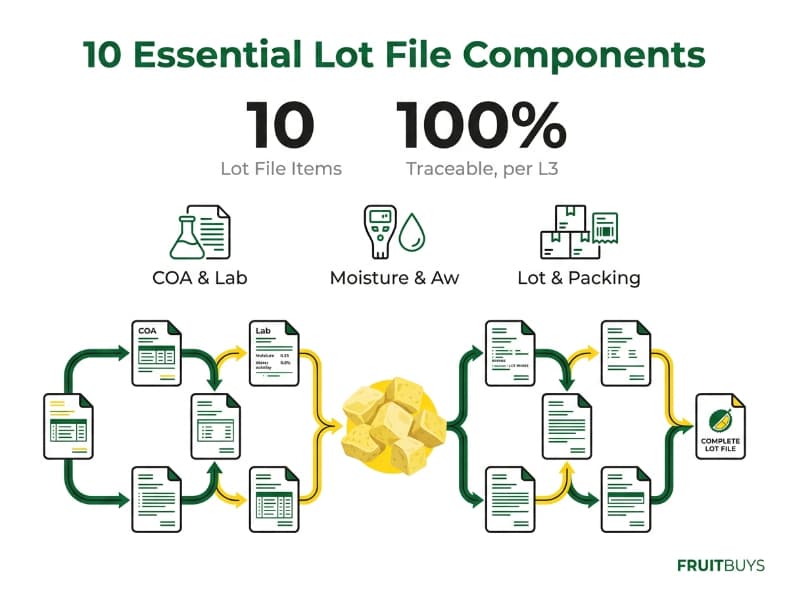
The buyer should not accept a COA that says only “pass” without a method, unit, result, limit and lot code. That document cannot carry a release decision. For the exact lab file, use durian laboratory testing requirements.
Certificate Scope Review
Certificate scope must match the production reality. HACCP, ISO 22000, BRCGS and HALAL should not appear as decorative badges. Each certificate must show the legal entity, production site, scope, validity, certifying body and product or process coverage.
A certificate can support a management system or production site. It does not prove one freeze-dried durian lot passed moisture, Aw or microbiology requirements. The COA and laboratory reports carry that lot-specific proof.
Buyers should ask:
- Does the certificate name the correct site?
- Does the scope cover the relevant product category or process?
- Does the validity cover the production period?
- Does the certificate apply to the production partner involved in the lot?
- Does the claimed standard match the buyer’s requirement?
- Does the certificate support the product claim on the label?
Codex’s General Principles of Food Hygiene provides broad food hygiene and HACCP principles, but a hygiene framework does not replace product-specific lot evidence or certificate-scope review for freeze-dried durian (Food Safety). FruitBuys should use certificates as support, not as a substitute for approved sample and bulk release.
U.S. Documentation Questions
The U.S. file should not use “FDA-approved product” language. FDA states that it does not certify, license or otherwise approve individual food importers, products, labels or shipments before importation. FDA also states that food offered for import must comply with FDA laws and labeling requirements. (U.S. Food and Drug Administration)

For packaged freeze-dried durian, the U.S. review should cover:
| U.S. Document Area | Buyer Question |
|---|---|
| Food facility registration | Does the relevant facility fall under registration requirements? |
| Prior Notice | Has the shipment information been prepared for required notice? |
| FSVP | Has the U.S. importer defined foreign supplier verification responsibility? |
| Label | Does the label match U.S. food-labeling requirements? |
| Ingredient statement | Does it match the actual formula? |
| Nutrition data | Does it match the product and serving basis? |
| Allergen review | Does it reflect ingredients and facility cross-contact? |
| Lot file | Does the COA match the packed goods? |
FDA’s import page states that importers can import foods without prior sanction by FDA when facilities that produce, store or otherwise handle products are registered as required and prior notice is provided (U.S. Food and Drug Administration)
FDA’s Prior Notice guidance states that FDA must receive prior notice for imported food shipments into or through the United States (U.S. Food and Drug Administration). FDA’s FSVP overview states that FSVP importers generally must develop, maintain and follow a verification program for each imported food unless an exemption applies (U.S. Food and Drug Administration)
This file should connect to freeze-dried durian Nutrition Facts development when retail packaging or private label work begins.
EU Documentation Questions
EU-bound freeze-dried durian needs label, contaminant, pesticide residue and document review based on product form, packaging and importer requirements.
Regulation (EU) No 1169/2011 governs food information to consumers and establishes general requirements for food information and labeling, including mandatory food information and nutrition declaration rules. (Food Safety) The EU also requires mandatory food information to appear in a language easily understood by consumers in the Member State where the food is marketed. (Food Safety)
For EU food safety review, Commission Regulation (EU) 2023/915 sets maximum levels for certain contaminants in food. (EUR-Lex) Regulation (EC) No 396/2005 governs maximum residue levels of pesticides in or on food and feed of plant and animal origin. (Publications Office of the EU)
EU documentation should review:
| EU Document Area | Buyer Question |
|---|---|
| Product name | Does it accurately describe freeze-dried durian? |
| Ingredient list | Does it match pure fruit or formulated powder? |
| Allergen communication | Does the label address required allergen information? |
| Nutrition declaration | Does it match EU format and formula basis? |
| Language | Does mandatory information fit the target Member State? |
| Contaminants | Does testing cover relevant EU limits where applicable? |
| Pesticide residues | Does the raw-material risk review match MRL expectations? |
| Phytosanitary status | Does the product classification require a certificate? |
| Lot traceability | Does the COA and packing file match the goods? |
Do not list phytosanitary documents as universally mandatory for durian. The European Commission’s plant-health import page states that no phytosanitary certificate is required for fruits of pineapple, coconut, durian, banana or date under the cited plant-health provision. (Food Safety) Freeze-dried or processed-product classification still needs destination and product-form review.
For lab support, link to freeze-dried durian COA and laboratory testing. For packaging and shelf-life support, link to freeze-dried durian packaging and shelf-life controls.
UAE Documentation Questions
UAE documentation should start with product registration, label review and importer coordination. The UAE Government platform states that food, whether imported or locally produced, or modified on its label, ingredients or composition, must be registered in the ZAD electronic system before being handled in UAE markets (uae) The UAE Government also describes ZAD as an integrated smart platform for food product data (uae).
For UAE-bound freeze-dried durian, the buyer should review:
| UAE Document Area | Buyer Question |
|---|---|
| Product registration | Has the importer confirmed the registration workflow? |
| Product label | Does artwork match required language and product data? |
| Ingredients | Does the formula match the registration file? |
| Pack image | Does the registered presentation match the commercial pack? |
| Nutrition | Does the nutrition panel match the formula and pack? |
| Claims | Are any nutrition or health claims supported? |
| Certificate file | Does the importer require specific certificate copies? |
| Lot COA | Does the lot evidence match the product and pack? |
Do not assume one UAE registration path covers every pack size, formulation or label change. The buyer should confirm with the importer and relevant authority workflow before packing the product. For private label work, use freeze-dried durian private label delivery. For label data, use freeze-dried durian Nutrition Facts development.
Packaging Documents
Packaging documents protect shelf life, label accuracy and shipment readiness. A buyer who approves a label without packaging evidence may later face moisture pickup, broken pieces, aroma leakage or pack mismatch.
The packaging file should include:
- Retail pouch or bulk inner bag specification
- Pack size and net weight
- Seal type or sealing control
- Carton size and carton configuration
- Storage instruction
- Shelf-life support status
- Lot code and date-code system
- Packaging sample or artwork proof
- Retained sample condition
- Product format: cubes, bites, slices or powder

Packaging must match the approved sample. A 20 g pouch, a 100 g pouch and a 1 kg bulk bag do not create the same exposure conditions. Powder also needs clumping review, carrier declaration and moisture protection. The next link is freeze-dried durian packaging and shelf-life controls. Transport-readiness belongs in freeze-dried durian carton and container planning.
OEM Label and Document Alignment
OEM and private label documentation must start from the approved product specification.
Artwork cannot fix an undefined formula, missing COA, unsupported cultivar claim or incomplete packaging file.
Buyers should lock product, label and document scope before moving into bulk packing.
Private label work adds document pressure because the consumer-facing pack must reflect the real product. The artwork must match the product name, ingredient statement, nutrition data, pack size, country of origin declaration where required, storage instruction, lot coding and any allowed claims.
The OEM file should include:
| OEM File Item | Required Alignment |
|---|---|
| Product specification | Matches approved sample |
| Formula | Matches ingredient statement |
| Nutrition basis | Matches pack and market rules |
| Pouch artwork | Matches product and destination |
| Lot code | Matches traceability system |
| Pack size | Matches packaging file |
| COA | Matches bulk lot |
| Certificate copies | Match scope and validity |
| Shelf-life support | Matches product-pack-storage system |
A private label buyer should not approve artwork from a sample photo. The product file must lead the artwork, not the reverse. For the OEM route, link to freeze-dried durian OEM and private label delivery.
Documentation Before Bulk Release
Bulk release should not begin until the document file is complete enough for buyer review. The document gate should happen before the product is packed into final cartons whenever possible. Late document checks expose the buyer to relabeling, repacking, hold decisions or delayed release.

FruitBuys should run this release sequence:
Approved sample
→ locked specification
→ packaging file
→ label file if applicable
→ COA and laboratory panel
→ retained sample
→ lot traceability
→ packing alignment
→ destination document checklist
→ final release review
The buyer should hold release when:
- Product name differs across documents
- Format differs from approved sample
- Lot number does not match
- COA lacks numeric results
- Moisture or Aw is missing
- Ingredient statement is not confirmed
- Certificate scope is unclear
- Label file does not match market rules
- Packaging differs from approved sample
- Shelf-life target lacks support
- Retained sample is missing
- Importer-specific requirements have not been confirmed
This gate connects directly to freeze-dried durian buyer checklist.
Application Mapping
| Buyer Type | Application | Required Format | Proof Needed | FruitBuys Delivery |
|---|---|---|---|---|
| Importer | Market entry and product approval | Bites, slices, cubes or powder | Destination document checklist, COA, label file, certificate scope | Documentation and Export Logistics Coordination |
| Distributor | Multi-SKU freeze-dried fruit range | Bites, slices or mixed pieces | Product file, lot code, packing alignment | Lot-based document handover |
| QA manager | Supplier and lot approval | Any format | Specification, lab reports, certificate scope, retained sample | Quality Control and Documentation |
| Private label buyer | Branded pouch | Cubes or bites | Artwork, nutrition basis, label file, COA, packaging file | OEM/Private Label Delivery |
| R&D developer | Food application trial | Powder, granules or broken pieces | Ingredient statement, particle size, COA, application notes | Application-aligned document control |
| Ingredient buyer | Manufacturing input | Powder or broken pieces | COA, microbiology, carrier status, traceability | Product specification and lot evidence package |
Highest-Risk Error: Treating Destination Documents as Generic
The highest-risk documentation error is using one generic file for every destination. The U.S., EU and UAE do not ask the same questions in the same format. The buyer may need the same product, but the document file must answer the market’s review points.
A weak document pack causes predictable failures:
- The label does not match the product formula
- Nutrition data uses the wrong serving basis
- Certificate scope does not cover the product or site
- COA belongs to a historical lot
- The importer cannot verify the facility or supplier file
- UAE registration data differs from pack artwork
- EU language or food-information requirements were not checked
- U.S. importer verification questions remain unanswered
- Phytosanitary status was assumed instead of verified
- Product format changed after sample approval
Documentation is not clerical work. It is the buyer’s first line of control before product movement, label release and market entry.
Why FruitBuys Delivers This
FruitBuys supplies freeze-dried durian through an Integrated Product Supply Model. Documentation sits inside that model because the buyer needs one finished product connected to one approved specification, one lot file and one release pathway.
FruitBuys applies Documentation by aligning specification, COA, laboratory reports, certificate scope, label inputs, traceability and packing file. FruitBuys applies Quality Control by connecting document review to moisture, Aw, microbiology, format tolerance and retained sample comparison. FruitBuys applies OEM/Private Label Delivery by aligning product data, artwork inputs, nutrition basis, coding and packaging review.
FruitBuys applies Raw Material Sourcing Governance by tying cultivar, origin and raw-material records to the finished product file. FruitBuys applies Export Logistics Coordination by preparing document handover around carton configuration, lot identity and buyer review timing.
The buyer does not need a pile of documents. The buyer needs a matched file.
Buyer Checklist
Before approving freeze-dried durian documentation, request:
- Product specification
- Product name and format
- Cultivar statement where used
- Ingredient statement
- Allergen and cross-contact statement
- Nutrition basis
- Packaging specification
- Storage instruction
- Shelf-life support status
- Lot-specific COA
- Moisture result
- Aw result
- Microbiology panel
- Contaminant panel where required
- Pesticide residue panel where required
- Certificate copies with scope and validity
- Label artwork if retail or private label
- Retained sample record
- Traceability record
- Packing list alignment
- Destination document checklist
- Importer-specific requirements
No matched file, no release confidence.
Summary
Freeze-dried durian documentation readiness means the specification, ingredient statement, COA, laboratory reports, certificate scope, label file, packaging file, lot traceability and packing record all describe the same product and lot. U.S. review should avoid “FDA-approved product” language and focus on facility, Prior Notice, FSVP, label and lot evidence. EU review should cover food information, language, contaminants, pesticide residues and phytosanitary applicability.
UAE review should confirm product and label registration workflow through ZAD or the relevant importer path. FruitBuys manages documentation through Documentation, Quality Control, OEM/Private Label Delivery, Raw Material Sourcing Governance and Export Logistics Coordination.
FAQ
What documents should buyers request for freeze-dried durian?
Request the product specification, ingredient statement, COA, laboratory reports, certificate copies, packaging file, label file where needed, retained sample record, traceability record and destination checklist.
Does one COA cover every shipment?
No. A COA must match the exact lot under approval. Historical COAs support supplier screening only.
Does FDA approve freeze-dried durian products?
No. FDA states that it does not certify, license or approve individual food products, labels or shipments before importation.
Does EU import always require a phytosanitary certificate for durian?
No. The European Commission states that no phytosanitary certificate is required for fruits of durian under the cited plant-health rule. Processed formats still need product-form review.
What should UAE buyers check first?
Check product registration and label registration workflow through the importer and ZAD-related process before approving artwork or packing.
What is the biggest private label document risk?
Artwork approval before formula, nutrition basis, COA, packaging and market label review. That sequence creates relabeling and release problems.
Which article should follow this one?
Read freeze-dried durian private label delivery next for branded pack control, or freeze-dried durian buyer checklist for final approval.
Conclusion
Request the destination document checklist after confirming product format, packaging configuration, importing market, label scope and lot-release evidence.
References
- U.S. Food and Drug Administration. “Importing Human Foods.” Current FDA import guidance page. (U.S. Food and Drug Administration)
- U.S. Food and Drug Administration. “Importing Food Products into the United States.” Current FDA import overview. (U.S. Food and Drug Administration)
- U.S. Food and Drug Administration. “Guidance for Industry: What You Need to Know About Prior Notice of Imported Food Shipments.” FDA guidance page. (U.S. Food and Drug Administration)
- European Commission. “Mandatory food information.” Food information to consumers guidance. (Food Safety)
- European Union. “Regulation (EU) No 1169/2011 on food information to consumers.” EUR-Lex text. (EUR-Lex)
- European Union. “Commission Regulation (EU) 2023/915 on maximum levels for certain contaminants in food.” EUR-Lex text. (EUR-Lex)
- European Union. “Regulation (EC) No 396/2005 on maximum residue levels of pesticides.” EU Publications Office text. (Publications Office of the EU)
- European Commission. “Trade in plants and plant products from non-EU countries.” Plant-health import guidance. (Food Safety)
- The Official Portal of the UAE Government. “Food safety.” UAE food registration and ZAD information. (u.ae)