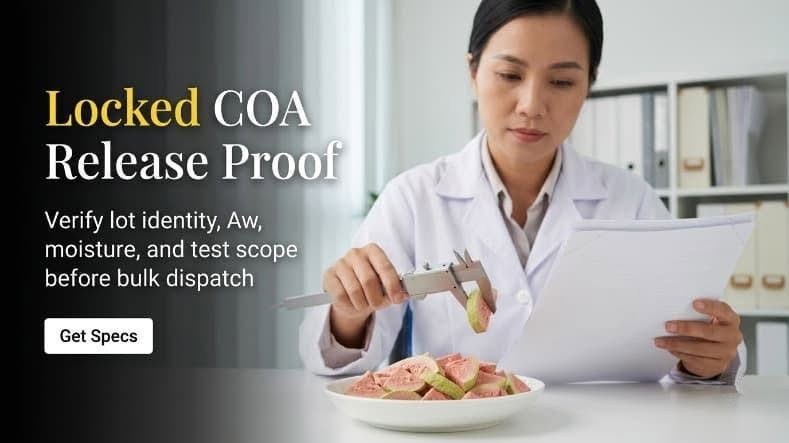
Freeze-Dried Guava COA and Laboratory Testing: What Buyers Must Verify
Freeze-dried guava COA and laboratory testing can look complete while still failing the buyer’s real approval need. A supplier may send a COA file with moisture, microbiology or pesticide results, but the buyer still must confirm product name, format, lot code, sample date, method, laboratory identity, reporting limit and whether the test belongs to the exact freeze-dried guava SKU being shipped.
A COA for guava powder cannot automatically release pink guava wedges. A sample report cannot automatically release bulk production. The COA is useful only when it connects the exact product, lot, test result, method and release specification. This article is for importers, QA managers, compliance teams, R&D developers and private label buyers who need laboratory proof before approving FruitBuys freeze-dried guava for sample-to-bulk release.
A COA Must Match the Exact Freeze-Dried Guava Lot
A freeze-dried guava COA should identify the product, format, lot code, test method, actual result and release specification.
A generic COA or old laboratory report cannot prove a new lot unless the product identity and testing basis match.
Buyers should request the COA scope before sample approval, not after bulk production.
A COA is not decoration. It is a release document that connects the supplied product to measurable proof. For FruitBuys freeze-dried guava, the COA should support the product file that includes guava route, format, moisture, Aw, microbiology, packaging, retained sample and destination-market testing requirements.

A buyer should first confirm which SKU is being released:
| Product Route | COA Risk |
|---|---|
| Pink guava wedges | Seed bite, broken tips, moisture and Aw must match piece format |
| Round slices | Thickness, seed center, breakage and moisture distribution matter |
| Cubes / dices | Size tolerance, fines and microbiology panel must match inclusion use |
| Granules | Particle range and dust level need product-specific review |
| Powder | Mesh, carrier status, caking, sediment and Aw require separate proof |
| Molded guava bites | Formula, binder, ingredient statement and Aw need separate review |
Buyers who need the full product route should start with freeze-dried guava supplier in Vietnam. This page focuses on the proof file that supports lot release.
What a Freeze-Dried Guava COA Should Include
A useful COA should show enough detail for a buyer to connect the document to the actual goods. If the COA only says “passed,” the buyer may still need the actual results, methods and limits depending on the approval standard.

| COA Field | Buyer Check |
|---|---|
| Product name | Freeze-Dried Guava /Freeze-Dried Pink Guava/approved SKU name |
| Product format | Wedge, slice, cube, granule, powder or molded bite |
| Ingredient route | Fruit-only, carrier-supported powder or formulated product |
| Lot code | Must match carton marks, packing file and retained sample |
| Sample date | Shows when the tested sample was taken |
| Test date | Shows when the laboratory work was completed |
| Method | Must be stated where buyer or market requires it |
| Specification limit | The acceptance standard used for release |
| Actual result | Numeric result or clear detected/not detected status |
| Reporting limit | Required where relevant for microbiology, residues or contaminants |
| Laboratory identity | Name and scope where required |
| Authorized review | Release status or responsible approval point |
The COA should not float separately from the product specification. It must match the approved sample, production lot and packaging route. This is why COA review connects directly to sample-to-bulk consistency.
Moisture and Aw Are Separate Release Controls
Moisture and Aw are not interchangeable.
FruitBuys uses moisture 3–5% and Aw <0.30 as working targets for freeze-dried guava, but each bulk lot needs the correct release evidence.
Buyers should request actual lot values when moisture and Aw are part of their approval requirement.
Moisture measures total remaining water. Aw measures water availability under equilibrium conditions. FDA defines water activity as the ratio of water vapor pressure in the food to the vapor pressure of distilled water under identical conditions, and FDA links Aw to food stability and microbial growth conditions. (U.S. Food and Drug Administration)
For freeze-dried guava, this difference matters. A product can feel crisp but still vary internally. A thick wedge can behave differently from a thin slice. Powder can pass a sample review and later cake if the package or handling route allows moisture pickup.
A COA should keep moisture and Aw separate:
| Test | What It Controls | Buyer Risk if Missing |
|---|---|---|
| Moisture | Total water remaining in the product | Soft texture, wet centers, uneven drying |
| Aw | Available water under stated conditions | Stability risk context and release confidence |
| Moisture after grinding | Powder caking risk | Powder clumps after packing or opening |
| Aw after packing | Packaging and handling risk | Product changes after drying |
| Retained sample comparison | Physical alignment | COA result does not match sample condition |
For the deeper technical review, use freeze-dried guava moisture and water activity. The COA should show the release values; the moisture/Aw page explains how buyers should interpret them.
Microbiology Testing: Low Aw Does Not Replace Food-Safety Review
Low moisture and low Aw are important controls, but they do not make microbiology review unnecessary. Freeze-dried guava may be used as a ready-to-eat snack, cereal inclusion, yogurt topping, beverage powder, bakery ingredient or private label product. Each route can carry a different microbiology panel.

FDA’s Bacteriological Analytical Manual states that BAM presents FDA’s preferred laboratory procedures for microbiological analyses of foods and cosmetics, including chapters for organisms such as Salmonella and E. coli /coliform bacteria (U.S. Food and Drug Administration). FDA’s BAM Salmonella chapter has also been updated with molecular screening context and validated-matrix references, which is useful for method review but does not replace buyer-specific laboratory scope. (U.S. Food and Drug Administration)
A buyer may request a microbiology panel such as:
| Microbiology Area | Buyer Review Point |
|---|---|
| Aerobic Plate Count | General hygiene and process-indicator context |
| Yeast and Mold | Dried fruit and powder storage relevance |
| Coliforms/Enterobacteriaceae | Hygiene indicator, buyer-defined |
| E. coli | Hygiene and food-safety indicator |
| Salmonella | Pathogen test, method and sample size must be stated |
| Staphylococcus aureus | Risk-based panel for some buyers |
| Bacillus cereus | Risk-based panel for powders or certain applications |
Do not turn “not detected” into “zero risk.” It means not detected under the stated method, sample, reporting limit and laboratory conditions. The buyer should review the method and result together.
Microbiology review should connect to freeze-dried guava processing controls because test results are only one part of release control. Sanitation, post-drying handling, packaging and retained-sample comparison matter as well.
Low-Moisture Sanitation and Post-Drying Handling
A freeze-dried guava lot can meet moisture and Aw targets but still require sanitation and post-drying handling review. The product is exposed after drying during unloading, sorting, grading, grinding, packing and sealing. That handling path affects finished-product risk.

FDA’s 2025 draft guidance for low-moisture ready-to-eat human foods gives FDA’s current thinking on routine sanitation programs that help prevent pathogen contamination events and recommends corrective actions if prevention fails. FDA identifies it as draft guidance. (U.S. Food and Drug Administration)
For buyers, the practical point is simple: laboratory testing should confirm the release file, not replace process discipline.
Review these controls:
- Post-drying exposure time
- Dry handling condition
- Sorting and grading hygiene
- Food-contact surface sanitation
- Foreign-material inspection route
- Packing-room discipline
- Inner-bag seal control
- Lot-code assignment
- Retained sample storage
- Corrective-action record where applicable
This belongs in supplier qualification, not only COA review. Use freeze-dried guava supplier qualificationwhen the buyer needs a broader vendor-approval file.
Pesticide Residue Testing and Peel Policy
Pesticide residue testing should follow the destination market, buyer specification and raw-material route. Peel-on products can require closer review because the fruit surface remains part of the finished product. Peel-off or pulp-based routes may create a different residue basis, but they do not remove the need for destination-market review.

For EU-bound goods, Regulation (EC) No 396/2005 establishes maximum residue levels for pesticides in or on food and feed of plant and animal origin. (EUR-Lex) The European Commission also provides an EU Pesticides Database for active substances and pesticide residue information, while noting that official information is published in the Official Journal of the European Union. (Food Safety)
A freeze-dried guava pesticide review should define:
| Review Area | Buyer Question |
|---|---|
| Destination market | Which residue framework applies? |
| Product route | Peel-on, peel-off, seed-on, powder or pulp-based? |
| Sampling basis | Raw material, finished product or both? |
| Test panel | Multi-residue panel or buyer-specific list? |
| Reporting limit | Does the report meet the buyer’s review need? |
| Lot identity | Does the report match the actual lot? |
| COA connection | Is the result summarized or attached as a lab report? |
This decision connects to pink guava variety, maturity and seed policy and freeze-dried guava HS code and import compliance. The raw-material route and market route decide the test requirement.
Heavy Metals and Contaminants
Heavy-metal or contaminant review should be handled by destination market and buyer risk assessment. Do not accept a generic statement such as “heavy metals passed” without knowing which elements were tested, what method was used, what reporting limit applied and which lot the report covers.
Common buyer-requested elements may include:
- Lead
- Cadmium
- Arsenic
- Mercury
For EU review, the European Commission states that maximum levels for certain contaminants in food are set in Commission Regulation (EU) 2023/915. (Food Safety) That source supports a market-readiness review, not a FruitBuys lot claim. FruitBuys needs a lot-specific laboratory report before claiming that a specific freeze-dried guava lot meets a contaminant limit.
A contaminant report should show:
| Field | Why It Matters |
|---|---|
| Product and lot | Prevents use of unrelated reports |
| Element tested | Shows exact contaminant scope |
| Result | Shows measured value |
| Reporting limit | Shows analytical sensitivity |
| Method | Supports technical review |
| Laboratory | Supports credibility and traceability |
| Applicable limit | Must match buyer or market review |
| Date | Prevents outdated evidence from being reused |
This should feed into the buyer’s COA and market file before bulk approval.
Laboratory Competence and Method Scope
A laboratory logo is not enough.
Buyers should review whether the laboratory, method, sample and scope match the exact freeze-dried guava test requirement.
FruitBuys aligns laboratory reports with the product file so QA can review lot evidence, not disconnected documents.
ISO describes ISO/IEC 17025:2017 as the international standard for testing and calibration laboratories and states that it relates to competence, impartiality and consistent operation of laboratories. (ISO) For buyers, this supports a practical review: check laboratory competence and scope where required, but do not treat accreditation as proof that every possible test result applies to every product.
Ask these questions before accepting a laboratory report:
| Question | Reason |
|---|---|
| Does the report name the exact product? | Prevents using another SKU’s data |
| Does the report show lot code? | Connects test result to goods |
| Does the method match the buyer’s requirement? | Supports QA review |
| Does the lab scope cover the test? | Strengthens evidence |
| Are reporting limits shown? | Needed for residues and contaminants |
| Is the sample date clear? | Prevents stale evidence |
| Is the result actual, not only “pass”? | Helps buyer compare against limits |
| Is the report attached to the COA file? | Supports document handover |
Laboratory reports should support freeze-dried guava supplier qualification and lot release. They should not be recycled across unrelated products.
Powder Requires a Separate COA Review
Freeze-dried guava powder needs a separate COA review because powder changes the test-risk profile. It has higher exposed surface area, can cake more easily, may contain seed particles, may use a carrier, and may require mesh or particle-range confirmation.

A powder COA should add:
| Powder Field | Buyer Review |
|---|---|
| Mesh or particle range | Confirms powder specification |
| Carrier status | Prevents ingredient-statement mismatch |
| Seed-particle tolerance | Supports beverage, dairy and texture review |
| Bulk density where required | Supports filling and dosing |
| Caking observation where required | Supports storage and open-pack review |
| Moisture/Aw after powder processing | Confirms powder route, not piece route |
| Microbiology panel | Must match powder application |
| Nutrition basis | Required before label approval |
Use freeze-dried guava powder specification before approving a powder COA. Do not release powder from a wedge COA unless the report clearly supports the powder SKU.
COA, Nutrition Facts and Private Label Artwork
Nutrition Facts and COA are related, but they are not the same document. The COA releases the lot against agreed technical requirements. Nutrition testing supports label and artwork approval. A buyer should not use a basic COA as final Nutrition Facts proof unless the nutrition laboratory data is included and matches the final SKU.
Private label risk increases when:
- Powder carrier status is not declared
- Added sugar status is not confirmed
- Vitamin C is claimed without final-product testing
- Fiber is claimed without market review
- Serving size is copied from another product
- The COA belongs to a different format
- The artwork uses a different product name
For label review, use freeze-dried guava Nutrition Facts. For branded retail execution, use OEM private label freeze-dried guava.
USA Importer Verification and COA Use
For USA-bound food, the COA can support the importer’s review, but it does not replace the importer’s own responsibility. FDA’s FSVP guidance states that importers must establish and follow a Foreign Supplier Verification Program to ensure each food they import meets applicable U.S. requirements and is not adulterated or, for human food, misbranded with respect to allergen labeling. (U.S. Food and Drug Administration)
For freeze-dried guava, this means the buyer should keep COA review connected to:
- Supplier approval
- Product specification
- Food facility information where applicable
- Ingredient statement
- Label review
- Lot identity
- Laboratory reports
- Corrective-action handling
- Shipment document file
FruitBuys can align the product and document package, but the importer must confirm its destination-market obligations.
The Highest-Risk Mistake: Approving Bulk From a COA File Name
The highest-risk mistake is approving bulk because the file name says “COA.” A COA title does not prove the document belongs to the shipped lot. A buyer must inspect the connection between product, lot, format, method, result and release condition.
This mistake creates predictable problems:
- The COA shows guava pieces, but the shipment contains powder
- The lot code on the carton does not match the report
- The moisture result is from an early sample, not the packed lot
- The microbiology panel does not match the buyer’s application
- The pesticide panel does not match the destination-market review
- The lab report lacks reporting limits
- The private label artwork uses nutrition values from another sample
- The certificate scope is assumed instead of verified
The release rule is direct: if the COA does not match the exact product file, the buyer should not use it as lot-release proof. Connect this review to sample-to-bulk consistency and freeze-dried guava RFQ checklist.
Application Mapping
| Buyer Type | Application | Required Format | Proof Needed | FruitBuys Delivery |
|---|---|---|---|---|
| Importer | Bulk freeze-dried guava sourcing | Wedge, slice, dice, granule or powder | Lot COA, product specification, lab reports and market file | Documentation, Quality Control |
| QA manager | Lot release approval | Any approved format | Product name, lot code, method, result, reporting limit and retained sample | Quality Control, Documentation |
| Private label brand | Retail pouch SKU | Wedge, bite, slice, powder or molded bite | COA, nutrition test basis, packaging file and artwork alignment | OEM/Private Label Delivery |
| Beverage developer | Guava powder | Fine or custom mesh powder | Mesh, carrier status, microbiology, moisture, Aw and sediment review | Quality Control, MOQ Flexibility/Market Trial Support |
| Cereal manufacturer | Dry inclusion | Cube, dice or granule | Size tolerance, fines, microbiology, moisture and Aw | Quality Control, Documentation |
| Compliance manager | EU or USA document review | Market-specific SKU | Residue panel, contaminant report, FSVP-support file and label inputs | Documentation, Export Logistics Coordination |
| Distributor | Multi-lot inventory | Stable repeated format | Lot identity, COA comparison, carton marks and retained samples | Documentation, Export Logistics Coordination |

Why FruitBuys Delivers This
FruitBuys supplies freeze-dried guava through an Integrated Product Supply Model that connects raw-material governance, production partners, QC, packaging, documentation and export logistics coordination under one accountable supplier relationship.
Under Quality Control, FruitBuys aligns the approved product format with moisture, Aw, microbiology, powder behavior, retained sample and release criteria. Under Documentation, FruitBuys connects the COA, laboratory report, specification, ingredient statement, packaging file, lot code and market-readiness documents. Under Raw Material Sourcing Governance, FruitBuys keeps guava route, maturity, peel policy and seed policy tied to the tested product identity.
Under OEM/Private Label Delivery, FruitBuys aligns laboratory proof with Nutrition Facts input, artwork version, pack type and release criteria. Under Export Logistics Coordination, FruitBuys keeps carton marks, packing records, lot identity and document handover aligned with the same shipped goods.
FruitBuys supplies the documented product file, not an isolated COA attachment.
Buyer Checklist
Confirm these points before sample approval, bulk release or private label artwork:
- Product name
- Product format
- Pink or white guava route
- Peel policy
- Seed policy
- Fruit-only or formulated route
- Powder carrier or binder status where applicable
- Lot code
- Sample date
- Test date
- Laboratory name
- Laboratory scope where required
- Method reference
- Reporting limit where relevant
- Specification limit
- Actual result
- Moisture result
- Aw result
- Microbiology panel
- Pesticide residue panel where required
- Heavy-metal or contaminant panel where required
- Powder mesh where applicable
- Nutrition test file where label values are required
- Packaging specification
- Retained sample
- Carton mark and packing record
- Destination-market requirement
- Change-control triggers
- Final request alignment through freeze-dried guava RFQ checklist
Do not approve a COA from file name, logo or supplier assurance alone. Approve it only when the document matches the exact released SKU.
Summary
Freeze-dried guava COA and laboratory testing should connect product name, format, lot code, sample date, test method, result, reporting limit and release specification. FruitBuys uses moisture 3–5% and Aw <0.30 as working targets, but each lot needs product-specific release evidence.
COA review may include microbiology, moisture, Aw, pesticide residues, heavy metals, contaminants, powder mesh, carrier status and Nutrition Facts inputs where required. FruitBuys aligns COA, laboratory reports, retained sample, packaging and lot identity through QC and Documentation.
FAQ
What should a freeze-dried guava COA include?
It should include product name, format, lot code, sample date, test date, method, specification limit, actual result, laboratory identity, moisture, Aw and required microbiology or chemical tests.
Can one COA cover wedges and powder?
No. Powder and wedges are different SKU routes. Powder needs mesh, carrier status, caking, sediment and powder-specific moisture/Aw review.
Is low Aw enough to approve food safety?
No. Low Aw is one release control. Buyers still need a risk-based microbiology panel, sanitation review, retained sample and lot-specific documentation.
What microbiology tests should buyers request?
Common panels may include APC, yeast and mold, coliforms or Enterobacteriaceae, E. coli and Salmonella. The final panel depends on buyer risk, application and market.
When should pesticide testing be requested?
Request pesticide testing when the destination market, buyer standard or raw-material route requires it. Peel-on products may need closer residue review.
Does a laboratory logo prove the test is valid?
No. Buyers should verify product identity, method, scope, reporting limit, lot code and whether the laboratory is suitable for the required test.
What should buyers send before requesting a COA?
Send target format, destination market, COA scope, microbiology panel, chemical testing needs, packaging route, label requirements and release criteria.
Conclusion
Submit the target format, destination market, COA scope, testing panel and release criteria so FruitBuys can align the freeze-dried guava lot documentation file.
References
- U.S. Food and Drug Administration. Water Activity (aw) in Foods. FDA Inspection Technical Guide. (U.S. Food and Drug Administration)
- U.S. Food and Drug Administration. Bacteriological Analytical Manual (BAM). FDA laboratory methods for microbiological analyses of foods and cosmetics. (U.S. Food and Drug Administration)
- U.S. Food and Drug Administration. BAM Chapter 5: Salmonella. FDA laboratory method chapter, updated with screening and validated-matrix context. (U.S. Food and Drug Administration)
- U.S. Food and Drug Administration. Draft Guidance for Industry: Establishing Sanitation Programs for Low-Moisture Ready-to-Eat Human Foods and Taking Corrective Actions Following a Pathogen Contamination Event. January 2025. (U.S. Food and Drug Administration)
- International Organization for Standardization. ISO/IEC 17025:2017 — General requirements for the competence of testing and calibration laboratories. (ISO)
- European Union. Regulation (EC) No 396/2005 on maximum residue levels of pesticides in or on food and feed of plant and animal origin. (EUR-Lex)
- European Commission. Contaminants legislation: Commission Regulation (EU) 2023/915. (Food Safety)
- U.S. Food and Drug Administration. Guidance for Industry: Foreign Supplier Verification Programs for Importers of Food for Humans and Animals. (U.S. Food and Drug Administration)