Pink Guava Variety, Maturity and Seed Policy for Freeze-Dried Guava Buyers
Freeze-dried guava buyers often start with the wrong question: “Can you send guava samples?” The better question is: “Which guava route, maturity, peel policy and seed policy will the bulk SKU use?” A bright pink wedge can look strong in a retail pouch but fail if the seed bite is too hard. A smooth powder can work in a beverage blend but fail if seed particles, carrier status or moisture behavior are not controlled.

A peel-on slice can show natural identity but may need tighter residue and visual-defect review. Guava variety and seed policy must be locked before the sample becomes a bulk approval. This article is for importers, QA managers, R&D developers, ingredient buyers and private label brands selecting the right raw-material route before approving freeze-dried guava from FruitBuys Vietnam.
Variety, Maturity and Seed Policy Must Be Locked Before Sampling
Freeze-dried guava is not one generic SKU.
Pink guava, white guava, peel-on pieces, seed-on cuts, reduced-seed dices and deseeded powder follow different approval routes.
Buyers should lock raw-material policy before approving sample appearance, Nutrition Facts, COA scope or private label artwork.
Guava’s accepted botanical species name is Psidium guajava L., according to Kew’s Plants of the World Online. Kew also describes guava fruit as having white or red pulp and numerous hard seeds, which directly explains why seed policy matters for freeze-dried guava buyers. (Plants of the World Online)
For FruitBuys, raw-material definition is part of Raw Material Sourcing Governance. The buyer should not approve “freeze-dried guava” as a broad name. The buyer should approve a specific product route:
| Decision Point | Buyer Must Define |
|---|---|
| Guava route | Pink guava, white guava or buyer-approved route |
| Maturity | Firmness, color and eating stage suitable for cutting and drying |
| Peel policy | Peel-on, peel-off or application-specific |
| Seed policy | Seed-on, reduced-seed or deseeded |
| Format | Slice, wedge, cube, stick, granule, powder or molded bite |
| Application | Snack, cereal, yogurt, chocolate, bakery, beverage or private label |
| Proof file | Specification, retained sample, COA and release criteria |
This article owns the raw-material and seed-policy decision. Buyers who need the full commercial supply route should start from freeze-dried guava supplier in Vietnam.
Pink Guava vs White Guava: What Changes for B2B Buyers
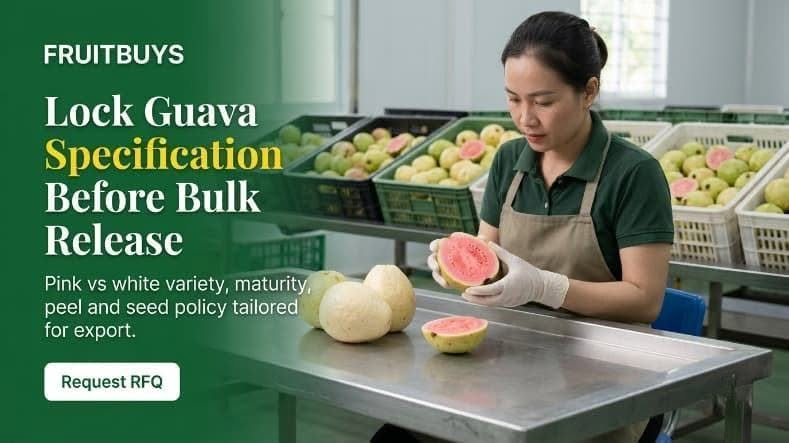
Pink guava is often selected for visible fruit identity. It can give stronger color contrast in snack pouches, toppings and mixed tropical assortments. White guava can be useful when the buyer wants a lighter visual profile or a more neutral ingredient route. Neither is automatically better. The correct route depends on application, seed tolerance, format, label basis and buyer sensory target.

UC Davis lists guava quality indices including firmness, gritty texture from stone cells, seed amount, aroma intensity, soluble solids and acidity. Those are commercial control points, not cosmetic details, because each factor can affect cutting, drying, bite and application performance. (UC Postharvest)
| Buyer Requirement | Pink Guava Route | White Guava Route |
|---|---|---|
| Strong visual fruit identity | Often preferred for snack and topping formats | Less color impact |
| Powder color | Can support pink-toned powder if stable | Lighter powder route |
| Seed visibility | May be more visible in contrast with pink flesh | Still present, route-dependent |
| Retail snack appeal | Strong when seed bite and breakage are controlled | Depends on buyer concept |
| Beverage or bakery use | Needs powder behavior and color review | Needs powder behavior and color review |
| Nutrition label basis | Must be tested by final SKU | Must be tested by final SKU |
The buyer should not ask only for “pink guava” as a visual preference. The RFQ should state whether the product is intended for snack pieces, powder, molded bites or ingredient inclusion. The next technical step is freeze-dried guava formats and custom cut sizes.
Maturity Controls Cutting, Drying and Bite
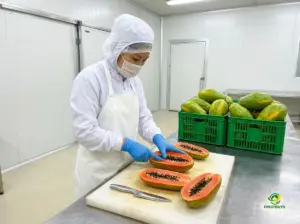
Maturity affects how guava behaves before it enters freeze-drying. Fruit that is too soft may deform during cutting, create uneven surfaces, increase handling loss or produce pieces that collapse more easily. Fruit that is too firm may produce weak aroma, harder bite or less suitable sensory performance.

UC Davis notes that guava may be picked at the mature-green stage in some markets and also identifies firmness, flesh color, soluble solids and acidity as quality indices. For freeze-dried guava, those indices should be translated into a practical raw-material acceptance file. (UC Postharvest)
A qualified supplier should align maturity with the buyer’s final use:
| Application | Maturity Direction | Reason |
|---|---|---|
| Snack wedges | Firm enough for clean cutting, ripe enough for aroma | Protects shape and eating quality |
| Round slices | Consistent diameter and flesh structure | Supports visual uniformity |
| Cubes/dices | Stable texture for cutting and sorting | Reduces off-size and collapse |
| Granules | Controlled solids and breakage behavior | Protects particle range |
| Powder | Suitable aroma and solids, controlled seed route | Protects flavor and mesh behavior |
| Molded bites | Stable powder or puree-derived base | Protects formula and texture |
Maturity is also tied to conversion. Fruit with different water content, trim loss and saleable recovery can affect how many kilograms of incoming guava are needed to produce one kilogram of finished freeze-dried guava. Buyers should connect this decision to freeze-dried guava conversion ratio.
Peel Policy: Visual Identity vs Residue and Texture Review
Peel-on guava can support natural visual identity. It can show that the product comes from real fruit pieces rather than anonymous cubes. That can be useful in retail pouches, toppings and foodservice garnish. But peel-on also creates additional controls around surface appearance, residue review, trimming quality and texture.

Peel-off guava can support a cleaner appearance and softer bite in some applications. It may reduce visual peel variation, but it also changes yield, format identity and nutrition basis. It should not be treated as a cosmetic afterthought.
| Peel Route | Better Fit | Buyer Risk |
|---|---|---|
| Peel-on slices | Snack, garnish, visible topping | Surface defects, peel toughness, residue review |
| Peel-on wedges | Retail pouch, tropical mix | Broken tips, seed bite, visual variability |
| Peel-off pieces | Softer snack or ingredient route | Lower visual fruit identity |
| Peel-off dice | Cereal, yogurt, bakery inclusion | Size drift and moisture exposure |
| Peel-controlled powder | Beverage, bakery, blend | Fiber and label basis change |
For EU or other residue-sensitive review, peel-on products should be evaluated carefully because the fruit surface remains part of the finished product. This does not mean peel-on is unsuitable.
It means the buyer should define pesticide residue, washing, sorting and COA requirements before approval. That proof route belongs in freeze-dried guava COA and laboratory testing and freeze-dried guava HS code and import compliance.
Seed Policy Is the Highest-Risk Sensory Decision
Guava seed policy is a bulk-release decision, not a minor preference.
Seed-on pieces can preserve natural fruit identity, but seed bite can create rejection in direct snack, yogurt, children’s snack and beverage applications.
Buyers should approve seed policy before sample approval, powder development or private label artwork.
Kew’s description of guava fruit notes numerous hard seeds, which is why seed policy must be written into the product specification rather than handled casually during sampling (Plants of the World Online).

A qualified supplier should define seed policy in one of three routes:
| Seed Policy | Description | Best Use | Risk |
|---|---|---|---|
| Seed-on | Natural guava structure remains visible | Snack wedges, slices, visual toppings | Hard bite and seed-centered breakage |
| Reduced-seed | Seeds reduced through preparation or sorting route | Bites, dices, yogurt topping | Yield loss and consistency control |
| Deseeded | Seed removal prioritized before drying or powder route | Powder, beverage, smooth applications | Higher processing complexity and changed nutrition/yield basis |
Seed-on may be acceptable for adult snack products when the buyer wants natural identity and approves the bite. Reduced-seed may be better for dices or topping applications.
Deseeded routes are often more relevant for powder, beverage, bakery cream or smooth blends. The buyer should not approve a seed-on sample for one application and assume it works everywhere. Application fit belongs in freeze-dried guava food applications.
How Variety and Seed Policy Affect Freeze-Drying Controls
Freeze-drying removes water from frozen food by sublimation, where ice changes directly into vapor under controlled conditions. Utah State University Extension explains that freeze drying removes ice from frozen food as water vapor through sublimation (Utah State University Extension).

That process creates a low-moisture, porous product, but raw material still controls drying behavior. Guava pieces with different thickness, maturity, seed distribution and peel policy may dry differently. A thicker wedge can carry more center risk than a thin slice. A seed-heavy section can break differently from pulp-dominant pieces. A powder route needs a different control file from a snack wedge.
FruitBuys uses working targets of moisture 3–5% and Aw <0.30 for freeze-dried guava. FDA defines water activity as the ratio of water vapor pressure in food to that of distilled water under the same conditions and connects Aw to microbial growth and food stability (U.S. Food and Drug Administration).
The buyer should therefore connect raw-material decisions to technical release:
| Raw-Material Decision | Release Impact |
|---|---|
| Pink vs white guava | Color range, label basis, application identity |
| Maturity | Cutting, aroma, texture and drying consistency |
| Peel-on | Surface control, visual standard, residue panel |
| Seed-on | Bite, breakage, powder sediment |
| Reduced-seed | Yield and sample-to-bulk control |
| Deseeded | Powder behavior, label and conversion basis |
| Thick wedge | Drying endpoint and broken-piece risk |
| Fine powder | Caking, Aw drift and packaging requirements |
The process file belongs in freeze-dried guava processing controls. Moisture and release conditions belong in freeze-dried guava moisture and water activity.
Format Selection by Guava Route
The best format depends on the raw-material route. A buyer should not choose a format only by appearance.
| Format | Guava Route Fit | Seed/Maturity Control |
|---|---|---|
| Round Slice | Strong visual identity, snack or garnish | Seed center must be accepted; diameter and thickness must be controlled |
| Triangle/Wedge | Retail snack and tropical mix | Seed bite, broken tips and thickness must be locked |
| Cube/Dice | Cereal, granola, yogurt, bakery | Better when maturity and size tolerance are stable |
| Stick | Differentiated snack concept | Requires stronger breakage control |
| Bite/Chunk | Snack and mixed fruit applications | Needs sensory approval for seed and peel |
| Granule | Chocolate, cereal and topping systems | Needs fines limit and particle range |
| Powder | Beverage, bakery, dairy, blend | Needs seed-particle, carrier, mesh and caking review |
| Molded Bite | OEM private label concept | Needs formula, binder, Aw and label review |
For powder, seed policy becomes more technical. Seed particles can affect mouthfeel, sediment, mesh and visual speckling. A pure guava powder, carrier-supported powder and molded bite should not share one generic specification. Buyers should review freeze-dried guava powder specification before approving powder samples.
Nutrition and Label Impact
Variety, peel policy and seed policy can change the Nutrition Facts basis. A peel-on seed-on wedge, peel-off dice and deseeded powder can test differently. A powder with carrier or a molded bite with binder changes the ingredient statement and may change the label basis.
A USDA-derived FoodData Central listing for raw common guava reports raw guava composition including high water content, vitamin C, potassium, carbohydrate, fiber and protein values per 100 g. This supports R&D context, but it does not prove the Nutrition Facts for a finished freeze-dried FruitBuys SKU (UC Postharvest)
Final Nutrition Facts should be based on the actual finished product, not fresh-guava database values or a competitor label. Buyers preparing retail packaging should review freeze-dried guava Nutrition Facts and OEM private label freeze-dried guava before artwork approval.
Sample-to-Bulk Risk: Where Variety Decisions Fail
The most common failure is not that the sample looks wrong. The sample often looks right. The failure appears when bulk production follows a different raw-material route or a wider maturity range.

Sample-to-bulk drift can appear as:
- Pink color becomes lighter or darker
- Seed bite becomes harder
- Peel becomes more visible than approved
- Wedges become thicker than sample
- Dices contain more seed-heavy pieces
- Powder has more seed sediment
- Aroma weakens from different maturity
- Broken pieces exceed the sample standard
- Moisture or Aw differs from sample release
- Nutrition or label basis no longer matches
The buyer should require re-approval if FruitBuys changes guava route, maturity direction, peel policy, seed policy, format, powder route or packaging condition. That bridge belongs in sample-to-bulk consistency.
Application Mapping
| Buyer Type | Application | Required Format | Proof Needed | FruitBuys Delivery |
|---|---|---|---|---|
| Importer | Bulk freeze-dried guava supply | Wedge, slice, dice, granule or powder | Raw-material route, seed policy, COA, moisture/Aw and retained sample | Raw Material Sourcing Governance, Quality Control |
| Private label snack brand | Retail guava pouch | Pink wedge, bite or slice | Seed-bite approval, peel policy, packed sample and label basis | OEM/Private Label Delivery, Documentation |
| Cereal manufacturer | Dry inclusion | Dice, cube or granule | Size tolerance, fines limit, moisture/Aw and seed visibility review | Quality Control, Documentation |
| Beverage developer | Guava powder | Fine or custom mesh powder | Deseeding route, carrier status, mesh, sediment and caking review | Quality Control, MOQ Flexibility/Market Trial Support |
| Yogurt brand | Topping application | Small dice, granule or bite | Rehydration, color bleed, seed bite and microbiology panel | Quality Control, Documentation |
| QA manager | Supplier and lot approval | Any approved format | Product specification, retained sample, COA and change-control triggers | Documentation, Quality Control |
| Compliance manager | Market-entry review | Market-specific SKU | Ingredient statement, peel/seed policy, residue panel and label route | Documentation, Export Logistics Coordination |
Why FruitBuys Delivers This
FruitBuys supplies freeze-dried guava through an Integrated Product Supply Model that connects growers, production partners, QC, packaging, documentation and export logistics coordination under one accountable product relationship.
Under Raw Material Sourcing Governance, FruitBuys aligns guava route, maturity, peel policy and seed policy with the buyer’s target application. Under Quality Control, FruitBuys verifies format, texture, seed bite, cut tolerance, moisture, Aw and retained-sample alignment. Under Documentation, FruitBuys connects the raw-material decision to product specification, COA, laboratory file, label input and lot code.
For product development, MOQ Flexibility/Market Trial Support allows buyers to compare seed-on, reduced-seed or powder routes before wider approval. Under OEM/Private Label Delivery, FruitBuys aligns the approved guava route with packaging, artwork input, Nutrition Facts and sample-to-bulk release. FruitBuys supplies the finished product route, not a disconnected fruit sample.
Buyer Checklist

Confirm these items before sample approval:
- Pink guava, white guava or both for trial
- Target application
- Target format
- Maturity direction
- Peel-on or peel-off route
- Seed-on, reduced-seed or deseeded route
- Seed-bite sensory tolerance
- Slice, wedge, dice, granule or powder dimensions
- Broken-piece limit
- Fines limit
- Powder mesh where applicable
- Carrier or binder status where applicable
- Moisture target
- Aw target
- Pesticide panel where required
- Heavy-metal or contaminant review where required
- Nutrition testing requirement
- Label claim direction
- Retained sample rule
- Change-control triggers
- Packaging route
- Final request alignment through freeze-dried guava RFQ checklist
- Supplier review through freeze-dried guava supplier qualification
Do not approve the phrase “pink guava” without seed policy. Do not approve “deseeded” without format, yield and application review.
Summary
Pink guava variety, maturity and seed policy are core controls for freeze-dried guava. Buyers should define pink or white guava route, maturity direction, peel-on or peel-off, seed-on, reduced-seed or deseeded policy, and target format before approving samples.
These decisions affect cut quality, drying behavior, bite, powder sediment, Nutrition Facts, COA scope, packaging and sample-to-bulk consistency. FruitBuys supplies specification-locked freeze-dried guava through raw-material governance, QC, documentation, OEM/private label delivery and market-trial support.
FAQ
Is pink guava better than white guava for freeze-drying?
Not always. Pink guava often supports stronger visual identity, while white guava may fit lighter ingredient routes. The correct choice depends on application, format, seed policy and label basis.
Why is seed policy important for freeze-dried guava?
Guava has hard seeds. Seed-on pieces can work for natural snack formats, but beverage powder, yogurt toppings and children’s snacks may require reduced-seed or deseeded routes.
Should buyers choose peel-on or peel-off guava?
Peel-on supports natural visual identity, while peel-off may provide a cleaner bite. The decision affects texture, residue review, yield, nutrition basis and appearance.
Does maturity affect freeze-dried guava quality?
Yes. Maturity affects cutting, aroma, texture, color, drying consistency and breakage risk. It should be part of the approved raw-material specification.
Can one sample cover slices and powder?
No. Slices and powder have different seed, mesh, caking, sediment, packaging and label risks. Treat them as separate SKU routes.
What should buyers approve first?
Approve application, guava route, peel policy, seed policy and target format before reviewing Nutrition Facts, packaging, COA or private label artwork.
When should re-approval be required?
Re-approval is needed when guava route, maturity, peel policy, seed policy, format, powder route, packaging or COA scope changes.
Conclusion
Submit the target application, preferred guava route, peel policy, seed policy and format so FruitBuys can prepare the correct freeze-dried guava sample path.
References
- Royal Botanic Gardens, Kew. Plants of the World Online: Psidium guajava L. Accessed August 2026. (Plants of the World Online)
- Royal Botanic Gardens, Kew. Psidium guajava L. — General Information. Accessed August 2026. (Plants of the World Online)
- University of California, Davis Postharvest Research and Extension Center. Guava Produce Fact Sheet. Accessed August 2026. (UC Postharvest)
- Utah State University Extension. Freeze Drying. Accessed August 2026. (Utah State University Extension)
- U.S. Food and Drug Administration. Water Activity (aw) in Foods. Accessed August 2026. (U.S. Food and Drug Administration)