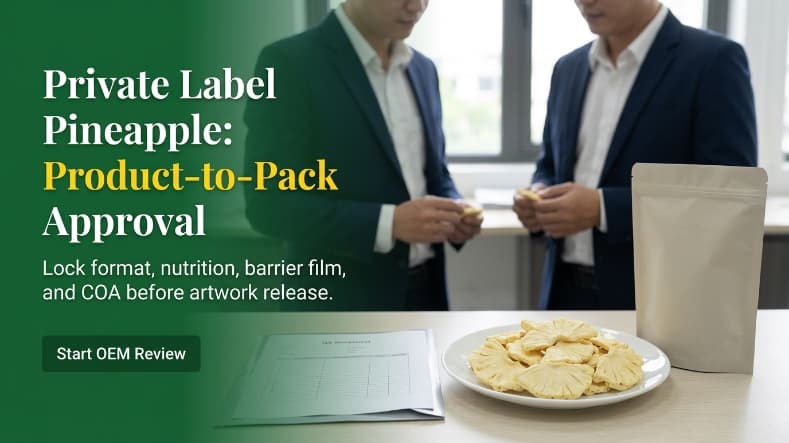
Private Label Freeze-Dried Pineapple: Product-to-Pack Approval
Private label freeze-dried pineapple fails when the buyer starts with pouch design instead of product control. A retail pack can look finished while the product inside is still undefined: cubes, bites, slices or powder, 100% pineapple or formulated powder, confirmed nutrition or copied panel, moisture and Aw tested or only assumed, bulk sample approved or not yet matched to production.
Importers, brand owners, distributors and retail category buyers should treat private label approval as a product-to-pack sequence, not an artwork sprint. A private label pouch is only ready when the product, label, packaging, COA and release file all describe the same SKU. FruitBuys supplies the configured product under one accountable route, aligning format, QC, documentation, packaging and export logistics before the buyer releases the SKU.
Private Label Approval Starts With Product Definition
Private label freeze-dried pineapple must begin with product definition, not artwork.
The buyer should lock format, ingredient statement, application, moisture, Aw, packaging and proof file before approving the retail pouch.
A pack design without product proof creates revision risk before launch.
Private label approval belongs inside the wider freeze-dried pineapple supplier qualification. A buyer should first confirm what FruitBuys will supply: pineapple cubes, bites, slices or powder, bulk ingredient or retail pouch, single-format SKU or application-specific product, 100% pineapple or formulated powder where applicable.
A private label file should begin with these decisions:
| Approval Area | Required Buyer Decision |
|---|---|
| Product form | Cubes, bites, slices or powder |
| Product role | Snack, topping, inclusion, dry mix or retail powder |
| Ingredient statement | 100% pineapple or formulated product |
| Pack type | Retail pouch, bulk inner bag or private label case |
| Label market | U.S., EU, UAE or another destination |
| Nutrition basis | Lab report, validated database or approved source file |
| Release proof | COA, lab reports and retained sample |
| Packaging proof | Film, seal, carton and storage controls |
| Bulk comparison | Sample-to-bulk approval method |
Private label does not reduce technical control. It adds another layer. Product, pack and label now move as one controlled SKU.
Choose the Format Before Designing the Pack
Private label buyers often ask for pouch design first because that feels tangible. The stronger sequence is format first, pack second. A bite pouch, slice pouch and powder pouch are not the same SKU architecture.

The buyer should connect this decision to private label pineapple format selection. Format controls pack size, headspace, breakage risk, nutrition basis, serving basis, label language and shelf-life support.
| Format | Private Label Use | Main Approval Risk |
|---|---|---|
| Bites | Snack pouch, retail fruit snack | Breakage, visual consistency, pouch protection |
| Slices | Topping, tea blend, visual snack | Edge breakage, pouch orientation, visual rejection |
| Cubes | Cereal inclusion, snack mix, topping | Size tolerance, fines, blending performance |
| Powder | Beverage mix, smoothie powder, dry blend | Mesh, carrier status, caking, ingredient statement |
A slice format may need more space and gentler filling. A bite format may need stronger intact-piece control. A powder format may need tighter moisture protection and carrier disclosure. If the buyer chooses the pouch before the product, the pack may protect the wrong risk. FruitBuys should lock the format with a retained sample and written specification before artwork moves to final approval.
Match SKU Fit to the Real Application
Private label buyers need one uncomfortable question: will the product survive the way the consumer, distributor or manufacturer will actually use it? This section connects to pineapple application and SKU fit. A direct snack pouch needs different proof from a cereal inclusion, tea blend or beverage powder.
| SKU Type | Likely Format | Proof Needed |
|---|---|---|
| Retail snack pouch | Bites or slices | Intact pieces, crispness, moisture, Aw, pouch condition |
| Kids or family snack pack | Bites | Size, texture, label review, breakage tolerance |
| Granola inclusion pack | Cubes or small pieces | Size distribution, fines, moisture migration |
| Tea blend pouch | Slices or pieces | Aroma, microbiology, rehydration behavior |
| Beverage powder pouch | Powder | Mesh, caking, carrier status, dispersibility |
| Ingredient pack | Cubes, pieces or powder | COA, packaging, storage, application trial |

A single attractive sample cannot approve every SKU. Private label approval should follow the real use case. If the product will enter a dry mix, test it in that mix. If it will sit in a retail pouch, test pouch protection. If it will be sold as powder, confirm mesh, carrier status and caking behavior. FruitBuys should supply private label samples as controlled product trials, not loose display pieces.
Nutrition Facts and Label Data Cannot Be Cosmetic
Nutrition data must match the exact private label product and pack basis.
Serving size, servings per container, ingredient statement and market rules must be confirmed before artwork approval.
Buyers should not publish copied or mathematically converted nutrition values without validation.
For U.S. labels, FDA explains that Nutrition Facts information is usually based on one serving of the food, and the label displays serving size and servings per container. (U.S. Food and Drug Administration) This matters for private label because a 50 g pouch, 100 g pouch and 500 g pack can require different serving and servings-per-container review.
This section must connect to Nutrition Facts verification for private label pineapple. The current dataset includes an uploaded Nutrition Facts panel with an abnormal iron line. That panel should not move into private label artwork until a valid nutrition source corrects or confirms the data.

Private label nutrition review should lock:
| Label Input | Required Source |
|---|---|
| Product name | Approved specification |
| Ingredient statement | Formula and product file |
| Serving size | Destination-market label review |
| Servings per container | Pack-size calculation |
| Nutrition values | Lab report or validated source |
| Added sugar status | Ingredient and process review |
| Vitamins and minerals | Reported values and label rules |
| Storage statement | Packaging and shelf-life file |
| Allergen statement | Ingredient and facility review |
| Country or origin statement | Market and document review |
Do not let a designer rebuild the Nutrition Facts panel by eyesight. The label file must come from controlled data.
Packaging Structure Protects the SKU
Private label packaging is not only branding. It protects crispness, piece integrity, powder flow, shelf-life support and buyer-facing label accuracy. FDA states that it regulates the safety of food ingredients and substances that come into contact with food, including substances added to packaging materials, containers and cookware. (U.S. Food and Drug Administration)
This section connects to private label pineapple packaging controls. Freeze-dried pineapple is moisture-sensitive. If the pouch does not protect the release condition, the product can soften, cake or fragment before consumer use.

A private label packaging file should include:
| Packaging Item | Why Buyer Must Review It |
|---|---|
| Pouch material | Food-contact and barrier review |
| Film structure | Moisture and oxygen barrier direction where relevant |
| Seal width | Moisture-ingress control |
| Seal integrity check | Release and storage protection |
| Pouch size | Fill behavior and label layout |
| Headspace | Breakage and appearance control |
| Retail carton or case | Handling and distribution condition |
| Storage statement | Shelf-life support |
| Lot and date coding | Traceability and recall readiness |
| Inner liner for bulk | Repacking and moisture protection |
Do not publish film barrier numbers, residual oxygen values or shelf-life claims unless the packaging file supports them. The product is dry. The approval file must stay dry too.
COA and Lab Proof for Private Label Release
Private label buyers need COA and laboratory proof because the product will carry their brand. The risk does not stop with FruitBuys. It moves to the buyer’s label, retail channel and consumer file. This section links to COA and laboratory proof for private label release. The COA must identify the exact product, format and lot. It should not describe a generic dried fruit or an earlier sample.

A private label release file should include:
| Proof Item | Required Review |
|---|---|
| Moisture | Result, method and lot identity |
| Aw | Result, method and lot identity |
| Microbiology | Product and market-specific panel |
| Contaminants | Destination-relevant testing |
| Pesticide residues | Destination-relevant panel where required |
| Nutrition report | Label and artwork support |
| Certificate copies | Legal entity, site, scope and validity |
| Retained sample | Comparison reference |
| Specification | Approved release criteria |
| Packaging record | Pouch, liner, carton and lot code |
For U.S. importers, FDA’s FSVP guidance states that importers must establish and follow a foreign supplier verification program for each food they import to help ensure imported food meets applicable U.S. requirements and is not adulterated or misbranded with respect to allergen labeling. (U.S. Food and Drug Administration)
Private label buyers should read that as an operating reality: product proof must support the buyer’s own verification file. FruitBuys should align the documents before the SKU moves into shipment readiness.
Import and Market Documentation
Private label retail products need tighter documentation than unlabeled bulk ingredients. The label, pouch, carton, COA, packing list and shipment documents must describe the same SKU. This section connects to import documentation for private label pineapple.
Pieces and powder may need separate product descriptions and classification review. A powder pouch should not travel under a document set written for pieces. For EU-oriented products, the European Commission explains that Regulation (EU) No 1169/2011 sets general principles, requirements and responsibilities for food information, including mandatory particulars for prepacked foods. (Food Safety). The Commission also states that most prepacked foods must bear a nutrition declaration. (Food Safety)
A destination-market documentation review should include:
| Document Area | Private Label Risk |
|---|---|
| Product name | Must match label and invoice description |
| Ingredient statement | Must match formula and pack |
| Nutrition declaration | Must match destination requirements |
| Storage instruction | Must match shelf-life support |
| Lot coding | Must match COA and packing list |
| Carton label | Must match SKU and shipment file |
| Certificate scope | Must match site and product category where used |
| Product classification | Must match pieces or powder definition |
| Artwork version | Must match final approved data |
Private label documentation should not be assembled at the end. It should be built while the product, pack and label are being approved.
Sample Approval and Bulk SKU Release
Private label approval must compare the approved sample with the released bulk lot.
The buyer should verify format, nutrition source, packaging, COA and label identity before SKU release.
A sample pouch cannot release a production run unless the release file matches it.
This section connects to sample-to-bulk consistency for private label pineapple. A retail SKU can fail even when the sample looked correct if the bulk lot changes size, breakage level, moisture, Aw, pouch structure, nutrition file or ingredient statement.
A private label sample-to-bulk review should compare:
| Control Point | Sample Approval | Bulk Release |
|---|---|---|
| Format | Approved bite, slice, cube or powder | Same format and tolerance |
| Product formula | Confirmed ingredient statement | Same formula |
| Nutrition source | Draft or approved report | Final source file |
| Pack size | Trial pouch | Approved SKU pack |
| Pouch material | Trial or proposed film | Approved production material |
| Seal condition | Sample pouch check | Production seal check |
| Moisture | Target or sample result | Current-lot result |
| Aw | Target or sample result | Current-lot result |
| Artwork | Draft file | Final approved version |
| COA | Sample file if available | Current-lot COA |
| Lot code | Sample identity | Production lot identity |
If any of these points changes, the buyer should treat it as a revision, not a minor note.
Highest Risk: Artwork Approved Before Product Proof
The highest private label risk is artwork approval before product proof. It feels efficient. It is usually not.
The failure pattern is predictable:
- Buyer approves pouch layout
- Product format changes from bites to powder
- Ingredient statement needs revision
- Nutrition values no longer match
- Pack size changes serving information
- Packaging film does not support shelf-life target
- COA lacks private label SKU identity
- Shipment documents use an older product description
- QA places the SKU on hold
This is not a design problem. It is approval sequencing failure.
FruitBuys should run private label through a disciplined gate sequence:
Product format
→ ingredient statement
→ sample approval
→ nutrition source
→ packaging structure
→ label text
→ artwork approval
→ COA and lab file
→ sample-to-bulk release
→ shipment documentation
When the buyer follows that sequence, revisions become controlled. When the buyer skips it, the artwork becomes a decorative trap.
Application Mapping
| Buyer Type | Application | Required Format | Proof Needed | FruitBuys Delivery |
|---|---|---|---|---|
| Private label brand owner | Retail snack pouch | Bites or slices | Format spec, nutrition file, pouch proof, COA | OEM/Private Label Delivery |
| Importer | Market-ready SKU | Cubes, bites, slices or powder | Import documents, label file, COA | Documentation and Export Logistics Coordination |
| Distributor | Retail or channel SKU | Approved private label pack | Carton identity, storage, lot coding | Shipment readiness alignment |
| QA manager | SKU approval | Any approved format | Lab reports, specification, packaging and label review | Quality Control |
| R&D developer | New product trial | Cubes, pieces or powder | Application trial, retained sample, bulk comparison | Market Trial Support |
| Beverage brand | Powder pouch | Powder | Mesh, carrier status, nutrition and caking review | Locked powder specification |
| Tea or snack brand | Visual fruit pouch | Slices or bites | Visual reference, breakage tolerance, packaging control | Product-to-pack alignment |
Why FruitBuys Delivers Private Label Through One Approval Route
FruitBuys supplies private label freeze-dried pineapple as one configured product under one accountable supplier relationship. The buyer does not receive a disconnected sample, pouch idea, nutrition table, lab report and shipment file. Those elements must point to the same SKU.
OEM/Private Label Delivery aligns product format, pack size, label inputs and artwork revision. Quality Control verifies moisture, Aw, sensory condition, breakage and release criteria. Documentation connects COA, lab reports, ingredient statement, nutrition file and shipment documents. Export Logistics Coordination protects the approved pack configuration through storage, coding and handover.
This route gives the buyer a cleaner decision: approve, revise, hold or release. The alternative is a pile of attractive files with no shared spine.
Buyer Checklist
Before approving private label freeze-dried pineapple, request:
- Intended SKU application
- Product format: cubes, bites, slices or powder
- Ingredient statement
- Carrier or additive status for powder
- Pack size and pouch type
- Serving size basis
- Nutrition source file
- Label market and language direction
- Storage statement
- Moisture target and current-lot result
- Aw target and current-lot result
- Breakage and fines tolerance
- Packaging material and seal review
- COA and laboratory file
- Certificate copies with scope and validity where used
- Retained sample code
- Artwork revision number
- Carton and lot coding
- Import document scope
- Sample-to-bulk comparison method
Reject any private label approval where artwork, COA, packaging and product specification describe different goods.
Summary
Private label freeze-dried pineapple approval should start with product format, ingredient statement and application fit before pouch artwork. Buyers should verify nutrition data, packaging structure, moisture, Aw, COA, label requirements and sample-to-bulk consistency before SKU release.
FruitBuys supplies private label pineapple through OEM/private label delivery, QC, documentation and export logistics coordination so the approved product, pack and document file describe the same SKU.
FAQ
What comes first in private label freeze-dried pineapple approval?
Product definition comes first. Lock format, ingredient statement, application, moisture, Aw and proof requirements before final pouch artwork.
Can I approve artwork before nutrition testing?
No. Artwork should wait until the nutrition source file, serving basis, ingredient statement and destination label route are confirmed.
Which format works best for a snack pouch?
Bites or slices usually fit snack pouches. Use private label pineapple format selection [FD-PIN-04] to define size, breakage, fines and pouch risk.
Does pineapple powder need a separate label review?
Yes. Powder requires mesh, carrier status, caking review, ingredient statement and nutrition verification. Do not approve powder through a piece-format file.
Which article covers packaging?
Use private label pineapple packaging controls to review pouch material, seal integrity, storage conditions and shelf-life support.
Which article covers COA proof?
Use COA and laboratory proof for private label release to check lot identity, moisture, Aw, microbiology, contaminants and nutrition reports.
Which article controls sample-to-bulk release?
Use sample-to-bulk consistency for private label pineapple to compare approved sample, specification, pouch, COA and released production lot.
Conclusion
Request private label approval review after locking the freeze-dried pineapple format, ingredient statement, pouch type, nutrition source, COA requirements and destination-market label route.
References
- U.S. Food and Drug Administration. Serving Size on the Nutrition Facts Label. Official guidance page, accessed 2026. (U.S. Food and Drug Administration)
- U.S. Food and Drug Administration. What’s on the Nutrition Facts Label. Official guidance page, accessed 2026. (U.S. Food and Drug Administration)
- U.S. Food and Drug Administration. Food Ingredients & Packaging. Official guidance page, accessed 2026. (U.S. Food and Drug Administration)
- U.S. Food and Drug Administration. Food Packaging & Other Substances that Come in Contact with Food – Information for Consumers. Official guidance page, accessed 2026. (U.S. Food and Drug Administration)
- U.S. Food and Drug Administration. Guidance for Industry: Foreign Supplier Verification Programs for Importers of Food for Humans and Animals. Official guidance page, accessed 2026. (U.S. Food and Drug Administration)
- European Commission. Mandatory Food Information. Official guidance page, accessed 2026. (Food Safety)
- European Commission. Nutrition Labelling. Official guidance page, accessed 2026. (Food Safety)