
How Long Does Freeze-Dried Pineapple Really Last, and What Keeps It From Clumping?
Freeze-dried pineapple in an aluminium-foil pack that is sealed well, gently vacuumed with a desiccant sachet inside, keeps 12 months at ≤25 °C, RH ≤60%; 18–24 months in cool storage at ≤18 °C, RH ≤50%. In metallised (VMPET) film it typically starts to soften within about three months in a humid warehouse, and in plain polyethylene it can clump into blocks sooner.
The shelf life of this product is decided by the pack and the storage, not the dryer. Freeze-dried pineapple is roughly two-thirds natural sugar and full of open pores. It pulls moisture from any air it meets, and once it has taken up a few points of moisture the pieces turn from crisp to sticky. The buying decision is therefore which pack structure, which evidence for the shelf-life date and which loading plan you put into the contract.
Why do freeze-dried pineapple chunks turn sticky?
Because they absorb water from the air, and pineapple’s sugars soften as soon as they do.
A freeze-dried piece is a dry, glassy sugar structure with a large internal surface. When moisture gets in, through a weak film, a leaking seal or a humid packing room, the sugars soften. Studies on freeze-dried pineapple show that the temperature at which the structure softens falls as moisture rises. When it falls below room temperature, the surface turns tacky, pieces touching each other stick, and later the sugar bridges between them harden into lumps. This is why exporters of dried pineapple describe pieces in a shared bag sticking together and having to be separated.
The same mechanism explains the three complaints buyers see most:
- Soft pieces on opening: moisture came through the film over months.
- Blocks in the bag: moisture reached the pieces at one point, often a seal or a pinhole, and the pieces bonded there.
- Clumps in the dosing hopper: the pack was opened and left in a humid factory.
Microbial spoilage is rarely the first failure. Texture fails long before.
What pack keeps freeze-dried pineapple crisp?
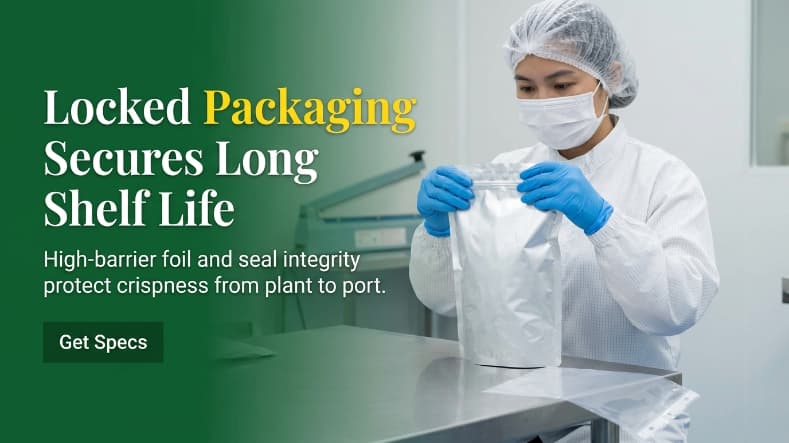
An aluminium-foil laminate with a strong seal, gently vacuumed so it sits flat, with a food-grade desiccant sachet inside. Metallised film and plain polyethylene are not enough to hold a 12-month shelf life.
FruitBuys ran a 90-day accelerated comparison at 38 °C and 90% relative humidity on the same freeze-dried pineapple, starting at water activity 0.22 and moisture 3.8%, packed in three structures:
| Pack structure | Water activity at end | Moisture at end | Condition |
|---|---|---|---|
| PET 12 / aluminium foil 7 / PE 80 | 0.28 | 4.5% | Still crisp, no caking |
| PET / metallised PET / PE | 0.42 | 6.8% | Soft, starting to stick |
| PE 80 µm, single film | 0.65 | 12% | Clumped, crispness gone |
The foil pack kept the product inside the usual release target of water activity ≤0.30. The metallised pack let the product cross into the soft zone; the single film failed completely. The test was run under hot, humid conditions to separate the structures quickly. It ranks packs reliably; it does not convert neatly into months at room temperature, because heating sugar-rich fruit changes how it behaves.
The pack structures FruitBuys specifies:
| Pack | Structure and controls |
|---|---|
| Retail pouch, 30–500 g | PET 12 / Al 7 / PE 80; water vapour transmission 0.8 g/m²/day at 38 °C/90% RH; oxygen transmission 0.5 cc/m²/day; 8 mm seal at >20 N/15 mm; vacuum leak test at −0.08 MPa |
| Bulk carton, 5–7 kg | PE liner 120 µm plus a PET 12 / Al 7 / PE 80 bag, heat sealed; food-grade silica gel at 10 g per kg of product; outer 5-ply carton 58 × 28 × 34 cm; drop test 80 cm, compression 300 kg |
For bulk packs, the sequence matters as much as the materials: fill in the dry packing room, add the silica sachet, draw a gentle vacuum so the bag lies flat in the carton, seal twice in parallel lines, then add a moisture indicator card. FruitBuys does not flush with nitrogen: an inflated 5 kg bag takes more carton space, raises freight per kilogram, and is squeezed when the carton is closed, which crushes pieces and can crack the foil. The desiccant does the moisture work; the vacuum keeps the pack compact. A foil pouch costs a few cents more than a plain film pouch, around USD 0.15 against USD 0.04 at retail size in our experience; that difference is small against a container of softened stock.
Whatever supplier you use, ask for the film structure, the water vapour transmission rate with its test conditions, seal strength records per shift and the desiccant dose per bag.
How long does freeze-dried pineapple last, and how can a supplier prove it?
12 months at ≤25 °C, RH ≤60%; 18–24 months in cool storage at ≤18 °C, RH ≤50%, unopened in the original foil bag with desiccant. The default best-before date is set on the 12-month figure; cool storage keeps the fruit’s sugars in their stable glassy state, which is what carries crispness and colour into the longer range. After opening, a resealed retail bag lasts about 7 days.
Multi-year claims found online apply to emergency-food packaging with oxygen absorbers and heavy foil containers. They do not apply to a snack pouch or a bulk carton.
A shelf-life date is only as strong as the evidence behind it. Ask for three things:
- The pack specification the date was established on. A date proven in foil does not transfer to metallised film.
- Stability data: accelerated results to compare packs, and real-time results at your storage condition to confirm the date. Check water activity, moisture, texture and colour at each point. If your private label needs a printed date beyond 12 months, FruitBuys can run an accelerated shelf-life study on your final pack format with you.
- The storage condition the date assumes. FruitBuys stores finished goods at 22 ± 2 °C and 55 ± 5% relative humidity, with pallets 30 cm from walls and 15 cm off the floor. If your warehouse is hotter or more humid, the date does not carry over automatically.
Where even 12 months will not hold: a hot, humid route with no dry storage at destination, packs opened and resealed in production, or a switch to cheaper film. In those cases set a shorter date or change the pack. Size bulk bags to one mixing batch or shift, open a bag only when it will be used up, and do not leave part-open bags in a humid store.
How much freeze-dried pineapple fits in a container, and does it need a reefer?
FruitBuys packs 5–7 kg net, by cut and packing method, in a 5-ply carton of 58 × 28 × 34 cm and floor-loads 550 cartons, or 2,750–3,850 kg, in a 20 ft container. You fill a container’s volume long before its weight limit, so freight per kilogram depends on how many kilograms each cubic metre of carton holds.
Freight per kg = container freight ÷ kg actually loaded
Compared like for like at 7 kg per carton, a larger 60 × 39 × 39 cm carton fits only about 306 cartons, or 2,142 kg, per 20 ft container, against 3,850 kg in the compact carton. At an illustrative USD 3,000 container freight, that is USD 1.40/kg against USD 0.78/kg. Ask every supplier for carton dimensions as well as net weight: the weight alone does not tell you the freight. The limit on packing denser is breakage, so check fines at arrival; the effect of fines on your cost per usable kilogram is covered in the conversion ratio guide.
A refrigerated container is not needed for low-water-activity product in a sealed foil pack. The real risk in a dry container is condensation, often called container rain. Freeze-dried pineapple is so light that a full container is mostly air. When that warm, humid air from a Vietnamese port cools on the voyage, for example crossing Suez in a European winter, water forms on the steel roof and drips onto the cartons. Wet cartons lose most of their stacking strength, pallets lean or collapse, and water spots the outside of the foil bags.
FruitBuys loads against it in seven steps, and they are worth writing into your shipping instructions:
| Step | What FruitBuys does | What it prevents |
|---|---|---|
| 1. Dry container | Floor timber below 18% moisture, no holes, door seals tight, light test passed; wet floors refused | Water already inside the box |
| 2. Dry pallets | Heat-treated ISPM 15 pallets below 22% moisture; no freshly sawn timber | A wet pallet can release 10–15 litres of water |
| 3. Rain cover | Stretch film plus a 150 µm PE cover over each pallet, taped at the base | Drips reaching the cartons |
| 4. Container desiccant | 10–12 calcium chloride poles of 1 kg in a 40 ft high cube on winter routes to Europe, hung on the walls, not above the cargo | Air moisture condensing on the roof |
| 5. Loading gaps | About 10 cm from the walls and 15 cm below the roof | Cartons touching cold steel |
| 6. Loading conditions | Loaded under cover, never in rain or above 85% relative humidity | Humid air sealed in at the start |
| 7. Paper trail | The steps above written on the packing list | Evidence for an insurance claim if the forwarder skips them |
Container desiccant uses calcium chloride rather than silica gel: silica holds about 30% of its own weight in water, calcium chloride about 250%. The silica inside each bulk bag protects the product; the poles protect the cartons. In our experience the poles and cover cost around USD 50 per 40 ft container, against USD 3,000–6,000 when wet cartons force a container to be reworked.
Does freeze-dried pineapple need refrigeration after opening?
No, but it needs to stay dry, and how long an opened pack lasts depends on where it is opened.
- Retail pack in a kitchen: use within about 7 days. In open air at around 70% humidity, water activity can climb from 0.25 to above 0.40 within hours, so the pieces turn chewy quickly unless the bag is closed.
- Bulk bag used within one shift: in a production room below 50% humidity at 20–25 °C, tip the bag into a lidded stainless hopper and use it within the 8-hour shift. No resealing is needed.
- Part-used bulk bag: press out the air, reseal with an impulse sealer (10–12 mm seal, not a clip), put a fresh 25 g silica sachet between the liner and the foil bag, not touching the fruit, and label it “opened on [date]”. Stored at 20 °C and below 60% humidity, use within 14 days.
- Splitting a bag into batch portions: divide it in a dry room below 45% humidity, work quickly, seal each portion with its own small sachet, and apply the same 14-day limit.
A simple check for your QA team: resealed product should still read water activity ≤0.30 after 14 days; above 0.35, reject it. Refrigerating an open bag makes things worse, because taking it out into warm air condenses moisture onto the cold pieces.
A single-ingredient pack cannot rely on an anti-caking agent. If one is added, such as silicon dioxide, it must appear in the ingredient list and the product is no longer 100% pineapple.
Shelf-life and packing checklist for your contract
| Requirement | Target | Checked |
|---|---|---|
| Pack structure | Aluminium foil laminate, stated layers | Per packaging lot |
| Water vapour transmission | Stated value with test conditions (FruitBuys retail: 0.8 g/m²/day at 38 °C/90% RH) | Per packaging lot |
| Seal strength | Stated minimum (FruitBuys: >20 N/15 mm) | Every shift |
| Bulk bag condition | Gently vacuumed, lying flat, no inflation; seal intact | Every carton |
| Desiccant, bulk | Food-grade silica, stated grams per kg (FruitBuys: 10 g/kg) | Every carton |
| Release water activity and moisture | As in your freeze-dried pineapple specification | Every lot |
| Shelf life | 12 months at ≤25 °C, RH ≤60%; 18–24 months in cool storage at ≤18 °C, RH ≤50%; longer printed dates backed by your own stability data | Before first order |
| Storage condition | Stated temperature and humidity; ≤18 °C and ≤50% RH for stock held beyond 12 months | On label and in contract |
| Container loading | Dry container, dry pallets, rain covers, calcium chloride poles, written on the packing list | Every shipment |
| Opened bulk bags | Bag size matched to one batch or shift; part-used bags resealed with impulse seal and fresh desiccant; 14-day limit | Every opened bag |
| Carton size and net weight | 58 × 28 × 34 cm, 5–7 kg by cut and packing method; 550 cartons per 20 ft (2,750–3,850 kg) | Before freight budget |
Frequently asked questions
Why did my freeze-dried pineapple turn into one block?
Moisture reached the pieces through the film, a seal or an open bag, and the sugar surfaces bonded. Check the seal first, then the film specification.
Can I use metallised film instead of aluminium foil?
For short shelf lives and dry markets, possibly. In FruitBuys’ accelerated comparison, metallised film let the product soften and start sticking where foil kept it crisp; in a humid warehouse that usually shows within about three months.
Can I print an 18- or 24-month best-before date?
With stability data on your own pack and storage, yes. Freeze-dried pineapple keeps 12 months at ≤25 °C, RH ≤60%, and 18–24 months in cool storage at ≤18 °C, RH ≤50%; an accelerated shelf-life study on your final pack supports the longer printed date.
Does freeze-dried pineapple need a refrigerated container?
No. Sealed foil packs ship in a standard dry container; loading against condensation matters more than temperature.
Request a packaging and pack-out review
Send your format, pack size, route, storage conditions and target shelf life. FruitBuys will return the pack structure, desiccant and loading plan that fit them, so you can decide on packaging and freight before the first order. You can also see available formats and pack sizes or browse the freeze-dried fruit category.



