Freeze-Dried Pineapple COA and Laboratory Testing Checklist
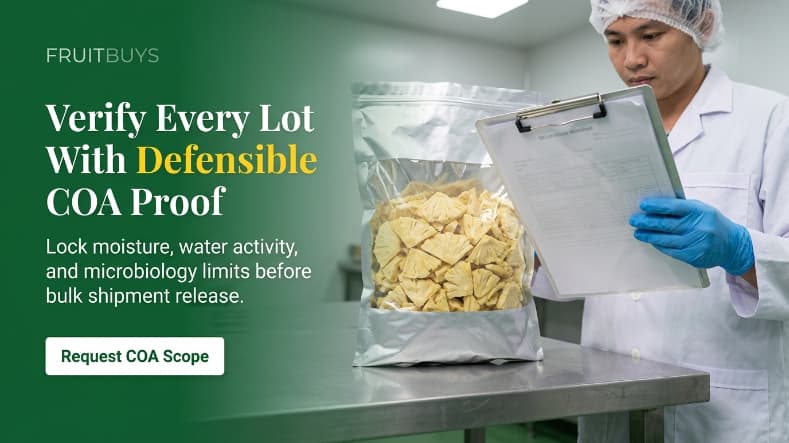
A freeze-dried pineapple COA can either protect the buyer’s approval decision or create a false sense of control. The difference sits in the details: product name, format, lot code, test method, specification limit, result, laboratory scope and release status. Importers, QA managers, procurement teams and private label buyers should not accept a generic “pass” document for cubes, bites, slices or powder. Each format carries different risks in moisture, Aw, breakage, fines, packaging and application performance.
A historical lab report does not release a current freeze-dried pineapple lot. FruitBuys treats the COA as part of one controlled product file, alongside the approved specification, retained sample, laboratory reports, packaging file and shipment documentation. When the buyer approves a lot without matching those records, the next failure moves from the supplier’s desk to the buyer’s warehouse.
A COA Must Identify the Exact Supplied Lot
A COA must identify the exact freeze-dried pineapple product, format and lot it claims to release.
A useful COA reports the specification limit, test result, method, sample identity and release status.
Buyers should reject generic COAs that do not connect to the approved sample and bulk lot.
A Certificate of Analysis is not a decoration in a shipment file. It must connect the supplied goods to measurable release criteria. For freeze-dried pineapple, that means the COA should identify whether the product is cubes, bites, slices or powder, then show the exact lot code and tested parameters.
The buyer should connect the COA back to freeze-dried pineapple supplier qualification. Supplier approval does not stop at factory capability or sample appearance. It requires a documented product route from approved specification to lot release.
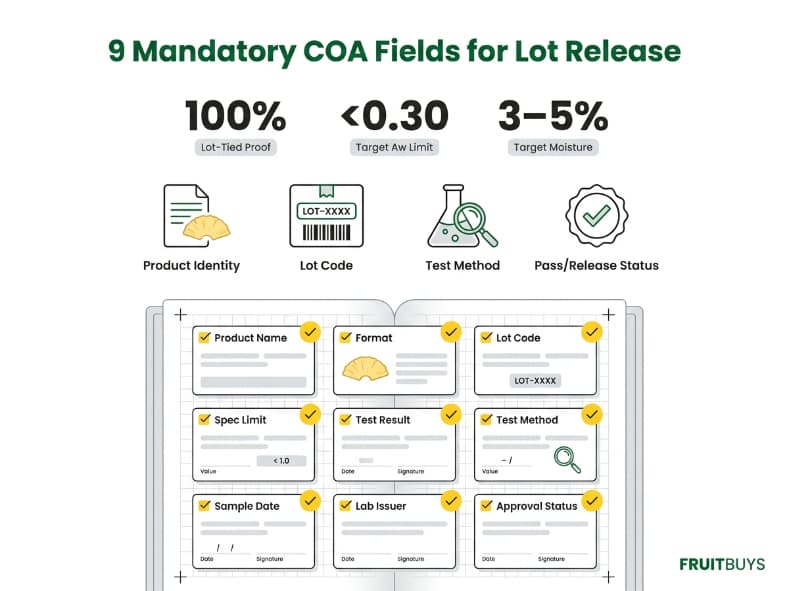
A serious COA should include:
| COA Field | Required Detail | Buyer Reason |
|---|---|---|
| Product name | Freeze-dried pineapple | Prevents product substitution |
| Product format | Cubes, bites, slices or powder | Aligns testing with application |
| Lot code | Exact production or packing lot | Connects proof to goods |
| Specification limit | Accepted value or range | Shows release standard |
| Test result | Actual value | Supports pass, hold or reject |
| Method | Test method or standard reference | Allows QA review |
| Sample date | Date of sample collection or testing | Controls document relevance |
| Laboratory or issuer | Internal QC or external lab | Clarifies source of result |
| Approval status | Released, pending, held or rejected | Converts data into action |
A COA without lot identity cannot protect the buyer. A COA without methods weakens QA review. A COA without specification limits leaves the result hanging in the air.
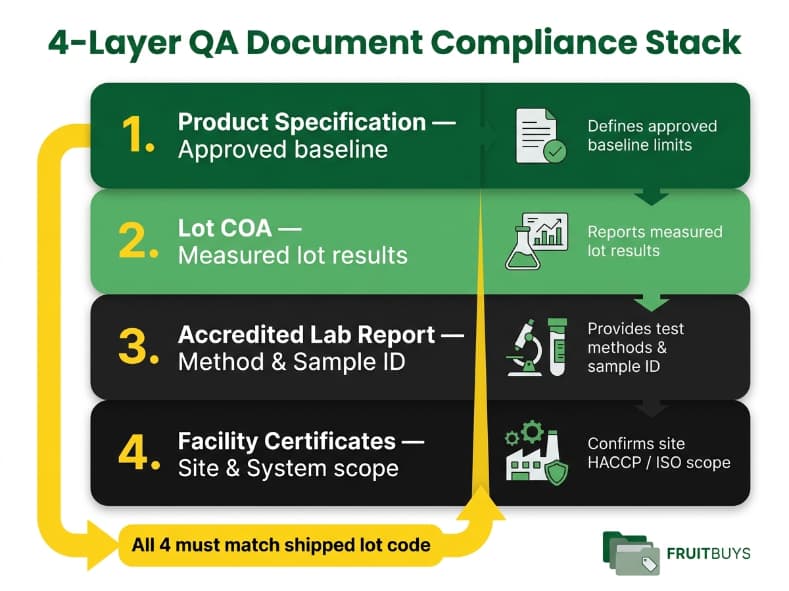
Product Specification, COA and Laboratory Report Serve Different Roles
Buyers often ask for “the COA” as if one document answers every proof question. It does not. The product specification, COA and laboratory report serve different jobs.
The product specification defines what the buyer approved. It should state product format, ingredient direction, physical criteria, moisture, Aw, microbiology limits, packaging and other release conditions. The COA reports results against that specification for a specific lot. The laboratory report gives deeper method, sample and result detail for parameters tested by an external or accredited laboratory.
A certificate, such as HACCP, ISO 22000, BRCGS or Halal, serves another role. It may describe a management system, process scope or facility status. It does not prove moisture, Aw, microbiology, pesticide residue or heavy metal result for a specific freeze-dried pineapple lot unless the document directly contains those lot-specific results.
Laboratory competence also matters. ISO/IEC 17025 defines general requirements for the competence of testing and calibration laboratories, so buyers should check whether the laboratory scope covers the exact tests being used for release. (ISO)
The right document stack looks like this:
| Document | What It Proves | What It Does Not Prove |
|---|---|---|
| Product specification | Buyer-approved standard | Actual lot result |
| COA | Lot result against specification | Full lab method detail in all cases |
| Laboratory report | Test method, sample and result | Supplier’s full operational control |
| Certificate copy | Site or system scope | Current lot compliance by itself |
| Packing file | Pack configuration and lot movement | Microbiology or contaminant result |
If the buyer mixes these roles, the approval file turns cloudy. A cloudy file causes delays, disputes and release risk.
Physical and Technical Parameters
Freeze-dried pineapple must pass more than microbiology. The buyer needs physical and technical parameters because they control product performance.
Core parameters include:
| Parameter | Why It Matters | COA or Spec Handling |
|---|---|---|
| Moisture | Controls texture, caking and storage behavior | COA result required |
| Aw | Controls available water and stability risk | COA result required |
| Size range | Controls application fit | Specification and inspection record |
| Mesh | Controls powder behavior | Specification and sieve result |
| Fines | Controls usable product and visual quality | Defined by sieve or weight basis |
| Broken pieces | Controls snack, topping and inclusion quality | Defined by agreed limit |
| Color | Controls visual consistency | Approved reference sample |
| Sensory | Controls flavor and texture expectation | Approved evaluation method |
| Foreign matter | Controls physical contamination risk | Inspection and release record |
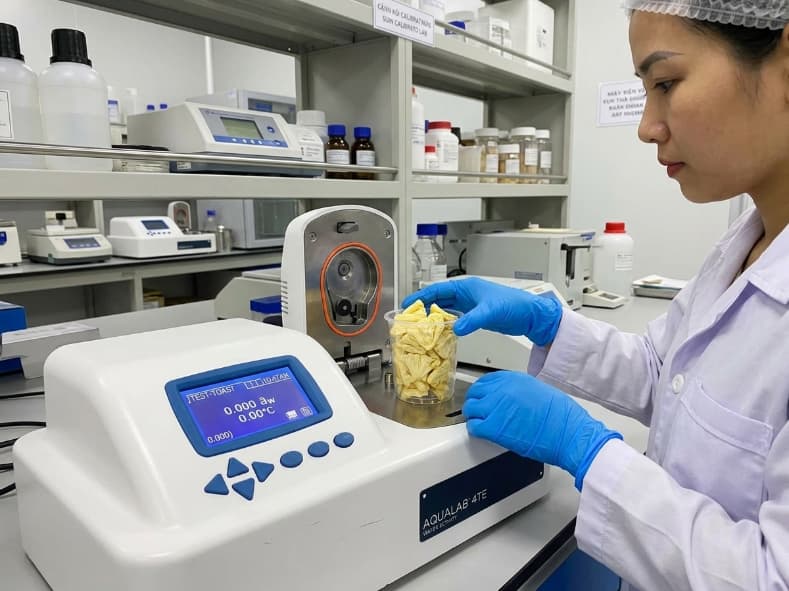
Physical testing must connect with pineapple size and format tolerances. A cube, bite, slice and powder cannot share one loose physical standard. Each format needs its own release logic. Moisture and Aw require special control because they affect multiple risks at once. Moisture measures total water content. Aw measures available water.
The FDA explains water activity as a vapor-pressure relationship, not total water percentage, which is why both measurements can matter for dry food stability (U.S. Food and Drug Administration). For this product cluster, moisture 3–5% and Aw below 0.30 function as target criteria. Buyers should connect them to moisture and Aw testing for freeze-dried pineapple before treating them as release values.
Microbiology Testing
Low Aw does not replace microbiology testing.
Freeze-dried pineapple may not support fast microbial growth under low Aw, but contamination can still enter through raw material, handling, equipment, environment or packaging.
Buyers should require organism-specific results, test method, sample identity and reporting limits.
Microbiology testing should appear in the QA file when the buyer, application or destination market requires it. Low moisture and low Aw do not make the product sterile. They control the environment available to microorganisms, but they do not erase contamination that occurred before or after drying.
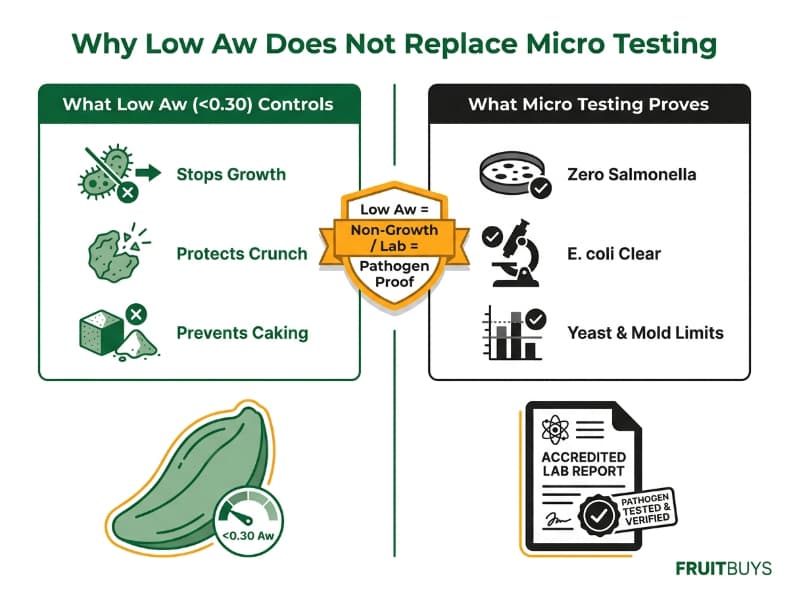
FDA’s low-moisture ready-to-eat food guidance focuses on sanitation programs and corrective actions because pathogen contamination events can occur in low-moisture food environments. (U.S. Food and Drug Administration)
A practical microbiology panel may include:
| Test Area | Buyer Review Point |
|---|---|
| Total plate count | General hygiene indicator |
| Yeast and mold | Dry fruit stability and handling indicator |
| Coliforms | Process hygiene signal |
| E. coli | Hygiene and contamination signal |
| Salmonella | Pathogen control requirement where applicable |
| Listeria spp. or L. monocytogenes | RTE environment and destination-specific review |
| Staphylococcus aureus | Handling and hygiene review where applicable |
Do not publish absolute language such as “pathogen-free” unless an exact validated report supports the exact statement under the stated method and sample basis. Even then, the correct wording should follow the report language. “Not detected in 25 g” does not mean the same thing as zero risk.
FruitBuys should define microbiology testing through Quality Control and Documentation. The buyer should see organism, method, unit, result, reporting limit, lot identity and release decision.
Contaminants and Residue Testing
Freeze-dried pineapple concentrates fruit solids. That makes raw-material governance and contaminant testing relevant to buyer approval. The buyer should not rely on a general supplier statement such as “safe for export.” QA review needs a test panel linked to the destination market and product use.
For EU-oriented review, Regulation (EU) 2023/915 sets maximum levels for certain contaminants in food and includes provisions relevant to dried fruits and processed products from dried fruits. (EUR-Lex) EU pesticide residue controls fall under Regulation (EC) No 396/2005, which covers maximum residue levels of pesticides in or on food and feed of plant and animal origin. (EUR-Lex)
A practical contaminant and residue file may include:
| Test Group | Why Buyer Requests It | Required Handling |
|---|---|---|
| Pesticide residues | Raw-material and market-entry risk | Destination-specific panel |
| Heavy metals | Contaminant control | Method, LOQ and sample identity |
| Mycotoxins where relevant | Dried-fruit contaminant review | Product and market assessment |
| Sulfites/SO₂ where relevant | Ingredient or processing disclosure risk | Test if used, suspected or required |
| Foreign matter | Physical contamination risk | Inspection method and limit |
Do not use one historical contaminant report as a permanent claim for future lots. Raw material origin, field practice, season and supplier route can change. FruitBuys should align residue and contaminant testing with Raw Material Sourcing Governance and Documentation for the exact supplied lot.
Nutrition Testing
Nutrition data requires discipline because it affects label approval, private label artwork and market compliance. The uploaded freeze-dried pineapple label in the earlier dataset contained a serious iron value issue. That label must not serve as final product data.
Nutrition testing should connect to Nutrition Facts verification for freeze-dried pineapple. A buyer should not convert rounded serving values into a final per-100-g declaration and publish them as laboratory data. Mathematical conversion can support internal review, but it cannot replace a laboratory nutrition report.
A nutrition file should identify:
| Nutrition Data Point | Required Detail |
|---|---|
| Sample identity | Product, lot and format |
| Basis | Per 100 g, per serving or both |
| Energy | Calculation basis and unit |
| Macronutrients | Fat, carbohydrate, sugars, fiber, protein |
| Sodium or salt | Market-specific label basis |
| Added sugars | Requires formulation confirmation |
| Minerals | Laboratory result, not copied value |
| Moisture | Important for dried-product concentration |
| Rounding | Market-specific label review |
Private label buyers need stricter revision control. If the product changes from bites to powder, or if powder uses a carrier, the nutrition data, ingredient statement and artwork may need revision. This must connect to private label pineapple approval file.
Certificate Scope Review
Certificate logos can distract buyers. A logo does not answer the key QA question: does this certificate apply to the legal entity, site, process, product category and validity period behind the supplied freeze-dried pineapple lot?
The buyer should review:
| Certificate Item | Required Review |
|---|---|
| Legal entity | Must match supplier, site or relevant production partner |
| Address | Must match the production or packing site |
| Standard | HACCP, ISO 22000, BRCGS, Halal or other stated scheme |
| Scope | Must cover the process and product category |
| Issue date | Shows document timing |
| Expiry date | Confirms current validity |
| Certification body | Must be identifiable |
| Annex or schedule | Often contains the actual scope detail |
| Relationship to lot | Must connect operationally to supplied goods |
Do not write that freeze-dried pineapple is “HACCP certified,” “ISO certified,” “BRCGS certified” or “Halal certified” unless the exact certificate, scope and validity support that statement. A certificate can support supplier qualification. It cannot replace lot-based COA and laboratory testing.
Importer and Market Documentation Review
For U.S. importers, FDA’s FSVP rule requires importers to perform risk-based foreign supplier verification activities to verify that imported food meets applicable U.S. safety standards. (U.S. Food and Drug Administration) This means the importer needs more than a product brochure. The importer needs documents that support hazard review, supplier verification and food-safety compliance.
For freeze-dried pineapple, the documentation set may include:
| Document | Buyer Use |
|---|---|
| Product specification | Defines approved product |
| COA | Releases the current lot |
| Laboratory reports | Support specific test results |
| Certificate copies | Support site or system review |
| Ingredient statement | Supports label and import review |
| Allergen statement | Supports market and label controls |
| GMO or other declarations | Market-specific review where required |
| Packaging specification | Supports shelf-life and storage |
| Traceability record | Links raw material to finished lot |
| Packing list | Supports shipment identity |
| Classification support | Supports product description and customs review |
Classification and shipment files should link to pineapple HS code and import documentation. Pieces and powder may need separate product descriptions and documentation. A single HS direction cannot cover every format without review.
Highest Risk: Historical Report Used as Current-Lot Proof
The highest-risk document mistake is using a historical lab report as proof for a current freeze-dried pineapple lot.
A report from another lot, format, site or date cannot release the goods now under review.
Buyers should match every COA and lab report to the approved specification, retained sample and bulk lot.
Historical reports enter approval files because they look official. They have a laboratory name, a date, test results and technical language. That appearance can fool a buyer who does not check lot identity.
A historical report fails when:
- The lot code differs
- The product format differs
- The production site differs
- The test method differs
- The sample date sits outside the current lot
- The product was repacked
- The ingredient statement changed
- The powder contains a carrier
- The certificate scope does not cover the process
- The shipment file uses a different product description
This section must connect to sample-to-bulk release controls. Bulk release depends on matching proof, not paper volume. Ten unrelated documents cannot replace one correct lot-specific COA. FruitBuys should hold this line firmly: no current-lot identity, no release-grade proof.
Application Mapping
| Buyer Type | Application | Required Format | Proof Needed | FruitBuys Delivery |
|---|---|---|---|---|
| Importer | Market entry and supplier approval | Cubes, bites, slices or powder | COA, lab reports, certificate scope, shipment file | Lot-based Documentation and Export Logistics Coordination |
| QA manager | Lot release | Any approved format | Specification limit, result, method, lot identity | Quality Control and controlled product release |
| Procurement manager | Bulk approval | Approved commercial format | Current-lot COA and retained sample comparison | Single-point commercial accountability |
| R&D developer | Recipe validation | Cubes, pieces or powder | Moisture, Aw, size, fines, sensory data | Application-specific sample control |
| Private label buyer | Retail pouch or branded pack | Bites, slices or powder | Nutrition, packaging, COA and artwork input file | OEM / Private Label Delivery |
| Distributor | Replenishment | Same approved SKU format | Repeatable COA file and packaging consistency | Documentation and shipment readiness alignment |
Why FruitBuys Delivers This Through Lot-Based Documentation
FruitBuys supplies freeze-dried pineapple as one configured product under one accountable route. The buyer does not purchase separate fragments: a nice sample from one table, a generic lab report from another folder and a shipment file assembled later. FruitBuys must align the approved product, retained sample, COA, laboratory report, packaging file and shipment documents before release.
This sits inside three pillars. Quality Control defines what gets tested and released. Documentation connects the result to the exact lot. Export Logistics Coordination keeps the approved product identity consistent through packing, storage and shipment handover. The buyer’s decision should become simple: approve, hold or reject based on the release file. If the file cannot support that decision, the product is not ready for buyer approval.
Buyer Checklist
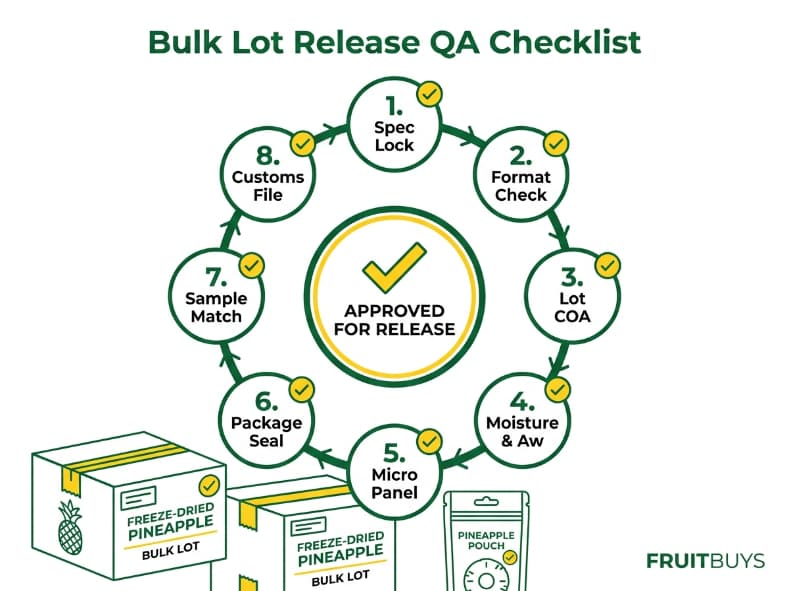
Before approving a freeze-dried pineapple lot, request:
- Approved product specification
- Exact product format: cubes, bites, slices or powder
- Current-lot COA
- Moisture result, limit and method
- Aw result, limit and method
- Microbiology panel with organism-specific results
- Pesticide residue report where required
- Heavy metal report where required
- Sulfite or SO₂ report where applicable
- Nutrition report for label use
- Certificate copies with site, scope and validity
- Ingredient statement
- Allergen statement
- Packaging specification
- Retained sample record
- Packing list and lot identity
- Shipment documentation scope
- Release approval status
Reject loose proof. A document that cannot identify the product, lot, method and limit cannot release the goods.
Summary
Freeze-dried pineapple COA review must connect each test result to the exact product format and lot. Buyers should review moisture, Aw, microbiology, contaminants, residues, nutrition data, certificate scope, packaging records and shipment documentation before approving bulk release.
FruitBuys supplies freeze-dried pineapple through one accountable product route where Quality Control, Documentation and Export Logistics Coordination support lot-based release decisions.
FAQ
What should a freeze-dried pineapple COA include?
A useful COA includes product name, format, lot code, specification limit, test result, method, sample date, issuer and release status. Without those details, the buyer cannot verify the lot.
Can a historical lab report release a current lot?
No. A historical report can support supplier review, but it cannot release a current lot unless it identifies the same product, lot, sample and test scope.
Which tests matter most for freeze-dried pineapple?
Moisture, Aw, microbiology, contaminants, pesticide residues, sulfites where applicable and nutrition data matter most. The exact panel depends on buyer requirement, application and destination market.
Does low Aw replace microbiology testing?
No. Low Aw can limit microbial growth potential, but it does not prove absence of contamination. Buyers still need microbiology testing when required by specification or market review.
How should buyers review certificate logos?
Review the legal entity, site address, standard, scope, product category, certification body, issue date and expiry date. A logo alone does not prove lot compliance.
Where should nutrition testing connect?
Nutrition testing should connect to Nutrition Facts verification for freeze-dried pineapple, especially for private label, retail pouches and destination-specific label review.
Which article controls bulk approval?
Use sample-to-bulk release controls to compare the approved sample, specification, COA, packaging and current bulk lot before release.
Conclusion
Request COA and laboratory file review after defining the freeze-dried pineapple format, destination market, packaging configuration and lot-release criteria.
References
- U.S. Food and Drug Administration. FSMA Final Rule on Foreign Supplier Verification Programs for Importers of Food for Humans and Animals. (U.S. Food and Drug Administration)
- U.S. Food and Drug Administration. Draft Guidance for Industry: Establishing Sanitation Programs for Low-Moisture Ready-to-Eat Human Foods and Taking Corrective Actions Following a Pathogen Contamination Event. (U.S. Food and Drug Administration)
- U.S. Food and Drug Administration. Water Activity (aw) in Foods. (U.S. Food and Drug Administration)
- European Union. Commission Regulation (EU) 2023/915 on Maximum Levels for Certain Contaminants in Food. (EUR-Lex)
- European Union. Regulation (EC) No 396/2005 on Maximum Residue Levels of Pesticides. (EUR-Lex)
- International Organization for Standardization. ISO/IEC 17025:2017, General Requirements for the Competence of Testing and Calibration Laboratories. (ISO)