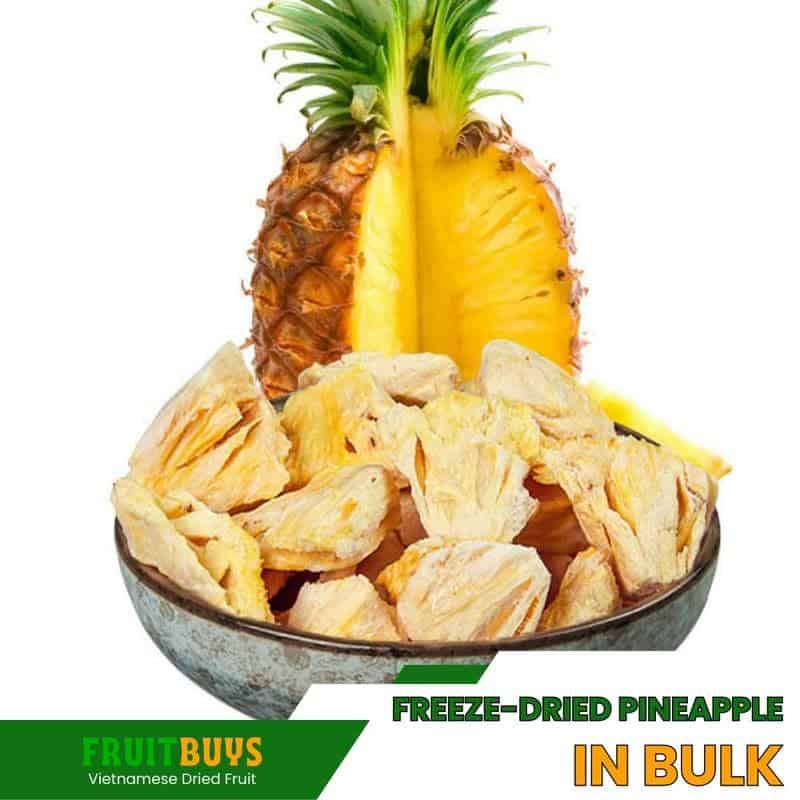
What Should a Freeze-Dried Pineapple Supplier Prove Before You Send an RFQ?
Freeze-dried pineapple is 100% pineapple flesh frozen and dried under vacuum into crisp, shelf-stable pieces, bought by importers, distributors and food manufacturers for snacks, cereal, dairy toppings and private-label packs. Before you ask anyone for a price, settle two things: what the supplier must prove about itself, and what your request for quotation (RFQ) must lock about the product.
Most requests skip both. FruitBuys receives around 30 RFQs a week, and about 1 in 6 carries enough detail to quote accurately. A complete RFQ gets a firm answer in hours; an incomplete one needs about eight follow-up questions and three days, and the prices that come back are rarely comparable. This guide sets out what to decide first and links to the detailed guide for each decision.
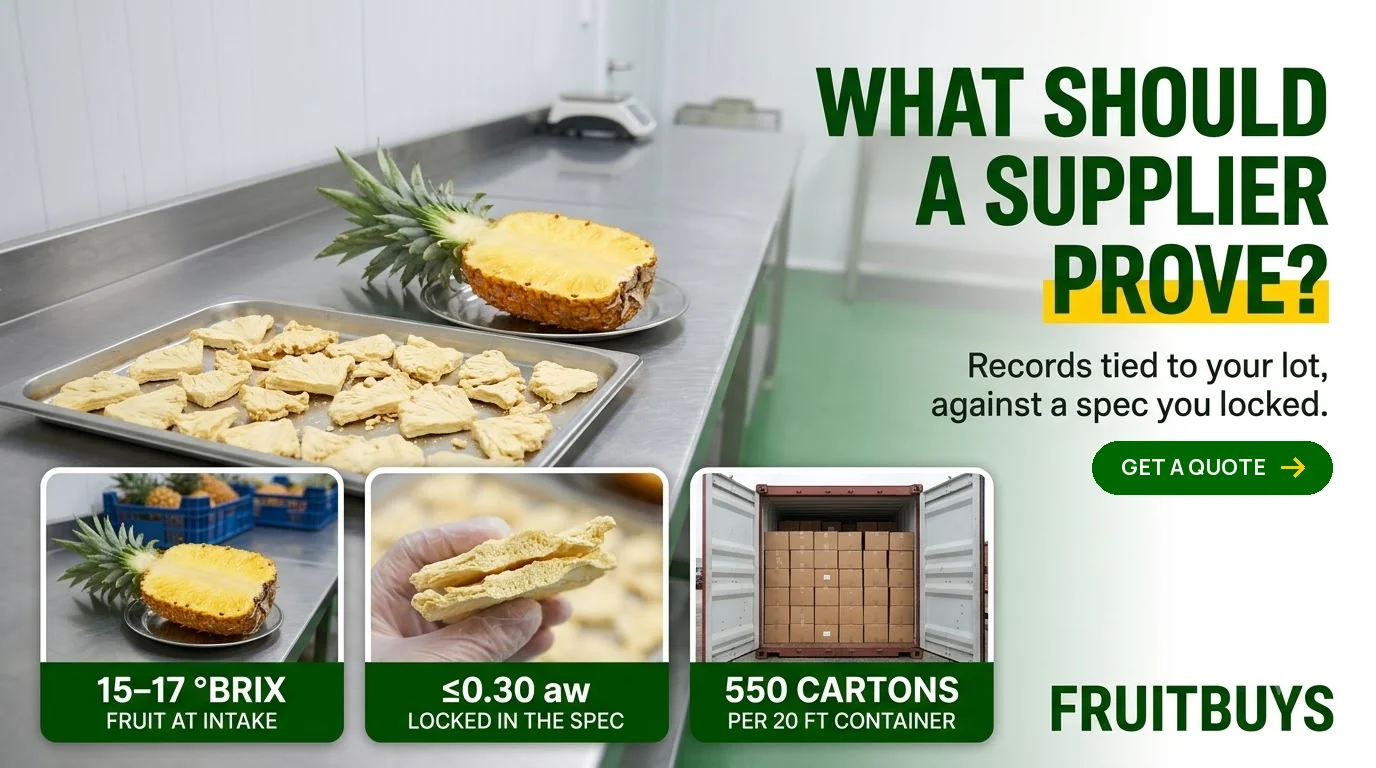
What should a supplier prove before you shortlist it?
Who makes the product, under which certification, and whether the evidence is tied to your lot.
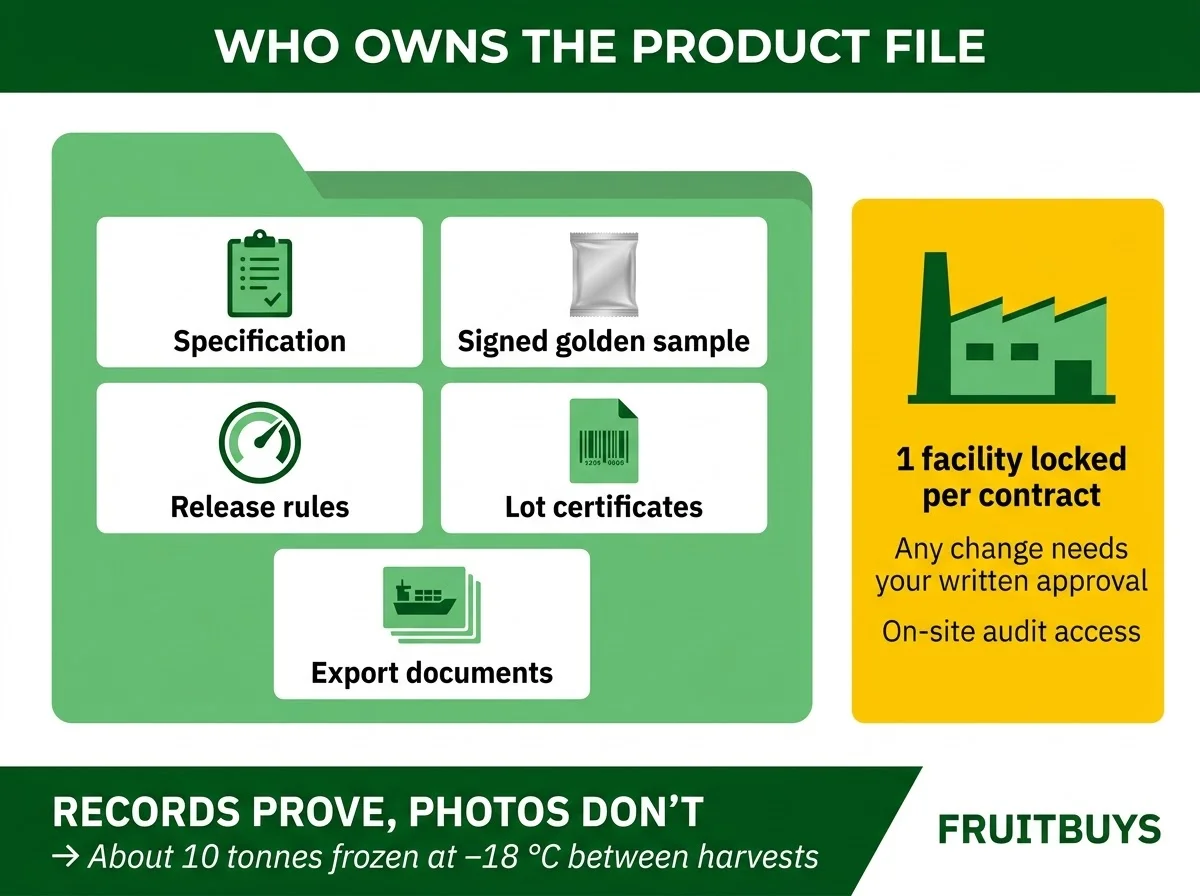
- Manufacturer or supply chain orchestrator. FruitBuys works as a supply chain orchestrator: it coordinates the growing areas, sets the process standard, owns the product file (specification, signed golden sample, release rules, lot certificates, export documents) and carries responsibility for the export paperwork. For each contract, FruitBuys locks one qualified processing facility; any change of facility requires your written approval and a re-approved pre-shipment sample, and you have on-site audit access. A buffer of around 10 tonnes of frozen pineapple at −18 °C keeps the dryers running between harvest peaks.
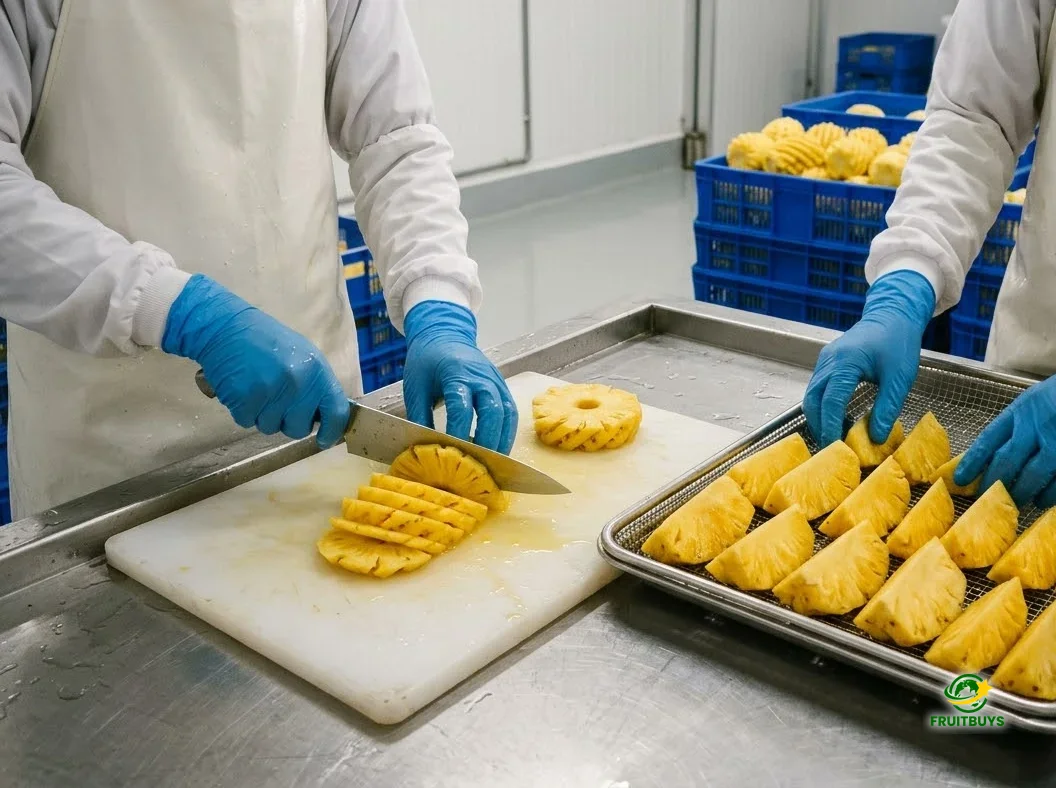
- What to ask any supplier to show. Production records for your kind of lot (fruit intake, cutting, drying cycle, sorting, packing), a retained sample kept for each lot, the factory’s GFSI audit report, and the last three lots measured against the golden sample. Photos of machines prove nothing; records do.
- Food safety certification. Most European importers ask for a GFSI-recognised certificate: BRCGS, IFS, FSSC 22000 or SQF. Check the certificate number, the site named on it, the scope (it should cover freeze-dried fruit) and the expiry date.
- Certificate versus lot evidence. A certificate shows the factory runs a system. It does not show your lot is safe. You still need lot results, set out in the specification and food-safety guide.
When this model is not right for you: if your programme only buys from a supplier that owns its dryers, choose a manufacturer-exporter and accept a narrower raw-material base. If you accept an orchestrated model, write the facility lock-in, change-control and audit access into the contract, and hold every supplier to the same terms.
What should the RFQ specify about the product?
A locked specification, not a description. “Freeze-dried pineapple, best price, 1 tonne” gets a guess back. Use numbers:
| Item | Write in the RFQ | Where to set it |
|---|---|---|
| Product | Freeze-dried pineapple, 100% pineapple, no added sugar, no sulphite | HS code and label guide |
| Fruit | Brix range, e.g. 15–17°; variety only if it is on your pack | Origin and variety guide |
| Format | Cut and size with tolerance, e.g. chunk 12 ± 2 mm, fines limit | Applications guide |
| Moisture and water activity | e.g. 3–5% and ≤0.30, same sample | Specification guide |
| Microbiology | Salmonella not detected in 25 g; E. coli <10 cfu/g; total plate count ≤10,000 cfu/g; yeasts and moulds ≤100 cfu/g; Listeria and Enterobacteriaceae as extended tests where your application needs them | Specification guide |
| Pesticides | EU limits, with ethephon tested by name on fresh fruit and finished lot | HS code and label guide |
| Colour and acceptance | Retained sample, colour tolerance (e.g. ΔE below 3) | Sample-to-bulk guide |
| Certificate of analysis | Lot COA for every full container, with methods and sampling stated; for trial and LCL orders, the factory release QC report plus the latest baseline surveillance report | Sample-to-bulk guide |
If a quote comes back without moisture, water activity, fines or microbiology against your numbers, it is not a quote for your product.
Freeze-dried or dried pineapple: what do importers switch for?
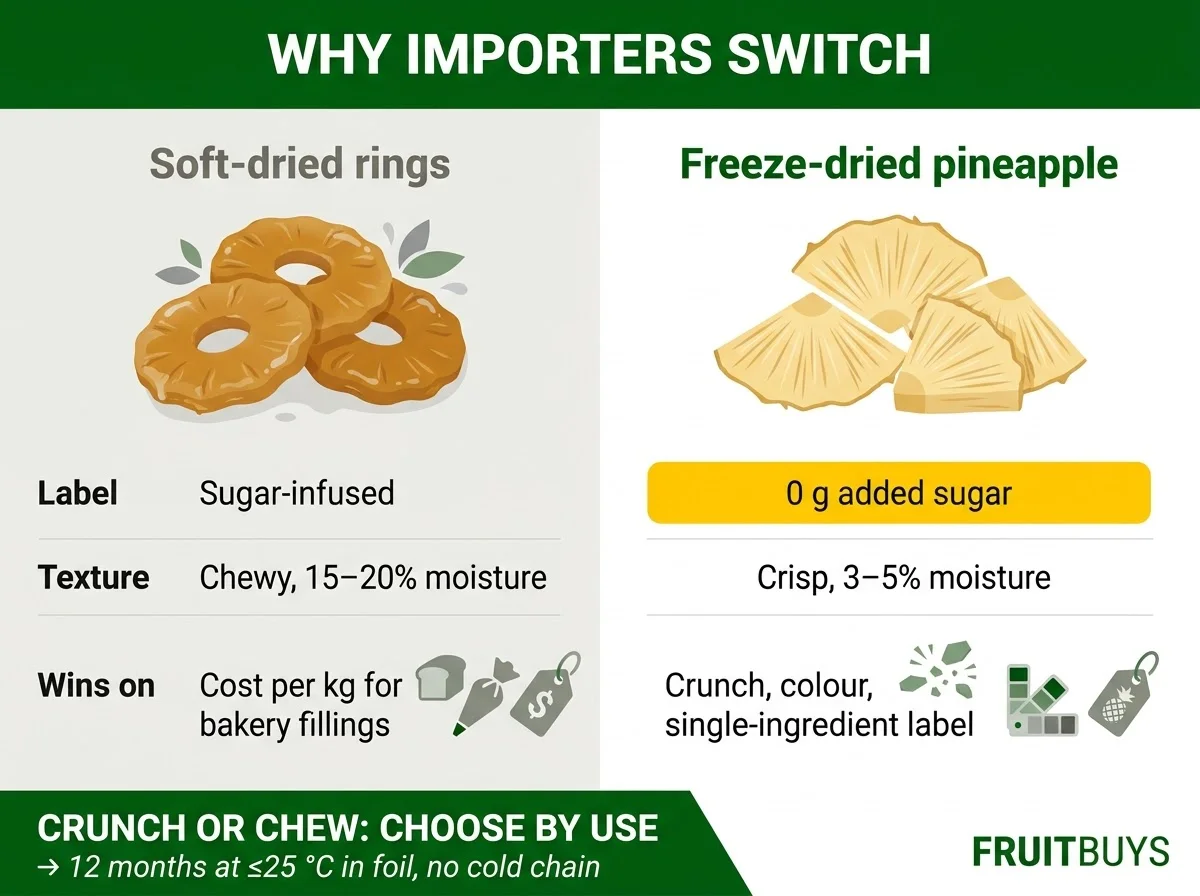
Importers move from soft-dried to freeze-dried pineapple for three reasons. The label: freeze-dried pineapple is 100% fruit with 0 g added sugar, while most soft-dried rings are infused with sugar to stay pliable. The texture: freeze-dried pieces are crisp at 3–5% moisture, so they work in cereal, trail mix and chocolate where a chewy piece at 15–20% moisture would migrate water into the mix. The shelf: 18–24 months in the sealed bulk foil bag in cool storage, 12 months once repacked into retail pouches, without a cold chain. Soft-dried still wins on cost per kilogram for bakery fillings and snacking where chewiness is the point; freeze-dried earns its price where crunch, colour and a single-ingredient label are what the customer pays for. How the two compare on nutrition is set out in dried vs freeze-dried vs fresh pineapple.
How much, when, and in what pack?
State the first order and the annual forecast separately. “1 tonne” can mean one trial or a year’s volume, and a supplier that cannot tell will price for the worst case.
- Volume. First order, forecast per month or quarter, and whether split shipments are acceptable.
- Timing. A need-by date, and whether your programme must run year-round. Vietnam harvests pineapple in a main season and an off-season, but fruit available is not product allocated: ask for allocation in writing.
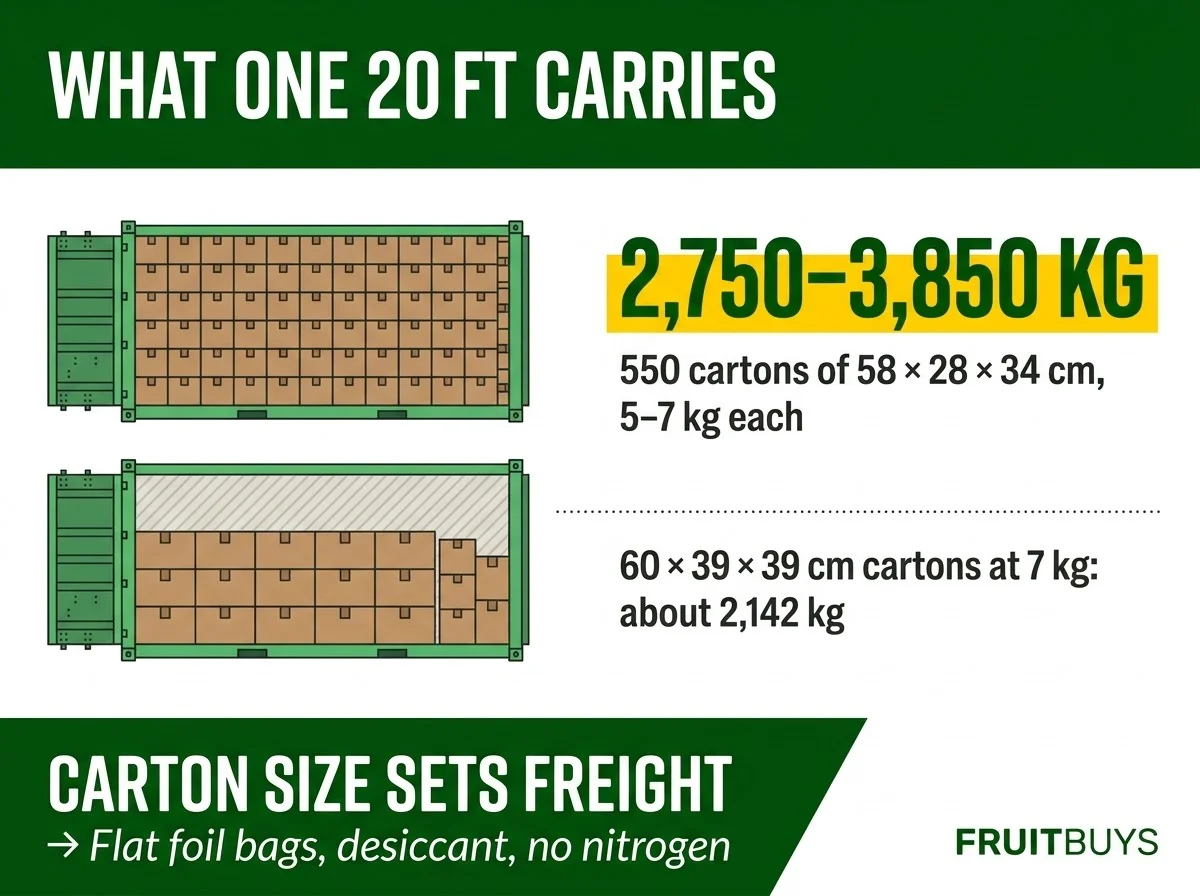
- Pack. Retail pouch or bulk; film structure; net weight per carton. FruitBuys packs in foil bags gently vacuumed with a desiccant sachet, no nitrogen, so bags lie flat, and loads 550 cartons of 58 × 28 × 34 cm at 5–7 kg net depending on cut and packing method, or 2,750–3,850 kg, per 20 ft container. At 7 kg per carton, a 60 × 39 × 39 cm carton fits only about 2,142 kg. Carton size and net weight together set your freight per kilogram. Pack choices are in packaging and shelf life.
Which Incoterms, destination and documents?
Name the destination port or warehouse and the Incoterm, because they decide who pays freight and who carries risk at sea.
- FOB (free on board): the seller delivers onto the vessel at the Vietnamese port; you arrange and pay the main freight. Choose it if you have a forwarder.
- CIF (cost, insurance and freight): the seller pays freight and minimum insurance to your port, but risk passes to you when the goods are loaded. Choose it if you want one delivered price, and check the insurance cover.
Both are sea-freight terms under Incoterms 2020. Then list the market and the documents it needs: for the EU, that includes proof of origin for EVFTA, a lot certificate of analysis with ethephon, and a signed ingredient declaration. The HS code and label guide covers the full list and the label checks for private-label packs.
How should you compare the quotes that come back?
On landed cost per usable kilogram, from the same RFQ sent to every supplier.
Send identical specifications, quantities, destination and terms to three to five suppliers, and ask each to state price, Incoterm, lead time, validity and any deviation from your specification. Then compare:
- the fruit-to-product basis each price assumes, explained in how much fresh pineapple makes 1 kg of freeze-dried pineapple;
- freight per kilogram at each supplier’s carton weight;
- duty for your market at the current rate;
- the usable share after fines and rejects.
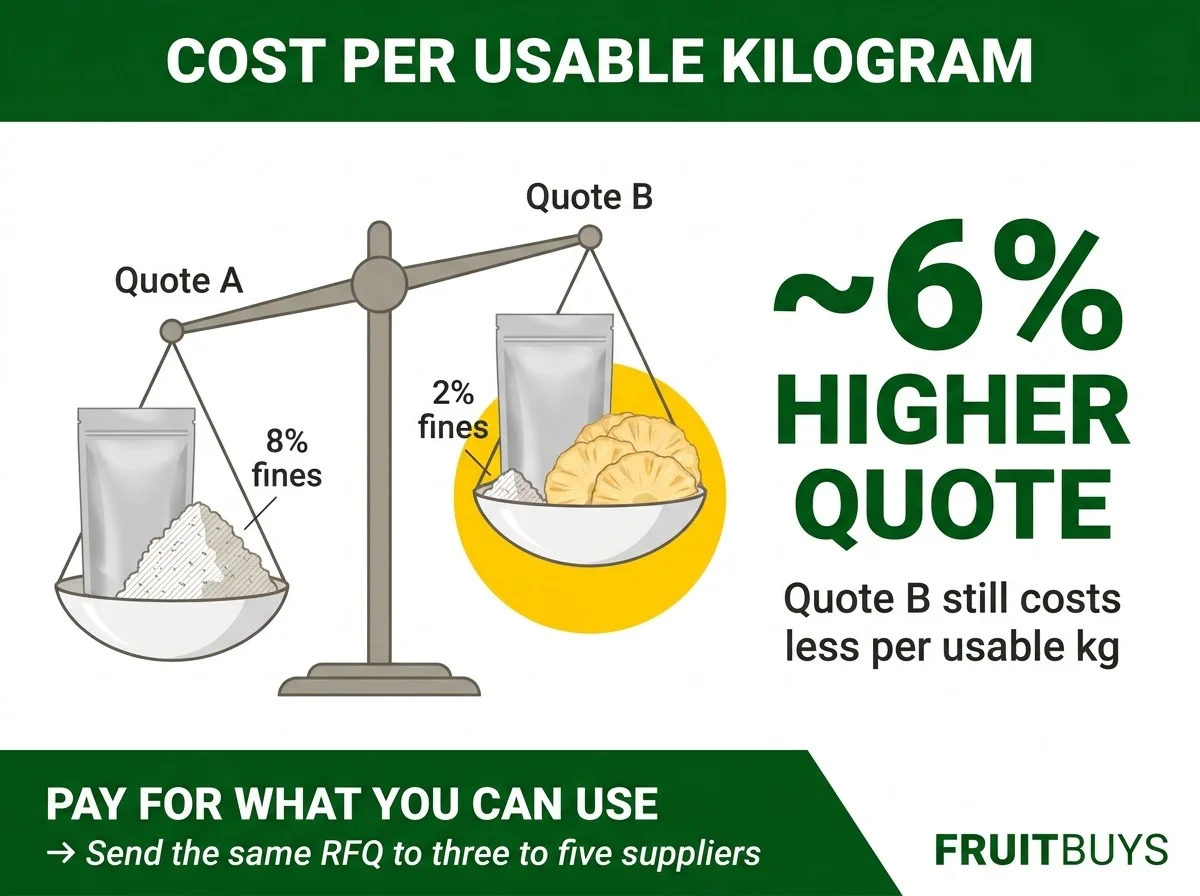
The lowest price per kilogram is often not the lowest cost per usable kilogram once freight, duty and fines are in. Two numbers show how far apart they can be. At an illustrative container freight of USD 3,000 and 7 kg per carton, a compact 58 × 28 × 34 cm carton costs about USD 0.62 less per kilogram in freight than a 60 × 39 × 39 cm carton. And a supplier delivering 2% fines can quote about 6% more than one delivering 8% fines and still cost you less per usable kilogram. The worked example is in the conversion ratio guide.
Ask every supplier to fill in the same lines, so gaps show:
| Line | What a usable answer looks like |
|---|---|
| Weighing point of the fruit ratio | Whole fruit, flesh or tray-loaded, stated |
| Conversion breakdown | Weighing-point records for three recent lots |
| Moisture and water activity | Both, on the same sample, with limits |
| Cut and fines | Size with tolerance; fines limit and sieve |
| Pack | Film structure; net kg per carton by cut |
| Container loading | Dry container, desiccant and rain covers |
| Lot evidence | Lot-specific certificate; retained and golden sample |
| Terms | Minimum order per SKU; payment tied to approval of the pre-shipment sample |
A blank line is a cost you will carry later.
Can freeze-dried pineapple be private-labelled?
Yes. Add three items to the RFQ: the pack format and pack size, whether the label data will be your responsibility or the supplier’s, and the target shelf life. Nutrition values for the label must come from analysis of the finished product, and the label should be approved on a printed proof before the production run. The label checks are in the HS code and label guide, and pack and shelf-life evidence in packaging and shelf life.
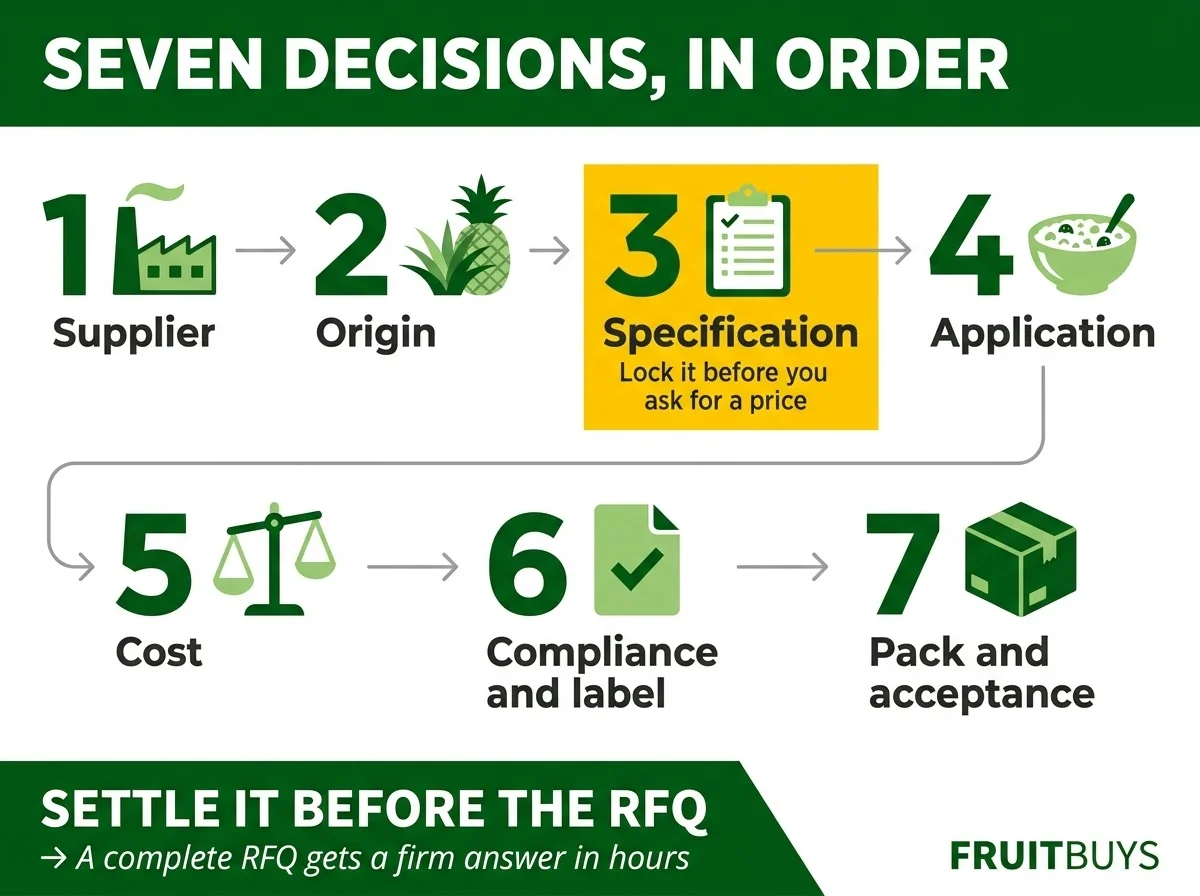
Seven decisions to settle, in order
| Stage | The question | Evidence to ask for | Detailed guide |
|---|---|---|---|
| 1. Supplier | Who makes it, under which certificate? | Product file owner, GFSI audit report, production records | This page |
| 2. Origin and technology | Vietnam or another origin; freeze-dried or dried? | Variety, Brix range, harvest calendar, duty | Origin |
| 3. Specification | Which limits go in the contract? | Moisture, water activity, micro, ethephon | Specification |
| 4. Application | Which format for your product? | Pilot samples, end-of-shelf-life test | Applications |
| 5. Cost | What does a usable kilogram cost? | Weighing point, conversion breakdown, carton weight | Conversion and cost |
| 6. Compliance and label | Will it clear and is the label right? | HS code, residue results, SKU nutrition analysis | HS code and label |
| 7. Pack and acceptance | Will it arrive crisp and match the sample? | Pack spec, shelf-life data, signed tolerances | Packaging · Sample to bulk |
An RFQ outline you can adapt
Subject: RFQ [number] – Freeze-dried pineapple chunk 12 mm – [quantity] – [market]

1. Buyer: company, country, business type, application (snack / inclusion / topping)
2. Product: freeze-dried pineapple, 100% pineapple, no added sugar, no sulphite
   Fruit Brix 15–17°; chunk 12 ± 2 mm; fines limit [x]%
   Moisture 3–5%; water activity ≤0.30 (same sample)
   Salmonella not detected in 25 g; E. coli, total plate count, yeasts and moulds per spec; extended tests (Listeria, Enterobacteriaceae) if required [attach]
   Pesticides to destination limits; ethephon reported by name, fresh fruit and finished lot
   GFSI certificate (number, site, scope, expiry); lot-specific COA
3. Quantity: first order [kg]; forecast [kg per month]; split shipments [yes/no]
4. Timing: need-by date; year-round programme [yes/no]
5. Pack: bulk or retail; film structure; net kg per carton; label [neutral / private]
6. Delivery: Incoterm [FOB Vietnamese port / CIF destination port]; destination
7. Documents: invoice, packing list, proof of origin, COA, declarations [list]
8. Commercial: currency, payment terms, quote validity, sample requirement
9. Quote must state: unit price, Incoterm, lead time, validity, deviations from spec
10. Contact and deadline
Frequently asked questions
Should I ask for samples or prices first?
Prices on a locked specification first, then samples against that specification. Samples before a specification tend to be the supplier’s best batch, not a reference you can hold bulk to.
Is a supplier that uses partner factories riskier than one that owns its plant?
Not by itself. What matters is who owns the specification and the golden sample, and what happens when a factory fails. A supplier that owns the product file can move production and keep the reference; a single-plant supplier that fails has no second source. Ask either kind for records, audit evidence and its plan for a failed lot.
What is the minimum order for freeze-dried pineapple?
Trial and LCL lots are possible for testing; full containers carry about 550 cartons in a 20 ft, or 2,750–3,850 kg of pieces. Private label starts from 500 kg per order on digital print.
Which documents should come with every shipment?
Commercial invoice, packing list, bill of lading, certificate of origin (EUR.1 for the EU), phytosanitary certificate and the lot COA carrying the lot code on your packing list.
Request a technical RFQ review
Send your draft RFQ or your current supplier’s specification. FruitBuys will return the missing items and a corrected outline, so your next request gets comparable answers the first time. A 15-minute call before you send it usually saves a week of follow-up. You can also view commercial product specifications and formats or browse the freeze-dried fruit category.