Freeze-Dried Pineapple Sample-to-Bulk Consistency
A freeze-dried pineapple sample can look clean, crisp and well-cut, then still fail the buyer when the bulk lot arrives. The sample may represent selected pieces, a different raw-material maturity, a different drying run, a different sorting level or a different packaging condition.
Importers, QA managers, procurement teams, R&D developers and private label buyers need a measurable bridge between sample approval and bulk release. Sample approval without bulk-release criteria is not approval, it is only a visual preference.
FruitBuys treats sample-to-bulk consistency as a controlled comparison across format, moisture, Aw, size, fines, breakage, color, sensory condition, packaging and documentation. When the buyer skips this discipline, disputes start after delivery, when the product already sits in inventory and every weak control becomes visible.
Sample Approval Does Not Automatically Control Bulk
A freeze-dried pineapple sample does not automatically represent the bulk lot.
Buyers need measurable release criteria because sample selection can hide variation in size, breakage, moisture, Aw and color.
The correct next step is to convert the approved sample into a written specification and lot-release checklist.
Sample approval begins the control process. It does not finish it. A sample pouch may show the buyer what the product can look like under a narrow condition. It does not prove that every production lot will match the same size, texture, color, moisture, Aw or packaging condition.
This article extends the freeze-dried pineapple qualification framework. The Pillar Hub explains how buyers qualify the product and supplier route. This risk-control article defines how the buyer turns that qualification into a practical bulk-release system.
Bulk inconsistency usually enters through five points:
- Raw-material maturity changes
- Cut size varies before tray loading
- Drying behavior changes with piece thickness and load
- Sorting criteria change after drying
- Packaging and handling expose the product to humidity or breakage
FruitBuys should not let a sample travel alone. The sample needs a specification, a retained reference, a COA, a packaging file and a release decision. Without that file, the buyer only approves a photograph in physical form.
What Must Be Locked at Sample Approval
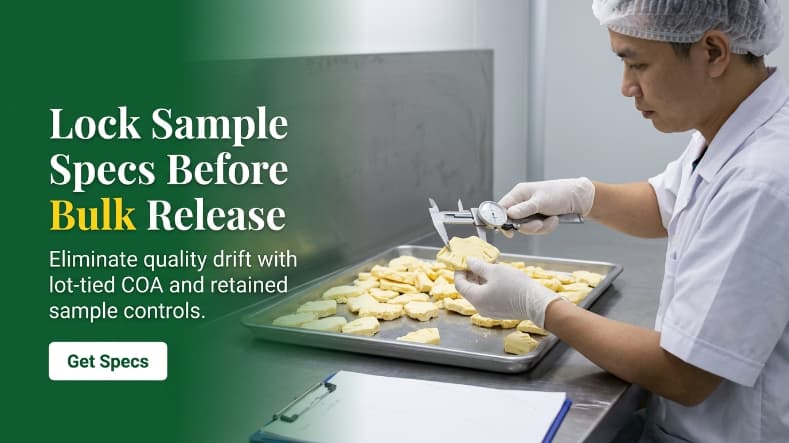
A buyer must lock the sample as a decision standard. The sample should not remain a loose “looks good” comment inside an email thread. It must become a controlled reference connected to measurable terms.
Lock these points at sample approval:
| Control Point | What to Lock | Why It Matters |
|---|---|---|
| Product name | Freeze-dried pineapple | Prevents product substitution |
| Format | Cubes, bites, slices or powder | Defines application fit |
| Ingredient statement | Pineapple and any added ingredient or carrier | Controls label and QA review |
| Variety direction | MD2 or agreed raw-material direction where confirmed | Supports sensory and color consistency |
| Size | Nominal size, mesh or range | Controls application performance |
| Fines | Definition and acceptable level | Controls usable payload and appearance |
| Broken pieces | Weight basis or inspection method | Controls snack and topping quality |
| Moisture | Target and release limit | Controls texture and storage response |
| Aw | Target and release limit | Controls available-water risk |
| Color | Approved reference | Controls buyer-facing visual acceptance |
| Sensory | Flavor, aroma, crispness | Controls product experience |
| Packaging | Inner bag, pouch, carton or liner | Controls moisture pickup and breakage |
| Documentation | COA and lab-report scope | Controls release proof |

The buyer should connect format details to freeze-dried pineapple format tolerances. Format words carry no operational value until both parties define their measurement basis. “Cube” without dimensions creates disputes. “Powder” without mesh and carrier status creates label and application risk.
For sample approval, FruitBuys should hold one practical rule: if the buyer cannot measure it or describe it clearly, the buyer cannot use it as a bulk-release standard.
Retained Sample and Approved Specification
A retained sample protects both sides only when it stays controlled. A loose pouch stored in a humid office cannot serve as a reliable reference after texture and color change. The retained sample needs identity, storage conditions and a link to the approved specification revision.
A retained sample record should include:
| Retained Sample Field | Required Detail |
|---|---|
| Sample code | Unique identification |
| Product format | Cubes, bites, slices or powder |
| Date approved | Buyer approval date |
| Specification revision | Version number |
| Storage condition | Dry, sealed, protected from heat and humidity |
| Seal condition | Original or resealed |
| Quantity retained | Enough for comparison |
| Responsible party | FruitBuys and buyer-side contact where relevant |
| Expiry of reference use | Review date or validity condition |
A retained sample cannot replace testing. It supports comparison. The approved specification defines the acceptance criteria. The COA reports the lot results. The retained sample helps evaluate visual and sensory alignment.
FruitBuys should issue the retained sample reference only after the buyer confirms intended application. A snack buyer may value intact pieces and crisp bite. A cereal manufacturer may prioritize cut-size distribution and low fines. A beverage developer may ignore piece shape but require mesh, caking control and dispersibility.
Technical Comparison: Moisture, Aw, Size, Fines and Breakage
Technical sample-to-bulk comparison must include measurable values, not only visual inspection.
Moisture and Aw need current-lot results because they affect texture, storage behavior and microbial-growth potential.
Buyers should compare the bulk lot against the approved sample, specification and COA before release.
Moisture and Aw create the most common false confidence. A freeze-dried pineapple sample may feel crisp during evaluation, but bulk cartons can show higher moisture, higher Aw or weaker packaging protection. The buyer should require current-lot results for both.
The FDA defines water activity as a vapor-pressure relationship that measures available water, not total moisture. FDA guidance also links available water to microbial growth potential, which makes Aw a different control from moisture percentage. (U.S. Food and Drug Administration)
This comparison must connect to moisture and Aw comparison. FruitBuys should report both values against the approved release criteria. The submitted target values for this cluster are moisture 3–5% and Aw below 0.30, but those numbers remain targets until the COA confirms the actual lot.

Technical comparison should cover:
| Parameter | Sample Approval | Bulk Lot Release |
|---|---|---|
| Moisture | Target or sample result | Current-lot result |
| Aw | Target or sample result | Current-lot result |
| Size | Approved range | Bulk inspection result |
| Fines | Agreed definition | Weight or sieve-based result |
| Broken pieces | Agreed acceptance | Bulk inspection result |
| Color | Reference sample | Bulk visual comparison |
| Sensory | Approved taste and texture | Bulk sensory check |
| Powder mesh | Approved mesh | Sieve or specification result |
| Caking | Sample observation | Bulk pack condition |
Attribute inspection can use agreed sampling logic when the buyer and supplier define the lot, sample size, acceptance level and rejection rule. ISO 2859-1:2026 covers sampling schemes indexed by acceptance quality limit for lot-by-lot inspection, but the buyer must define whether that approach fits the product and inspection purpose (ISO). Do not let “within normal variation” enter the file without numbers. Variation needs a range, method and acceptance decision.
Packaging Condition During Bulk Delivery
A bulk lot may pass moisture and Aw at release, then fail buyer expectations because packaging exposes the product to humidity, compression or rough handling. Freeze-dried pineapple has a porous structure. That structure supports crispness when protected, but it also makes the product vulnerable after poor sealing or repeated opening.
The buyer should connect this review to package condition during bulk delivery. Packaging protects the technical result. It does not merely carry the product.

Bulk delivery comparison should review:
| Packaging Item | Sample Stage | Bulk Stage |
|---|---|---|
| Inner bag | Sample pouch or liner type | Actual production liner |
| Seal | Sample seal condition | Seal integrity check |
| Headspace | Sample fill condition | Bulk pack fill condition |
| Carton | Not always present | Actual carton specification |
| Desiccant or absorber | If specified | Confirmed placement |
| Storage instruction | Draft or verbal | Printed and documented |
| Handling exposure | Sample opening | Packing and repacking exposure |
| Breakage risk | Small pouch effect | Carton and load effect |
Shelf life also depends on packaging. A target shelf-life range does not stand alone. It requires moisture, Aw, package barrier, seal integrity, storage conditions and validation evidence. If the packaging file remains missing, the shelf-life claim remains incomplete.
Documentation Comparison
Documentation must match the same product and lot that the buyer plans to release. A strong sample means nothing when the COA names a different lot, the lab report uses a different sample or the certificate scope does not cover the relevant production or packing site.
This section connects directly to lot-based COA verification. The COA should not float above the shipment like decorative paper. It must identify the exact product, format, lot, result, method, limit and approval status.

The release file should include:
| Document | Match Requirement |
|---|---|
| Approved specification | Same product and revision |
| Retained sample record | Same approval code |
| COA | Same lot and format |
| Moisture result | Same lot and method |
| Aw result | Same lot and method |
| Microbiology report | Same sample identity |
| Contaminant report | Same sample or destination-relevant panel |
| Nutrition report | Same product when used for label |
| Certificate copies | Correct site, scope and validity |
| Packaging file | Same pouch, liner, carton and coding |
| Packing list | Same lot and shipment identity |
FDA’s preventive controls rule requires covered food facilities to comply with CGMPs and risk-based preventive controls unless an exemption applies, so buyers serving the U.S. market should treat documentation as part of food-safety verification, not paperwork afterthought. (U.S. Food and Drug Administration)
Laboratory competence also needs review. ISO/IEC 17025:2017 states general requirements for the competence of testing and calibration laboratories, and buyers should check whether the laboratory’s scope covers the relevant test methods (ISO). FruitBuys should align the document file before the buyer sees the bulk lot. Late paperwork creates late decisions.
Application-Specific Bulk Approval
Freeze-dried pineapple consistency does not mean every buyer needs the same criteria. The same product can fail one application and pass another. A snack brand needs attractive pieces, crisp texture and controlled breakage. A cereal manufacturer needs stable cut size and low fines because small particles disappear into the mix.
A beverage developer using powder needs mesh, dispersibility, caking review and carrier disclosure. A private label buyer needs product, nutrition, packaging and artwork inputs to move together. This review connects to application-specific pineapple sample evaluation. The application tells FruitBuys which risks deserve tighter control.
| Application | Most Important Bulk-Control Criteria |
|---|---|
| Direct snack | Intact pieces, crispness, color, moisture, Aw |
| Cereal or granola | Size distribution, fines, breakage, moisture migration |
| Chocolate inclusion | Particle size, breakage, low moisture exposure |
| Tea or infusion | Slice integrity, aroma, microbiology, rehydration behavior |
| Bakery topping | Visual consistency, breakage, moisture response |
| Beverage powder | Mesh, caking, dispersibility, carrier status |
| Retail private label | Nutrition, pouch condition, seal, label inputs |
Private label review must connect to private label pineapple approval workflow. Artwork approval before technical release creates a trap. If moisture, Aw, ingredient statement or nutrition data changes later, the label file becomes unstable.
Deviation Handling
A deviation should trigger hold, review and documented decision, not silent substitution.
FruitBuys should compare the deviation against application risk, specification limits and buyer approval conditions.
Buyers should require a written disposition before accepting any bulk lot outside the approved criteria.
Deviation control separates serious suppliers from product movers. A bulk lot may show higher fines, darker color, weaker crispness, higher moisture, different powder mesh or packaging variation. The issue does not always require rejection, but it always requires a documented decision.
A practical deviation workflow:
- Detect the deviation
- Identify affected lot and quantity
- Compare with specification
- Review application impact
- Review COA and lab data
- Check retained sample
- Hold release when needed
- Decide: approve, downgrade, rework or reject
- Record corrective action
- Prevent repeated deviation in the next lot
Do not hide a changed cut size under the same product name. Do not move powder with carrier under a previous ingredient statement. Do not release a lot with changed packaging without buyer review. These shortcuts convert operational variation into buyer liability.
FDA low-moisture ready-to-eat guidance emphasizes sanitation programs and corrective actions for low-moisture foods because contamination events and environmental issues still require structured response. (U.S. Food and Drug Administration)
Highest Risk: Bulk Product Released Against the Wrong Sample
The sharpest risk appears when the supplier and buyer compare the bulk lot against the wrong sample. This happens when several samples moved through the approval process, the buyer selected one pouch informally, and the supplier used another reference for production release.
That mistake can produce the wrong format, different size, changed color, higher fines, weaker texture or mismatched packaging. The issue may not show until the buyer opens cartons or tests the product in application.
FruitBuys should prevent this by locking:
- Sample code
- Approval date
- Specification revision
- Retained sample photo or record
- Product format
- Moisture and Aw criteria
- Packaging configuration
- COA requirements
- Release sign-off
The buyer should not approve bulk release until every document points to the same approved sample. One product route. One specification. One release file.
Application Mapping
| Buyer Type | Application | Required Format | Proof Needed | FruitBuys Delivery |
|---|---|---|---|---|
| Importer | Bulk supply approval | Cubes, bites, slices or powder | Specification, COA, retained sample, shipment file | Documentation and controlled release |
| QA manager | Lot release | Approved format | Moisture, Aw, microbiology, method and lot identity | Quality Control |
| Procurement manager | Supplier performance review | Buyer-approved SKU | Sample-to-bulk comparison and deviation record | Single-point commercial accountability |
| R&D developer | Formula validation | Cubes, pieces or powder | Application trial, size, fines and sensory check | Market Trial Support |
| Private label buyer | Retail pouch approval | Bites, slices or powder | Nutrition, packaging, label inputs and COA | OEM / Private Label Delivery |
| Distributor | Replenishment consistency | Same approved format | Repeatable release file and packaging condition | Export Logistics Coordination |
Why FruitBuys Controls Sample-to-Bulk Release
FruitBuys supplies freeze-dried pineapple as one configured, documented and quality-controlled product. The buyer does not need a charming sample followed by loose execution. The buyer needs the same product identity to run from raw-material direction through sample approval, drying, sorting, packaging, COA and shipment handover.
Quality Control defines the measurable release criteria. Documentation connects the criteria to the current lot. OEM/Private Label Delivery aligns the product with pouch, label and artwork inputs. Export Logistics Coordination protects product condition through packaging, storage and shipment readiness.
This structure reduces argument. When the file stays clear, the buyer can approve, hold or reject without guesswork. When the file stays loose, the buyer inherits the uncertainty.
Buyer Bulk-Release Checklist

Before releasing bulk freeze-dried pineapple, check:
- Approved sample code
- Approved specification revision
- Product format: cubes, bites, slices or powder
- Ingredient statement
- Moisture target and current-lot result
- Aw target and current-lot result
- Size range, mesh or piece-weight basis
- Fines definition and result
- Broken-piece tolerance and result
- Color reference
- Sensory reference
- Packaging structure and seal condition
- Carton and inner-liner configuration
- COA with lot identity
- Laboratory reports with method and sample identity
- Certificate scope where relevant
- Packing list and lot traceability
- Deviation record
- Release decision
A buyer who skips this checklist buys uncertainty. That uncertainty will show up later as soft texture, excess fines, caking, label revision, document delay or rejected internal QA approval.
Summary
Freeze-dried pineapple sample-to-bulk consistency requires measurable comparison between the approved sample and the released lot. Buyers should compare format, size, moisture, Aw, fines, breakage, color, sensory condition, packaging and COA documentation.
FruitBuys controls this through Quality Control, Documentation, OEM/private label alignment and export logistics coordination under one accountable supplier relationship. Sample approval should become a written specification before bulk release.
FAQ
Does an approved sample release the bulk lot?
No. An approved sample starts the control process. Bulk release still requires specification matching, COA results, packaging review and sample-to-bulk comparison.
What should buyers compare first?
Compare product format, moisture, Aw, size, fines, breakage, packaging and lot identity first. These points drive the most common bulk disputes.
Why does retained sample storage matter?
A retained sample changes when exposed to humidity, heat or poor sealing. Store it sealed, identified and linked to the approved specification revision.
Can FruitBuys use one sample for all applications?
No. Each application needs its own acceptance logic. Snack, cereal, tea, powder blend and private label pouch buyers judge different risks.
What happens when bulk differs from the sample?
FruitBuys should hold the lot, document the deviation, assess application impact and seek a written approval, rework decision or rejection.
Which article covers COA proof?
Use lot-based COA verification to review test result, method, lot code, specification limit and laboratory report scope.
Which article covers moisture and Aw comparison?
Use moisture and Aw comparison to separate total moisture from available water and define release criteria.
Conclusion
Request sample-to-bulk comparison after locking the freeze-dried pineapple format, retained sample code, moisture, Aw, breakage tolerance, packaging configuration and COA criteria.
References
- U.S. Food and Drug Administration. Water Activity (aw) in Foods. (U.S. Food and Drug Administration)
- U.S. Food and Drug Administration. Draft Guidance for Industry: Establishing Sanitation Programs for Low-Moisture Ready-to-Eat Human Foods and Taking Corrective Actions Following a Pathogen Contamination Event. (U.S. Food and Drug Administration)
- U.S. Food and Drug Administration. FSMA Final Rule for Preventive Controls for Human Food. (U.S. Food and Drug Administration)
- International Organization for Standardization. ISO/IEC 17025:2017, General Requirements for the Competence of Testing and Calibration Laboratories. (ISO)
- International Organization for Standardization. ISO 2859-1:2026, Sampling Procedures for Inspection by Attributes, Part 1. (ISO)