
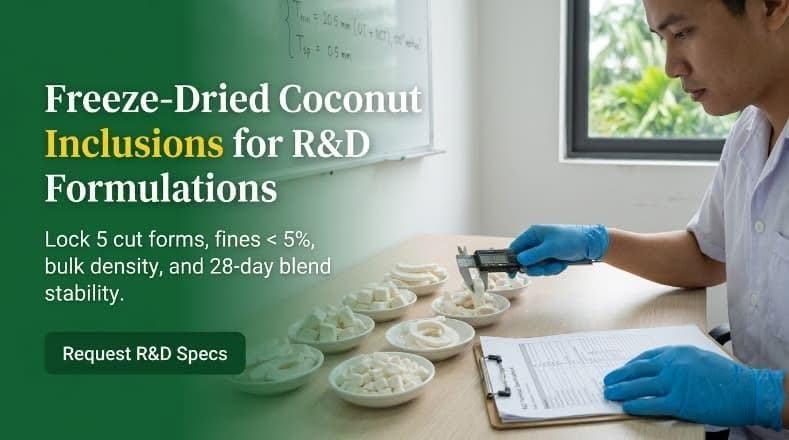
Which freeze-dried coconut cut fits your chocolate, granola, bar or topping?
Chunks for chocolate and trail mix, dice for cereal and toppings, chips for snack packs and crumble for bars. The cut decides how the coconut looks on your pack photo, how it runs through your filler and how much freight you pay per kilo. Getting it right on the first sample saves a reformulation later. Every cut below is the same freeze-dried coconut meat: the white, crisp kernel of mature Ben Tre coconuts, pared, blanched and freeze-dried to water activity ≤0.30, so the only thing that changes is shape.
Which cut goes into which product?
Match the piece to the product, then set the fines limit.
| Your product | Cut | Size | How to add it | Watch for |
|---|---|---|---|---|
| Chocolate bars, clusters, enrobed pieces | Chunks | 8–15 mm | Into tempered chocolate or onto the bar back before cooling | Tighter fines limit by contract, so dust does not grey the chocolate |
| Ready-to-eat coconut snack pouches | Cubes | 10–20 mm | Packed straight | Even size across the pouch; breakage in transit |
| Breakfast cereal, granola, muesli | Dice or chips | 5–8 mm / 1–3 mm | After the oven for white colour; before for a toasted note | Moisture from other components (see below) |
| Protein and energy bars | Crumble | 2–5 mm | Into the binder at 10–25% of bar dry mass | Larger pieces crack the bar under compression |
| Yogurt, smoothie bowls, açaí | Chips or chunks | 1–3 mm / 8–15 mm | Sprinkled at serving or in a separate topping compartment | Crisp for 15–30 minutes on a wet base |
| Bubble tea and dessert toppings | Dice | 5–8 mm | Dispensed at serving | Sweetened version available as an OEM order |
| Trail mix, tropical snack mixes | Chunks or cubes | 8–20 mm | Dry-blended | Pair with components at a similar water activity |
| Cookies, muffins, bakery fillings | Dice or crumble | 2–8 mm | Folded into dough or batter | No water bleeds into the batter |
Cuts run to ±2 mm of the stated size, and fines are held at ≤5% by weight at loading. Any other shape is cut to your drawing.
Chips, flakes or shredded: what changes on your line?
Thickness and surface area.
- Chips and slices (1–3 mm) are the thinnest freeze-dried cut: the most crunch per bite, the biggest visual presence on a snack pack or a smoothie bowl, and the most fragile in a bag. They fill a carton toward 7 kg.
- Flakes are slices broken to smaller, irregular pieces. They spread evenly through granola and look natural on top of a yogurt cup. Order them as a cut-to-drawing spec with your target size range.
- Shredded coconut is almost always desiccated, hot-air dried and dense. It is the right choice for baking where the coconut disappears into the crumb, and the wrong one where you want a crisp white piece. The full comparison is in desiccated, dehydrated or freeze-dried coconut.
The freight point most buyers miss. Compact cuts, dice, crumble and cubes, fill the standard 58 × 28 × 34 cm carton toward 10 kg; chips stop near 7 kg. Freight is paid per carton, so the same container carries about 40% more coconut in crumble than in chips, and freight per kilo falls by roughly 30%. If your line mills, crushes or doses the coconut into a bar or a granola anyway, order crumble or dice, not chips you break yourself.
How does freeze-dried coconut behave in chocolate?
Very well, which is why chocolate makers are taking a closer look at it. With cocoa costs at record levels, many confectioners are reworking recipes toward plant inclusions that add volume, texture and a story, and coconut does all three.
Three things make it work:
- No water to bloom the coating. At water activity ≤0.30 the chunk carries no free water into tempered chocolate, so the surface stays glossy and the piece stays crisp inside.
- White contrast. The kernel is blanched, not sulfited, and stays ivory white against dark or milk chocolate.
- Clean ingredient line. One word: coconut.
One thing to test: coconut fat is a lauric fat and does not blend well with cocoa butter. In warm storage, over months, fat can move from an exposed piece into the surrounding chocolate and soften it or dull the surface. Fully enrobed pieces stored below 25 °C hold well. Run a four-week shelf test at your own warehouse temperature before you scale, and specify a tighter fines limit for chunks so coconut dust does not fleck the chocolate.
Will it stay crisp in ice cream, yogurt and smoothie bowls?
On a wet base, for 15–30 minutes. That is long enough to eat a bowl, not long enough to sit mixed in a cup on a shelf for a week.
- Smoothie bowls, açaí, yogurt at the counter: sprinkle at serving.
- Retail yogurt cups: put the coconut in a separate topping compartment.
- Ice cream mixed at the plant: coat the pieces in chocolate or a fat coating first, or use them as a topping on the finished cup.
- Milk and cereal: crisp through a normal bowl.
Blends with other dry components. Water moves from wetter ingredients to drier ones. If your granola clusters or dried fruit sit well above aw 0.30, they hand moisture to the coconut until both even out, and the coconut softens on the shelf. Keep the components at a similar water activity, or pair the coconut with other freeze-dried fruits that ship to the same ≤0.30 standard.
How much goes into a bar or granola?
In bars, crumble at 10–25% of the dry mass survives compression and spreads evenly. Below 10% the coconut barely shows; above 25% the bar loses cohesion unless the binder is adjusted.
In granola, the coconut goes in after the oven for a white, fresh look, or before for a toasted note. Either works, because the piece holds no water to bleed into the clusters.
Freeze-dried coconut is denser than most freeze-dried fruits (bulk density 0.15–0.22 kg/L), so calibrate volumetric fillers on the actual cut you will run: cubes and crumble sit at different ends of that range.
What should go on the label?
Unsweetened freeze-dried coconut fits most clean-label positions on its own:
- Ingredient line: coconut. No added sugar, sulfite or preservative.
- Diet positioning: vegan, gluten-free, paleo and keto-friendly, at about 2 g net carbohydrate per 28 g serving.
- Signature fat: lauric acid, coconut’s signature medium-chain fatty acid, makes up about half of its fat.
- Allergens: coconut has not been listed as a tree nut for US labelling since FDA’s January 2025 allergen guidance, and it is not one of the EU’s 14 allergen groups.
Freeze-dried coconut is naturally high in saturated fat, so it suits keto, fibre and clean-label claims, not low-fat ones. Per-100 g and per-serving values for your label are in freeze-dried coconut nutrition facts.
What should you send with a sample request?
The product, not just the cut. A sample matched to your matrix answers more in one trial than three generic samples.
- Your application: inclusion, topping, bar or snack pack.
- Your matrix: the other components and roughly how wet they are.
- Up to three cuts to compare: FruitBuys sends them together so your team tests side by side.
- Your destination market, so the lot documents match.
Samples ship in 3–5 working days. For a production trial on your line, order 1–2 full export cartons (about 7–20 kg by cut) before you commit to a container.
When another form fits better. If your product keeps the coconut in a wet base for days, such as a pre-mixed yogurt or an overnight oat cup, no crisp piece will survive. Use freeze-dried coconut powder for flavour and body, and keep the pieces for the topping.
Test three cuts on your own line
Tell us your product and your matrix. FruitBuys sends up to three cuts of freeze-dried coconut side by side, with the specification for each.
FAQ
Which freeze-dried coconut cut is best for chocolate?
Chunks of 8–15 mm with a tight fines limit. They give a white, crisp contrast and carry no water into the chocolate.
Can you cover freeze-dried coconut in chocolate?
Yes. Fully enrobed pieces stay crisp and hold well below 25 °C. Run a shelf test at your storage temperature, because coconut fat and cocoa butter do not blend well over time.
What is the difference between coconut chips and coconut flakes?
Chips are whole thin slices of 1–3 mm; flakes are slices broken into smaller, irregular pieces. Both give strong crunch and a natural look on toppings and granola.
Does freeze-dried coconut stay crisp in yogurt?
For 15–30 minutes on a wet base. Sprinkle it at serving or pack it in a separate topping compartment.
How much freeze-dried coconut goes into a protein bar?
Crumble of 2–5 mm at 10–25% of the bar’s dry mass.
Can freeze-dried coconut go into ice cream?
As a topping, yes. Mixed into the ice cream at the plant, coat the pieces in chocolate or a fat coating first so they stay crisp in the freezer.
Is coconut a tree nut allergen?
Not for US labelling since FDA’s January 2025 allergen guidance, and it is not one of the EU’s 14 allergen groups.



