
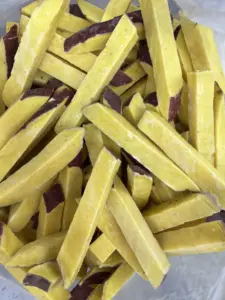
What should a pet treat or pet food maker specify when buying freeze-dried sweet potato?
Specify four things: the cut for your SKU, water activity ≤0.30, a microbiology line with Salmonella not detected in 25 g, and the nutrition data your pet label needs. Get those right and freeze-dried sweet potato drops into single-ingredient bites, meal toppers, freeze-dried raw blends and kibble coatings without a separate pet-only supply chain. It is the same food-grade freeze-dried yellow sweet potato that FruitBuys ships to cereal and snack brands: 100% yellow-fleshed sweet potato, nothing added, packed in foil with desiccant and shipped in a standard dry container. The cut decides your cost per kilogram; the spec decides whether your QA team releases the lot.
Chunks, dice, granules or powder: which cut fits which pet SKU?
Start from the product on your shelf and work back to the cut:
| Pet SKU | Cut to specify | Why it fits | Carton fill |
|---|---|---|---|
| Single-ingredient crunchy bites, training treats | Natural chunks 10–25 mm | Irregular pieces read as “real food”; no shape grading needed | toward 10 kg |
| Chip-style treats in a retail pouch | Slices 3–5 mm | The whole round is what the shopper sees | toward 7 kg |
| Meal toppers, freeze-dried raw blends | Dice 5–10 mm | Doses evenly with freeze-dried meat; 5–6 mm dice soften in 1–2 min in hot broth | toward 10 kg |
| Kibble inclusions, baked biscuits | Granules 1–4 mm | Spreads through dough and dry mixes | toward 10 kg |
| Kibble coatings, biscuit dough, binders | Powder 80–100 mesh | Carries colour and carbohydrate into the mix | by trial pack |
Chunks and dice also lower your landed cost. They pack toward 10 kg per carton against about 7 kg for slices, so sea freight per kilogram falls by about 30% and a 20 ft container carries up to 5,500 kg instead of 3,850 kg. Keep slices for the SKU where the shape is the product; buy chunks or dice for everything that gets mixed, broken or dosed. Powder has its own specification page: freeze-dried yellow sweet potato powder.
Why sweet potato works next to salmon, chicken or beef liver
Freeze-dried sweet potato gives a grain-free formula a carbohydrate with colour, fibre and a crisp bite, without grain, gluten or any of the common food allergens. It sits well beside freeze-dried salmon, chicken breast or beef liver in toppers and mixers: the golden pieces stand out against the meat, and the crunch matches freeze-dried meat cubes instead of turning soft and chewy like hot-air dried vegetables.
For dog products, the natural chestnut-like sweetness is a palatability lever: dogs respond to sweet taste, and sweet potato rounds out a liver or fish formula. Cats do not taste sweetness, so in cat products sweet potato earns its place as carbohydrate, fibre and texture, not as a flavour. Write your formula brief accordingly, and keep any “grain-free” positioning on your label to what the formula is, not to what it does for the animal.
Water activity, microbiology and heavy metals: the spec a pet QA team asks for
Pet food QA teams ask the same questions as human food QA, and in one respect they ask harder: Salmonella in pet food is a recall trigger in the US, because pet owners handle treats with bare hands. The FruitBuys lot COA covers what a pet QA team needs to release an ingredient:
| Parameter | Release limit |
|---|---|
| Moisture | ≤5.0% by contract, 3–4% at release |
| Water activity | ≤0.30 |
| Total plate count | ≤10⁴ CFU/g |
| Yeasts and moulds | ≤10² CFU/g |
| Coliforms | ≤10² CFU/g |
| E. coli | <10 CFU/g |
| Salmonella | Not detected in 25 g |
| Physical and sensory | Colour, odour, black spots, peel residue, foreign matter; metal detection on every carton |
Every container ships with this lot COA from an independent ISO/IEC 17025 accredited laboratory. Lead, arsenic and aflatoxin are covered by periodic baseline surveillance. For a pet SKU, add the panels your market and your retailer ask for: a heavy-metal panel (lead, cadmium, arsenic, mercury), a pesticide multi-residue screen and Listeria monocytogenes. These are booked with the laboratory before the container is stuffed, buyer-paid or shared by volume. How each limit is read, and the 48-hour receiving check, are set out in freeze-dried sweet potato moisture, water activity and COA.
What nutrition data does your new pet label need?
More than it used to. Under AAFCO’s pet food label modernisation, US pet food labels are moving from the old guaranteed analysis to a Pet Nutrition Facts box that shows calories, total carbohydrates (including fibre) and a serving, with states adopting it over a multi-year transition. A treat brand building that box needs real composition data for every ingredient, and sweet potato is usually the main carbohydrate.
Typical values per 100 g of freeze-dried yellow sweet potato:
| Nutrient | Per 100 g |
|---|---|
| Total carbohydrate (including fibre) | 85–89 g |
| Dietary fibre | 6–9 g |
| Sugars (naturally occurring; 0 g added) | 10–18 g |
| Protein | 3.5–6.0 g |
| Fat | 0.5 g |
| Moisture | 3–4% at release |
Typical values for 100% freeze-dried yellow sweet potato; values typically move within ±5–10% with season, origin and ripeness. Lot nutrition panel available for label artwork.
Two practical points for your formulator. Pet calories are calculated with modified Atwater factors, so the kcal figure on a pet label differs from the human-food figure for the same ingredient; ask for the proximate analysis (moisture, protein, fat, fibre, ash) on the lot nutrition panel and run your own calculation. And because sweet potato contributes most of the carbohydrate in many grain-free treats, a panel on your actual commercial lot is worth more than a textbook value when the label goes to print.
Food-grade lots, pet-food paperwork
The sweet potato for your pet SKU comes from the same lots, the same partner facility and the same release check as the product sold to cereal and snack brands. The facility works under HACCP, ISO 22000, BRC (qualified processing facility) and US FDA food facility registration. Every shipment carries the standard export dossier: Commercial Invoice, Packing List, Bill of Lading, the lot COA, C/O Form EUR.1 for EU and UK orders, and a phytosanitary certificate with every shipment, so your broker clears the container without chasing paperwork.
One line for your marketing team: a “human-grade” claim on a pet product depends on how the whole finished product is made, stored and labelled, not only on the ingredient. FruitBuys supplies the food-grade ingredient and the documents behind it; the claim on the finished pack is decided on your own production chain.
When a different texture fits better
Freeze-dried sweet potato is crisp and breaks under the teeth. If your SKU is a long-lasting chew that a dog has to pull and work at, a hot-air dried sweet potato chew is the better product; freeze-dried pieces will be eaten in seconds. Where freeze-dried earns its place is in crunchy bites, toppers, freeze-dried raw blends, kibble inclusions and powder. FruitBuys supplies freeze-dried only, so for a new treat line the quickest route is to run chunks, dice and powder side by side in your own pilot and build the spec from what works. How each cut behaves in human food is covered in freeze-dried sweet potato formats and applications.
A pre-shipment sample of 100–200 g comes in two sealed foil pouches with desiccant: one for your pilot and palatability work, one kept sealed for your lab. Trial orders start from 1–2 full export cartons, and private-label packs from 500 kg per SKU.
FAQ
Can freeze-dried sweet potato be used in dog treats?
Yes. Pet treat makers use natural chunks for single-ingredient crunchy bites, dice for toppers and freeze-dried raw blends, and powder for kibble coatings and biscuit dough. It is 100% sweet potato with nothing added.
Which cut costs the least for pet treats?
Natural chunks and dice. They pack toward 10 kg per carton against about 7 kg for slices, which lowers sea freight per kilogram by about 30%, and irregular pieces need no shape grading.
Is sweet potato powder suitable for pet food?
Yes, as a grain-free carbohydrate and binder in baked biscuits and kibble coatings. The powder is 100% sweet potato at 80–100 mesh, with no carrier.
What microbiology spec should a pet treat ingredient meet?
Water activity ≤0.30, total plate count ≤10⁴ CFU/g, yeasts and moulds ≤10² CFU/g, coliforms ≤10² CFU/g, E. coli <10 CFU/g and Salmonella not detected in 25 g, reported on a third-party lot COA.
What nutrition data do I need for the new pet label?
Calories, total carbohydrate including fibre, protein, fat and moisture for every ingredient. Order the lot nutrition panel with proximate analysis and calculate pet calories with modified Atwater factors.
Does sweet potato make treats more palatable for cats?
Not through sweetness: cats do not taste sweet. In cat products it adds carbohydrate, fibre and crunch.
Is freeze-dried sweet potato good for long-lasting chews?
No. It is crisp and breaks quickly. For a chew a dog has to work at, hot-air dried sweet potato fits better.



