What moisture, water activity and lot tests should freeze-dried sweet potato pass before it ships?
Write moisture ≤5.0% and water activity (Aw) ≤0.30 into the contract, and ask what moisture the supplier actually releases at. FruitBuys releases freeze-dried yellow sweet potato at 3–4% moisture, and every container carries a lot COA from an independent ISO/IEC 17025 accredited laboratory with two items many dried-fruit COAs leave out: coliforms and a physical and sensory check for black spots and peel. Sweet potato grows in soil, not on a branch, and a root crop deserves a root-crop COA. Get these lines right and a cereal inclusion or a cup-noodle dice arrives as crisp and clean as the sample your R&D team approved.
Which limits go in the contract, and which is the release target?
Put two columns in your specification: the ceiling your QA team accepts against, and the level FruitBuys releases at. The gap between them is the buffer that covers the sea leg, the port and your first weeks in storage.
| Parameter | Contract limit | FruitBuys release | What it protects |
|---|---|---|---|
| Moisture | ≤5.0% | 3–4% | You pay for sweet potato solids, not water |
| Water activity | ≤0.30 | Released with the 3–4% moisture buffer | Dice stay crisp and loose in the bag and in your mix |
| Total plate count | ≤10⁴ CFU/g | Every lot on the COA | Ready-to-eat use as snack, topping or inclusion |
| Yeasts and moulds | ≤10² CFU/g | Every lot on the COA | No mould growth in storage |
| Coliforms | ≤10² CFU/g | Every lot on the COA | Hygiene from washing and peeling through packing |
| E. coli | <10 CFU/g | Every lot on the COA | Ready-to-eat safety |
| Salmonella | Not detected in 25 g | Every lot on the COA | Zero tolerance: no lot leaves without a passing result |
Moisture tells you how much water is left in the piece. Water activity tells you how free that water is to move, and that decides crunch and whether anything can grow. Below Aw 0.30 nothing grows, which is why freeze-dried sweet potato needs no preservative and the ingredient line reads “sweet potato” and nothing else.
What does Aw ≤0.30 mean on a cereal or snack line?
It means the dice behave like the rest of your dry mix. Water always moves from the wetter ingredient to the drier one. A breakfast cereal flake or a granola cluster sits at a low water activity, and an inclusion held at ≤0.30 sits at the same level, so the flakes stay crisp and the sweet potato stays crisp next to them. A hot-air dried piece at a higher water activity does the opposite: it hands its water to the flakes around it, and three months into shelf life the whole bowl goes soft.
The same number is why the product ships in a standard dry container, no reefer, and why your warehouse needs no cold room. Sweet potato is still hygroscopic once the bag is open, so the protection is built in at packing: foil barrier bags of 1–5 kg, light vacuum and food-grade silica gel, no nitrogen. Once a bag is opened, press out the air, reseal it with the original desiccant and use it within 2–4 weeks for full crunch. In the unopened bag the product keeps 12 months at ≤25 °C and RH ≤60%, and 18–24 months in cool storage at ≤18 °C and RH ≤50%. Carton, container and storage choices are covered in dried sweet potato shelf life and packaging.
Why does a root crop add coliforms and a sensory check to the COA?
Because the risks of a root are different from the risks of a fruit picked from a tree. Sweet potatoes come out of the ground carrying soil, and the defects that matter to a buyer, black spots, weevil damage and specks of peel, are visible ones. A COA that only lists total plate count and pathogens says nothing about either.
So every FruitBuys container ships with a lot COA covering moisture, water activity, total plate count, yeasts and moulds, coliforms, E. coli and Salmonella, plus a physical and sensory release check: colour, odour, black spots, peel residue and foreign matter. Coliforms are the hygiene indicator for the washing, peeling and cutting steps; the sensory section records what your own QA team would look at first when they open a bag. Every carton also passes a metal detector before it is closed.
Baseline surveillance answers a different question: is this supplier in control over time? Lead, arsenic and aflatoxin reflect the growing area and the process rather than a single lot, so FruitBuys screens them on a periodic schedule with an independent laboratory, with reports available on request for your supplier approval file.
Which tests travel with every lot, and which do you add for your market?
| Test | How often | When to add it |
|---|---|---|
| Moisture, Aw, TPC, yeasts and moulds, coliforms, E. coli, Salmonella | Every container lot | Standard |
| Physical and sensory: colour, odour, black spots, peel, foreign matter | Every container lot | Standard |
| Lead, arsenic, aflatoxin | Periodic baseline surveillance | Standard supplier approval |
| Heavy metals incl. cadmium, per lot | Market panel | Baby and toddler food; EU contaminant limits for root vegetables |
| Pesticide multi-residue | Market panel | EU and UK programmes |
| Listeria monocytogenes | Market panel | Ready-to-eat programmes that require it |
| Acrylamide | Market panel | Snack and cereal brands preparing for EU limits |
| Nutrition panel | Market panel | Label artwork and front-of-pack claims |
Market panels are booked with the laboratory before the container is stuffed, so the results sit in your QA file before the vessel sails; plan 3–5 working days of lab time into the booking date. They are paid by the buyer or shared by volume, agreed in the contract.
For baby and toddler food, write the heavy-metal panel into the lot specification from the start. The US FDA action level for lead in processed food for children under two is 20 ppb for single-ingredient root vegetables and dry infant cereals, and your finished product will be held to it.
Test methods worth naming in the specification:
| Parameter | Method |
|---|---|
| Water activity | ISO 18787 |
| Total plate count | ISO 4833-1 |
| Yeasts and moulds | ISO 21527-2 |
| Coliforms | ISO 4832 |
| E. coli | ISO 16649-2 |
| Salmonella | ISO 6579-1 |
One request worth making of every supplier, including FruitBuys: ask for water activity as a measured number on the COA, not “pass”. That single figure tells your team more about how the lot will behave in your warehouse than anything else on the sheet.
Black spots, weevil damage, peel residue: what should QA look for?
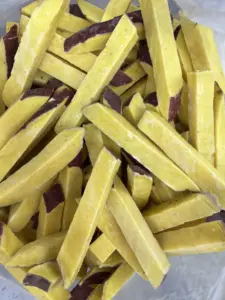
A good lot is even light yellow to golden, with a clean cut face and the smell of baked sweet potato when the bag opens. Most defects in sweet potato start before the dryer, and each one has a cause your QA team can name:
| What you see | What it means |
|---|---|
| Even light yellow to golden, sweet chestnut aroma | Ripe, well-handled roots, blanched promptly after cutting |
| Grey or brown cast across the piece | Cut pieces waited too long before blanching; enzymes browned the flesh |
| Brown core or dark ring inside the dice | Roots chilled below about 12 °C before processing (chilling injury) |
| Small black pits or tunnels, bitter taste | Weevil-damaged roots; the damage turns the whole root bitter |
| Thin dark specks on the edge of a slice | Peel residue from incomplete peeling |
| Brown edges, toasted smell | Excess heat in drying, or an aged lot |
FruitBuys deals with these at the start of the chain rather than at the sorting table: weevil-damaged roots are turned away whole at intake, roots are never chilled below about 12 °C, and cut pieces are rinsed and blanched at 85–90 °C for 2–3 minutes before freezing. How each step works, and why 3.8–4.3 kg of fresh roots go into every kilogram, is set out in how freeze-dried sweet potato is made.
Use colour in your specification as a match to the approved sample, and write numeric limits for black spots and peel residue per 200 g into the contract. A visual limit with a number on it is one your receiving team can enforce on the dock.
What should you check in the first 48 hours after unloading?
A lot released at 3–4% moisture in sealed foil should open at your dock as it left Vietnam. A short receiving routine within 48 hours of devanning lets your QA team confirm that and sign it into stock:
- Photograph the container interior and the cartons as found, before unloading further.
- Open two or three sealed bags from different rows; check snap, colour and aroma against the approved sample.
- Read water activity on a freshly opened bag within minutes: it should sit inside the 0.30 contract limit.
- In a 200 g portion, count pieces with black spots or peel residue against the contract limit.
- For instant-food programmes, pour 90 °C water over a portion of 5–6 mm dice: soft right through in 2–3 minutes.
- File the lot COA against the lot code on the carton.
If anything differs from the approved sample, tell FruitBuys within 14 days of devanning for packaging, appearance, breakage or water activity, or within 30 days for laboratory results. FruitBuys keeps a retained sample from every container lot for its full shelf life and tests it alongside yours, so the answer rests on the same lot and the same seal.
Set your specification with this table
| Your use | What to write into the spec |
|---|---|
| Breakfast cereal, granola, muesli | Dice 8–10 mm; Aw ≤0.30; full lot COA; black-spot limit per 200 g |
| Cup noodles, instant oatmeal, congee | Dice 5–6 mm; rehydration in 2–3 minutes at 85–95 °C as an acceptance check |
| Ready-to-eat crisp snack | Slices or sticks; snap test against the approved sample; peel-residue limit |
| Baby and toddler cereal (manufacturer) | Dice 5–6 mm or powder; heavy-metal panel per lot matched to market |
| Snack bars, pet treats | Natural chunks; same ready-to-eat limits; lower cost per kilogram |
| EU destination | Add pesticide multi-residue and cadmium to the pre-stuffing panel |
| Private label with a long printed date | Accelerated shelf-life study on your final pack, run by FruitBuys as a service |
Your QA team can approve FruitBuys before the sample lands with one document set: the specification, a container-lot COA template and the baseline surveillance reports. The full specification and RFQ fields are on the freeze-dried yellow sweet potato product page.
FAQ
What water activity should freeze-dried sweet potato have?
At or below 0.30 in the contract. FruitBuys releases at 3–4% moisture, so the product arrives with a buffer against humid air.
What is the difference between moisture and water activity?
Moisture is how much water is left in the product; water activity is how free that water is to move. Water activity decides crunch, caking and whether microorganisms can grow, so it is the number to read first.
Which tests come with each container?
A lot COA from an independent ISO/IEC 17025 accredited laboratory for moisture, water activity, total plate count, yeasts and moulds, coliforms, E. coli and Salmonella, plus a physical and sensory release check. Lead, arsenic and aflatoxin are covered by periodic baseline surveillance.
Why are coliforms on a sweet potato COA?
Sweet potato is a root grown in soil. Coliforms are the hygiene indicator for washing, peeling and cutting, so they belong on every lot COA for a root crop.
What causes black spots in dried sweet potato?
Mostly problems before drying: roots chilled below about 12 °C, weevil damage, or cut pieces left too long before blanching. Good intake control and prompt blanching prevent them.
Is freeze-dried sweet potato preserved or sulfited?
No. The ingredient is 100% sweet potato. The colour is kept by blanching, and at Aw ≤0.30 the product is shelf-stable without preservatives.
How is a question about a lot resolved?
Tell FruitBuys within 14 days of devanning for appearance, breakage or water activity, or within 30 days for laboratory results. FruitBuys tests the retained sample from your lot alongside yours.