
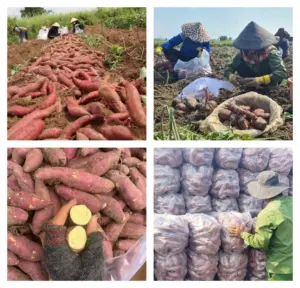
Where does Vietnam’s Japanese-type sweet potato come from, and why does it suit freeze-drying?
FruitBuys sources the Japanese-type sweet potato (red-purple skin, golden flesh) behind its freeze-dried yellow sweet potato from two Vietnamese regions, the Mekong Delta and the Central Highlands, and the tropical climate lets the crop be planted and harvested in every month of the year. That is the difference a procurement team feels first. In Japan the main crop comes in once a year, in autumn, and is stored until the next one. In Vietnam a root goes from planting to harvest in 3.5–4.5 months, and staggered planting across two regions keeps fresh roots arriving at the partner facility all year. Your container programme runs on scheduled call-offs from fresh harvests, not on roots that have spent months in storage.
Two regions, one calendar: where do the roots come from?
| Region | Provinces | What it brings to your supply |
|---|---|---|
| Mekong Delta | Vinh Long (including the Binh Tan sweet potato area), Dong Thap | Vietnam’s long-established sweet potato belt, on alluvial soil along the Mekong; large, steady volumes close to the export port |
| Central Highlands | Dak Lak, Gia Lai, Lam Dong | Upland red basalt soils, a second crop calendar and a hedge against flooding in the Delta |
The scale is real. As of 2023, the Binh Tan area of Vinh Long grew around 10,000 ha of sweet potato, producing roughly 300,000 tonnes a year, and Dak Lak another 10,000 ha, mostly Japanese-type yellow flesh. Nationally, Vietnam grew around 100,000 ha and 1.2–1.3 million tonnes. Two regions with different weather mean that a bad month in one rarely stops your supply.
Which months give the best roots, and what does that mean for your contract?
Every month gives roots; the dry months give the best ones. In both regions the dry season runs from about December to April, and roots that grow through it carry the highest dry matter and the sweetest flavour. Roots harvested through the rains are wetter.
| Harvest window | Roots | What it means for you |
|---|---|---|
| Dry season (about Dec–Apr) | Highest dry matter, sweetest | Fresh-to-dry ratio toward the low end of 3.8–4.3 kg per kg; the strongest baked-sweet-potato flavour |
| Rainy season (about May–Nov) | Wetter, slightly less sweet | Ratio toward the high end of the range, up to 4.8 kg for young, wet roots; same release spec |
The finished spec does not change with the season: moisture ≤5.0%, water activity ≤0.30, the same cuts and the same COA. What moves is how many kilograms of fresh roots stand behind each kilogram you buy, and with it the seasonal cost of raw material. If flavour intensity matters most to your product, place your largest orders for dry-season production. How the fresh-to-dry ratio is built, tonne by tonne, is explained in how freeze-dried yellow sweet potato is made.
Beni Haruka, Beniazuma, Kokei 14 and “honey sweet potato”: what do the names mean?
They are names from Japanese breeding and trade, and they tell you what kind of root to expect. Beni Haruka is known for a moist, very sweet flesh once cooked. Beniazuma and Kokei 14 are older lines with flakier, drier, chestnut-like flesh. In Vietnam all of these sit under one trade name, khoai lang Nhật (Japanese sweet potato), and the sweetest roots are sold as “honey sweet potato”.
For freeze-drying, the name on the root matters less than two things you can measure: dry matter and flesh colour. Drier roots give more product per tonne and a crisper piece; golden flesh gives the colour your customer sees. FruitBuys selects roots on those two qualities rather than promising a single cultivar name, which would tie your supply to one planting calendar. If your program needs a named cultivar on the label, raise it before contract, so supply can be checked against the season.
Murasaki and Okinawa are different roots
Two names often get mixed into Japanese sweet potato searches, and neither is this product:
- Murasaki has purple skin and white flesh. It looks like the Japanese type from outside but cuts white.
- Okinawa has pale skin and purple flesh. It is a purple sweet potato, sold for colour.
Freeze-dried yellow sweet potato is neither. It is also not a yam (a different plant family) and not the orange-flesh sweet potato common in US supermarkets, which is softer and wetter. If your brief calls for purple colour, ask for freeze-dried purple sweet potato, a separate product with its own specification.
What does FruitBuys check when the roots arrive?
The quality of the bag is decided at the intake door, before a single root is peeled:
| Check at intake | Why it matters to you |
|---|---|
| Root size | Even sizes peel and cut evenly, so dice are uniform |
| Dry matter | Sets the fresh-to-dry ratio and the crispness of the finished piece |
| Flesh colour | Golden flesh is the colour on your pack; pale or mixed roots go elsewhere |
| No weevil damage | A weevil-tunnelled root tastes bitter well beyond the visible damage, so the whole root is turned away |
| No chilling injury | Roots held below about 12 °C before processing develop a hard core and internal browning that show up as dark specks in the dice |
| No black spots | Spots carry through drying and show on light-coloured product |
Roots are processed fresh, not cold-stored. That is one reason Vietnamese supply works well for freeze-drying: with harvests every month, there is no need to hold roots in a cold store, where they risk chilling injury, between seasons.
Planting-area codes and export discipline
Vietnam began exporting fresh sweet potato to China in 2023 under recognised planting-area codes and approved packing houses, starting with 70 planting areas and 13 packing houses. That programme has brought growing records, pesticide-use logs and export paperwork into the sweet potato areas that supply it.
On the processing side, the partner facility works under HACCP, ISO 22000 and BRC (qualified processing facility), so every lot is traceable back to its intake of roots and forward to your container. Each container lot carries its own lot COA, a retained sample is held for the full shelf life (up to 24 months), and FruitBuys locks one qualified partner facility to your contract. A facility change needs written notice and a new pre-shipment sample approval before it happens.
Vietnam-grown or Japan-grown: what changes in the bag?
The root type is the same: red-purple skin, golden flesh, chestnut-like sweetness. What changes is the supply model. Japan harvests its main crop once a year and stores the roots; Vietnam harvests every month and processes them fresh. For an ingredient buyer that means steadier volumes, call-offs planned across twelve months and roots that reach the freeze-dryer at harvest quality.
When a Japan-grown source fits better. If your program needs “Product of Japan” or a Japanese prefecture on the front of the pack, the roots have to be grown there, and this is not that product. If you need Japanese-type yellow sweet potato with golden colour, natural sweetness and a twelve-month supply calendar, the Vietnamese source is built for it. The quickest way to decide is to put a FruitBuys sample next to the product you buy today.
A pre-shipment sample of 100–200 g comes in two sealed foil pouches with desiccant: one for tasting and rehydration, one sealed for your lab. Full specification, cuts and packing are on the freeze-dried yellow sweet potato page.
FAQ
Is Japanese sweet potato grown in Vietnam?
Yes. Vietnam grows Japanese-type sweet potato (red-purple skin, golden flesh) in the Mekong Delta (Vinh Long, Dong Thap) and the Central Highlands (Dak Lak, Gia Lai, Lam Dong). It is sold locally as khoai lang Nhật.
Is Vietnamese sweet potato available all year?
Yes. Roots are harvested 3.5–4.5 months after planting, and staggered planting across two regions brings fresh roots to harvest every month.
Which season gives the best sweet potato?
The dry season, about December to April. Dry-season roots carry the highest dry matter and the sweetest flavour.
What is the difference between Beni Haruka and Murasaki?
Beni Haruka has red-purple skin and golden, moist, very sweet flesh. Murasaki has purple skin and white flesh.
What is honey sweet potato?
A trade name in Vietnam for the sweetest Japanese-type yellow sweet potatoes, often from dry-season harvests.
Can I specify a cultivar such as Beni Haruka?
Raise it before contract. FruitBuys selects roots on dry matter and flesh colour rather than cultivar name, so a named-cultivar requirement is checked against the season first.
Is Vietnamese Japanese-type sweet potato the same as Japan-grown?
The root type is the same. Vietnam harvests every month and processes roots fresh; Japan harvests its main crop once a year and stores it.



