Freeze-Dried Soursop Nutrition Facts for Label Development
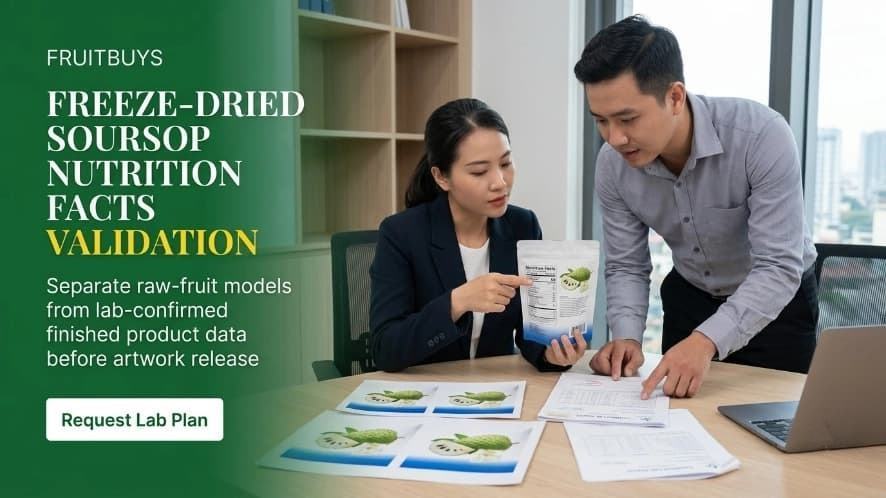
Freeze-dried soursop Nutrition Facts cannot be copied from raw fruit data, a supplier image or another dried fruit label. Importers, QA managers and private-label buyers need to separate three things: an R&D nutrition estimate, a finished-product laboratory report and a label-ready Nutrition Facts panel.
Raw soursop data helps build a preliminary model, but freeze-drying removes water, concentrates solids and exposes the final panel to variation from maturity, format, moisture, powder milling, carrier use and serving-size rules. A buyer should not approve retail artwork until the final recipe, serving format and laboratory plan are locked. FruitBuys Vietnam treats nutrition data as Documentation and Quality Control, not as a decorative marketing block. The buyer needs one product formula, one test basis and one label route.
Why Fresh-Fruit Nutrition Data Cannot Be Copied Directly
Raw soursop nutrition data can support R&D planning, but it cannot become the finished freeze-dried soursop label by itself.
Freeze-drying removes water and changes nutrient concentration per 100 g of finished product.
Buyers should use calculated values for early formulation and laboratory results for label approval.
USDA raw soursop data reports 81.16g water, 66 kcal, 16.84g carbohydrate, 3.3g dietary fiber, 13.54g sugars, 1.00g protein, 0.30g fat, 14 mg sodium and 278 mg potassium per 100 g edible portion. (Growables)

Those values describe raw edible soursop, not freeze-dried soursop. When water leaves the fruit, the solids become concentrated. A finished product with 3–5% moisture will show very different values per 100 g compared with raw pulp.
That does not mean the calculated number is wrong. It means the calculated number has a narrow function. It supports R&D, product planning and early buyer discussion. It does not replace a finished-product laboratory report. FruitBuys connects nutrition review to the full freeze-dried soursop B2B specification guide. The pillar guide gives the product path. This article owns nutrition-label logic.
Problems in Common Reference Nutrition Labels
Buyer-provided or market-sourced nutrition panels often look official but fail basic review. A label format can look clean while the numbers inside remain inconsistent.
One reference panel for freeze-dried soursop showed a 28 g serving with 90 kcal and 26.6 g total carbohydrate. That creates a problem. Carbohydrate alone, calculated by standard calorie factors, would already exceed the stated calorie value. The panel may contain an input error, serving-size mismatch, formula mismatch or copied data from another product.
A second reference panel showed values such as energy, fat, carbohydrate, fiber, sugars, protein, vitamin C and potassium, but the image did not clearly confirm serving size, product formula, process type, ingredient statement or whether the product was pure fruit, powder, snack or formulated blend.
The buyer should reject weak nutrition data when any of these gaps appear:
| Label Gap | Buyer Risk |
|---|---|
| Serving size unclear | Wrong panel basis |
| Calories inconsistent with macros | Calculation or data-entry error |
| Formula not declared | Added ingredient or carrier risk |
| Process unclear | Spray-dried and freeze-dried data may be mixed |
| Moisture unknown | Per-100 g concentration may be wrong |
| Vitamin value untested | Retention claim risk |
| Potassium value copied from raw fruit | Finished-product mismatch |
| Powder carrier not declared | Ingredient and nutrition error |
FruitBuys should not use these panels as label-ready evidence. They can support a discussion of what must be corrected.
R&D Nutrition Model vs Label-Ready Data
An R&D nutrition model estimates how raw soursop nutrients concentrate after drying.
A label-ready Nutrition Facts panel must match the final commercial product, serving size, formula and market requirement.
Buyers should decide early whether the data will support formulation, artwork or regulatory review.

For freeze-dried soursop, an R&D model can start with raw soursop nutrient data and normalize the solids to a finished product at approximately 4% moisture. This gives a working estimate for formulation and buyer discussion.
R&D Nutrition Model — Per 100 g Finished Product
| Nutrient | Estimated Amount | %DV Direction |
|---|---|---|
| Calories | 340 kcal | — |
| Total Fat | 1.5 g | 2% |
| Saturated Fat | 0.3 g | 2% |
| Trans Fat | 0 g | — |
| Cholesterol | 0 mg | 0% |
| Sodium | 70 mg | 3% |
| Potassium | 1,420 mg | 30% |
| Total Carbohydrate | 86 g | 31% |
| Dietary Fiber | 17 g | 61% |
| Total Sugars | 69 g | — |
| Includes Added Sugars | 0 g, if no sugar is added | 0% |
| Protein | 5 g | — |
This table is not label-ready. It assumes raw soursop data, a finished moisture near 4%, no added sugar, no carrier, no anti-caking agent and no formula change. It also does not validate vitamin or mineral values for a specific FruitBuys lot.
FDA states that the Nutrition Facts label must list total fat, saturated fat, trans fat, cholesterol, sodium, total carbohydrate, dietary fiber, total sugars, added sugars, protein and certain vitamins and minerals. (U.S. Food and Drug Administration) FDA also states that actual amount and % Daily Value must be declared for vitamin D, calcium, iron and potassium. (U.S. Food and Drug Administration)
That means a buyer should not use a simplified R&D model as final artwork. The final panel needs the correct nutrient list, serving size, rounding, %DV basis and market-specific label format.
Serving Size and Dried Fruit RACC
Serving size is not a design choice. It must follow the product category, market route and intended use. FDA RACC guidance lists 40 g as the reference amount for dried fruit, with label statements depending on whether the pieces are large or small. (U.S. Food and Drug Administration) This is why a 28 g panel from an unrelated product should not be copied into a U.S.-bound freeze-dried soursop label without review.
A buyer must answer:
| Product Route | Serving-Size Question |
|---|---|
| Retail snack pouch | Does dried fruit RACC apply? |
| Large half-moon slices | Should the label use piece count and grams? |
| Small cubes or crumble | Should the label use cup measure and grams? |
| Powder ingredient | Does the product require a different category review? |
| Multi-serving pouch | Does the package require single-column or dual-column format? |
| Foodservice pack | Is Nutrition Facts required on the same basis as retail? |
| Private-label SKU | Which country or retailer label rule applies? |
The buyer should connect serving-size review to freeze-dried soursop market readiness. A nutrition panel built for one market may not fit another.
How Moisture Changes Nutrition Values
Moisture controls concentration. A freeze-dried product at 3% moisture and a product at 5% moisture will not show identical per-100 g values, even when they start from the same fruit. A higher final moisture level leaves more water in the finished product and slightly dilutes the nutrients per 100 g.
This matters for freeze-dried soursop because the locked technical target is moisture 3–5% with Aw <0.30. Moisture and Aw serve different functions. Moisture affects concentration and weight basis. Aw affects available-water behavior and stability.
The buyer should not build Nutrition Facts while ignoring moisture. A nutrition model must state the assumed final moisture. A finished-product label should use laboratory data from the final commercial product. FruitBuys handles this through freeze-dried soursop moisture and water activity control. Nutrition review and QA release must use the same product condition.
Nutrients That Require Laboratory Confirmation
A lab-ready plan should reflect the final formula and label market. At minimum, buyers should confirm the nutrients that appear on the label and any nutrient used for a claim.
The required confirmation usually includes:
| Nutrient/Item | Why It Needs Confirmation |
|---|---|
| Calories | Must match lab basis or validated calculation method |
| Total fat | Required label nutrient |
| Saturated fat | Required label nutrient |
| Trans fat | Required label nutrient |
| Cholesterol | Required label nutrient |
| Sodium | Required label nutrient |
| Total carbohydrate | Required label nutrient |
| Dietary fiber | Required label nutrient |
| Total sugars | Required label nutrient |
| Added sugars | Required when sugar or sweetener is added |
| Protein | Required label nutrient |
| Vitamin D | Mandatory public-health nutrient on U.S. Nutrition Facts |
| Calcium | Mandatory public-health nutrient on U.S. Nutrition Facts |
| Iron | Mandatory public-health nutrient on U.S. Nutrition Facts |
| Potassium | Mandatory public-health nutrient on U.S. Nutrition Facts |
FDA’s current Nutrition Facts guidance identifies vitamin D, calcium, iron and potassium as nutrients where the actual amount and %DV must appear (U.S. Food and Drug Administration). For freeze-dried soursop, potassium may appear meaningful in an R&D model, but the final number still needs product-specific confirmation before the buyer prints the label.
Vitamin C needs even stronger caution. Raw soursop contains vitamin C, but processing, oxygen exposure, pre-freezing delay and storage can change vitamin C content. Do not claim vitamin C retention without a finished-product test. FruitBuys connects laboratory planning to freeze-dried soursop COA and laboratory testing. The COA article handles test scope and lot evidence. This article handles label logic.
Powder Nutrition Requires Extra Formula Control
Powder is the format most likely to create nutrition-label mistakes. A buyer may ask for “soursop powder” but fail to specify whether it is pure freeze-dried powder, spray-dried powder, powder with carrier, powder with anti-caking agent or a custom blend.

Each route changes the label:
| Powder Route | Nutrition/Label Risk |
|---|---|
| Pure freeze-dried powder | Nutrients concentrate from fruit solids |
| Spray-dried powder with carrier | Carbohydrate and ingredient declaration change |
| Powder with anti-caking agent | Ingredient list and label review change |
| Powder with added sugar | Added sugars and calorie values change |
| Fruit blend powder | Identity and nutrient values change |
| Beverage premix | Serving size and formula basis change |
A powder cannot carry a “100% fruit” implication if the formula includes carrier or other added ingredients. The buyer must confirm the formula before approving Nutrition Facts. Use freeze-dried vs spray-dried soursop powder to separate technology choice from nutrition-panel approval. Use freeze-dried soursop formats and size selection to define whether the product is pieces, crumble or powder.
Claims That Depend on Nutrition Data
Nutrition data does not automatically authorize a marketing claim.
A nutrient claim needs finished-product evidence, correct serving size and destination-market review.
Buyers should approve claims after the lab report, formula and label market are confirmed.
A freeze-dried soursop label may be able to support simple product statements such as “no added sugar” only when the formula and lab/ingredient record support the statement. It should not make disease, treatment, detox, immunity or cancer-related claims.

Nutrition-related claims that need extra review include:
| Claim Type | Proof Needed |
|---|---|
| No added sugar | Formula, ingredient declaration and added-sugar review |
| Source of fiber | Finished-product fiber value per serving and market rule |
| High fiber | Finished-product fiber value per serving and market rule |
| Potassium claim | Lab-confirmed potassium per serving |
| Vitamin C claim | Lab-confirmed vitamin C after processing and storage |
| No preservatives | Formula and processing-aid review |
| 100% fruit | Formula, carrier and ingredient statement review |
| Retains nutrients | Product-specific validation, not a generic freeze-drying claim |
FruitBuys separates marketing risk in soursop marketing claims food brands must avoid. The buyer should move nutrition data into claim review only after laboratory values are available.
Application Mapping

| Buyer Type | Application | Required Format | Proof Needed | FruitBuys Delivery |
|---|---|---|---|---|
| Private-label snack brand | Retail freeze-dried soursop pouch | Half-moon slices or chunks | Final recipe, serving size, lab nutrition panel | OEM/Private Label Delivery and Documentation |
| Importer | Bulk dried fruit distribution | Cubes, chunks or powder | Product specification, COA scope, nutrition basis | Documentation and Quality Control |
| QA manager | Label approval | Final commercial format | Lab report, method, serving basis, ingredient statement | Quality Control |
| Beverage developer | Powder drink system | Powder | Formula, carrier status, mesh, serving size, lab values | OEM/Private Label Delivery |
| Cereal manufacturer | Fruit inclusion | Cubes or crumble | Nutrition contribution, moisture, Aw, ingredient declaration | Quality Control |
| Regulatory reviewer | Destination-market label file | Final SKU | RACC/category review, mandatory nutrient values, claims file | Documentation |
| R&D developer | Trial formulation | Buyer-defined format | R&D nutrition model and application trial notes | MOQ Flexibility/Market Trial Support |
Highest-Risk Decision: Printing a Label from Calculated Data
The highest-risk shortcut is printing Nutrition Facts from a calculated model or sample image.
A calculated panel can support R&D, but it cannot prove the final commercial product, recipe, serving size or market label format.
Buyers should approve artwork only after the final lab plan and label route are confirmed.
This shortcut usually happens late in private-label development. The product looks approved. The pouch design is ready. The buyer asks for a quick Nutrition Facts panel. A supplier copies values from raw fruit, another brand or a preliminary model.
That decision creates avoidable risk. If the lab result later differs, the artwork must change. If the product contains carrier, the ingredient list must change. If the serving size is wrong, the entire label panel can become wrong. If a claim depends on a nutrient value, the claim may need removal.

FruitBuys prevents this by connecting nutrition data to OEM/Private Label Delivery. The formula, format, moisture, serving size, lab plan, label market and artwork input must move together. The buyer should structure that request through freeze-dried soursop OEM and private-label workflow and freeze-dried soursop RFQ checklist.
Why FruitBuys Delivers This
FruitBuys Vietnam supplies export-ready freeze-dried soursop through an integrated product supply model. The buyer receives one configured product, one approved specification and one accountable supplier relationship.
Documentation connects product identity, ingredient statement, lab report, serving size, Nutrition Facts, claims review and market file. FruitBuys does not treat nutrition data as a copy-paste field.
Quality Control aligns nutrition review with moisture, Aw, format and lot evidence. A calculated model must not override the finished-product condition.
OEM/Private Label Delivery protects artwork accuracy. FruitBuys aligns formula, pack size, serving basis, mandatory nutrients, claims and buyer approval before label release.
MOQ Flexibility/Market Trial Support allows buyers to test format and application route before investing in final packaging. That trial can use an R&D estimate, but commercial artwork needs finished-product evidence.
Buyer Checklist

Before approving freeze-dried soursop Nutrition Facts, request:
- Final product format
- Final recipe
- Ingredient statement
- Confirmation of no added sugar if claimed
- Confirmation of carrier or anti-caking agent for powder
- Final moisture target
- Aw target
- Serving-size basis
- Destination market
- Retail, bulk or foodservice label route
- Laboratory test plan
- Calories
- Macronutrients
- Sugars and added sugars
- Dietary fiber
- Sodium
- Vitamin D, calcium, iron and potassium where required
- Claim review file
- Artwork approval gate
- Retained sample
- Change-control rule for recipe, format, pack size or market
Do not release artwork until the Nutrition Facts panel matches the final product.
Summary
Freeze-dried soursop Nutrition Facts should separate R&D estimates from label-ready data. USDA raw soursop values can support a preliminary model, but freeze-drying concentrates nutrients by removing water.
A 100 g R&D estimate can be built from raw fruit data and final moisture assumptions, but commercial labels need finished-product laboratory confirmation. Serving size, formula, powder carrier status, added sugar, mandatory nutrients and destination-market rules affect the final panel. FruitBuys Vietnam supports nutrition-label development through Documentation, Quality Control and OEM/private label delivery.
FAQ
Can raw soursop nutrition data be used for freeze-dried soursop labels?
No. Raw data can support R&D estimates, but finished freeze-dried product needs laboratory confirmation before label approval.
What is the estimated Nutrition Facts profile per 100 g?
An R&D model at about 4% moisture estimates around 340 kcal, 86 g carbohydrate, 17 g fiber, 69 g sugars, 5 g protein, 1.5 g fat and 1,420 mg potassium per 100 g. It is not label-ready.
What serving size should dried fruit use in the U.S.?
FDA RACC guidance lists 40 g for dried fruit. The final serving statement depends on product form, package type and label route.
Does freeze-dried soursop have added sugar?
Only if sugar is added. For a 100% pulp product, added sugars can be 0 g, but the formula and ingredient record must support that statement.
Does soursop powder need a different label review?
Yes. Powder may include carrier, anti-caking agent or other ingredients. Those change Nutrition Facts, ingredient declaration and claims.
Can FruitBuys claim vitamin C retention?
Not without finished-product testing. Vitamin C can change during preparation, drying, oxygen exposure and storage.
What should buyers request first?
Request laboratory planning after confirming the final recipe, serving format and destination label requirements.
Conclusion
Request laboratory planning after confirming the final freeze-dried soursop recipe, serving format and destination label requirements.
References
- U.S. Department of Agriculture, Agricultural Research Service. FoodData Central. Current USDA food-composition database. (FoodData Central)
- USDA National Nutrient Database for Standard Reference. “Full Report: 09315, Soursop, raw.” USDA legacy nutrient report mirrored from SR data. (Growables)
- U.S. Food and Drug Administration. “Guidance for Industry: Reference Amounts Customarily Consumed.” FDA guidance listing dried fruit RACC at 40 g. (U.S. Food and Drug Administration)
- Electronic Code of Federal Regulations. “21 CFR § 101.12 — Reference amounts customarily consumed per eating occasion.” (Viện Thông Tin Pháp Luật)
- U.S. Food and Drug Administration. “Daily Value on the Nutrition and Supplement Facts Labels.” Current FDA Nutrition Facts guidance. (U.S. Food and Drug Administration)
- U.S. Food and Drug Administration. “Changes to the Nutrition Facts Label.” Current FDA Nutrition Facts guidance. (U.S. Food and Drug Administration)
- Electronic Code of Federal Regulations. “21 CFR § 101.9 — Nutrition labeling of food.” (Viện Thông Tin Pháp Luật)