
Freeze-Dried Soursop COA, Microbiology and Laboratory Testing
Freeze-dried soursop buyers should never release a bulk lot because a supplier sends a clean-looking COA. A COA only matters when it matches the product, lot, format, test scope, method, date, specification and destination requirement. Importers, QA managers and private-label buyers face a real risk when they accept a historical lab report, certificate logo or sample COA as proof for a new production lot.
A buyer must review the QA file behind the exact freeze-dried soursop lot before approving bulk release. FruitBuys Vietnam connects COA, laboratory testing, process records, retained samples, packaging files and export documents under one accountable product route. The buyer needs evidence that follows the product from approved sample to finished lot.
What a Lot-Specific COA Must Contain
A freeze-dried soursop COA must identify the exact product, lot, test scope, method, result and release specification.
A COA that does not match the current lot cannot support bulk approval.
Buyers should request the COA together with the laboratory report and retained-sample file.
A COA summarizes release evidence. It does not replace the full QA file. A strong COA helps the buyer confirm that the supplied product matches the approved specification, but only when the document connects to the exact finished lot.
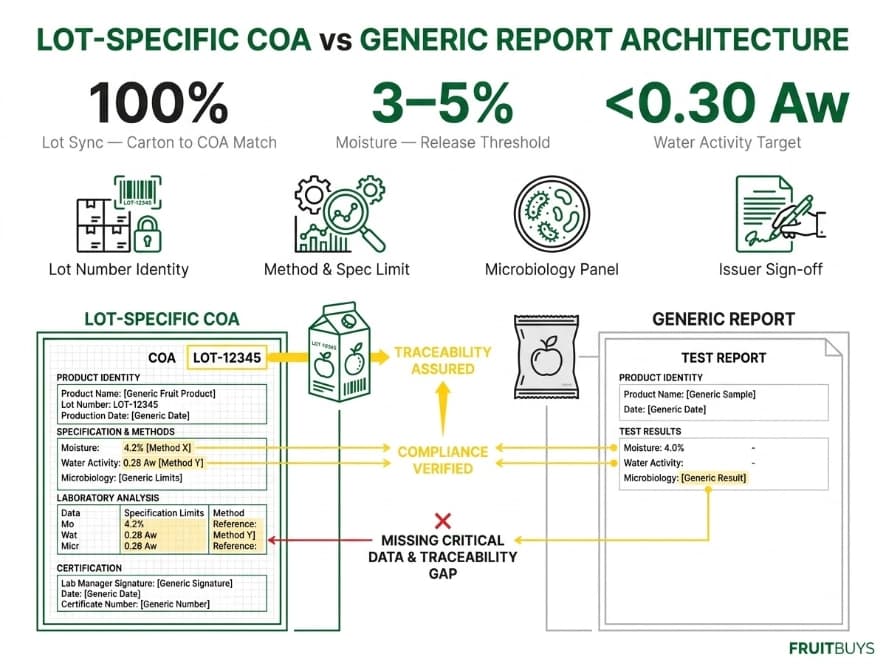
A practical COA for freeze-dried soursop should include:
| COA Field | Buyer Review Point |
|---|---|
| Product name | Freeze-dried soursop, not a generic fruit item |
| Botanical identity | Annona muricata L. where required |
| Product format | Slice, cube, chunk, crumble or powder |
| Lot number | Must match packing and shipment records |
| Production date | Confirms production-lot identity |
| Sample date | Confirms when the test sample was taken |
| Test item | Moisture, Aw, microbiology, contaminants or agreed test |
| Method | Shows how the test was performed |
| Specification | Shows the approved limit or target |
| Result | Shows the measured value or status |
| Unit | Confirms the reporting basis |
| Laboratory or issuer | Identifies who issued the result |
| Release status | Confirms whether the lot can move forward |
FruitBuys connects COA review to the full freeze-dried soursop B2B specification guide. The pillar guide explains the full product route. This article owns the QA-file and laboratory-testing decision.
COA vs Laboratory Report
A COA and a laboratory report serve different functions. Buyers weaken their approval process when they treat them as interchangeable.
| Document | Function | Buyer Risk if Misused |
|---|---|---|
| COA | Summarizes lot release against specification | May hide method, sample size or reporting detail |
| Laboratory report | Shows test method, result, sample identity and reporting basis | May not show commercial release decision |
| Specification | Defines what the lot must meet | Useless if not linked to test results |
| Retained sample record | Supports sample-to-bulk comparison | Cannot replace lab testing |
| Packing record | Links product to final pack and lot code | Cannot prove microbiology or contaminants |
The buyer should ask one direct question:
Does this COA prove the current freeze-dried soursop lot, or only a previous sample?If the answer is unclear, the lot should not move to approval. FruitBuys handles this through Documentation and Quality Control. The buyer receives a reviewable file behind the supplied product, not disconnected claims from different documents.
Physical and Technical Tests
Physical and technical tests confirm whether the lot matches the approved freeze-dried soursop specification.
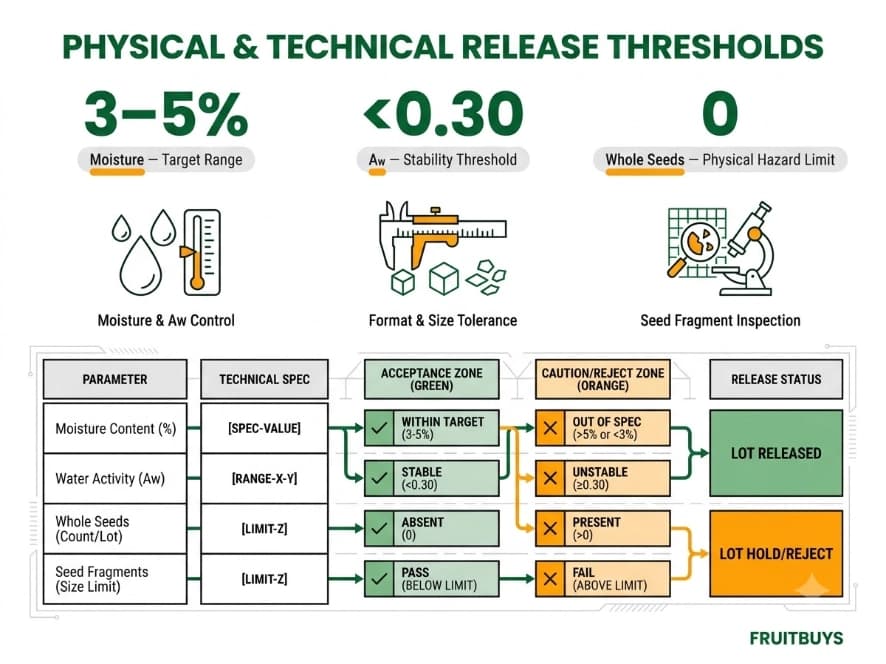
Moisture and Aw must appear as separate release controls because they do not measure the same condition.
Buyers should review these values before accepting texture, shelf-life or packaging claims.
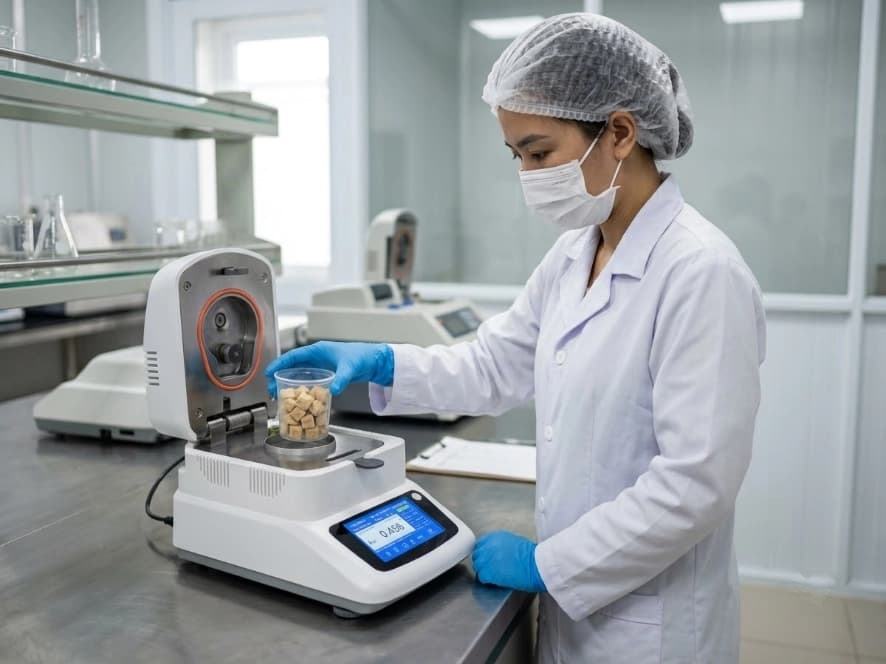
The working technical targets for freeze-dried soursop are:
| Parameter | Working Target |
|---|---|
| Moisture | 3–5% |
| Water activity | Aw <0.30 |
| Texture | Light, porous and crisp |
| Format | Buyer-approved shape and size |
| Defects | Buyer-defined limits |
| Packaging | Final pack matched to shelf-life plan |
FDA’s water activity guidance defines Aw as a distinct measure related to available water, not just total moisture. That makes Aw a separate release item for freeze-dried soursop, especially when the buyer needs crisp texture and storage stability. (U.S. Food and Drug Administration)
Physical testing should also reflect format. A powder lot needs mesh, caking observation and particle behavior review. A cube or chunk lot needs size tolerance, fines and breakage review. A slice lot needs visual and edge-breakage review.
Buyers should connect this section to freeze-dried soursop moisture and water activity control, freeze-dried soursop formats and size selection and common freeze-dried soursop defects and release controls.
Microbiological Testing
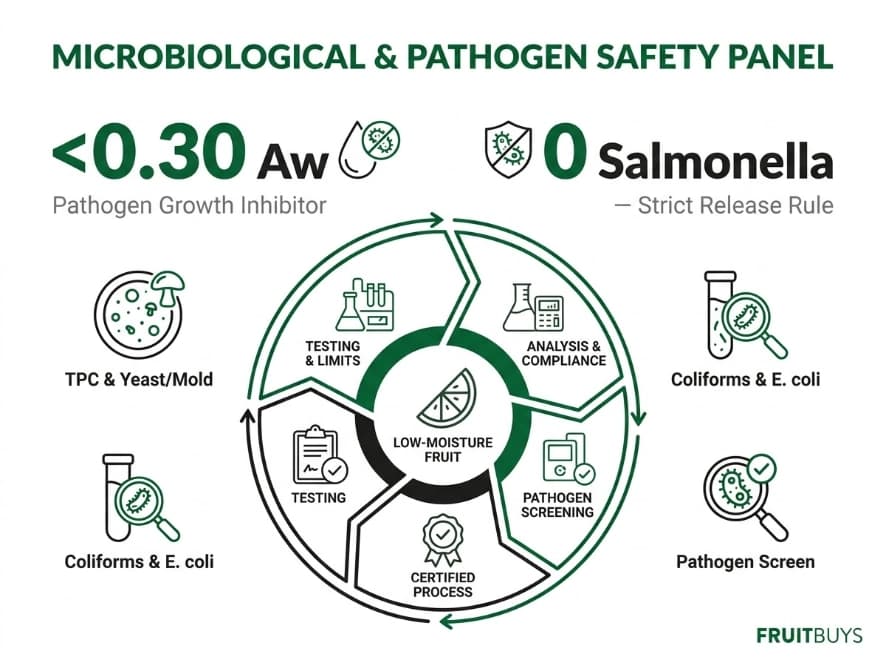
Microbiological testing must match product risk, destination requirement, buyer specification and use case. Freeze-dried soursop has low moisture and low Aw, but low Aw does not make the product sterile.
Codex low-moisture food guidance states that pathogens such as Salmonella cannot multiply in low-moisture foods, but cells may remain viable for extended periods. That distinction matters: low Aw supports stability, but it does not remove the need for hygiene controls, microbiology review and lot-linked documentation. (FAOHome)
A buyer may require a microbiological panel such as:
| Test Area | Buyer Review Point |
|---|---|
| Total aerobic count | General hygiene indicator |
| Yeast and mold | Storage and moisture-risk indicator |
| Coliforms | Process hygiene indicator |
| E. coli | Hygiene and contamination indicator |
| Staphylococcus aureus | Handling and hygiene indicator where relevant |
| Bacillus cereus | Buyer-defined risk review where relevant |
| Salmonella | Pathogen review under defined method and sample basis |
This table is not a universal legal limit. It is a buyer-review structure. Each buyer must define method, unit, sample basis and acceptance criteria.
FruitBuys links microbiology to the supplied product route. Testing should connect to raw-material handling, process flow, post-drying exposure and packaging. The buyer should review freeze-dried soursop process control and freeze-dried soursop packaging and shelf-life control before treating microbiology as a document-only task.
Pesticide Residue Testing
Pesticide testing must follow the destination market and buyer specification. A generic “pesticide passed” statement does not protect the importer if the test panel does not match the destination route.
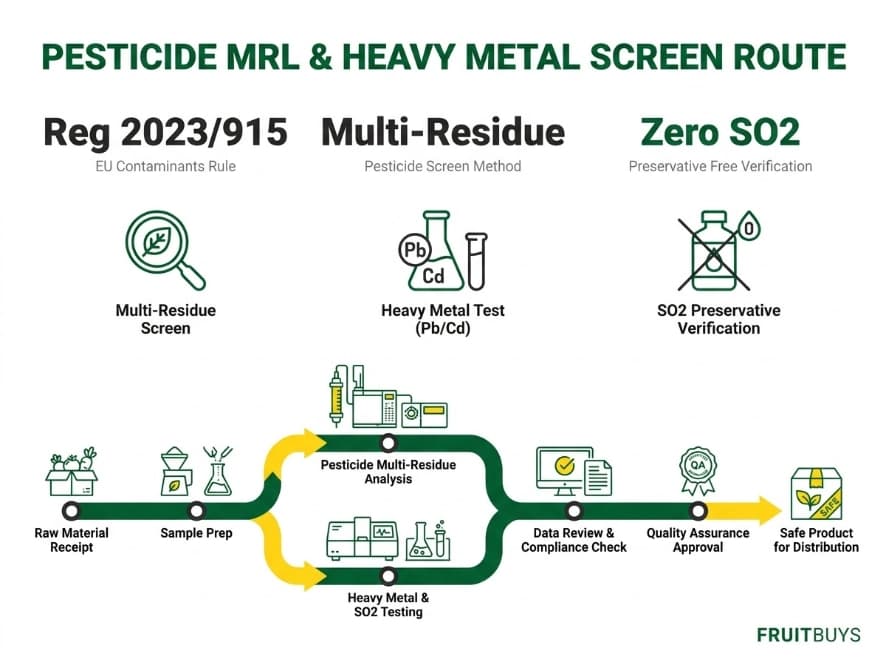
The European Commission states that the EU Pesticides Database allows users to search active substances, Maximum Residue Levels and emergency authorisations, while official information for active substances and pesticide residues appears in the Official Journal of the European Union. (Food Safety)
A pesticide report should show:
| Report Item | Buyer Review Point |
|---|---|
| Product identity | Freeze-dried soursop or relevant raw material |
| Sample identity | Must match lot or approved testing plan |
| Test panel | Active substances covered |
| Method | Multi-residue method and scope |
| LOQ/reporting limit | Shows sensitivity |
| Result | Detected, not detected or quantified value |
| Destination relevance | Matches buyer market review |
| Laboratory identity | Shows report source |
| Date | Confirms timing relevance |
FruitBuys should not treat one pesticide report as permanent proof for all future lots. Raw-material origin, season, grower route and destination requirements can change the required panel. This connects directly to Vietnam soursop origin and maturity control and freeze-dried soursop market readiness.
Heavy Metals and Contaminants
Heavy-metal and contaminant testing should also follow destination requirements and product use. Buyers should define which contaminants matter for the product, market and customer file before release.
The European Commission states that maximum levels for certain contaminants in food are set under Commission Regulation (EU) 2023/915, and EUR-Lex provides the current consolidated regulatory text. (Food Safety)
A contaminant testing plan may include:
| Test Area | Buyer Review Point |
|---|---|
| Lead | Destination-specific contaminant review |
| Cadmium | Destination-specific contaminant review |
| Arsenic | Product and market risk review |
| Mercury | Buyer-defined contaminant scope |
| Mycotoxins | Risk-based review where relevant |
| Sulfur dioxide | Required when process or cross-contact risk exists |
| Preservatives | Required if “no preservatives” or clean-label claim is used |
| Added sugar verification | Required if the label or claim needs proof |
Do not turn a general regulation into a product-specific claim. The regulation defines a legal framework. A FruitBuys lot still needs product-specific testing when the buyer or destination route requires it.
Seed, Foreign Matter and Physical Hazards
Not every release risk appears on a COA. Seed fragments, peel residue, core fiber, plastic, metal or other foreign matter may need process records and physical inspection files rather than a standard chemistry report.
FDA’s hard or sharp foreign-object guidance states that such objects in food can create injury concern and that review depends on product use, object characteristics and mitigating controls. (U.S. Food and Drug Administration)
For freeze-dried soursop, the physical-hazard file should include:
- Seed-removal process flow
- Whole-seed and seed-fragment definition
- Foreign-material inspection point
- Finished-product inspection record
- Equipment or detection method where verified
- Corrective-action record
- Retained sample
- Lot disposition
FruitBuys separates this issue in soursop seed-removal and foreign-material control. Buyers should not expect a standard COA to prove every physical-defect issue unless the COA or attached QA file includes that inspection scope.
COA Review for U.S., EU and UAE Readiness
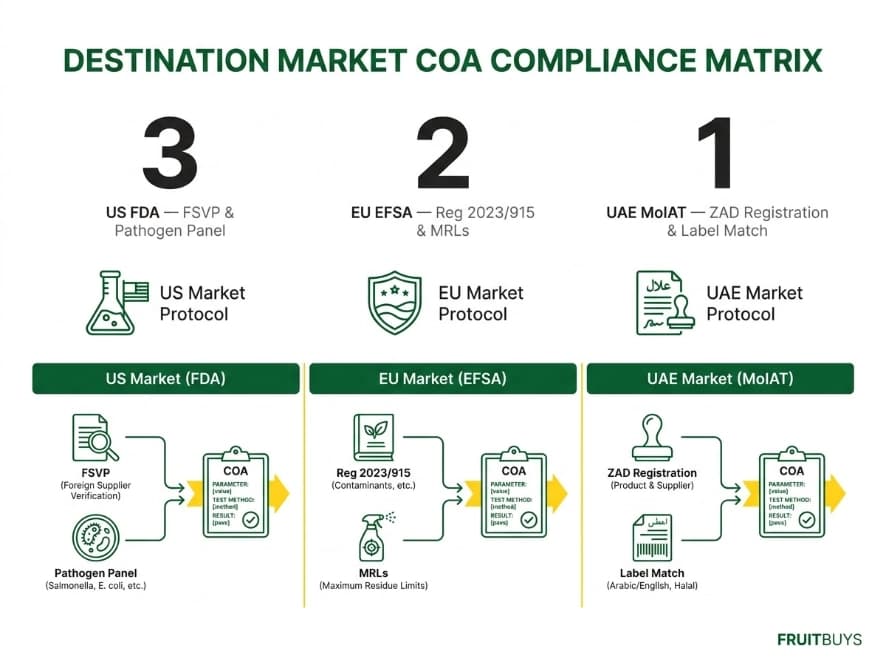
A COA must fit the destination review path. A document set for one buyer or market may not satisfy another buyer’s internal QA file. For U.S. import routes, FDA FSVP guidance states that importers of food for humans and animals must establish and follow a foreign supplier verification program to help ensure imported food meets applicable U.S. requirements and is not adulterated or, for human food, misbranded with respect to allergen labeling unless an exemption applies (U.S. Food and Drug Administration).
For EU routes, buyers should review pesticide MRLs, contaminant rules, ingredient status, labeling route and importer requirements. For UAE routes, buyers should align label review, product registration route where applicable, shelf-life file, Halal scope where required and importer-specific document requests.
FruitBuys connects market review to Documentation and Export Logistics Coordination. The buyer should not wait until pre-shipment review to discover that the testing panel, label route or certificate scope does not match the destination. Use freeze-dried soursop market readiness to define the destination-specific document path before bulk release.
How Buyers Should Review the QA File
A strong QA file connects specification, process, COA, laboratory report, retained sample, packaging file and lot identity.
The buyer should reject unmatched documents because they do not prove the supplied lot.
Review the QA file before final sample approval, not after packing.

Use this review sequence:
| Review Step | Buyer Question |
|---|---|
| Product identity | Does the document match freeze-dried soursop? |
| Format | Does it match slice, cube, chunk, crumble or powder? |
| Lot number | Does it match the packing and release file? |
| Date | Does the test apply to the current lot? |
| Method | Does the method match buyer requirement? |
| Specification | Does the test compare against the approved limit? |
| Result | Does the result pass the stated specification? |
| Scope | Does the panel cover buyer and destination needs? |
| Laboratory | Is the report source identified? |
| Retained sample | Can the lot be compared if a dispute occurs? |
| Packaging | Does the package protect the released condition? |
| Change control | Would a process or origin change trigger reapproval? |
The review path should connect to freeze-dried soursop sample-to-bulk approval. A sample that has no QA-file path cannot approve a commercial lot.
Application Mapping
| Buyer Type | Application | Required Format | Proof Needed | FruitBuys Delivery |
|---|---|---|---|---|
| Importer | Bulk ingredient distribution | Cubes, chunks or powder | Lot-specific COA, pesticide panel, contaminant scope | Documentation and Quality Control |
| QA manager | Supplier approval | Buyer-defined format | Method, sample identity, specification, result and lot match | Quality Control |
| Private-label snack brand | Retail freeze-dried soursop | Half-moon slices or chunks | COA, microbiology, packaging file, retained sample | OEM/Private Label Delivery |
| Cereal manufacturer | Fruit inclusion | Cubes or crumble | Aw, moisture, microbiology, size and fines review | Quality Control |
| Beverage developer | Powder system | Powder | Mesh, caking review, microbiology, contaminants, ingredient status | Documentation and Market Trial Support |
| Regulatory reviewer | Destination-market approval | Final commercial format | Market-specific test panel and label-support documents | Documentation |
| Procurement manager | Bulk release | Final approved format | COA, lab report, retained sample, change-control file | Quality Control and Export Logistics Coordination |
Highest-Risk Decision: Using an Unmatched COA
The highest-risk shortcut is using a COA that does not match the current freeze-dried soursop lot.
An unmatched COA cannot prove moisture, Aw, microbiology, pesticide, contaminant or physical-defect status for the supplied product.
Buyers should require lot-linked documents before approving release.
This mistake often happens when the buyer receives a sample COA, a generic certificate or a lab report from another production date. The file looks technical, so the buyer moves forward. Later, the bulk lot shows different moisture, higher fines, weaker packaging, clumping, label questions or missing destination data.
A COA must answer five questions:
- What exact product was tested?
- Which lot does it cover?
- Which method produced the result?
- Which specification does the result meet?
- Which destination or buyer requirement does the file support?
If the COA cannot answer those questions, it does not support release.
Why FruitBuys Delivers This
FruitBuys Vietnam supplies export-ready freeze-dried soursop through an integrated product supply model. The buyer receives one configured product, one approved specification and one accountable supplier relationship.
Quality Control defines the release criteria for moisture, Aw, microbiology, physical defects and buyer-approved test scope. FruitBuys does not treat testing as a generic attachment. It must match the exact product and lot.
Documentation connects the product specification, COA, laboratory report, retained sample, packaging file, certificate scope and shipment records. The buyer can review the evidence behind the supplied product.
Raw Material Sourcing Governance reduces risk before testing starts. Origin route, maturity, raw-material intake and seed-removal control influence the finished lot and the testing plan.
OEM/Private Label Delivery connects QA evidence to label, artwork, pack type and market route. A private-label product needs a document file that supports the actual SKU.
Export Logistics Coordination aligns the QA release with packing, lot coding and document handover so the buyer reviews the right file before the product moves.
Buyer Checklist
Before approving freeze-dried soursop, request:
- Product specification
- Ingredient statement
- Botanical identity where required
- Approved product format
- Lot number
- COA for the current lot
- Laboratory report where required
- Moisture result
- Aw result
- Microbiology panel
- Pesticide panel by destination
- Heavy-metal and contaminant scope
- Foreign-material inspection record
- Seed-removal record
- Packaging specification
- Retained sample
- Certificate scope where applicable
- Label-support file where applicable
- Change-control rule for origin, process, format, packaging or market route
Do not approve the lot if the documents do not match the product, lot and destination.
Summary
A freeze-dried soursop COA must match the exact product, format, lot, test scope, method, result and release specification. Moisture and Aw require separate review because Aw controls available-water behavior. Low Aw does not make freeze-dried soursop sterile, so microbiology and hygiene controls still matter.
Buyers should also review pesticide residues, contaminants, seed-removal records, foreign-material control, packaging files and destination-specific documents. FruitBuys Vietnam supplies lot-linked QA documentation through Quality Control and Documentation.
FAQ
What should a freeze-dried soursop COA include?
It should include product name, format, lot number, production date, test date, method, specification, result, unit, issuer and release status.
Is a sample COA enough for bulk release?
No. A sample COA only supports the sample. Bulk release needs documents linked to the current production lot.
Does low Aw replace microbiology testing?
No. Low Aw can stop microbial growth, but some microorganisms may survive. Buyers still need hygiene controls, microbiology review and lot documentation.
Which tests matter most?
Moisture, Aw, microbiology, pesticides, heavy metals, foreign-material control and buyer-defined destination tests matter most for release review.
Can one pesticide report cover every shipment?
No. The report must match the required panel, origin route, destination market, product status and buyer specification.
Does COA prove seed fragments are absent?
Only if the COA or attached QA file includes physical inspection scope. Otherwise, buyers need seed-removal and foreign-material inspection records.
What should buyers request first?
Request a QA-file review after defining product format, destination market, test scope and lot-release criteria.
Conclusion
Request a QA-file review after defining the freeze-dried soursop format, destination market, microbiology panel, contaminant scope and lot-release criteria.
References
- U.S. Food and Drug Administration. “Water Activity (aw) in Foods.” FDA Inspection Technical Guide. FDA page.
- Codex Alimentarius Commission. “Code of Hygienic Practice for Low-Moisture Foods, CXC 75-2015.” Adopted 2015. Codex PDF.
- U.S. Food and Drug Administration. “Guidance for Industry: Foreign Supplier Verification Programs for Importers of Food for Humans and Animals.” Current FDA guidance page. FDA page.
- European Commission. “EU Pesticides Database.” Current European Commission food-safety page. European Commission page.
- European Commission. “Legislation on contaminants.” Current European Commission food-safety page. European Commission page.
- EUR-Lex. “Commission Regulation (EU) 2023/915 of 25 April 2023 on maximum levels for certain contaminants in food.” Consolidated text. EUR-Lex text.
- U.S. Food and Drug Administration. “CPG Sec. 555.425 Foods, Adulteration Involving Hard or Sharp Foreign Objects.” Revised 2005. FDA page.