Freeze-Dried Soursop
Freeze-dried soursop looks simple when the buyer sees a crisp sample, a tropical fruit name and a clean product photo. The commercial risk starts after that first sample: conversion basis, maturity control, seed removal, moisture, Aw, defect limits, powder behavior, COA scope, packaging, Nutrition Facts, claims, HS code and destination documentation all decide whether the product can move from interest to approved supply. Importers, food manufacturers and private-label buyers should not approve freeze-dried soursop as a generic dried fruit.
The buyer needs one locked product specification, one retained sample, one lot-release file and one accountable supply route. FruitBuys Vietnam supplies export-ready freeze-dried soursop through an Integrated Product Supply Model covering raw-material sourcing governance, qualified production partners, QC, packaging, documentation and export logistics coordination.
What FruitBuys Supplies
FruitBuys supplies buyer-defined freeze-dried soursop under one locked specification and one accountable product route.
The product is configured by format, moisture, Aw, seed-removal standard, packaging, COA scope and destination-market requirements.
Buyers should define the application before requesting a commercial sample.
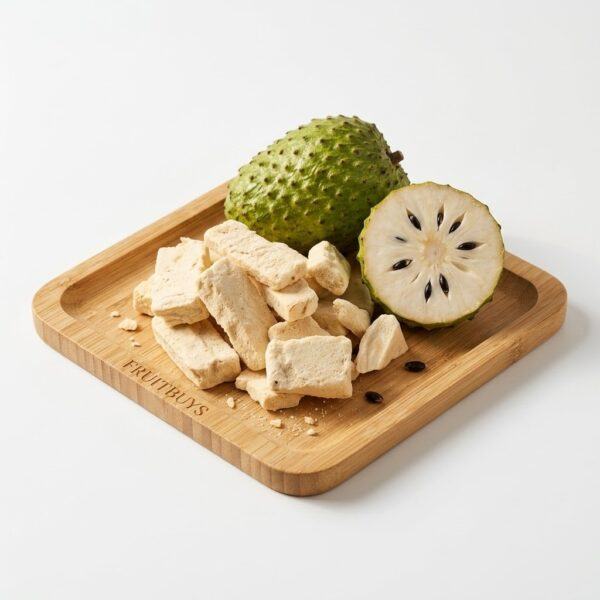
FruitBuys supplies freeze-dried soursop made from edible soursop pulp after peel, core and seed removal. The product can be configured as half-moon slices, cubes, chunks, crumble or powder, depending on the buyer’s application.
This is not an introducer model. FruitBuys controls the buyer-facing product route through raw-material sourcing governance, production-partner coordination, QC, packaging alignment, documentation and export logistics coordination. The buyer receives one approved product file, not disconnected claims from different parties.
Core product basis:
| Specification Area | FruitBuys Planning Basis |
|---|---|
| Product | Freeze-dried soursop |
| Botanical identity | Annona muricata L. |
| Ingredient | Soursop pulp after peel, core and seed removal |
| Formats | Half-moon slice, cube, chunk, crumble, powder/custom size |
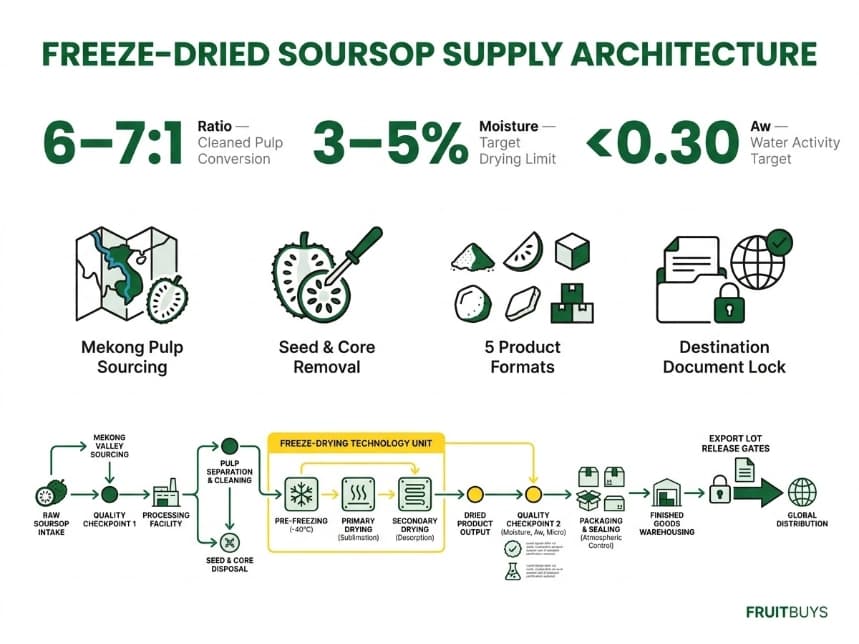
| Fresh-to-dry ratio | 6–7 kg cleaned pulp → 1 kg finished product |
| Moisture | 3–5% |
| Water activity | Aw <0.30 |
| Packaging | Buyer-approved retail, foodservice or bulk route |
| Documentation | COA, lot file, label inputs and destination documents where required |
Use this guide as the hub for all technical decisions. For the direct yield calculation, review freeze-dried soursop fresh-to-dry conversion ratio. For the full RFQ structure, use the freeze-dried soursop RFQ checklist.
Product Identity and Raw Material Basis
Freeze-dried soursop should be defined by product identity before price, pack design or shipment planning enters the discussion. The buyer should confirm whether the product is pure soursop pulp, pure powder, formulated powder, fruit blend or retail snack SKU.
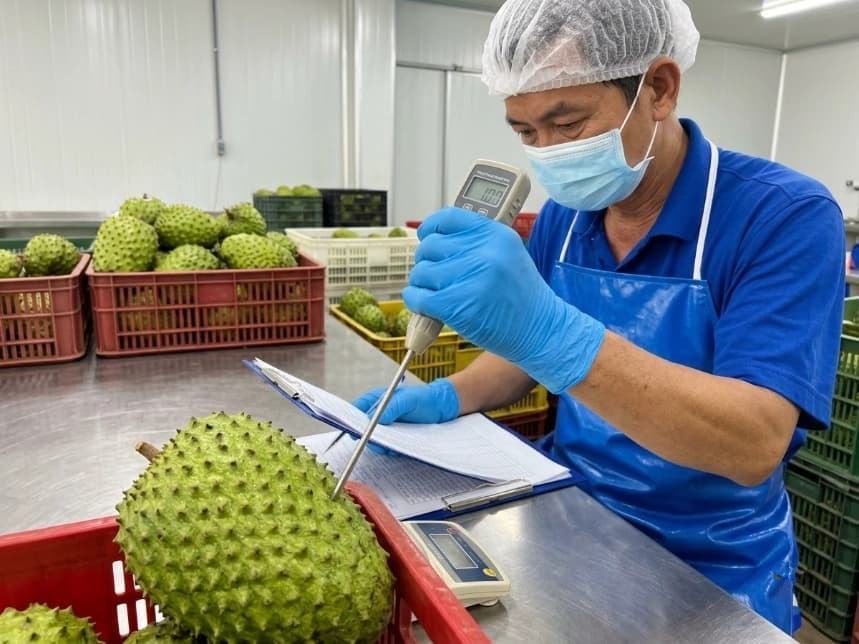
Soursop is Annona muricata L., also known as guanabana or graviola. Soursop pulp has high water content, reported in a 2026 review at 76–83%, which supports the practical need for a high fresh-to-dry conversion ratio. (Springer)
FruitBuys uses the working conversion basis:
6–7 kg cleaned soursop pulp → 1 kg freeze-dried soursop
That ratio starts from cleaned edible pulp after peel, core and seed removal. It should not be confused with whole-fruit planning, which must account for peel, core, seeds, trimming, fruit rejection and pulp recovery.
Raw-material control affects:
| Raw-Material Factor | Commercial Impact |
|---|---|
| Origin route | Traceability and intake planning |
| Maturity | Aroma, texture, cutting behavior and yield |
| Seed load | Pulp recovery and physical-defect risk |
| Fruit softness | Trimming loss and texture risk |
| Intake timing | Browning, fermentation and process stability |
| Pulp recovery | Conversion and commercial planning |
FruitBuys uses Raw Material Sourcing Governance to align origin route, maturity, cleaned pulp recovery and seed-removal expectations. The detailed sourcing logic is covered in Vietnam soursop origin and maturity control.
Process Route: From Fruit to Finished Lot
Freeze-drying is not just “drying fruit.” It is a controlled dehydration route that removes frozen water under low pressure by sublimation. Nowak and Jakubczyk describe freeze-drying as a process involving freezing, primary drying and secondary drying, and explain that process conditions affect physical properties of food materials. (PubMed Central (PMC))
A practical freeze-dried soursop process route includes:
- Raw-material intake
- Fruit sorting
- Washing and preparation
- Peel, core and seed removal
- Pulp inspection
- Cutting or format preparation
- Freezing
- Freeze-drying
- Post-drying inspection
- Moisture and Aw review
- Sorting and defect control
- Packing
- Lot coding
- COA and document release
The buyer should not approve the finished sample without understanding which process gates protect the product. A good-looking sample does not prove seed removal, drying uniformity, packaging stability or bulk-repeatability.
Review the full route in freeze-dried soursop process control. For seed-specific risk, use soursop seed-removal and foreign-material control.
Moisture and Water Activity Are Release Controls
Moisture and Aw must be controlled separately.
Moisture affects texture, weight basis and nutrition concentration, while Aw reflects available-water behavior and storage stability.
FruitBuys uses 3–5% moisture and Aw <0.30 as working release targets for freeze-dried soursop.
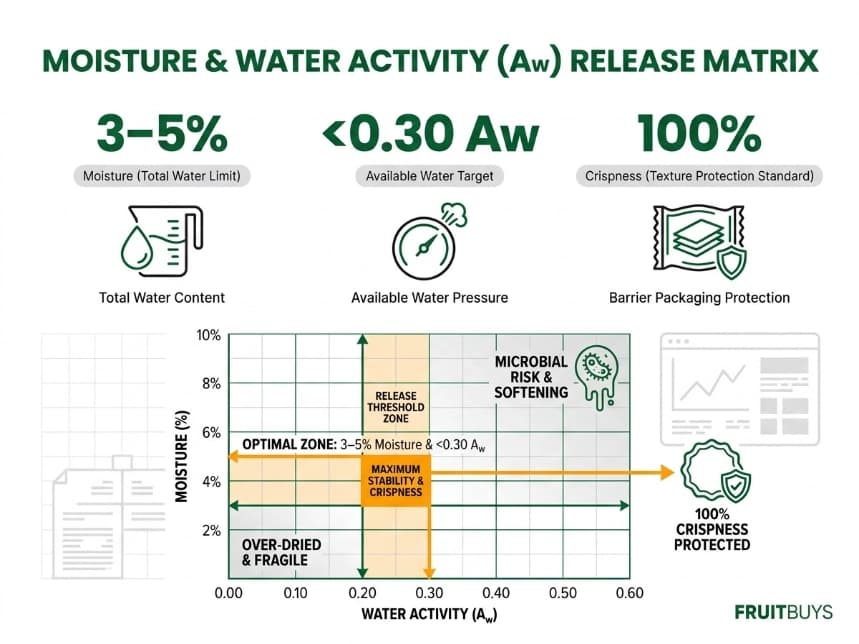
For FruitBuys freeze-dried soursop, the locked technical targets are:
| Parameter | Target |
|---|---|
| Moisture | 3–5% |
| Water activity | Aw <0.30 |
FDA defines water activity as the ratio between the vapor pressure of the food and the vapor pressure of distilled water under identical conditions. That makes Aw a distinct control point from total moisture. (U.S. Food and Drug Administration)
This matters because two products with similar moisture can behave differently in storage. A lot can also pass sensory review but fail later if Aw rises through weak packaging, poor sealing or humid handling.
Moisture and Aw connect directly to:
- Crisp texture
- Clumping risk
- Powder caking
- Shelf-life validation
- Packaging barrier
- Retained sample comparison
- COA release
- Buyer complaint review
The detailed technical explanation is in freeze-dried soursop moisture and water activity control.
Format Selection: Slices, Cubes, Chunks, Crumble or Powder
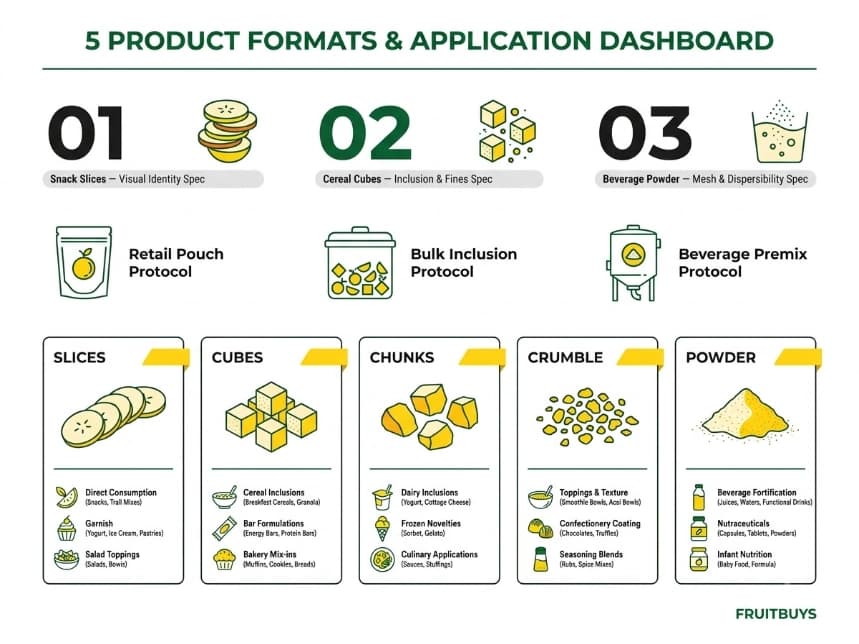
Freeze-dried soursop format should follow application. The wrong format creates failure even when the fruit quality is acceptable.
| Format | Best-Fit Application | Main Risk |
|---|---|---|
| Half-moon slice | Retail snack, garnish, visual topping | Edge breakage and visual rejection |
| Cube | Cereal, granola, chocolate, dairy topping | Size variation and fines |
| Chunk | Snack mix, foodservice, dessert | Breakage and irregular drying behavior |
| Crumble | Chocolate, bakery, granola, yogurt topping | Dust and uncontrolled particle range |
| Powder | Beverage, premix, dairy, bakery, chocolate | Caking, dispersibility and ingredient declaration |
A buyer should not approve one format and use it as approval for another. Powder requires a different specification from chunks. Crumble must be intentional, not broken product. Slices need packaging that protects visual appearance.
Use freeze-dried soursop formats and size selection before sample request. Use freeze-dried soursop applications for food manufacturers to match the format to the actual food system.
Defect Control and Lot Release
Freeze-dried soursop defects must be defined before bulk release. A buyer cannot rely on terms like “good color,” “crispy,” or “clean.” Those terms do not control commercial lots.
Defect categories should include:
| Defect Area | What to Control |
|---|---|
| Texture | Soft, chewy, collapsed or over-brittle pieces |
| Color | Browning, dark spots, dull tone or oxidation |
| Aroma | Fermented, stale or off odor |
| Seeds | Whole seeds and seed fragments |
| Foreign matter | Plastic, metal, glass, insects or non-target material |
| Size | Oversize and undersize pieces |
| Fines | Dust and uncontrolled small particles |
| Breakage | Broken slices, crushed chunks or excess powdering |
| Clumping | Piece clumps or powder caking |
| Packaging | Punctures, seal failure or carton damage |
Low Aw supports stability, but it does not remove hygiene and microbiology responsibility. Codex low-moisture food guidance states that pathogens such as Salmonella cannot multiply in low-moisture foods but may remain viable for extended periods. (U.S. Food and Drug Administration)
For defect limits, use common freeze-dried soursop defects and release controls. For lab scope, use freeze-dried soursop COA and laboratory testing.
COA, Lab Testing and Documentation
A COA is useful only when it matches the exact product, format, lot, test scope, method, result and release specification. A historical lab report or sample COA does not approve a new bulk lot.
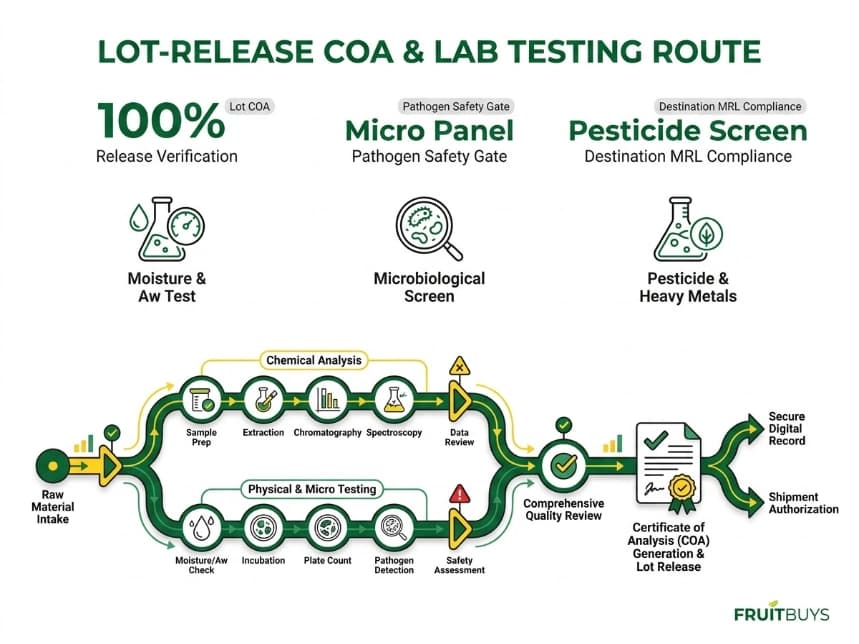
A freeze-dried soursop QA file should cover:
| Document | Buyer Review Point |
|---|---|
| Product specification | Defines the product to be supplied |
| COA | Summarizes current lot release data |
| Laboratory report | Shows method, result and sample identity where required |
| Moisture and Aw result | Confirms release condition |
| Microbiology panel | Supports hygiene and buyer QA review |
| Pesticide screen | Supports destination and importer requirements |
| Heavy metals/contaminants | Supports market and buyer review |
| Seed-removal record | Supports physical-quality control |
| Defect inspection record | Supports lot disposition |
| Packaging file | Supports shelf-life and texture protection |
| Retained sample | Supports sample-to-bulk comparison |
For U.S. import routes, FDA FSVP guidance states that importers of human and animal food must establish and follow a foreign supplier verification program unless an exemption applies. (U.S. Food and Drug Administration) FDA also states that it must receive prior notice for food imported or offered for import into the United States. (U.S. Food and Drug Administration)
FruitBuys supports buyers through Documentation and Export Logistics Coordination. The buyer should define the required test panel and destination-market route before commercial packing.
Packaging and Shelf-Life Control
Packaging protects the condition achieved during drying. Freeze-dried soursop can pass moisture and Aw release, then fail during storage if the pack, seal, liner, carton or handling route does not protect the product.
Packaging should define:
| Packaging Item | Why It Matters |
|---|---|
| Primary pouch or inner bag | Protects from moisture exposure |
| Seal method | Prevents localized softening |
| Pack size | Affects serving, label and handling |
| Headspace | Affects breakage and fill appearance |
| Carton | Protects product during movement |
| Storage instruction | Supports shelf-life control |
| Lot code | Links product to COA and retained sample |
| Shelf-life validation | Supports date coding and buyer file |
FruitBuys uses a planning carton basis of 60 × 39 × 39 cm / 10 kg net, with practical planning of 2.5 MT per 20ft and 6.0 MT per 40ft or 40HC until loading validation confirms the route. That planning should protect the product condition, not simply maximize carton count.
For packaging, review freeze-dried soursop packaging and shelf-life control. For container planning, use freeze-dried soursop carton and container loading.
Powder Decisions: Freeze-Dried vs Spray-Dried
Soursop powder is not one product. A pure freeze-dried soursop powder and a spray-dried powder with carrier require different specifications, labels, Nutrition Facts, claims and HS review.
Powder buyers must define:
| Powder Item | Buyer Decision |
|---|---|
| Powder route | Freeze-dried, spray-dried, blend or premix |
| Ingredient statement | Pure fruit or formulated product |
| Carrier status | None, maltodextrin, gum Arabic or other carrier |
| Mesh | Particle-size target |
| Moisture and Aw | Release values |
| Caking | Storage and handling risk |
| Dispersibility | Beverage or premix behavior |
| Nutrition Facts | Formula-specific |
| Claims | Evidence-based only |
| Packaging | Moisture barrier and seal control |
Spray drying of fruit powders often uses carrier agents because fruit sugars and acids can create stickiness and drying challenges; carrier choices then affect powder behavior, solubility, flow and ingredient declaration. (ScienceDirect)
Review freeze-dried vs spray-dried soursop powder before approving a powder sample. Powder buyers should also review the broader dried fruit powder category where relevant.
Nutrition Facts and Claims
Nutrition Facts should not be copied from raw soursop data, another brand’s label or a sample image. Freeze-drying removes water and concentrates solids, but the final label depends on formula, serving size, moisture, powder route, carrier status and finished-product testing.
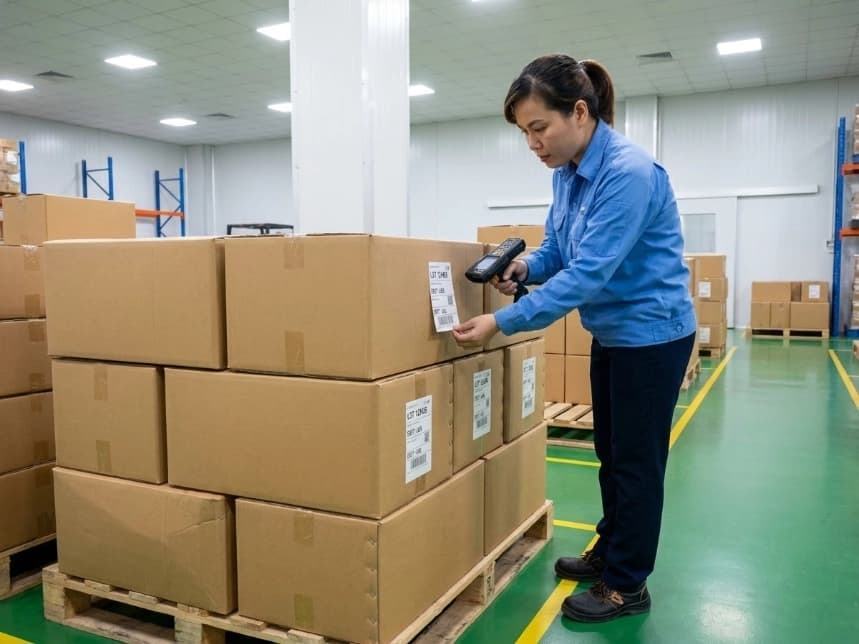
Nutrition review should confirm:
| Label Item | Review Requirement |
|---|---|
| Serving size | Market and product-form review |
| Calories | Finished product or validated calculation |
| Total carbohydrate | Final formula and lab basis |
| Dietary fiber | Lab-confirmed if claimed |
| Sugars/added sugars | Formula and label route |
| Potassium | Lab-confirmed for label or claim use |
| Vitamin C | Do not claim without finished-product testing |
| Ingredient statement | Pure fruit or formulated product |
| Powder carrier | Declared if used |
FDA labeling guidance identifies categories of label claims for foods and dietary supplements, including health claims, nutrient content claims and structure/function claims. (U.S. Food and Drug Administration) Disease, cancer, cure, detox and unsupported wellness language should be removed from soursop food marketing.
For label development, use freeze-dried soursop Nutrition Facts. For claim control, use soursop marketing claims food brands must avoid.
HS Code and Market Readiness
HS classification starts with product form. Freeze-dried soursop pieces and powder should not be treated as the same classification question.
At planning level:
| Product Form | Planning Direction |
|---|---|
| Dried soursop pieces | 0813.40 — other dried fruit |
| Pure fruit powder | 1106.30 — flour, meal and powder of Chapter 8 products |
| Powder with carrier | Separate formula and classification review |
| Blend or premix | Separate composition review |
| Retail SKU | Label, pack and destination review |
The World Customs Organization describes the Harmonized System as a legal and logical structure using six-digit commodity groups. (U.S. Food and Drug Administration) UNSD lists HS 110630 as flour, meal and powder of products of Chapter 8. (U.S. Food and Drug Administration)
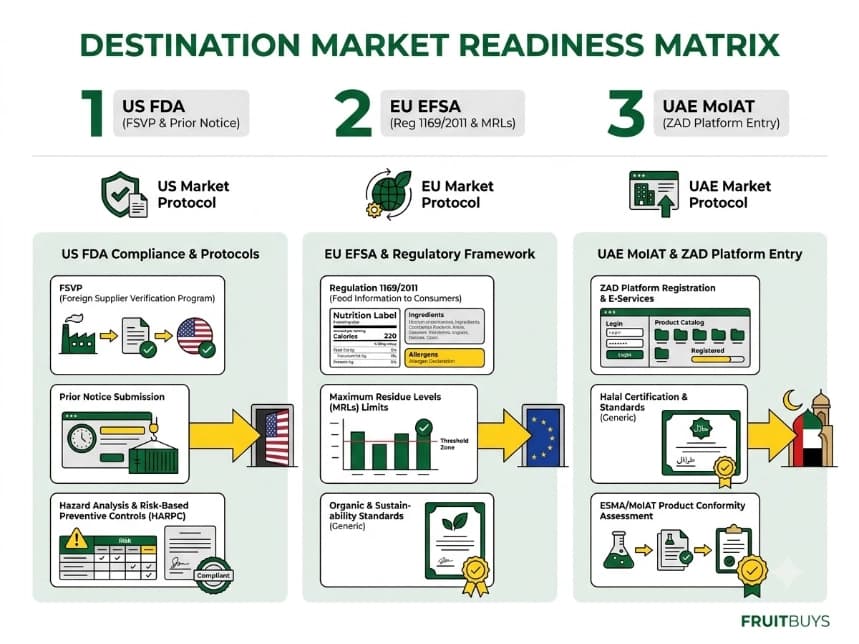
Destination readiness must be reviewed separately. EU food information rules are governed by Regulation (EU) No 1169/2011, and EU contaminant maximum levels are set under Regulation (EU) 2023/915. (EUR-Lex) The EU Pesticides Database supports active-substance and MRL review. (Food Safety) UAE official guidance states that imported, locally produced or modified food products must be registered in ZAD before being handled in UAE markets. (u.ae)
Use freeze-dried soursop HS code review and freeze-dried soursop US, EU and UAE market readiness before final document release.
Sample-to-Bulk Approval
The highest-risk shortcut is approving bulk production from a sample photo or informal tasting note.
A sample cannot control bulk unless it becomes a retained sample, written specification, COA plan, packaging route and change-control rule.
Buyers should approve sample-to-bulk before commercial release.
Sample-to-bulk approval converts a sample into a repeatable commercial standard. It should define what must repeat, what may vary and what requires buyer reapproval.
A proper approval file includes:
| Approval Element | Function |
|---|---|
| Approved sample | Physical reference |
| Written specification | Product and release criteria |
| Retained sample | Comparison for commercial lot |
| COA scope | Lot-release evidence |
| Defect limits | Accept, hold or reject decision |
| Packaging route | Protects sample condition in bulk |
| Destination file | Prevents market-readiness gaps |
| Change-control rule | Triggers reapproval when needed |
| Lot code | Links product, record and shipment |
Change-control triggers include format, cut size, mesh, raw-material route, moisture, Aw, packaging, formula, COA scope, destination market and label claims. Use freeze-dried soursop sample-to-bulk approval before moving from sample interest to commercial supply.
Application Mapping
| Buyer Type | Application | Required Format | Proof Needed | FruitBuys Delivery |
|---|---|---|---|---|
| Importer | Bulk ingredient distribution | Cubes, chunks, crumble or powder | Product spec, COA, HS basis, carton plan | Documentation and Export Logistics Coordination |
| QA manager | Supplier and lot approval | Buyer-defined format | Moisture, Aw, defects, lab reports, retained sample | Quality Control |
| Private-label snack brand | Retail freeze-dried pouch | Half-moon slices or chunks | Final pouch, Nutrition Facts, claims file, breakage limit | OEM/Private Label Delivery |
| Beverage developer | Powder drink or premix | Powder | Carrier status, mesh, dispersibility, caking and label route | MOQ Flexibility/Market Trial Support |
| Cereal manufacturer | Fruit inclusion | Cubes or crumble | Size tolerance, fines, Aw and blend trial | Quality Control |
| Chocolate manufacturer | Inclusion, topping or powder system | Crumble, micro-cube or powder | Particle range, moisture, Aw and application test | Quality Control and Documentation |
| Foodservice distributor | Dessert, topping or beverage use | Chunks, crumble or powder | Pack size, storage instruction and after-opening handling | Export Logistics Coordination |
| Regulatory reviewer | Market file approval | Final commercial SKU | Label, COA, HS, claims and destination checklist | Documentation |
Why FruitBuys Delivers This
FruitBuys Vietnam supplies export-ready freeze-dried soursop through an Integrated Product Supply Model. The buyer receives one configured product, one locked specification and one accountable supplier relationship.
Raw Material Sourcing Governance controls origin route, maturity condition, cleaned-pulp preparation and seed-removal expectations. That protects yield, flavor, texture and physical-quality control.
Quality Control defines moisture, Aw, format, seed rules, defects, retained samples and lot-release decisions. A sample does not replace QC evidence.
Documentation connects specification, COA, laboratory reports, Nutrition Facts inputs, HS basis, claim review, packaging file and market-readiness checklist.
OEM/Private Label Delivery aligns product format, pouch route, artwork inputs, label data, pack size, claims and commercial SKU approval.
MOQ Flexibility/Market Trial Support allows buyers to test application fit where operationally supported before final packaging or bulk release.
Export Logistics Coordination aligns carton configuration, lot codes, storage instructions, loading plan and shipment documents with the approved product route.
Buyer Checklist
Before approving freeze-dried soursop supply, confirm:
| Checklist Area | Required Input |
|---|---|
| Product identity | Freeze-dried soursop, Annona muricata L. |
| Ingredient | Soursop pulp after peel, core and seed removal |
| Application | Snack, cereal, chocolate, beverage, dairy, bakery or foodservice |
| Format | Half-moon slice, cube, chunk, crumble or powder |
| Conversion | 6–7 kg cleaned pulp → 1 kg finished product |
| Moisture | 3–5% |
| Aw | <0.30 |
| Seed control | Whole-seed and seed-fragment rule |
| Defects | Color, texture, fines, breakage, clumping and foreign matter |
| COA | Current lot and agreed test scope |
| Lab testing | Microbiology, pesticide, heavy metals and buyer-specific panel |
| Packaging | Retail, foodservice or bulk route |
| Shelf life | Final-pack validation basis |
| Nutrition | Lab plan or approved calculation route |
| Claims | Exact wording and evidence file |
| HS code | Pieces and powder reviewed separately |
| Market readiness | US, EU, UAE or destination-specific checklist |
| Sample approval | Retained sample and pass/fail criteria |
| Logistics | Carton, lot code, storage instruction and loading plan |
Do not approve a bulk lot until the product, packaging, QA file and destination documents match the approved sample.
Summary
Freeze-dried soursop from FruitBuys Vietnam is supplied as an export-ready product made from edible Annona muricata L. pulp after peel, core and seed removal. The working conversion ratio is 6–7 kg cleaned pulp for 1 kg finished product, with moisture 3–5% and Aw <0.30.
Formats include half-moon slices, cubes, chunks, crumble and powder. Buyers should approve format, seed control, defects, COA, packaging, Nutrition Facts, HS code, claims and market-readiness documents before bulk release.
FAQ
What is freeze-dried soursop?
Freeze-dried soursop is dried soursop pulp processed into a low-moisture, low-Aw fruit product. FruitBuys supplies it as slices, cubes, chunks, crumble or powder under buyer-approved specification.
How much fresh soursop makes 1 kg freeze-dried product?
Use 6–7 kg cleaned soursop pulp for 1 kg freeze-dried soursop. This starts after peel, core and seed removal, not from whole fruit.
What are the key specifications?
The working FruitBuys targets are 3–5% moisture and Aw <0.30, with buyer-defined format, size, seed control, defect limits, packaging and COA scope.
Which format should buyers choose?
Choose format by application. Slices and chunks fit snack packs; cubes fit cereal; crumble fits chocolate and toppings; powder fits beverages, premixes, dairy and bakery systems.
Can FruitBuys support private label?
Yes. FruitBuys supports OEM/private-label delivery through product specification, sample approval, packaging coordination, Nutrition Facts inputs, claims review and documentation alignment.
Can freeze-dried soursop make health claims?
Do not use cancer, cure, detox or unsupported health claims. Nutrition and clean-label claims require formula, lab data and destination-market review.
What should buyers request first?
Submit the freeze-dried soursop RFQ after confirming application, format, destination market and approval criteria.
Conclusion
Submit the freeze-dried soursop RFQ after confirming your application, required format, destination market and approval criteria.
References
- Igiehon, O.O.; Idowu, A.T.; Toluwabori, S. “Soursop (Annona muricata) Nutritional Composition, Bioactivities and its Potential Applications: A Review.” Waste and Biomass Valorization, 2026. (Springer)
- Nowak, D.; Jakubczyk, E. “The Freeze-Drying of Foods—The Characteristic of the Process Course and the Effect of Its Parameters on the Physical Properties of Food Materials.” Foods, 2020. (PubMed Central (PMC))
- U.S. Food and Drug Administration. “Water Activity (aw) in Foods.” FDA Inspection Technical Guide. (U.S. Food and Drug Administration)
- Codex Alimentarius Commission. “Code of Hygienic Practice for Low-Moisture Foods, CXC 75-2015.” (U.S. Food and Drug Administration)
- U.S. Food and Drug Administration. “Guidance for Industry: Foreign Supplier Verification Programs for Importers of Food for Humans and Animals.” (U.S. Food and Drug Administration)
- U.S. Food and Drug Administration. “Prior Notice of Imported Foods.” (U.S. Food and Drug Administration)
- World Customs Organization. “What is the Harmonized System?” (U.S. Food and Drug Administration)
- United Nations Statistics Division. “HS 110630 — Flour, meal and powder; of the products of Chapter 8.” (U.S. Food and Drug Administration)
- EUR-Lex. “Regulation (EU) No 1169/2011 on the provision of food information to consumers.” (EUR-Lex)
- EUR-Lex. “Commission Regulation (EU) 2023/915 on maximum levels for certain contaminants in food.” (EUR-Lex)
- European Commission. “EU Pesticides Database.” (Food Safety)
- The Official Portal of the UAE Government. “National Food Accreditation and Registration System.” (u.ae)
- U.S. Food and Drug Administration. “Label Claims for Conventional Foods and Dietary Supplements.” (U.S. Food and Drug Administration)