Freeze-Dried Soursop OEM and Private-Label Workflow
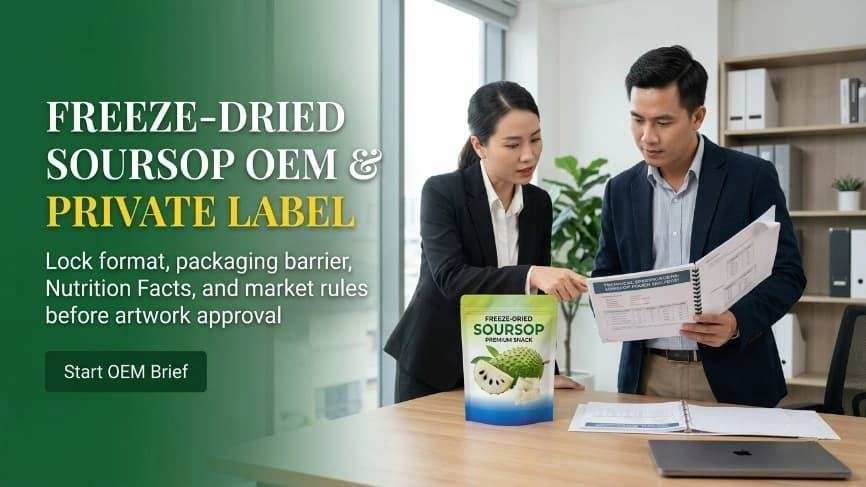
Private-label freeze-dried soursop can fail before production starts if the buyer begins with pouch design instead of product control. A retail pack, powder pouch or distributor SKU needs more than a fruit image and a brand name. It needs a locked format, moisture target, Aw target, seed-control rule, defect limit, packaging route, Nutrition Facts basis, claims review, COA scope and destination-market file.
A private-label buyer should approve the product system before approving artwork. FruitBuys Vietnam supplies buyer-defined freeze-dried soursop through an integrated product supply model that connects raw-material sourcing governance, QC, packaging, documentation, OEM/private label delivery and export logistics coordination under one accountable supplier relationship.
OEM Development Starts With the Product, Not the Pouch
Freeze-dried soursop OEM development must start with product specification, not artwork.
The buyer must define format, pack type, label route, claims, test scope and destination before commercial packing.
Artwork should only move forward after the approved sample and documentation path are clear.
The first OEM decision is not visual identity. The first decision is product identity. Is the buyer developing half-moon slices, cubes, chunks, crumble, pure freeze-dried powder, carrier-containing powder or a formulated SKU? Each answer changes packaging, label, Nutrition Facts, HS code, claims and QA release.

For U.S. retail routes, FDA states that food labeling is required for most prepared foods, while nutrition labeling for raw produce and fish is voluntary. That distinction matters because a packaged private-label freeze-dried soursop SKU usually needs a label file, not only a bulk ingredient specification. (U.S. Food and Drug Administration) FDA’s Nutrition Facts updates also require added sugars on the label and require vitamin D and potassium, while calcium and iron continue to be required. (U.S. Food and Drug Administration)
FruitBuys connects OEM development to the full freeze-dried soursop B2B specification guide. The pillar guide gives the product route. This article owns the OEM and private-label workflow.
The Private-Label Input Brief
A private-label brief must be technical enough for sourcing, QC, packaging and documentation teams to execute the same product. A brand concept is not enough.
A practical buyer brief should include:
| Brief Item | Required Buyer Decision |
|---|---|
| Product form | Half-moon slice, cube, chunk, crumble or powder |
| Application | Retail snack, cereal inclusion, beverage powder, topping or ingredient |
| Ingredient statement | 100% soursop pulp or formulated product |
| Pack route | Retail pouch, foodservice pack or bulk inner bag |
| Pack size | Buyer-defined retail or bulk configuration |
| Texture target | Crisp pieces, crumble behavior or powder flow |
| Moisture target | Working target: 3–5% |
| Aw target | Working target: Aw <0.30 |
| Defect limits | Seeds, seed fragments, fines, breakage, clumping and color |
| Nutrition route | R&D estimate or lab-confirmed label file |
| Claims | No added sugar, fiber, fruit identity or other reviewed claim |
| Destination | US, EU, UAE or other importer route |
| Documentation scope | COA, lab report, origin file, label file and shipment records |
| Approval path | Sample, retained sample, bulk release and change control |
FruitBuys uses the brief to configure the product, not to find an anonymous production source. The buyer receives one product pathway with single-point commercial accountability. The buyer can structure the request through the freeze-dried soursop RFQ checklist when the full brief is ready.
Format Selection for OEM SKUs
The OEM format decides how the product looks, packs, breaks, absorbs moisture and performs in the buyer’s market. It also decides the evidence needed for release.
| Format | OEM Use | Main Control Point |
|---|---|---|
| Half-moon slice | Retail snack, gift pouch, garnish | Visual standard and breakage limit |
| Cube | Cereal, granola, chocolate and snack blends | Size tolerance and fines control |
| Chunk | Retail snack, foodservice, dessert topping | Structural integrity and packing protection |
| Crumble | Chocolate, bakery, yogurt topping, bar inclusion | Particle range and dust control |
| Powder | Beverage, smoothie, premix, bakery, dairy and powder SKU | Mesh, caking, ingredient declaration and packaging |
The buyer should not approve one format and later use the approval for another. A slice sample does not approve powder. A powder sample does not approve retail chunks. Each format needs its own retained sample, release criteria and packaging route.
FruitBuys separates format decisions in freeze-dried soursop formats and size selection. Application-specific decisions are mapped in freeze-dried soursop applications for food manufacturers.
Product Specification Before Sample Request
A private-label sample should test a specification, not replace it.
The sample request must define product form, size, moisture, Aw, defect limits, pack route and documentation scope.
Otherwise, the buyer may approve a beautiful sample that cannot repeat in bulk.
A sample without a specification creates confusion. The buyer may like the taste, but the QA team still does not know whether the lot should pass or fail. The pack designer may create artwork, but the ingredient statement and Nutrition Facts may still change. The importer may approve a launch plan, but the market file may still be incomplete.

A private-label sample specification should include:
| Specification Section | Required Detail |
|---|---|
| Product identity | Freeze-dried soursop from Annona muricata L. pulp |
| Ingredient | Soursop pulp after peel, core and seed removal |
| Format | Slice, cube, chunk, crumble or powder |
| Size / mesh | Buyer-approved dimension or particle range |
| Moisture | 3–5% working target |
| Aw | <0.30 working target |
| Seed rule | No whole seed and buyer-defined seed-fragment criteria |
| Defect rule | Color, texture, fines, breakage, clumping or caking limits |
| Packaging | Trial pack or intended commercial pack |
| Sample purpose | R&D, sensory, label, retail review or distributor review |
| Documentation | COA, lab scope, Nutrition Facts plan and market file |
| Retained sample | Reference sample for bulk comparison |
FruitBuys connects the specification to freeze-dried soursop moisture and water activity control, common freeze-dried soursop defects and release controls and soursop seed-removal and foreign-material control.
Packaging and Retail Pack Development
OEM packaging must protect the product condition, carry the correct label information and support the buyer’s distribution route. It should not be treated as a design-only item.
Planning options may include retail packs such as 50 g, 100 g, 500 g and 1 kg, or bulk packs such as 1–5 kg inner bags for ingredient, foodservice or distributor use. The final pack must still be approved by format, barrier requirement, seal integrity, breakage risk, shelf-life basis and destination-market needs.

A private-label packaging file should define:
| Packaging Item | Why It Matters |
|---|---|
| Pack size | Affects label panel, serving, logistics and retail shelf fit |
| Film or pouch structure | Protects moisture, Aw and aroma |
| Seal method | Prevents localized moisture pickup |
| Headspace | Affects breakage and visual fill |
| Inner bag | Protects bulk product after drying |
| Carton | Protects fragile pieces during handling |
| Lot code | Links pack to COA and retained sample |
| Storage instruction | Supports shelf-life and customer handling |
| Artwork file | Must match final ingredient, label and claims |
| Final sample | Must match commercial pack route where required |
Freeze-dried soursop packaging must protect low moisture and low Aw. The detailed packaging decision is handled in freeze-dried soursop packaging and shelf-life control.
Nutrition Facts, Ingredient Statement and Claims
Nutrition and claims are not copywriting tasks. They are documentation tasks. For a private-label SKU, the ingredient statement, Nutrition Facts and claims must match the final product formula, serving size, pack route and destination market.
For U.S. routes, FDA’s current Nutrition Facts guidance identifies added sugars, vitamin D, potassium, calcium and iron as label items affected by the updated Nutrition Facts requirements (U.S. Food and Drug Administration).

FDA also states sesame is the ninth major food allergen and must be labeled as an allergen on packaged foods and dietary supplements as of January 1, 2023 (U.S. Food and Drug Administration). This matters for private-label development because the buyer must review allergen and cross-contact statements based on formula and production route, not only on the fruit itself.
The label file should confirm:
| Label Item | Required Check |
|---|---|
| Product name | Must match pieces, powder or formulated SKU |
| Ingredient statement | Pure soursop pulp or full formula |
| Nutrition Facts | Lab-confirmed or approved calculation route |
| Serving size | Market and pack-route review |
| Added sugars | Formula-based confirmation |
| Allergen statement | Ingredient and facility-route review |
| Claims | Evidence and destination-market review |
| Storage instruction | Packaging and shelf-life basis |
| Country of origin | Document consistency |
| Barcode/product data | Retail or market registration need |
FruitBuys keeps Nutrition Facts in a separate technical article: freeze-dried soursop Nutrition Facts for label development. Claim risk is handled in soursop marketing claims food brands must avoid.
Powder OEM Requires Extra Control
Powder projects require stricter formula review because the word “powder” can hide different technical routes. A pure freeze-dried soursop powder and a spray-dried powder with carrier cannot share one ingredient statement, Nutrition Facts panel or claims file.

Powder OEM should define:
| Powder Input | Required Decision |
|---|---|
| Powder route | Freeze-dried, spray-dried, blend or premix |
| Carrier status | None, maltodextrin, gum Arabic or other declared carrier |
| Mesh | Buyer-approved particle size |
| Bulk density | Pack and fill planning input |
| Flowability | Filling and handling review |
| Dispersibility | Beverage or premix performance |
| Caking limit | Packaging and storage review |
| Ingredient declaration | Final formula basis |
| Claims | Must match actual formula |
| HS review | Powder and formula route check |
FruitBuys separates this comparison in freeze-dried vs spray-dried soursop powder. The powder route must be locked before artwork or Nutrition Facts move forward.
Market Readiness for Private Label
Private-label approval is not complete until the destination-market file is clear.
The US, EU and UAE can require different label, importer, registration, claims, testing and document-review paths.
Buyers should lock the destination checklist before commercial packing.
Market readiness depends on where the SKU will be sold or imported. A pouch prepared for one market may need revision for another.
For U.S. import routes, FDA FSVP guidance states that importers of human and animal food must establish and follow a foreign supplier verification program unless an exemption applies. (U.S. Food and Drug Administration) For EU retail routes, Regulation (EU) No 1169/2011 governs food information to consumers and establishes requirements and responsibilities for food information and labeling. (EUR-Lex) For UAE market routes, official UAE government information states that food products must be registered in ZAD before being handled in UAE markets. (u.ae)
A private-label market file should define:
| Market File Item | Why It Matters |
|---|---|
| Destination | Determines label, registration and test expectations |
| Importer role | Clarifies who owns importer-side obligations |
| Ingredient statement | Supports label and claims review |
| Nutrition panel | Supports retail artwork |
| COA scope | Supports QA release and customer file |
| Pesticide/contaminant scope | Supports destination review where required |
| HS basis | Supports shipment document consistency |
| Packaging file | Supports shelf-life and registration data |
| Product image | Required in some registration workflows |
| Barcode | Required for many retail or registration routes |
| Claim evidence | Prevents unsupported brand statements |
FruitBuys connects this to freeze-dried soursop market readiness for the US, EU and UAE and freeze-dried soursop HS code for pieces and powder.
Sample-to-Bulk Approval for OEM
Private-label buyers often approve a small sample, then expect bulk production to match it without defining the approval bridge. That is a weak control point.

A proper approval bridge should include:
| Approval Step | Required Evidence |
|---|---|
| Development sample | Matches brief and intended application |
| Buyer feedback | Sensory, format, pack and application comments |
| Revised sample if needed | Confirms specification changes |
| Approved sample | Becomes the retained reference |
| Written specification | Defines release criteria |
| Final packaging direction | Confirms pack route and label inputs |
| COA plan | Defines lot-release testing |
| Pre-production confirmation | Aligns product, pack and documentation |
| Commercial lot review | Confirms sample-to-bulk consistency |
| Change-control rule | Defines when buyer reapproval is required |
FruitBuys treats this as a Quality Control and Documentation gate. The sample cannot approve bulk unless the same format, specification, pack and evidence can repeat. The detailed approval system belongs in freeze-dried soursop sample-to-bulk approval.
Application Mapping

| Buyer Type | Application | Required Format | Proof Needed | FruitBuys Delivery |
|---|---|---|---|---|
| Private-label snack brand | Retail freeze-dried soursop pouch | Half-moon slices or chunks | Approved sample, final pouch, Nutrition Facts, claims file | OEM/Private Label Delivery and Documentation |
| Importer | Distributor SKU | Cubes, chunks, crumble or powder | Product spec, COA, HS basis, packaging file | Documentation and Export Logistics Coordination |
| Beverage brand | Soursop powder pouch or premix | Powder | Carrier status, mesh, caking, dispersibility, label file | OEM/Private Label Delivery |
| Cereal manufacturer | Fruit inclusion under buyer brand | Cubes or crumble | Size tolerance, fines limit, Aw and application trial | Quality Control and Market Trial Support |
| Retailer | Private-label snack range | Slices, chunks or cubes | Artwork, product image, barcode, retained sample and shelf-life file | OEM/Private Label Delivery |
| QA manager | Supplier and SKU approval | Final commercial format | COA, lab report, defect file, packaging validation | Quality Control |
| Regulatory reviewer | Market file | Final packed SKU | Label, Nutrition Facts, claims and destination checklist | Documentation |
| Logistics coordinator | Shipment handover | Final carton and pack | Lot code, carton file, storage instruction and document match | Export Logistics Coordination |
Highest-Risk Decision: Approving Artwork Before Specification
The highest-risk shortcut is approving private-label artwork before the product specification is locked.
Artwork can become wrong if the format, ingredient statement, Nutrition Facts, claims, pack size, market file or shelf-life basis changes.
Buyers should approve artwork only after product, label and documentation gates are aligned.
This shortcut creates predictable rework. The brand team designs a beautiful pouch. Then QA asks for a different serving size. The regulatory reviewer removes a claim. The powder route changes because carrier status was not clear. The importer requests different label wording. The final pack changes because the first pouch does not protect texture.
The result is avoidable delay and repeated approval loops.
The correct sequence is:
Product format → application → specification → sample → retained sample → packaging → Nutrition Facts → claims → market file → artwork → commercial lotDo not start at artwork. Start at the product system.
FruitBuys protects this sequence through OEM/Private Label Delivery, Quality Control and Documentation. The buyer should submit a private-label brief after locking the product format, pack type, documentation scope and destination market.
Why FruitBuys Delivers This
FruitBuys Vietnam supplies export-ready freeze-dried soursop through an integrated product supply model. The buyer receives one configured product, one approved specification and one accountable supplier relationship.
OEM/Private Label Delivery connects product format, pack type, artwork inputs, Nutrition Facts, label route and claims review. FruitBuys does not separate brand execution from product control.
Quality Control defines moisture, Aw, seed control, defect limits, sample approval, retained samples and bulk release criteria. This protects sample-to-bulk consistency.
Documentation aligns specification, COA, laboratory reports, ingredient statement, Nutrition Facts, HS basis, claims file, market readiness and shipment records.
MOQ Flexibility/Market Trial Support helps buyers test product format, pack concept and application route where operationally supported before moving into commercial packing.
Export Logistics Coordination ensures final cartons, lot codes, storage instructions and shipment documents match the approved private-label SKU.
Raw Material Sourcing Governance supports repeatable sourcing, maturity control and pulp preparation behind the finished product.
Buyer Checklist
Before starting a freeze-dried soursop OEM or private-label project, confirm:
- Target market
- Buyer channel
- Product application
- Product format
- Size range or mesh
- Ingredient statement
- Carrier status for powder
- Added-sugar status
- Moisture target
- Aw target
- Seed-fragment rule
- Defect limits
- Sample purpose
- Retained-sample rule
- Retail or bulk pack size
- Pouch or inner-bag structure
- Carton configuration
- Storage instruction
- Nutrition Facts route
- Allergen review
- Claims file
- COA scope
- HS basis
- Market-readiness checklist
- Artwork approval gate
- Change-control rule for format, formula, pack, source, process, label or destination
Do not release artwork before the product and document file are locked.
Summary
Freeze-dried soursop OEM and private-label development should start with product specification, not pouch design. Buyers must define format, application, ingredient statement, moisture, Aw, seed-control rule, defect limits, pack type, Nutrition Facts, claims, COA scope, HS basis and destination-market requirements.
FruitBuys Vietnam supplies buyer-defined freeze-dried soursop through OEM/private label delivery, Quality Control, Documentation, Raw Material Sourcing Governance, Market Trial Support and Export Logistics Coordination.
FAQ
What should a private-label freeze-dried soursop project start with?
Start with product format, application, ingredient statement, moisture, Aw, defect limits, packaging route and destination market. Do not start with artwork.
Which formats work for private label?
Slices and chunks fit visual snack pouches. Cubes and crumble fit inclusions. Powder fits beverage, smoothie, bakery, dairy and powder SKU development.
Can one sample approve the final retail pouch?
No. The sample must connect to written specification, retained sample, packaging file, Nutrition Facts, claims review and destination-market checklist.
When should Nutrition Facts be prepared?
Prepare Nutrition Facts after the final recipe, serving format, moisture basis and destination label route are confirmed. Use laboratory planning for label-ready data.
Does soursop powder need special OEM review?
Yes. Powder needs carrier status, mesh, caking, dispersibility, ingredient declaration, Nutrition Facts, HS review and packaging validation.
Should claims be written before lab data?
No. Claims should follow formula, lab evidence and destination-market review. Avoid disease, treatment, detox or unsupported health claims.
What should buyers request first?
Submit the private-label brief after locking product format, pack type, documentation scope and destination market.
Conclusion
Submit the freeze-dried soursop private-label brief after locking product format, pack type, documentation scope and destination market.
References
- U.S. Food and Drug Administration. “Nutrition, Food Labeling, and Critical Foods.” Current FDA food labeling information page. (U.S. Food and Drug Administration)
- U.S. Food and Drug Administration. “Changes to the Nutrition Facts Label.” Current FDA Nutrition Facts guidance. (U.S. Food and Drug Administration)
- U.S. Food and Drug Administration. “The FASTER Act: Sesame Is the Ninth Major Food Allergen.” Current FDA allergen guidance. (U.S. Food and Drug Administration)
- U.S. Food and Drug Administration. “Guidance for Industry: Foreign Supplier Verification Programs for Importers of Food for Humans and Animals.” Current FDA FSVP guidance. (U.S. Food and Drug Administration)
- EUR-Lex. “Regulation (EU) No 1169/2011 on the provision of food information to consumers.” Consolidated regulation text. (EUR-Lex)
- The Official Portal of the UAE Government. “Food safety.” Current UAE government information on food registration and ZAD. (u.ae)