Is soursop safe to eat, and what are its side effects?
Reviewed 6 November 2026. General information, not medical advice.
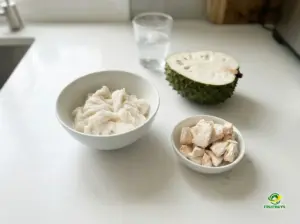
For most people, eating soursop fruit in normal portions causes nothing worse than the occasional loose stomach. The fruit is eaten every day across Latin America, the Caribbean and Southeast Asia. The concerns you read about come from three places: the seeds, which are not eaten; leaf teas, extracts and capsules sold as supplements; and a long-running question about a natural compound called annonacin and heavy, long-term consumption. This guide takes each one in turn, says who should be careful, and explains what changes when soursop is freeze-dried.
Which parts of soursop carry the risk?
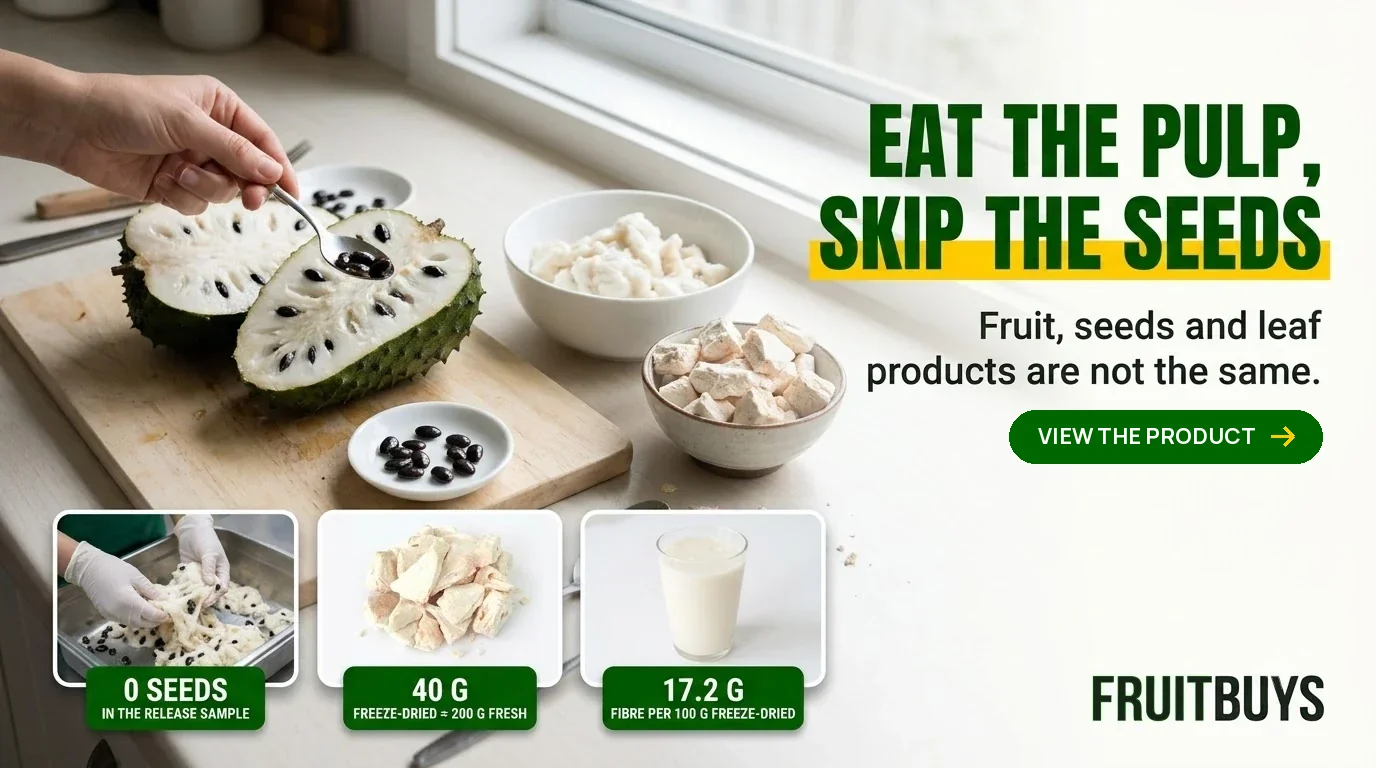
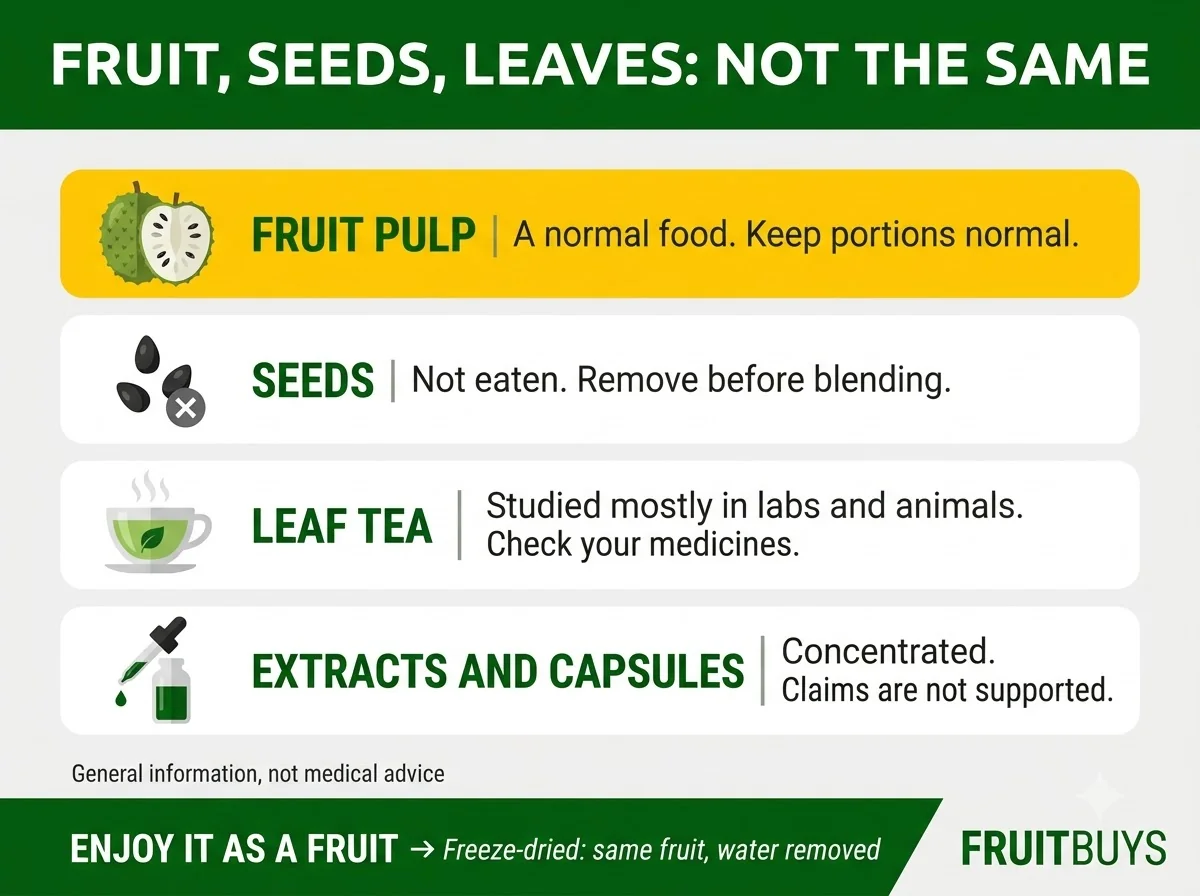
Most confusion clears once you separate the fruit from the rest of the plant. Soursop, guanábana and graviola are the same species, Annona muricata, but “graviola” products online are often made from leaves, not fruit.
| Part or product | What it is used for | What to know | Who should take care |
|---|---|---|---|
| Fruit pulp, fresh or frozen | Eaten fresh, in juice, batido, ice cream | A normal food; contains fibre, natural sugars and potassium, plus small amounts of annonacin | People on potassium-restricted diets; anyone with a history of reacting to related fruits |
| Seeds | Not eaten | Hard, and the part of the fruit richest in acetogenins, the compound family that includes annonacin | Everyone: remove them before eating or blending |
| Leaves (tea, infusions) | Folk remedies, “graviola tea” | Studied mostly as extracts in the lab and in animals | People on blood pressure or diabetes medicines; pregnancy and breastfeeding |
| Capsules, extracts, bitters | Sold as supplements | Concentrated preparations; often marketed with health claims that are not supported | Same as leaves, and anyone being treated for cancer |
| Freeze-dried pulp | Snacks, smoothies, ingredients | The fruit with the water removed, so a small portion carries more fruit | Portion it like the fresh fruit it replaces |
Can soursop cause an allergic reaction?
Yes, though true soursop allergy is uncommon. Symptoms are the same as for any food allergy: itching or tingling in the mouth, hives, swelling of the lips or throat, stomach cramps and, rarely, breathing difficulty. Swelling or wheezing after eating any food needs urgent medical care.
People with latex allergy deserve a specific mention. Some proteins in latex resemble proteins in certain fruits, a cross-reaction called latex-fruit syndrome. Banana, avocado, kiwi and chestnut are the best-known triggers, and cherimoya, a close relative of soursop, has been reported too. If you react to latex or to those fruits, try a small amount of soursop first, or ask an allergist before adding it to your diet.
Why does soursop upset some stomachs?
Mostly fibre and fruit sugar. Fresh soursop is a soft, juicy fruit, and a large serving brings a fair load of both. Eaten in quantity, especially by people who are sensitive to fructose or not used to much fibre, it can cause bloating, gas or loose stools. The effect is the same as overdoing mango or pear, and it settles when the portion comes down.
Freeze-dried soursop concentrates this. At 17.2 g of fibre per 100 g, a handful of crisp pieces holds more fibre than it looks. Eat freeze-dried pieces in snack-sized portions and drink water with them; blended into a smoothie, the same dose spreads through the glass.
Can soursop damage the nervous system?
This is the question behind most searches, and the honest answer is that it has not been proven, and there are reasons for moderation.
The concern started in Guadeloupe, in the French Caribbean, where doctors in the late 1990s found an unusually high rate of an atypical form of parkinsonism. Many patients reported eating soursop and related fruits, and drinking leaf infusions, regularly over many years. Researchers then looked at annonacin, the main acetogenin in soursop, which damages nerve cells in laboratory and animal studies. A 2005 study measuring annonacin in soursop found it in the fruit as well as the leaves, at about 15 mg in an average fruit, and estimated that one fruit or one can of commercial nectar a day for a year could add up to doses that harmed the brain in rats given the pure compound by infusion.
That estimate compares a rat receiving a purified compound in its bloodstream with a person eating whole fruit, so it is a warning sign, not proof of harm. France’s food safety agency reviewed the evidence in its 2010 opinion on soursop and its preparations and concluded that a link between soursop and the Guadeloupe cases could not be confirmed, that other environmental or genetic causes had not been ruled out, and that no precise consumption limit could be set. It did single out soursop preparations, meaning extracts and concentrated products, for particular attention.
What this means in practice:
- Enjoy soursop as a fruit, in normal portions, as part of a varied diet.
- Do not turn large daily servings of fruit, nectar or leaf tea into a long-term habit, which is the pattern behind the Guadeloupe reports.
- Never eat the seeds.
- If you have Parkinson’s disease or another movement disorder, it is reasonable to keep soursop occasional and avoid leaf products altogether.
Does soursop interact with medicines?
Possibly, if you take it as a supplement. Memorial Sloan Kettering’s review of graviola notes that extracts lowered blood sugar and blood pressure in animal studies, so they could add to the effect of diabetes and blood pressure medicines. It also notes an effect on the uptake of tracers used in PET scans in animals, and advises against taking graviola before such a scan. These findings come from leaf and extract research, not from people eating the fruit.
If you take medicine for diabetes or blood pressure, or have a scan coming up, consult your doctor before using soursop capsules, extracts or regular leaf tea. Eating the fruit occasionally is a different matter from a daily supplement routine.
Is soursop safe during pregnancy and breastfeeding?
There are no good human studies either way. The fruit is eaten as ordinary food by pregnant women in the countries where it grows, but leaf teas, extracts and capsules have not been tested for safety in pregnancy or breastfeeding, and concentrated preparations are where the open questions sit. The cautious course is to keep the fruit to normal food portions, skip the seeds, and avoid leaf and supplement products until you have stopped breastfeeding. Consult your doctor or midwife if you are unsure about any food or herbal product.
Is soursop safe for your kidneys?
For healthy kidneys, yes. The point to watch is potassium. Freeze-dried soursop carries 1,445 mg of potassium per 100 g, and fresh pulp about one-fifth of that. Potassium is a nutrient most people need more of, but people with chronic kidney disease, or those taking medicines that raise potassium, are often told to limit it. If you are on a potassium-restricted diet, consult your doctor or renal dietitian before eating soursop regularly, and count freeze-dried portions as the fresh fruit they replace.
Does soursop cure cancer?
No. Soursop and graviola extracts have killed cancer cells in laboratory dishes and slowed tumours in some animal studies, but there are no clinical trials showing any benefit for people with cancer. Memorial Sloan Kettering states plainly that there is no proof graviola benefits cancer patients.
In the US, a product sold with a claim to treat or cure cancer is treated as an unapproved drug, and the FDA has sent warning letters to companies marketing soursop and graviola products that way. The agency’s guidance on products claiming to “cure” cancer warns that such products can delay real treatment. In the EU, no health claim is authorised for soursop. If you are being treated for cancer, talk to your oncology team before taking any soursop supplement, and never use it in place of treatment.
How do you eat soursop safely?
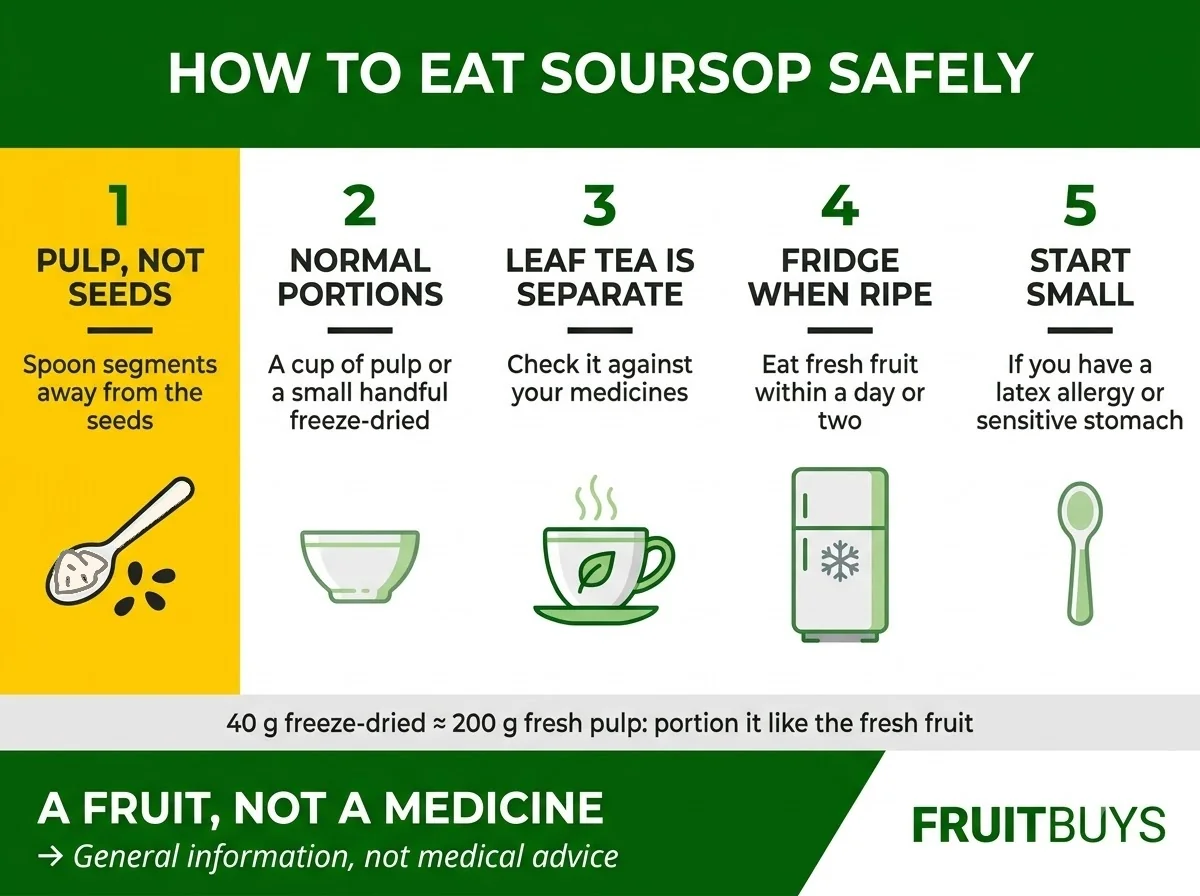
- Eat the pulp, not the seeds. Spoon the white segments away from the shiny black seeds, or press the pulp through a sieve before blending.
- Keep portions normal. A cup of fresh pulp, a glass of batido or a small handful of freeze-dried pieces is a typical serving.
- Treat leaf tea and supplements as a separate decision, not as “more soursop”, and check them against your medicines.
- Store fresh fruit in the fridge once ripe and eat it within a day or two; it ferments quickly at room temperature.
- Start small if you have a latex allergy or a sensitive stomach.
For drinks made from the fruit rather than the leaves, see how to make soursop tea, juice and batido. For fibre, vitamin C and potassium per 100 g, see what soursop is good for.
What changes when soursop is freeze-dried?
Freeze-drying takes out the water, about 81% of the fresh pulp, and leaves the rest of the fruit in place. One kilogram of freeze-dried soursop carries the pulp of about five kilograms of fresh fruit, so a 40 g serving of freeze-dried pieces or powder equals roughly 200 g of fresh pulp. Portion it the way you would portion the fresh fruit, and the advice in this guide applies unchanged.
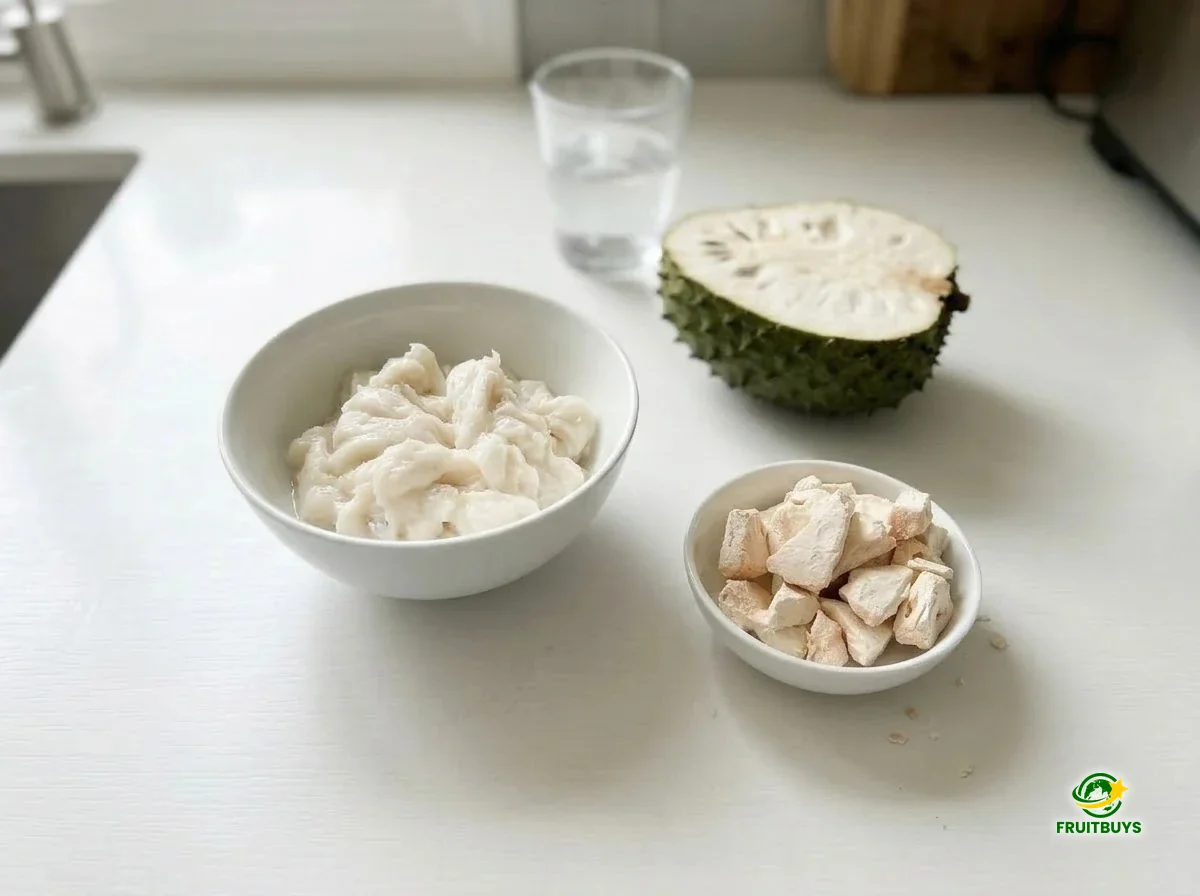
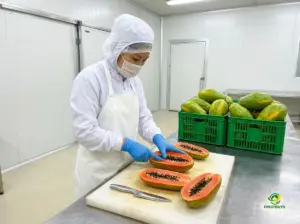
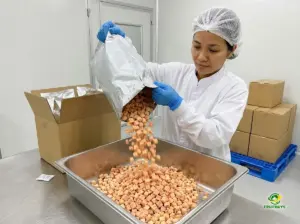
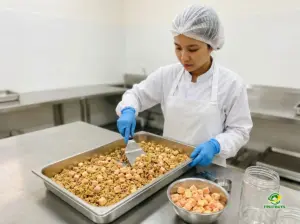
The seed question is handled before drying. For FruitBuys freeze-dried soursop, the pulp is separated from the seeds by hand and sorted on the line under FruitBuys’ processing protocol, and each lot is released with zero whole seeds and no visible seed fragments in the release sample. FruitBuys supplies fruit pulp only, as pieces, crumble and powder, and does not supply leaves, leaf tea, capsules or bitters.
For brands putting soursop on a label, this sets a simple rule: sell it as a fruit, with nutrition values and portion size, and leave disease claims off the pack and the website.
Building a soursop snack or drink?
Freeze-dried soursop pulp from Vietnam, hand-deseeded, in pieces, crumble or powder, with the specification, nutrition values per 100 g and COA policy on one page.
FAQ
Is soursop illegal in the US?
No. Soursop is a legal food, sold fresh, frozen, as pulp and as freeze-dried fruit. Fresh fruit imports are restricted by plant-health rules and are allowed only from approved origins under quarantine conditions. What the FDA acts against is soursop or graviola products sold with claims to treat disease.
Is it good to eat soursop every day?
As an occasional fruit, soursop is fine for most people. Because annonacin is present in the pulp and the long-term effects of heavy intake are still unresolved, it is sensible not to make large daily servings of fruit, nectar or leaf tea a habit over months and years.
Can you eat soursop seeds?
No. The seeds are hard, inedible and the richest part of the fruit in acetogenins. Remove them before eating or blending.
Does soursop affect the liver?
Research on soursop and the liver is mostly in animals and uses leaf or seed extracts, so it says little about eating the fruit. If you have liver disease, check any herbal supplement with your doctor first.
What are soursop bitters?
Herbal drinks sold as supplements, usually made from soursop leaves or bark blended with other herbs. They are a leaf preparation, not the fruit, so the advice on leaf teas and supplements in this guide applies.
Is freeze-dried soursop safer than fresh?
It is the same fruit with the water removed, so the advice is the same. The practical differences are that the seeds are already taken out by hand before drying, and that a small portion of freeze-dried pulp equals a larger portion of fresh fruit, so it is easy to eat more than you think.
Is graviola the same as soursop?
Yes, graviola is the Portuguese name for the same species, Annona muricata. Many “graviola” capsules and powders sold online are made from leaves, so read the ingredient list to see which part of the plant you are buying.