
Freeze-Dried Pineapple Conversion Ratio: How Buyers Should Verify Yield
Freeze-dried pineapple conversion ratio looks like a simple purchasing question: how many kilograms of fresh pineapple become one kilogram of finished product? The real answer depends on input basis. Whole fruit, peeled fruit, trimmed flesh, tray-loaded flesh, total dried output and released finished pieces produce different ratios. Importers, procurement teams, QA managers and R&D buyers should not accept one number until the supplier explains what entered the calculation.
A 9-11 kg ratio means nothing unless the buyer knows exactly what was weighed, what was removed and what was released. FruitBuys treats conversion ratio as a mass-balance control, not a marketing number. The buyer should verify raw-material intake, trimming loss, moisture, Aw, format loss, fines, rejects and current-lot documentation before using a ratio in planning or supplier approval.
What Does a Pineapple Conversion Ratio Measure?
A freeze-dried pineapple conversion ratio measures how much input material produces one kilogram of finished product.
The ratio changes when the input basis shifts from whole fruit to peeled fruit, trimmed edible flesh or released finished pieces.
Buyers should ask for the weighing points before accepting any conversion claim.
A conversion ratio should answer one controlled question: what material entered the process, and what product came out after release? If the supplier skips that definition, the ratio becomes a loose number.
This article belongs under the B2B freeze-dried pineapple qualification guide. Supplier qualification requires more than a sample and a short specification. It requires a controlled explanation of raw-material basis, processing loss and finished-product release.
A serious conversion ratio can refer to at least six different input-output relationships:
| Ratio Basis | What It Measures | Buyer Risk If Unclear |
|---|---|---|
| Whole fruit to finished product | Pineapple with peel, crown, eyes and core to dried output | Looks higher because non-edible parts remain in input weight |
| Peeled fruit to finished product | Fruit after major peel removal | Still may include trimming and core variation |
| Trimmed edible flesh to finished product | Usable pineapple flesh to dried output | Should be lower than whole-fruit basis if measured cleanly |
| Tray input to dried output | Loaded cut pineapple to dried product | Excludes earlier trimming loss |
| Total dried output to finished product | Dried pieces before final sorting | Can hide fines and rejects |
| Released finished product | Accepted pieces after sorting and QA release | Most useful for buyer planning |
The user-supplied claim states that 9-11 kg of fresh pineapple flesh, peeled and eyes removed, produces 1 kg of freeze-dried pineapple. That claim requires batch mass-balance proof before FruitBuys can publish it as a locked edible-flesh ratio.
Why Whole-Fruit and Edible-Flesh Ratios Cannot Be Combined
Whole pineapple includes crown, peel, eyes, core, damaged tissue and trimming loss. Edible flesh excludes some or all of those parts, depending on how the processor defines trimming. A ratio based on whole fruit naturally looks higher because the input includes material that never reaches the tray.
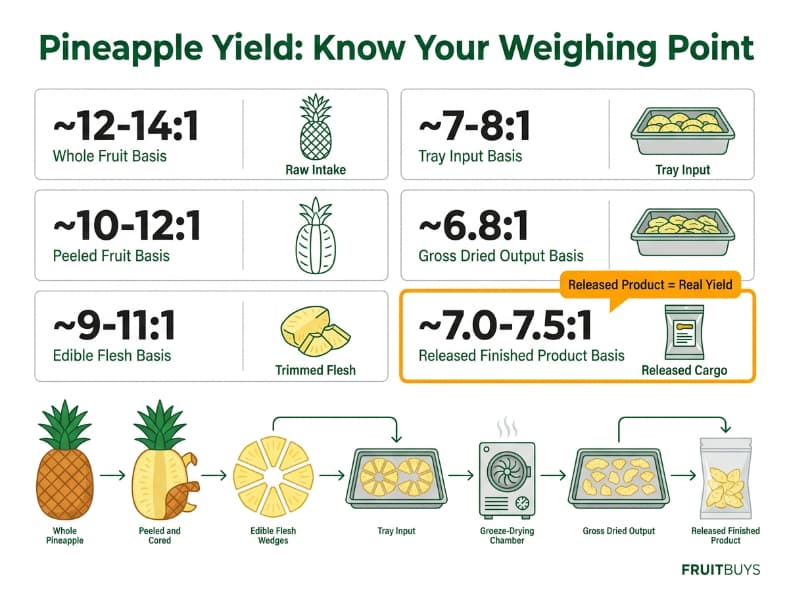
The buyer must not compare a whole-fruit ratio from one supplier with an edible-flesh ratio from another supplier. That comparison breaks before the calculation begins. It creates a paper illusion, then turns into raw-material planning confusion.
A clean ratio must name the weighing point:
| Weighing Point | Correct Buyer Question |
|---|---|
| Whole fruit received | Does this include peel, crown and core? |
| Peeled pineapple | Which parts remain after peeling? |
| De-eyed pineapple | Were eyes, bruises and defects removed? |
| Cored pineapple | Was core removed fully or partly? |
| Cut tray input | What weight actually entered the freeze dryer? |
| Dried output | Is this before or after sorting? |
| Released product | Does this exclude fines, broken pieces and rejects? |
The correct procurement question is not “What is your conversion ratio?” The correct question is: “What input basis and released output basis define your conversion ratio?”
Moisture and Solids Drive the Theoretical Yield
Fresh pineapple contains high water content. The UNCTAD pineapple commodity profile lists water at about 86.3 g per 100 g edible pineapple, which means only a small fraction of fresh edible material remains as dry solids before processing loss. (UNCTAD)
Freeze-drying removes water from frozen food under vacuum and can preserve products such as fruits and vegetables, but the final yield still depends on input solids, final moisture and production recovery. (Ask USDA)
The buyer can use this simplified mass-balance logic:
Fresh edible flesh required =
(final dry matter in 1 kg finished product)
÷
(fresh dry matter fraction × solids recovery)
If the finished freeze-dried pineapple contains 4% final moisture, then 1 kg finished product contains about 0.96 kg dry matter. If fresh pineapple flesh contains about 86.3% water, then its dry matter fraction is about 13.7%.
Without process loss:
0.96 kg ÷ 0.137 = about 7.0 kg fresh edible fleshThat is the theoretical starting point. It does not include trimming after the first weighing point, drip loss, tray residue, sorting loss, fines, broken pieces, rejects or product held back from release.
This section must connect to moisture inputs behind conversion yield. Moisture drives the calculation at both ends. Fresh material moisture affects input solids. Final product moisture affects finished weight.
Aw still matters for release, but Aw does not replace moisture in mass-balance calculation. FDA guidance distinguishes water activity from total moisture because Aw measures available water rather than water percentage. (U.S. Food and Drug Administration)
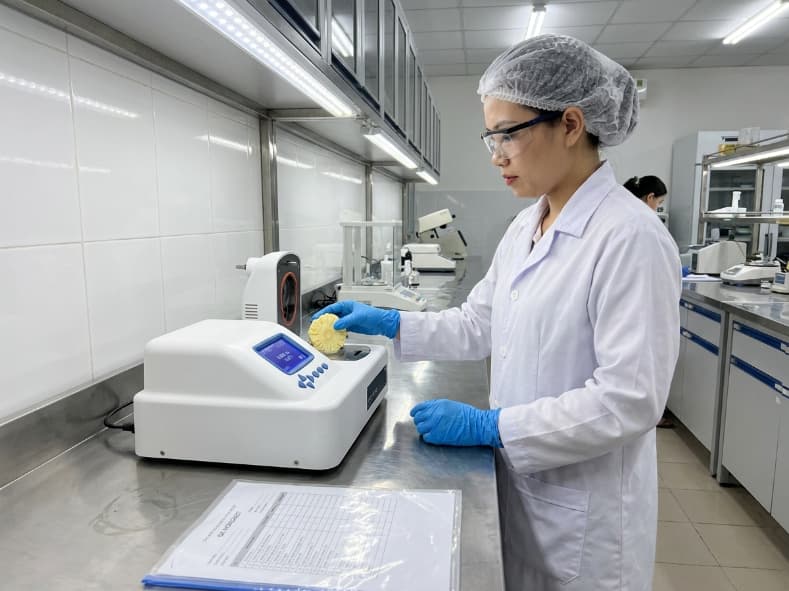
Audit of the Submitted 9-11 kg Claim
The submitted ratio states:
9-11 kg fresh pineapple flesh, peeled and eyes removed, equals 1 kg freeze-dried pineapple.
This statement needs tighter wording before publication. It may prove correct for a defined FruitBuys route after batch records support it. It should not appear as a universal edible-flesh ratio without evidence.
Using the 86.3% water reference as a rough edible-flesh starting point, 9 kg of fresh edible flesh contains about 1.23 kg dry matter. Eleven kilograms contains about 1.51 kg dry matter. One kilogram of finished product at 4% moisture contains about 0.96 kg dry matter.
That means the submitted range can imply meaningful solids loss if it truly uses fully trimmed edible flesh as the input basis.
| Input Claim | Approximate Dry Matter In | Dry Matter in 1 kg Finished Product at 4% Moisture | Implied Solids Not Released |
|---|---|---|---|
| 9 kg edible flesh | 1.23 kg | 0.96 kg | About 0.27 kg |
| 11 kg edible flesh | 1.51 kg | 0.96 kg | About 0.55 kg |
This does not prove the claim wrong. It proves the claim needs batch records.
Higher loss can occur when the number includes:
- Additional trimming after the initial flesh weighing point
- Juice loss during cutting
- Uneven maturity
- Fibrous core removal
- Rejected discolored pieces
- Tray adhesion
- Handling loss
- Fines not counted as released finished product
- Broken pieces downgraded or excluded
- Powder loss during milling or sieving
- Moisture difference between target and actual finished product
The clean publication position should be:
The 9-11 kg conversion range requires batch mass-balance confirmation and must state whether the input basis is whole pineapple, trimmed edible flesh, tray-loaded material or released finished product.
This protects the buyer and prevents FruitBuys from locking a claim before the proof exists.
Batch Mass-Balance Record
Conversion ratio becomes useful only when every weighing point is recorded.
A batch mass-balance record separates raw-material loss, process loss, sorting loss and released-product yield.
Buyers should request the record before using any ratio for procurement or production planning.
A batch mass-balance record should follow the product from raw material to released output. It does not need clever language. It needs disciplined weighing.
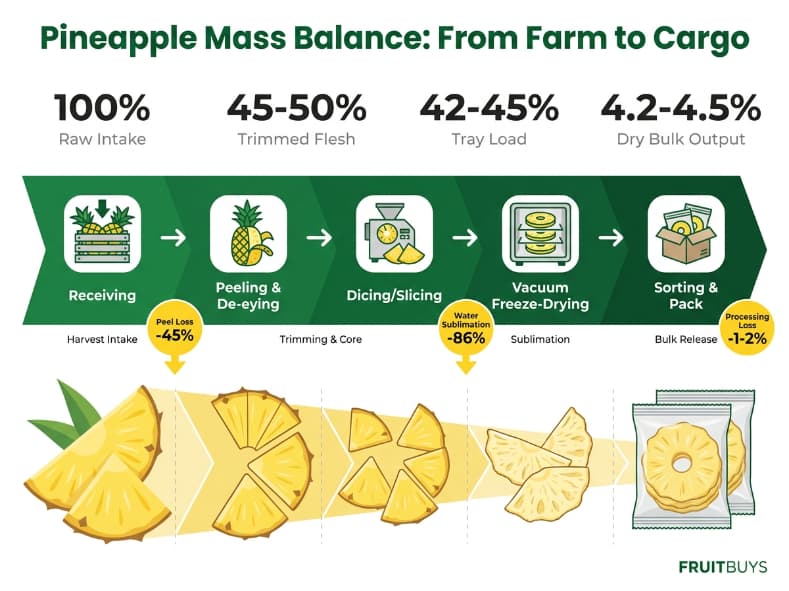
Minimum record structure:
| Stage | Required Weight | Buyer Meaning |
|---|---|---|
| Whole pineapple received | kg | Raw-material planning basis |
| Pineapple after crown and peel removal | kg | Major non-edible loss |
| Pineapple after eye and defect trimming | kg | Usable processing basis |
| Pineapple after core handling | kg | Edible-flesh definition |
| Cut pineapple loaded to trays | kg | Freeze-drying input |
| Dried output before sorting | kg | Gross dried production |
| Released pieces | kg | Buyer-usable product |
| Fines | kg | Application-dependent output |
| Broken pieces | kg | Usable or downgraded output |
| Reject or rework | kg | Loss requiring explanation |
| Final moisture | % | Finished weight basis |
| Final Aw | value | Stability and release control |
The record should also identify batch code, product format, cut size, raw-material variety where confirmed, processing date, packing date and release decision. FruitBuys should use this record under Raw Material Sourcing Governance and Quality Control. The buyer should see what FruitBuys controls, verifies and releases.
How Format Changes Released Yield
Cubes, bites, slices and powder do not produce the same released yield. Format changes the cut surface, drying behavior, breakage risk, sorting loss and usable product definition. This section connects to format losses and released yield.
A buyer who asks for “pineapple pieces” without format tolerance cannot evaluate yield. The supplier may recover more material as small fragments, but the buyer may reject those fragments for a retail snack pouch.
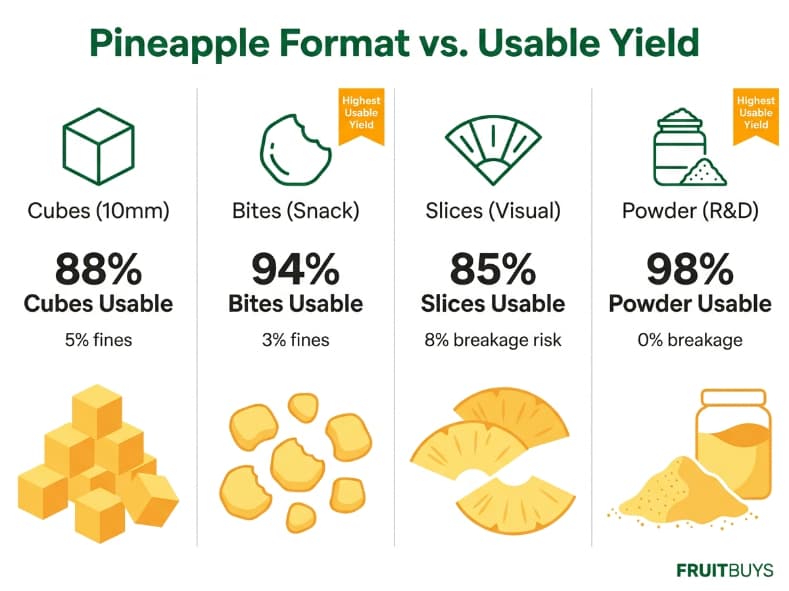
| Format | Yield Risk | Buyer Control Point |
|---|---|---|
| Cubes | Broken corners and undersized pieces | Size range and fines limit |
| Bites | Irregular pieces and visual variation | Piece range and intact-piece expectation |
| Slices | Edge breakage and rejected fragments | Thickness and broken-slice tolerance |
| Powder | Milling loss, caking and sieve loss | Mesh, carrier status and released powder weight |
A yield number should state whether fines count as saleable product. For cereal or powder applications, fines may still carry value if the buyer approves them. For snack pouches, the same fines may become rejection risk.
FruitBuys should not publish one conversion claim across all formats unless batch data supports that exact claim. Format-specific yield creates cleaner buyer expectations.
How Process Controls Affect Conversion Ratio
Processing does not merely remove water. It also determines what becomes releasable product. Pineapple maturity, cut geometry, tray loading, freezing, sublimation and unloading all influence loss. The buyer should connect yield review to pineapple freeze-drying process controls. A conversion ratio without process context leaves too many variables unmanaged.
Important controls include:
- Maturity at intake
- Soluble solids and texture
- Trim standard
- Cut size
- Tray loading density
- Freezing condition
- Drying endpoint
- Unloading exposure
- Sorting criteria
- Packaging timing
If the processor dries uneven pieces, thicker pieces may retain more moisture while thinner pieces become fragile. If the operator overloads trays, drying uniformity may suffer. If sorting rules change, the released yield changes even when drying output remains similar.
This is why the ratio must use released finished product, not only dried output. The buyer does not approve “what came out of the dryer.” The buyer approves product that passes the specification.
COA, Moisture and Released Yield
A conversion ratio that ignores final moisture can mislead the buyer. Higher final moisture increases finished weight. Lower final moisture decreases finished weight. That difference can distort yield unless the ratio states the final moisture basis.
For this cluster, the submitted target is moisture 3-5% and Aw below 0.30. These values require current-lot confirmation before use as release proof. The COA should identify the product format, lot code, moisture result, Aw result, method and release status.

This section connects to lot-based COA and laboratory proof. The COA does not calculate yield by itself, but it confirms the final condition of the product used in the yield calculation.
A release-grade yield file should include:
| Proof Item | Why It Matters |
|---|---|
| Mass-balance record | Shows input and output weights |
| COA | Confirms final moisture and Aw |
| Product specification | Defines accepted format |
| Sorting record | Separates pieces, fines and rejects |
| Retained sample | Supports visual and sensory comparison |
| Packaging record | Shows final released pack condition |
Do not approve a conversion ratio that stands alone. It needs the release file behind it.
Highest Risk: Using a Universal Ratio for Procurement Planning
The highest risk appears when a buyer treats one conversion ratio as universal. That shortcut damages planning because raw material, format and release basis change the number.
A buyer may receive a statement such as “9-11 kg fresh pineapple makes 1 kg freeze-dried pineapple” and assume it applies to every order. It may not. The ratio may shift when the buyer changes from bites to slices, from pieces to powder, from whole-fruit basis to edible-flesh basis or from gross dried output to released product.
That mistake creates downstream friction:
- Sample approval uses one yield basis
- Production planning uses another basis
- COA reports final moisture without explaining yield
- Bulk lot contains more fines than expected
- Buyer disputes usable output
- Both sides argue from different definitions
FruitBuys should prevent this by locking the ratio only after batch evidence confirms the input basis and finished-output basis.
Application Mapping
| Buyer Type | Application | Required Format | Proof Needed | FruitBuys Delivery |
|---|---|---|---|---|
| Importer | Bulk qualification | Cubes, bites, slices or powder | Mass balance, COA, released-product yield | Raw Material Sourcing Governance and Documentation |
| Procurement manager | Raw-material planning | Approved format | Whole fruit vs edible-flesh basis | Yield-basis clarification |
| QA manager | Lot release | Any approved format | Moisture, Aw, sorting record, COA | Quality Control |
| R&D developer | Pilot application | Cubes, pieces or powder | Usable output by format | Application-specific sample control |
| Private label buyer | Retail pouch | Bites, slices or powder | Released pieces, fines, packaging impact | OEM/Private Label Delivery |
| Distributor | Replenishment planning | Same approved SKU | Repeatable yield and release file | Documentation and shipment readiness |
Why FruitBuys Locks Yield by Product Definition
FruitBuys supplies freeze-dried pineapple as one configured product under one accountable route. The conversion ratio must serve that product definition. It cannot float outside the specification.
Raw Material Sourcing Governance controls variety direction, maturity and intake criteria. Quality Control records moisture, Aw, sorting and release. Documentation connects batch weights, COA and product identity. When those pieces align, the buyer can use the conversion ratio as a planning tool. When they do not align, the number becomes noise.
FruitBuys should not claim a universal ratio for every pineapple format. The right approach is stricter: define the input basis, define the output basis, record the batch, confirm moisture and Aw, then report the conversion range only for the approved product route.
Buyer Checklist
Before accepting a freeze-dried pineapple conversion ratio, request:
- Whether the input basis is whole fruit, peeled fruit, trimmed edible flesh or tray-loaded material
- Whether the output basis is gross dried output or released finished product
- Product format: cubes, bites, slices or powder
- Raw-material variety where confirmed
- Batch code and production date
- Whole-fruit weight
- Trimmed edible-flesh weight
- Tray-loaded weight
- Dried output before sorting
- Released pieces
- Fines and broken pieces
- Reject or rework weight
- Final moisture result
- Final Aw result
- COA and test method
- Sorting criteria
- Retained sample
- Packaging condition
Reject any conversion claim that does not state its weighing points. The ratio may sound technical, but without mass balance it cannot support a buyer decision.
Summary
Freeze-dried pineapple conversion ratio depends on input basis, fresh moisture, trimming loss, drying loss, final moisture and released-product criteria.
A 9-11 kg claim must state whether it refers to whole pineapple, peeled fruit, trimmed edible flesh or tray-loaded material. FruitBuys treats conversion ratio as a mass-balance control supported by moisture, Aw, sorting record, COA and sample-to-bulk release review.
FAQ
How many kilograms of pineapple make one kilogram of freeze-dried pineapple?
The answer depends on input basis. Whole fruit, trimmed edible flesh and released product give different ratios. The submitted 9-11 kg claim needs batch mass-balance proof before publication as a locked edible-flesh ratio.
Why does edible-flesh basis matter?
Edible-flesh basis excludes peel, crown, eyes and some trimming loss. If a supplier mixes whole-fruit and edible-flesh ratios, the buyer cannot compare yield correctly.
Does final moisture affect conversion ratio?
Yes. Final moisture changes finished weight. A lot at higher final moisture weighs more than a drier lot, so the ratio must state final moisture and COA result.
Do cubes, slices and powder have the same yield?
No. Each format carries different cutting, drying, breakage, sorting and release loss. Use format losses and released yield before comparing formats.
Can fines count as finished product?
Only when the buyer approves them for the intended application. Snack pouches may reject fines, while powder or cereal applications may use some smaller fractions.
Which article covers moisture and Aw?
Use moisture inputs behind conversion yield to understand how moisture and Aw affect release proof and product stability.
Which article controls bulk yield consistency?
Use bulk yield and release consistency to compare approved samples, released product, sorting output and current-lot documentation.
Conclusion
Request batch mass-balance review after defining the pineapple input basis, finished format, released-product criteria, moisture, Aw and COA requirements.
References
- UNCTAD. Pineapple: An INFOCOMM Commodity Profile. 2016. (UNCTAD)
- USDA Food Safety and Inspection Service. Does freeze-drying make food shelf stable? Updated 2024. (Ask USDA)
- U.S. Food and Drug Administration. Water Activity (aw) in Foods. (U.S. Food and Drug Administration)
- USDA FoodData Central. Downloadable Data and Documentation. 2026 release information. (FoodData Central)
- USDA FoodData Central. Data Documentation. (FoodData Central)