
Should You Source Freeze-Dried Pineapple from Vietnam, and When Is Another Origin Better?
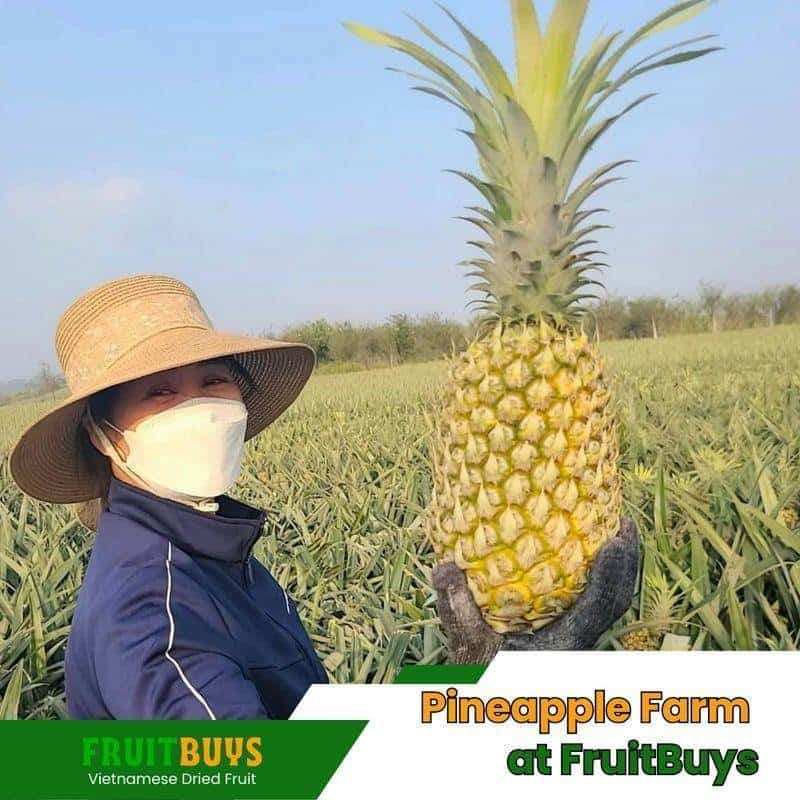
Source from Vietnam when your product sells on flavour. Queen pineapple from the acid-sulphate soils of the Mekong Delta gives freeze-dried pieces a deep natural gold, a strong aroma and a sharp sweet-tart bite that still comes through when the consumer opens a bag of granola or bites into a chocolate-coated piece. That is a different eating experience from milder MD2, and it is why Vietnam fits specifications built on aroma, colour and year-round processing rather than one variety name on the pouch. The country grows about 52,000 hectares of pineapple and produces more than 860,000 tonnes a year. MD2, the variety that dominates fresh supermarket shelves, covers under 5% of Vietnam’s planted area. FruitBuys sources Queen from Mekong Delta farms within a few hours’ drive of its Ho Chi Minh City base, close enough to check ripeness and spray records in the field.
That one fact sets the sourcing strategy:
- If your pack must say “MD2” at enterprise volume, source from Costa Rica. Vietnam’s MD2 supply is too small for large contracts.
- If your specification targets crisp texture, golden colour, a balanced sweet-tart taste and a single-ingredient label, Vietnamese Queen fruit gives you flavour and continuity advantages.
Queen or MD2: which variety should you specify?
Specify eating quality, not a variety name, unless the name is printed on your pack. Many buyers default to MD2 because it dominates the fresh trade; in freeze-drying, that default narrows supply without improving the product.
| Variety | Brix at receiving | In freeze-dried form | Best fit |
|---|---|---|---|
| Queen | 14–18° | Strong aroma, deep yellow, balanced acidity | Retail snacks, cereal inclusions, chocolate enrobing |
| MD2 | 15–17° | Sweet, uniform golden colour, mild acidity | Programmes with MD2 named on the pack |
Brix is the sugar reading of the juice, and in freeze-drying it is a cost number, not only a taste number. Sweeter, denser fruit carries more solids per kilogram of flesh: in FruitBuys production, high-Brix Queen needs about 9 kg of trimmed flesh per kilogram of finished product, while fruit near the bottom of the intake range needs about 11 kg. That is roughly 22% more fruit for the same output, before any difference in colour or taste. This is why FruitBuys receives retail-grade fruit at 15–17° Brix and rejects deliveries below 12°: the cut-off protects your cost per kilogram and keeps bulk lots close to the approved sample. The full fruit-to-product calculation is in how much fresh pineapple makes 1 kg of freeze-dried pineapple.
Specification rule: write “Queen or MD2, Brix 15–17°, moisture 3–5%, water activity ≤0.30” instead of a single variety. Vietnam can meet that in every quarter.
Can Vietnam supply freeze-dried pineapple all year?
Yes. Mekong Delta farms stagger planting and flowering on irrigated land, so the region harvests Queen pineapple every month, and the nearby Central Highlands add volume when demand peaks.
| Region | Varieties | Harvest window and control |
|---|---|---|
| Mekong Delta (Tiền Giang, Long An, Kiên Giang, Hậu Giang) | Queen (main source), MD2 in small volume on request | Year-round, supported by irrigation; farms within a few hours’ drive of FruitBuys in Ho Chi Minh City, visited during the season |
| Central Highlands | Queen | Year-round supplementary supply; sweetness varies by season |
Keeping every farm within driving distance is a deliberate choice. Fruit reaches the freezer fast, and ripeness, spray records and the pre-harvest interval are checked at the farm, not taken on trust from a trader.
Fruit in the field does not by itself put product on your truck. Factories lock freeze-dryer capacity against written volumes; programmes without them buy spot, at whatever the domestic fresh market charges that month. Two clauses turn the calendar into a supply plan:
- Quarterly allocation. Reserve volume per quarter in writing. It is the clause that protects you from fresh-market price spikes.
- Approved substitution. If one region’s crop fails, the supplier may deliver from the other approved region at the same cut, moisture and water activity, with 30 days’ notice and your approval of a pre-shipment sample within 7 days. A crop shortfall becomes a documented change, not a missed shipment.
FruitBuys runs a working buffer of about 10 tonnes of frozen pineapple at −18 °C, which keeps freeze-dryers running between harvest peaks regardless of daily farm-gate swings. Mekong Delta fruit reaches the freezer within 24–48 hours of harvest, which is what holds the aroma you are paying for. Colour and sweetness still move between regions, so a year-round programme also needs a Brix range and colour tolerance, covered in why the bulk shipment differs from the sample.
How do you pick a ripe pineapple at harvest and intake?
A pineapple does not ripen further once it is cut: what is picked is what goes into the bag. FruitBuys and its partner farms look for the same signs a careful shopper does, then measure them.
| Check | Ripe Queen pineapple | Why it matters |
|---|---|---|
| Shell colour | Yellow rising from the base, at least a third of the way up | Green fruit dries pale and sour |
| Aroma | Sweet pineapple smell at the base | No smell means low sugar; a vinegary smell means overripe |
| Eyes and shell | Eyes flat and full, shell firm with a slight give | Sunken eyes or soft patches mean bruising or rot inside |
| Weight | Heavy for its size | Juicy flesh carries more solids per kilogram |
| Sweetness at intake | 15–17 °Brix for snack grades | Fruit below 12 °Brix is turned away |
| Spray records | No ethephon in the 14 days before harvest | Keeps EU-bound lots inside the residue limit |
| Time to freezer | Within 24–48 hours of harvest | Holds the aroma you are paying for |
The same four field signs work in a supermarket: colour from the base, sweet smell, firm full eyes and weight. The intake checks are what turn them into a specification you can sign.
Freeze-dried, air-dried or sugar-infused: which technology fits?
Choose the technology by what the piece must do in your product.
| Technology | What you get | Where it wins | Trade-off |
|---|---|---|---|
| Freeze-dried | Crisp, light, porous, 100% fruit | Cereal, snack mixes, toppings, fast rehydration, clean label | Uses about 4–10 times the energy of hot-air drying |
| Hot-air or solar dried | Dense, chewy | Bakery, bars, trail mix | Loses crispness and colour |
| Sugar-infused dried | Soft, sweet, glossy | Confectionery, sweet snacks | No “no added sugar” claim; classified as prepared fruit (HS 2008.20) |
Freeze-drying costs more for structural reasons: each kilogram of finished product starts as 18–22 kg of whole fruit and needs a vacuum cycle of 18–30 hours. Where crunch and a single-ingredient label are part of the product, that cost buys the product. Where they are not, air-dried pineapple is cheaper per usable kilogram. Much of Europe’s dried pineapple comes from West Africa (Ghana, Togo, Benin, Côte d’Ivoire) and is mainly air- or solar-dried; it competes on that technology, not on freeze-dried pieces.
How do Vietnam, Costa Rica, Thailand and the Philippines compare?
Each origin is built for a different product. Match the origin’s infrastructure to your format.
| Origin | Strength | Limitation for freeze-dried pineapple |
|---|---|---|
| Vietnam | Queen aroma and colour; off-season harvest; EVFTA access to the EU | Small MD2 volume; US duty position since July 2026 |
| Costa Rica | MD2 at scale: about 60% of global fresh pineapple supply, around 40,000 ha of MD2 | Industry built for fresh export, not freeze-drying |
| Thailand | Large processing base for canned and dried pineapple | Capacity centred on canned and heat-dried products |
| Philippines | Year-round supply at scale | Volume committed mainly to canning, juice and fresh export |
When another origin is the better choice:
- Costa Rica, when MD2 must be named on the pack at large volume.
- Thailand or the Philippines, when you need canned cuts, puree or low-cost sugar-infused pieces.
What duty applies in the EU and the US?
Single-ingredient freeze-dried pineapple is classified under HS 0804.30, pineapples, fresh or dried; the classification reasoning is in the HS code and EU residue guide.
- European Union. The standard third-country duty on CN 0804 30 00 is 5.8%. Under the EU–Vietnam Free Trade Agreement, shipments clearing with an EUR.1 certificate of origin issued in Vietnam, on the same HS code as the invoice, enter at 0% preferential duty. That removes the full 5.8% and offsets part of the long sea freight.
- United States. Duty treatment for Vietnamese dried fruit has changed several times since 2025. Confirm the current rate for HS 0804.30 at the time of contract and enter it in the formula below.
Landed duty = applicable duty rate at entry × customs value
The number that decides the contract is landed cost per usable kilogram, with duty as one line in it.
US imports also need paperwork that EU imports do not. FruitBuys’ partner factories hold active FDA food facility registrations for your Foreign Supplier Verification Programme file, and each shipment is covered by Prior Notice filed before arrival. US label rules are in the HS code and label guide.
Origin and technology decision matrix
| If your product needs… | Choose | Write into the specification |
|---|---|---|
| Crisp pieces, strong pineapple flavour, 100% fruit | Freeze-dried, Vietnam (Queen) | Brix 15–17°, moisture 3–5%, water activity ≤0.30, quarterly allocation |
| MD2 named on the pack, large volume | Freeze-dried from an MD2 origin, or limited Vietnamese MD2 | Variety declaration per lot |
| Chewy pieces for bakery or bars | Hot-air or solar-dried | Moisture and texture limits |
| Soft, sweet confectionery pieces | Sugar-infused | HS 2008.20 and sugar labelling |
| US market | Freeze-dried, Vietnam, compared on landed cost | Confirmed duty and exemption status; factory FDA registration |
| EU market, year-round programme | Freeze-dried, Vietnam | EUR.1 under EVFTA; off-season Brix range |
Frequently asked questions
Is Queen pineapple worse than MD2 for freeze-drying?
No. They are different products. MD2 was bred for uniform size and long fresh shelf life; Queen brings a stronger pineapple aroma and more natural acidity, which balances milk in yogurt and bars. Choose by application and write the Brix and colour you need into the specification.
How do you pick a ripe pineapple?
Look for yellow colour rising from the base, a sweet smell at the base, flat full eyes, a firm shell with a slight give, and fruit that feels heavy for its size. Pineapple does not ripen after picking, so choose by these signs rather than waiting.
Where does FruitBuys source its pineapple?
Queen pineapple from the Mekong Delta (Tiền Giang, Long An, Kiên Giang and Hậu Giang), with the Central Highlands as supplementary supply. MD2 is available in small volume on request.
Can I get MD2 freeze-dried pineapple from Vietnam?
In small volumes, on request. Vietnam’s MD2 area is under 5% of plantings, so a large programme that must name MD2 on the pack is better sourced from an MD2 origin.
What is the difference between moisture and water activity?
Moisture is the total water by weight; water activity is the share of that water free to move and soften the piece or support microbes. A lot at 3–5% moisture and water activity ≤0.30, sealed in high-barrier foil, stays crisp without preservatives.
Request an origin and technology review
Send us your application, target market, cut size, moisture limits and quarterly volumes. FruitBuys will check your specification against Vietnam’s harvest calendar, conversion cost and duty position, so you know whether Vietnamese Queen fruit fits before you issue an RFQ. You can also view commercial specifications and formats or browse the freeze-dried fruit category.



