
What is the nutrition of freeze-dried passion fruit per 100 g?
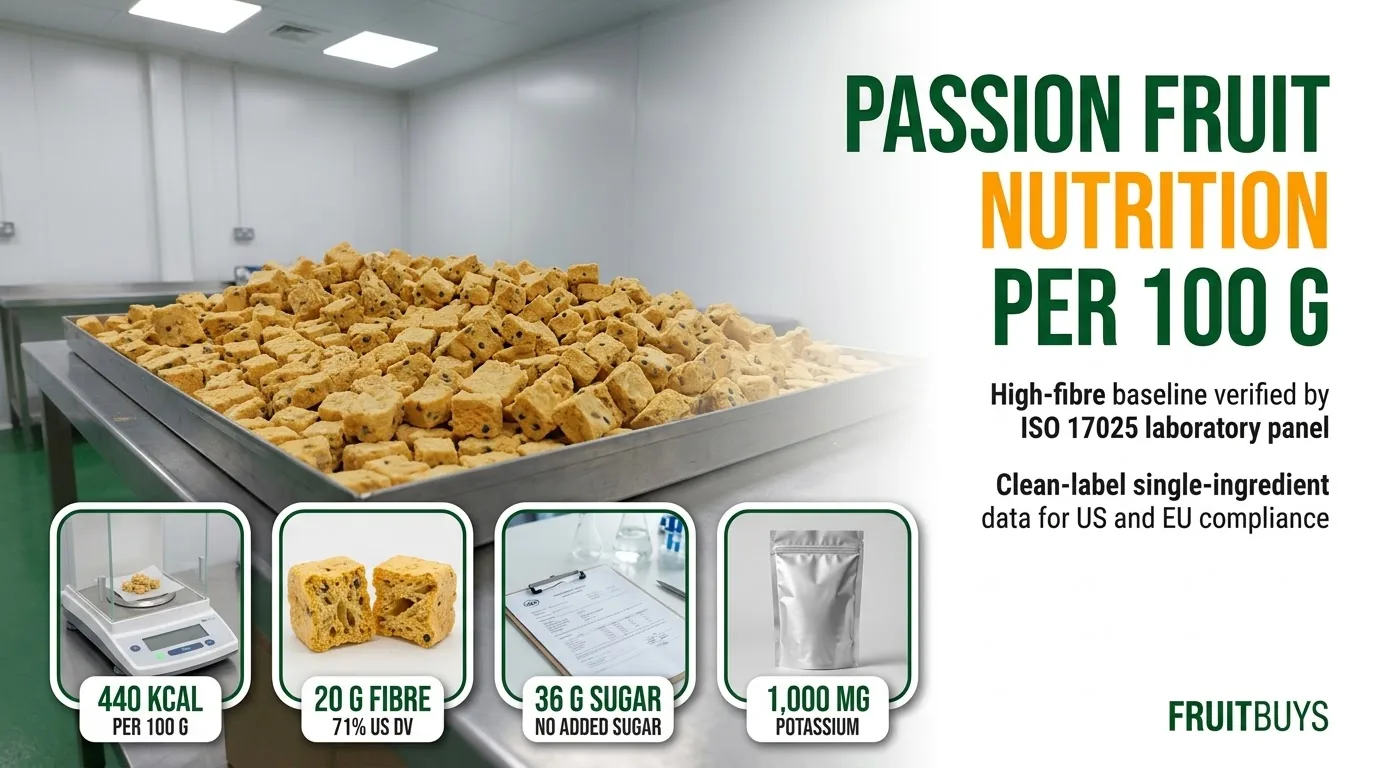
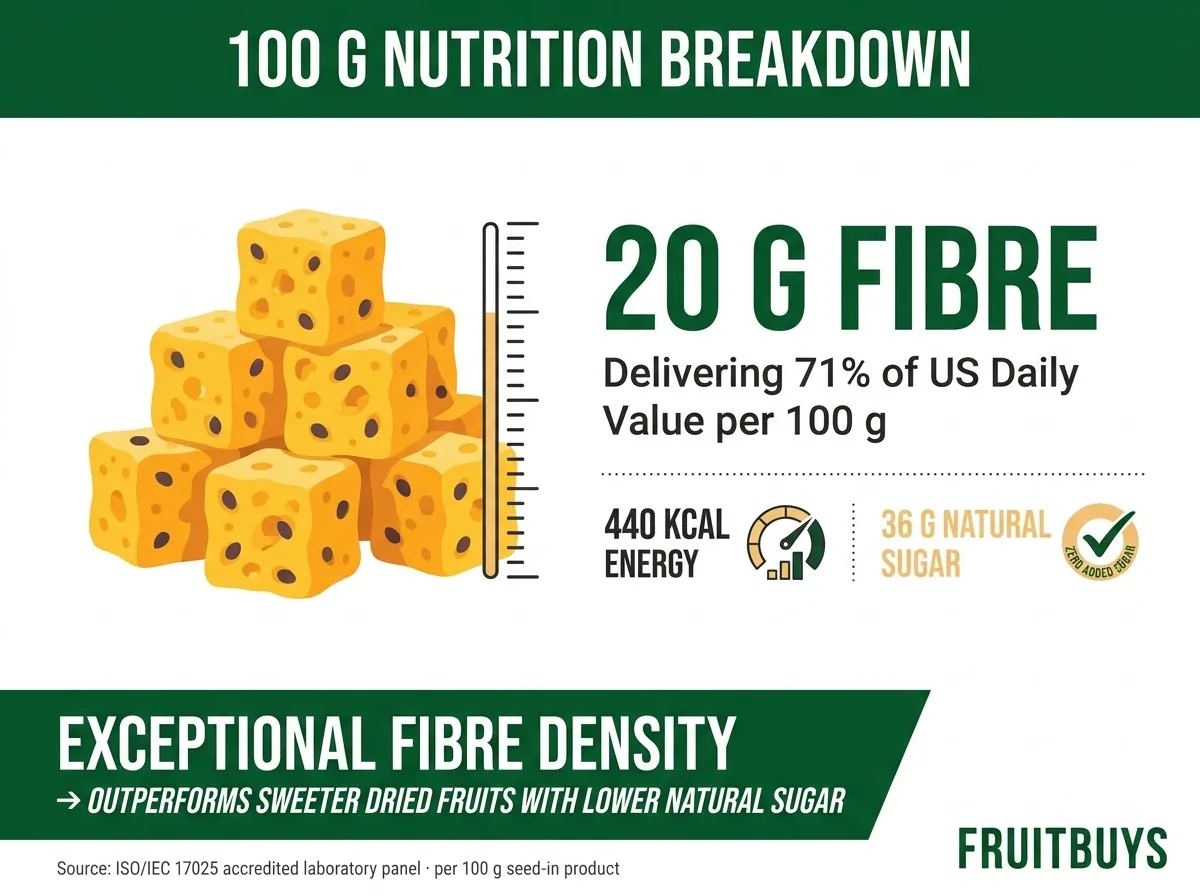
Per 100 g, seed-in freeze-dried passion fruit delivers 440 kcal, 20 g of dietary fibre, 36 g of the fruit’s own sugar, 8 g of protein and 1,000 mg of potassium, with no added sugar. The fibre is the headline.
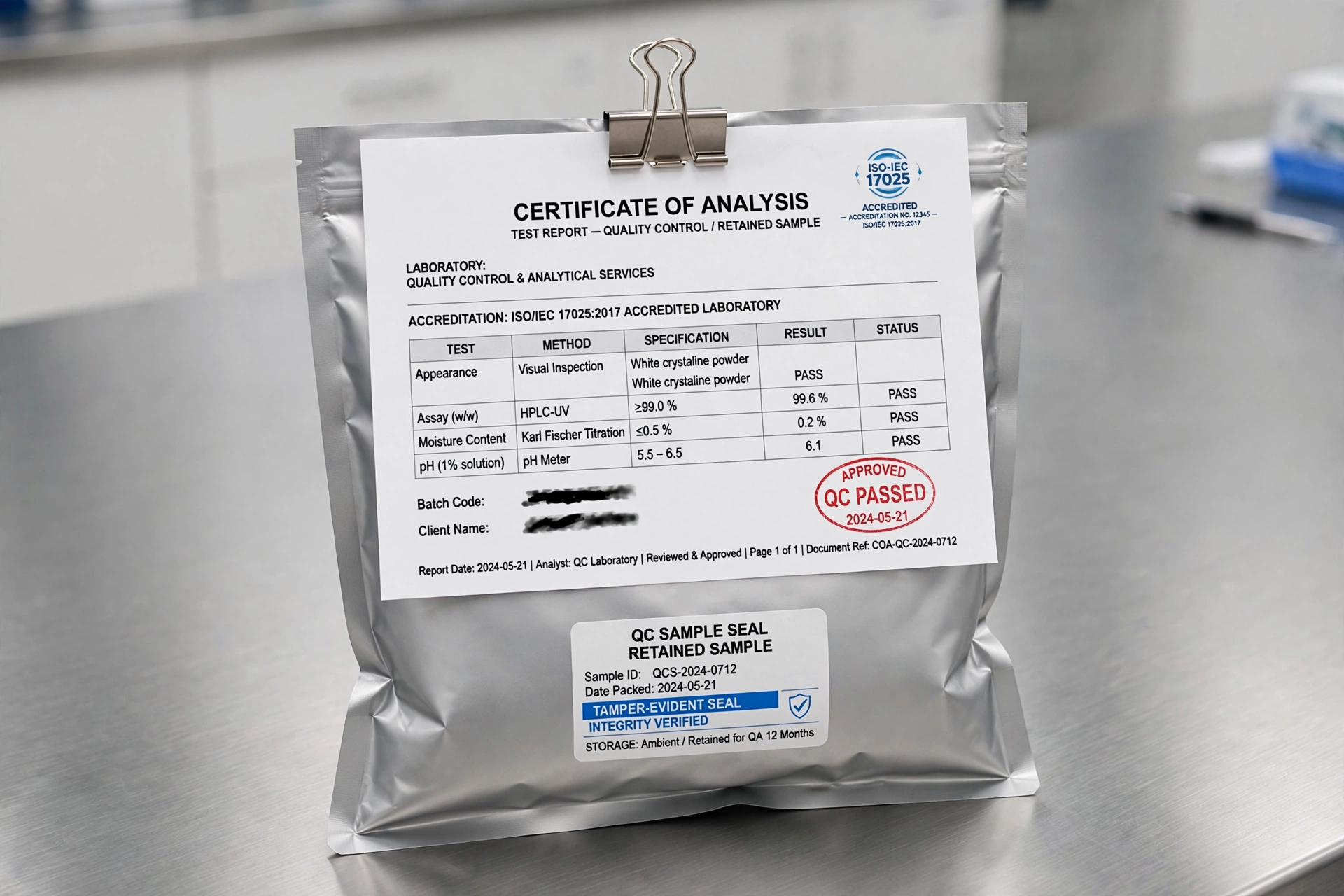
At 71% of the US Daily Value per 100 g, it qualifies for a “high fibre” claim in both the US and the EU, which gives a private-label brand a front-of-pack message most dried fruits cannot carry. The numbers below come from an independent ISO/IEC 17025 accredited laboratory panel on FruitBuys finished product.
What does 100 g of freeze-dried passion fruit contain?
| Nutrient | Per 100 g | % DV (US) |
|---|---|---|
| Calories | 440 kcal | |
| Total fat | 8 g | 10% |
| Saturated fat | 0 g | 0% |
| Trans fat | 0 g | |
| Cholesterol | 0 mg | 0% |
| Sodium | 0 mg | 0% |
| Total carbohydrate | 80 g | 29% |
| Dietary fibre | 20 g | 71% |
| Total sugars | 36 g | |
| Added sugars | 0 g | 0% |
| Protein | 8 g | 16% |
| Potassium | 1,000 mg | 21% |
| Iron | 2 mg | 11% |
Three of these figures surprise buyers who know other dried fruits. The fibre is far above what most freeze-dried fruits carry. The sugar is low for a dried fruit, because passion fruit pulp is sour rather than sweet; for a brand that wants a fruit snack without a “too much sugar” reputation, that sharp, lower-sugar profile is a real advantage over sweeter dried mango or banana. And the fat is high, which the next section explains.
Why does passion fruit carry 8 g of fat and 20 g of fibre?
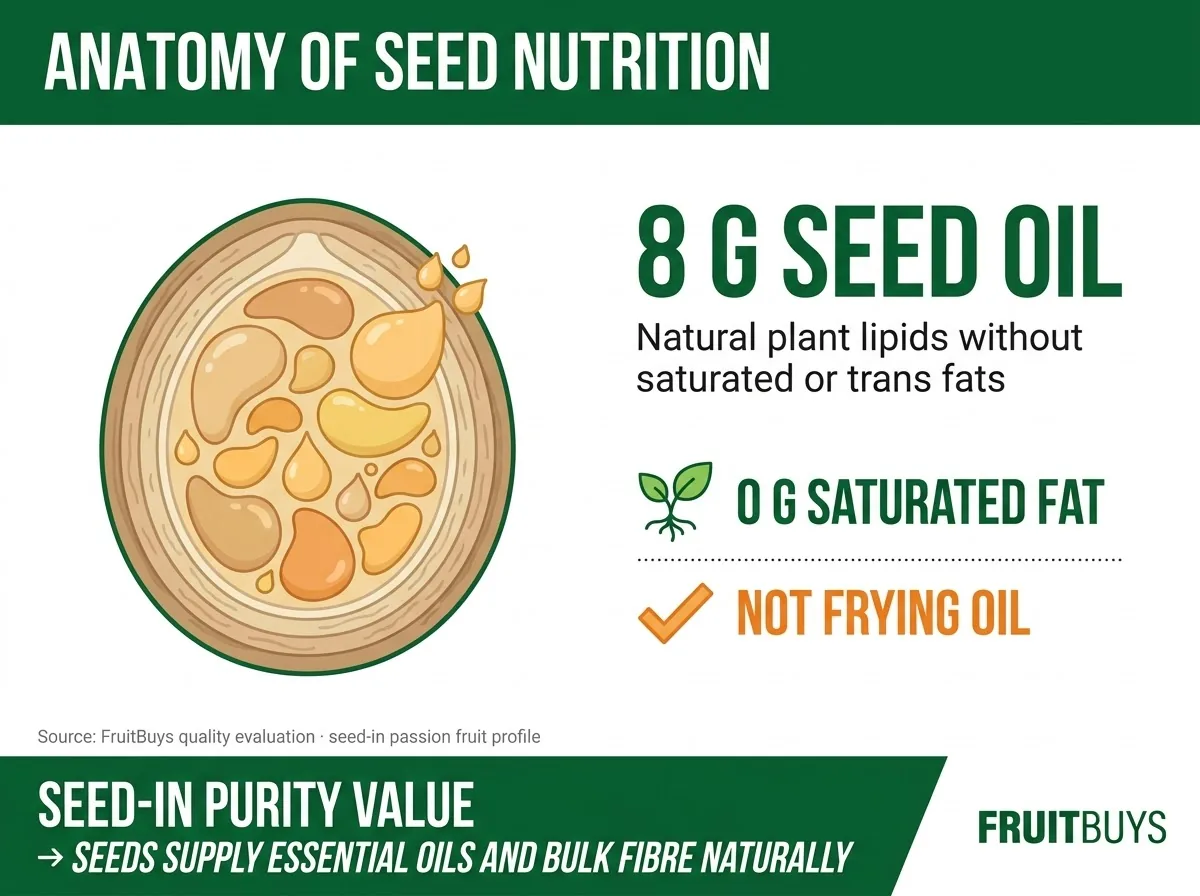
Because of the seeds. Seed-in freeze-dried passion fruit keeps every black seed in the pulp, and passion fruit seeds are rich in oil and insoluble fibre. The 8 g of fat is natural seed oil, not frying oil, and it carries no saturated or trans fat on the panel. The seeds also supply most of the 20 g of fibre and a good part of the aroma.
This is the reason seed-in is the default for most buyers. The seedless version, made to order at a higher price, loses much of the fibre and fat along with the seeds; its nutrition must come from its own panel, not from this table. The choice between the two is set out in seed-in or seedless freeze-dried passion fruit.
Per 100 g or per serving: which number goes on your label?
Per serving, set by the rules of your market, not by the supplier’s sample size. A US label is built on the reference amount customarily consumed (RACC) in 21 CFR 101.12, which for dried fruit is 40 g, and formatted under 21 CFR 101.9. An EU label always shows per 100 g under Regulation (EU) 1169/2011, with per-portion values as an option.
Here is what the same product looks like on a 40 g US serving:
| Nutrient | Per 40 g serving | % DV |
|---|---|---|
| Calories | 176 kcal | |
| Total fat | 3.2 g | 4% |
| Dietary fibre | 8 g | 29% |
| Total sugars | 14.4 g | |
| Added sugars | 0 g | 0% |
| Protein | 3.2 g | |
| Potassium | 400 mg | 9% |
Can you put “high fibre” on the pack?
Yes, in both the US and the EU, on 100% seed-in product.
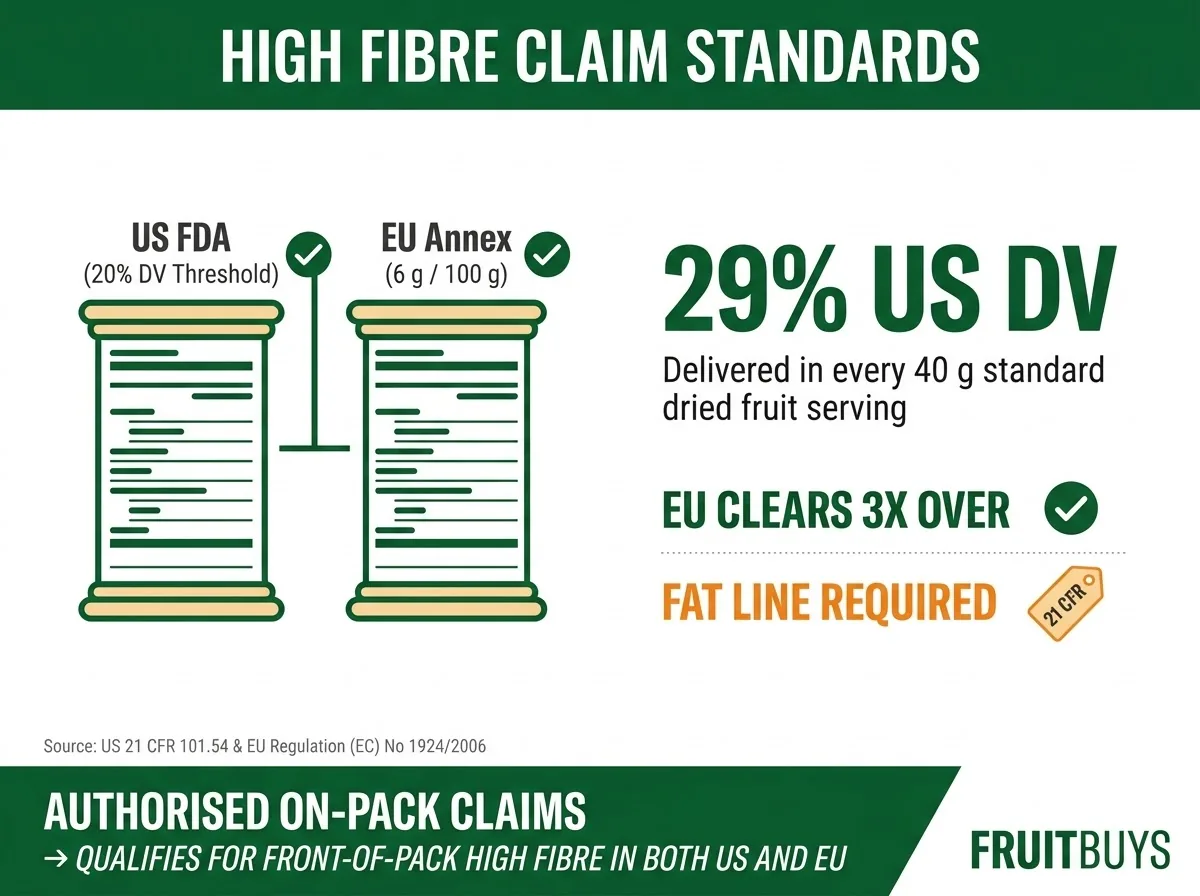
US. “High fibre” requires at least 20% of the Daily Value per reference amount under 21 CFR 101.54. At 8 g per 40 g, freeze-dried passion fruit delivers 29%. The same rule asks any fibre claim on a food that is not “low fat” to show the fat per serving next to it. That is standard label layout for seed-rich foods such as chia or flax, and here the 3.2 g per serving is all natural seed oil with 0 g saturated and 0 g trans fat. Put the fat line beside the claim in your artwork and the label is done.
EU. “High fibre” requires at least 6 g of fibre per 100 g under the annex to Regulation (EC) 1924/2006 on nutrition and health claims. At 20 g per 100 g, the product clears it more than three times over.
The fibre is also the kind shoppers want. It comes from the fruit cells and seed coats, not from added inulin, polydextrose or corn fibre, so the pack can carry a fibre claim with a one-word ingredient list.
Can you claim potassium too?
In the EU, yes. At 1,000 mg per 100 g, freeze-dried passion fruit is well above the 30% of the reference intake that the same annex sets for “high in potassium”. For a brand building sports snacks, energy bites or smoothie powders, that gives a second authorised claim alongside high fibre, from fruit alone.
In the US, potassium does not reach a claim on its own: 400 mg per 40 g serving is about 9% of the Daily Value, just under the 10% needed for “good source”. It still shows on the Nutrition Facts panel, and in a blend with other potassium-rich ingredients the finished product may qualify.
What changes the answer is your recipe. In a cereal or bar where passion fruit is 2–5% of the mix, the claim belongs to the finished product, not to the ingredient, and it will usually not carry across. Use the fibre story where passion fruit is the product: a retail pouch of cubes, a fruit snack, a powder sachet.
Passion fruit seeds also contain natural polyphenols, and they are a good story for brand copy. On the label itself, though, compound-specific health claims need their own regulatory approval in both markets, which slows a launch. The fastest route to market is to build the pack on the authorised nutrition claims this product already meets: high fibre, plus high potassium in the EU.
Is any sugar added?
No. The ingredient line is 100% passion fruit with seeds. The 36 g of sugar per 100 g is the fruit’s own, concentrated by drying. That is also a quick check on any other supplier’s product: a panel showing well above 36 g of total sugars, or added sugars above zero, means sugar has gone in. The ratio behind that check is in how many kilos of passion fruit make 1 kg of freeze-dried.
Can you print these numbers on your own label?
Use them to plan your formula, your claims and your artwork. Then print from a panel on your own commercial lot, in your final format. Fruit varies with season and ripeness, and your label has to describe the product in the pack, not a reference sample.
FruitBuys makes this a service rather than a hurdle: on a commercial run, we sample your lot and arrange the nutrition panel at an ISO/IEC 17025 accredited laboratory, formatted for the US, EU or UAE label. Your printed numbers then describe the fruit you actually sell, which is what a market inspector checks against. Brand owners launching a private-label pouch can line this up with the packaging and artwork timeline from private-label freeze-dried passion fruit.
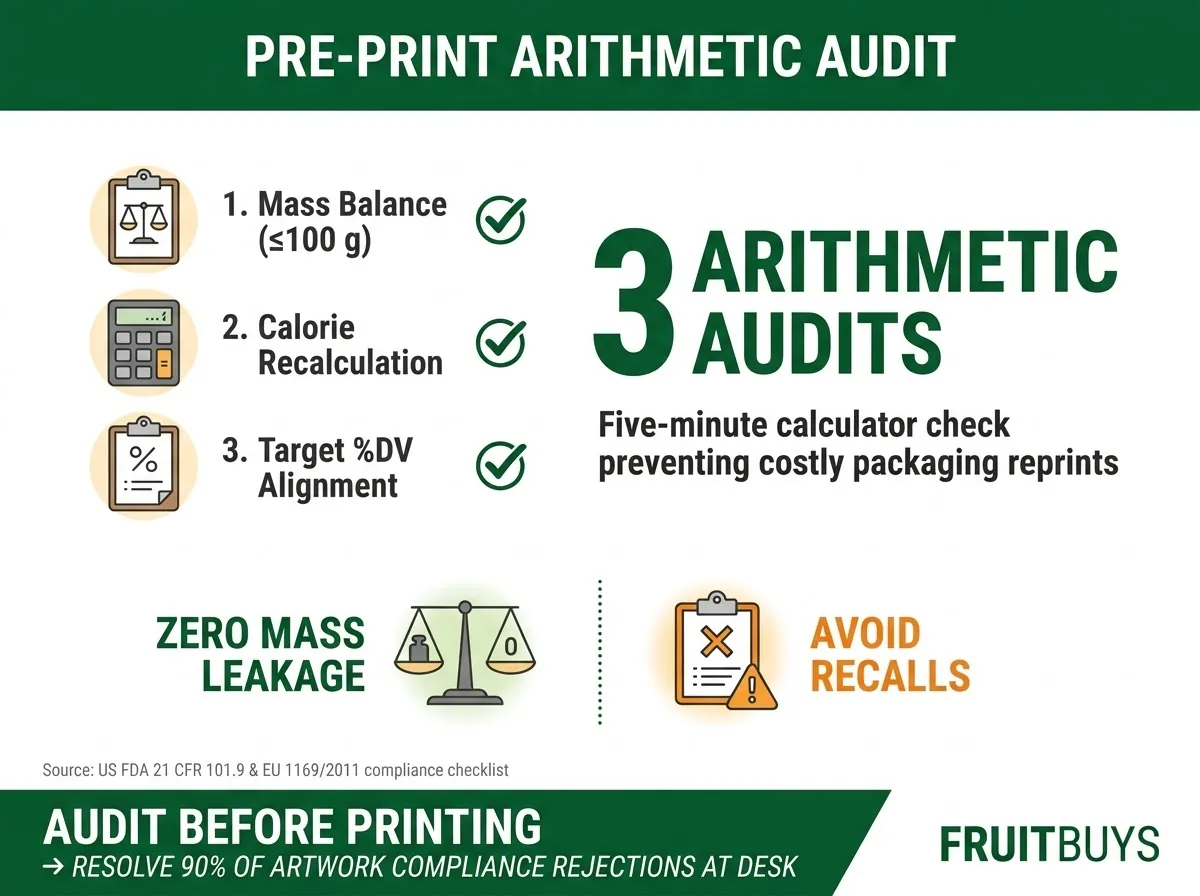
Use this check before you send artwork
| Check | How | Fails when |
|---|---|---|
| Mass balance | Fat + carbohydrate + protein per 100 g | Total exceeds 100 g, or leaves far more than the moisture and ash allow |
| Calories | Recalculate from fat, carbohydrate, protein and fibre | Declared energy is far from the calculation |
| %DV | Recalculate against current US Daily Values | Rounding or reference values do not match your market’s rules |
Most label rejections trace back to one of those three lines, and each takes five minutes with a calculator.
Get the nutrition report for your label file
Send your market, pack size and serving. FruitBuys returns the nutrition panel, the product specification and a per-serving table for your format. Full product details are on the freeze-dried passion fruit page, and the buyer checklist for a first order is in what to check before buying freeze-dried passion fruit in bulk.
FAQ
How many calories are in freeze-dried passion fruit? About 440 kcal per 100 g, or 176 kcal per 40 g serving.
Is freeze-dried passion fruit high in fibre? Yes. It carries 20 g of fibre per 100 g, enough for a “high fibre” claim in the US and the EU on 100% seed-in product.
Can I make a potassium claim? In the EU, yes: 1,000 mg per 100 g qualifies for “high in potassium”. In the US, a 40 g serving gives about 9% DV, just under the 10% needed for “good source”.
How much sugar does it contain? About 36 g per 100 g, all from the fruit. No sugar is added.
Why is the fat higher than in other dried fruits? The seeds stay in, and passion fruit seeds are rich in natural oil. There is no saturated or trans fat on the panel.
Can I use these numbers on my private-label pack? Use them to plan. Print from a panel on your own commercial lot, which FruitBuys arranges at an ISO/IEC 17025 accredited laboratory.



