
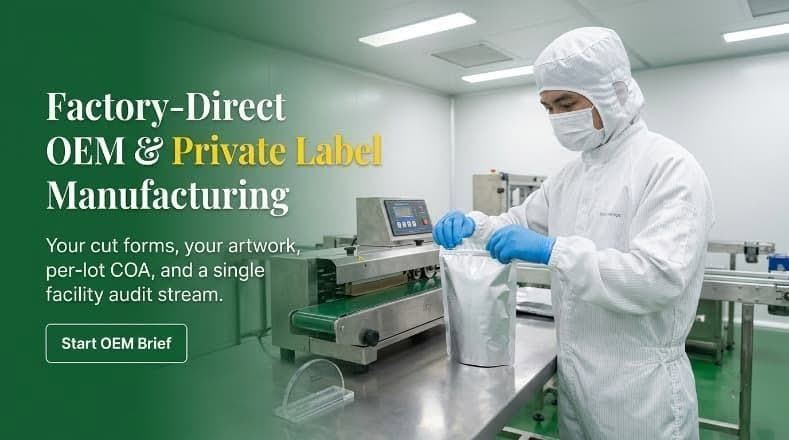
OEM & Private Label Freeze-Dried Fruit: Direct Supply Partner, Not Broker
A brand owner orders private label freeze-dried fruit through a broker, and the first audit request reveals three separate locations: the trading company that signed the contract, the factory that actually produces the product, and the packaging line that runs the artwork. Each location holds a different part of the documentation your retailer requires, and the chain between them answers slowly. Market forecasts for private label freeze-dried fruits project 6.1% annual growth between 2026 and 2036, with retail private label holding the majority share of that segment.
That projected growth rewards buyers who consolidate the audit into one factory, and it punishes buyers who carry three audits instead. This page defines what factory-direct OEM includes, the documentation stream that carries your product into retail, the engagement flow from your spec to full production, and the profile of buyers this model does and does not fit.
Answer Box: Factory-direct OEM delivers cut forms against your drawing, your artwork, pack sizes from 50 g to 5 kg, lot-level COA on every production lot, and a single facility audit covering the freeze-dried fruit range, coconut products, veggie chips, and dried fruit powders.
FruitBuys Vietnam operates freeze-drying, soft-drying, and veggie-chip lines in ISO/HACCP-certified facilities in Ho Chi Minh City with FDA facility registration for US shipments.
What Factory-Direct OEM Includes
The service scope divides into four artifacts you receive with each order, and each artifact replaces a question you would otherwise chase through intermediaries.
| Artifact | What it contains | Why it matters |
|---|---|---|
| Cut form per drawing | Chunk, cube, slice, dice, crumble, or custom shape sized to your inclusion or retail pack | Particle size drives fines percentage, topping performance, and shelf presentation; the spec engineering follows the sequence in the R&D inclusions article |
| Your artwork, your brand | Pouch artwork files run directly through the packing line; pack sizes from 50 g retail to 5 kg food-service | Retail shelf, food-service, and food-manufacturing channels each need their own pack format from the same production specification |
| Lot-level COA | Moisture, aw, micro results, metal detection log, and traceability per production lot | The document your retailer’s QA file demands; every sample and shipment carries it |
| Allergen file | Facility allergen declarations and processing records | Feeds the allergen statement your label system requires without re-testing at each order |

The standard order floor sits at 500 kg per order. Orders below that floor do not match the production-line economics of freeze-drying, and buyers with smaller programs should route through a groupage or distribution arrangement rather than contract manufacturing.
Documentation for Retail Entry
Retail buyers audit the supply chain, not the marketing claim, and factory-direct structure shortens that audit to one location. The documentation stream assembles against the requirements that US and EU retail buyers verify most often: facility audit reports from the manufacturing site, HACCP and ISO 22000 certification in current status, FDA facility registration with renewal history for US programs, and certificates of origin that carry preferential treatment under EVFTA for EU-bound containers.
The certification architecture section of the sourcing guide names the failure points that appear when documentation fragments across broker, factory, and packer.
One certification status deserves honest disclosure. The facility holds HACCP and ISO 22000 with FDA registration, GFSI-recognized schemes including BRCGS and FSSC 22000 sit on the current audit roadmap rather than in the certification file.

Buyers whose retailer mandates GFSI should ask for the current roadmap stage and the audit timeline before contracting, and a supplier who claims GFSI completion during the roadmap phase hands you a compliance problem at your next retail audit.
The Engagement Flow: Spec to Container
The engagement sequence runs through four gates, and each gate produces a document the next one requires.
| Stage | What happens | Output |
|---|---|---|
| Brief and feasibility | You send the product, cut form, pack size, destination market, and annual volume intent; the team returns feasibility, line capacity check, and lead time | Feasibility confirmation within 48 hours |
| Sample | Production run on the target line against your specification, COA accompanies the sample | Sample with lot-level COA in 3 to 5 days |
| Pilot lot | First commercial run validates the specification at volume: cut form, fines, moisture, packaging seal, and documentation file | Pilot lot results against your acceptance criteria |
| Full production | Recurring orders against the validated specification; each lot ships with its COA and your labeling system | Containers at 20 to 30 days production lead time per container |

The consolidation model that follows matters for freight. A portfolio across the freeze-dried range, coconut products, veggie chips, and dried fruit powders ships together in one container, and the container math in the container economics article shows how multi-SKU consolidation spreads fixed freight components across combined tonnage. The compliance chain for each market, including HS classification and phytosanitary rules, appears in importing dried coconut: HS code, FDA, and EVFTA.
One Audit, Multi-Category
A buyer building a snack portfolio audits once against the Ho Chi Minh City facility, and the audit covers the product families that share the certification umbrella: freeze-dried fruit SKUs including freeze-dried banana, freeze-dried mango, freeze-dried pineapple, freeze-dried strawberries, freeze-dried durian, freeze-dried jackfruit, freeze-dried dragon fruit, and freeze-dried mango, coconut products anchored by the freeze-dried coconut meat product page, and the veggie chips and dried fruit powder lines. The full catalog spans the freeze-dried fruit category, the veggie chips category, and the dried fruit powder category.
The model fits buyers who run a brand program with annual volume intent, carry retail or food-manufacturing requirements that demand facility documentation, and prefer one audit stream across a multi-category portfolio.

The model does not fit buyers seeking sub-500 kg spot purchases, buyers whose program requires completed GFSI certification before any commitment, or buyers who need a broker’s sourcing flexibility across third-party factories, since a factory-direct structure trades sourcing breadth for control of the production line and the audit file.
Frequently Asked Questions
What does OEM private label include? Cut forms per your drawing, your artwork, pack sizes from 50 g to 5 kg, lot-level COA, and allergen files.
What is the minimum order? 500 kg per order, smaller programs route through groupage or distribution arrangements.
How long from spec to container? Sample with COA in 3 to 5 days, full production at 20 to 30 days per container after pilot lot validation.
How fast do you confirm feasibility? Within 48 hours of receiving your brief covering product, cut form, pack size, market, and volume intent.
Which certifications do you hold? HACCP and ISO 22000 with FDA facility registration; BRCGS and FSSC 22000 sit on the audit roadmap, and buyers should verify the current stage before contracting.
Can I consolidate categories in one container? Yes. Freeze-dried fruit, coconut, veggie chips, and powders share the facility audit and ship together, which spreads freight components across combined tonnage.

Send the Brief, Get the Feasibility
Send your product, cut form, pack size, destination market, and volume intent by email, and the response returns feasibility and lead time within 48 hours. A sample with lot-level COA against your specification follows in 3 to 5 days. Start with the specification that anchors your program: request freeze-dried coconut meat with your cut form and market, or request samples across the full freeze-dried fruit range for a consolidated program.
*FruitBuys Vietnam operates freeze-drying, soft-drying, and veggie-chip lines in ISO/HACCP-certified, FDA-registered facilities in Ho Chi Minh City. Contact: [email protected]. Export line: +84-919 739 589.
References
- FMI, Private Label Freeze-Dried Fruits market data (2026 to 2036: $750M to $1.36B at 6.1% CAGR; retail private label share; lot-level COA as buyer decision factor): https://www.futuremarketinsights.com/
- U.S. FDA, Food Safety Modernization Act: Preventive Controls for Human Food (21 CFR 117; facility requirements; buyer verification expectations ): https://www.fda.gov/food/fsma-final-rule-preventive-controls-human-food



