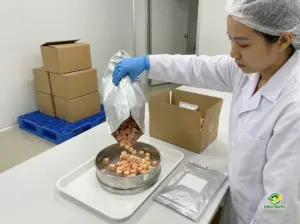
What moisture, water activity and microbiology limits should a freeze-dried papaya contract set?
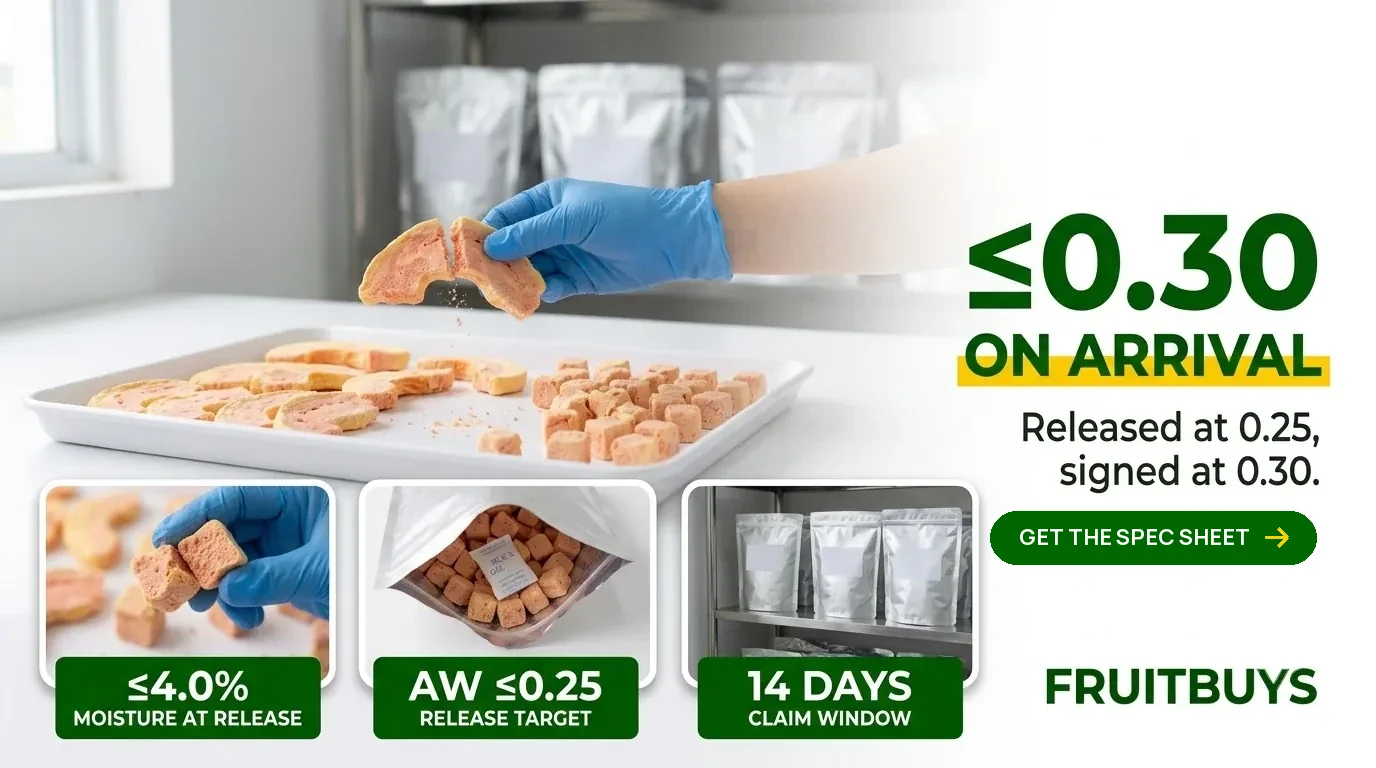
Sign freeze-dried papaya at moisture ≤5.0% and water activity (aw) ≤0.30, and ask for a tighter release level of ≤4.0% and ≤0.25 on the day the lot is packed. The gap between the two is your buffer for four to six weeks at sea and a few days in a humid port. Add the six-line microbiology set to every lot COA, choose the inclusion grade if the papaya goes into chocolate, dairy or ice cream, and agree in writing how you will re-test on arrival. That set of limits decides whether the dice still snap when your line opens the first bag.
Which limits belong in the contract, and which on the release sheet?
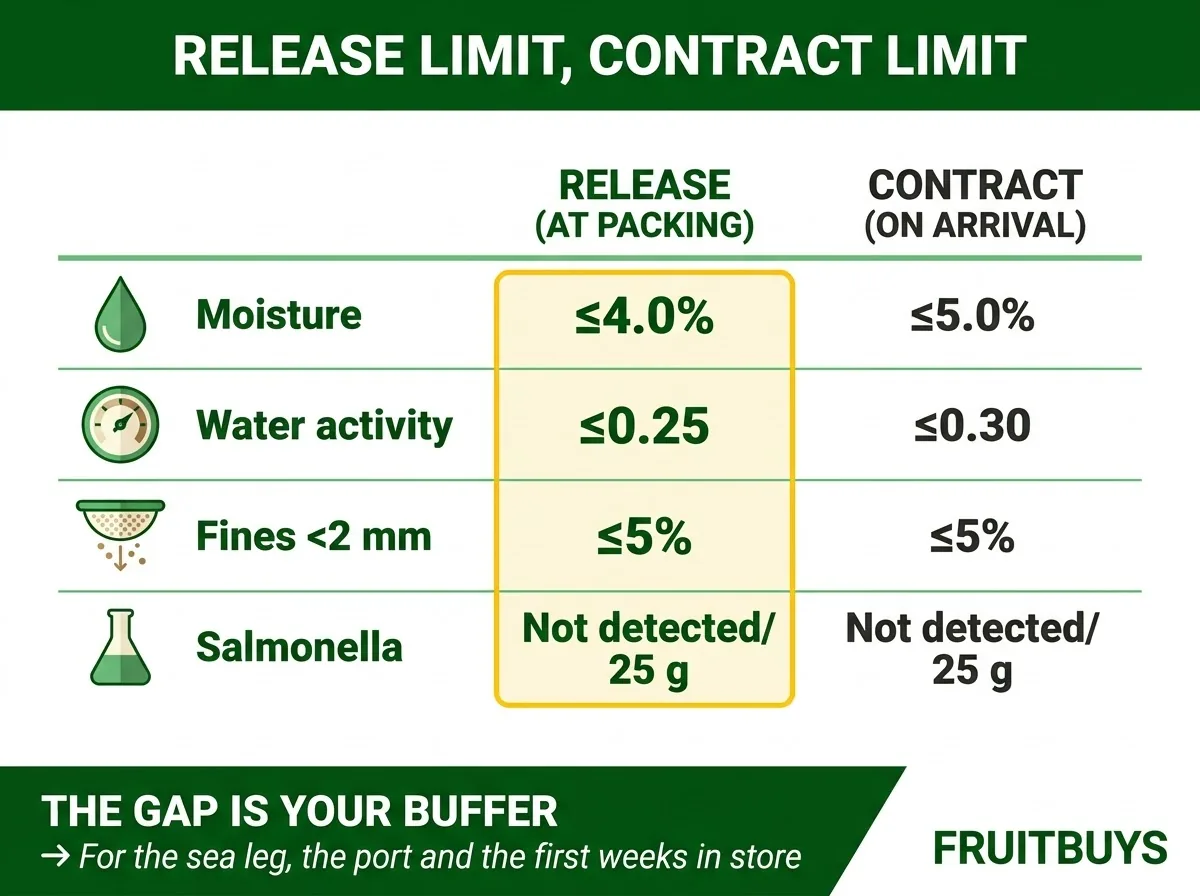
The contract limit is the line a lot must meet when it reaches you; the release limit is what FruitBuys holds a lot to before the container is sealed. Write both into the specification, so everyone knows how much margin the lot left the partner facility with. The full product specification, by cut, is on the freeze-dried papaya product page.
| Parameter | Release (at packing) | Contract (on arrival) | What it protects |
|---|---|---|---|
| Moisture | ≤4.0% | ≤5.0% | Fruit solids per kg you pay for; crisp texture |
| Water activity at 25 °C | ≤0.25 | ≤0.30 | Crispness, flow and microbial stability |
| Total plate count | ≤10⁴ CFU/g | ≤10⁴ CFU/g | General hygiene of prep and packing |
| Yeasts and moulds | ≤10² CFU/g | ≤10² CFU/g | Spoilage risk once the product meets moisture |
| E. coli | <10 CFU/g | <10 CFU/g | Hygiene indicator |
| Salmonella | Not detected / 25 g | Not detected / 25 g | The pathogen that matters most in dry foods |
| Cut size | ≥90% within the stated cut | ≥90% within the stated cut | Dosing accuracy and look |
| Fines (<2 mm) | ≤5% in dice and slices | ≤5% in dice and slices | Yield on your line; dust at the bottom of the bag |
Guaranteed specifications: moisture ≤5.0% and aw ≤0.30 on every lot COA; no added colour, no added sugar.
A clause your purchasing team can paste into the contract reads: “Freeze-dried papaya, 100% fruit, no additives. Moisture ≤5.0% and water activity ≤0.30 at 25 °C on arrival (release ≤4.0% / ≤0.25). Microbiology per lot COA from an ISO/IEC 17025 accredited laboratory: TPC ≤10⁴ CFU/g, yeasts and moulds ≤10² CFU/g, E. coli <10 CFU/g, Salmonella not detected in 25 g. Claims within 14 days of unloading; lab results within 30 days.”
Why does papaya turn sticky faster than most freeze-dried fruits?
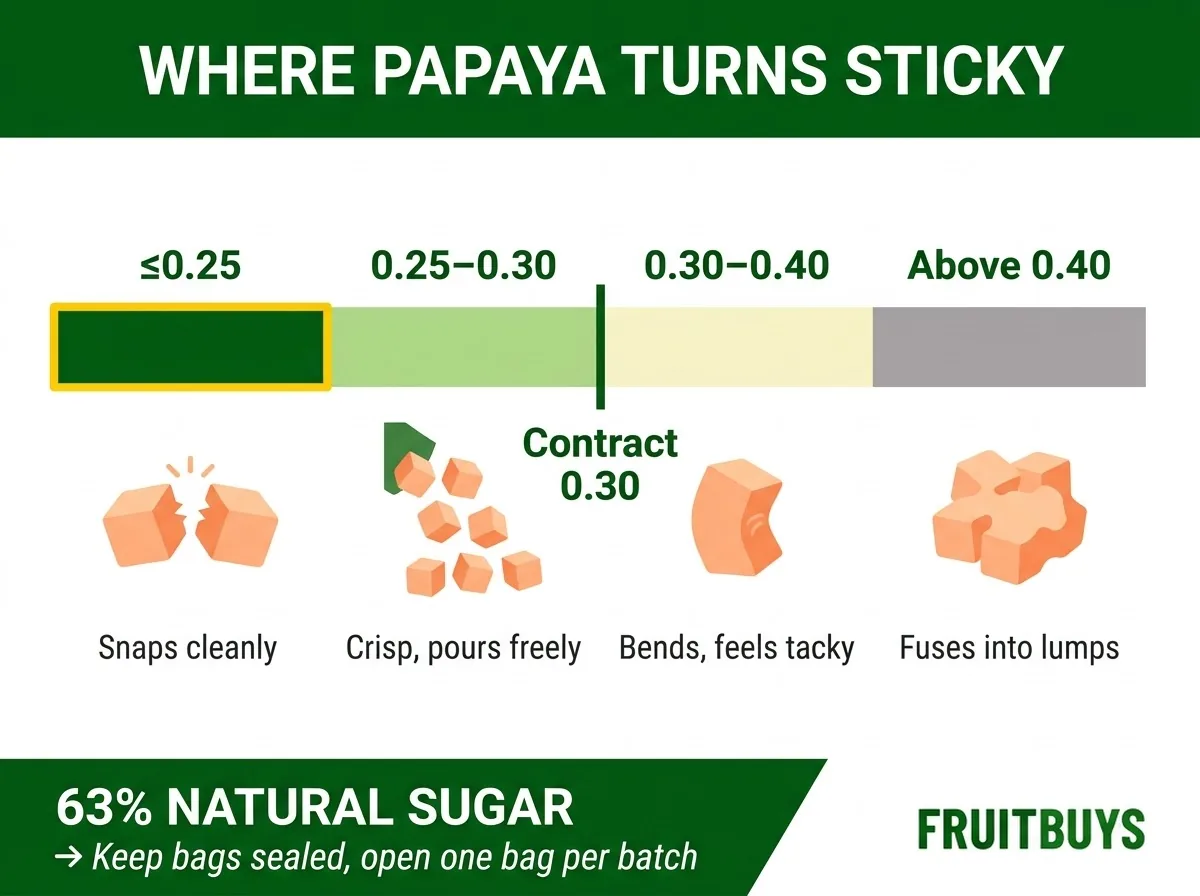
Because papaya is about 63% natural sugar on a dry basis. In a freeze-dried piece that sugar sits in a glassy, brittle state, and it stays glassy only while water activity stays low. Below about 0.30 the dice snap and pour like gravel. As aw climbs toward 0.40, the surface of each piece turns tacky and pieces start to cling in clusters; further up, they collapse, darken and set into a block.
| Water activity | What you see in the bag | What it costs you |
|---|---|---|
| ≤0.25 | Dice snap cleanly, slices ring when tapped | Nothing; this is release condition |
| 0.25–0.30 | Still crisp, pours freely | Within contract; normal transit pick-up |
| 0.30–0.40 | Pieces bend instead of snapping, surfaces feel tacky, clusters form | Dosing errors on volumetric feeders; returns from retail |
| Above 0.40 | Pieces shrink, darken and fuse into lumps | Lot unusable for inclusions |
Moisture alone does not show this. Two lots at the same moisture can sit at different water activity, depending on how the sugars dried, so the meter reading, not the moisture figure, predicts whether your bag will cake. When we open a bag that has stood half-open in a humid store for a week, the dice no longer snap; they bend and stick to each other. That is why bulk bags are sized to one production batch and sealed with food-grade silica gel in a dehumidified packing room at ≤40% RH: one bag is opened, used through, and every other bag stays crisp until its turn.
What does each line on the lot COA tell your QA team?
From one full container, every lot ships with a COA from an independent ISO/IEC 17025 accredited laboratory covering moisture, water activity, total plate count, yeasts and moulds, E. coli and Salmonella. Read it line by line against the contract:
| COA line | Common reference method | Read it as |
|---|---|---|
| Moisture | Vacuum-oven or gravimetric drying | Fruit content per kg: a lot at 5% carries about 1% less papaya solids than one at 4% |
| Water activity | ISO 18787 | Will it stay crisp and free-flowing through your shelf life? |
| Total plate count | ISO 4833-1 | Hygiene of cutting, tray loading and packing |
| Yeasts and moulds | ISO 21527-2 | What could grow if the product picks up moisture after opening |
| E. coli | ISO 16649-2 | Faecal hygiene indicator |
| Salmonella | ISO 6579-1 | Pass or fail: one positive result means the lot does not ship |
Why Salmonella stays on every COA. Low water activity stops bacteria, yeasts and moulds from growing, but it does not kill them, and freeze-drying is not a kill step. Salmonella can survive for months in dry, sugary foods. A ready-to-eat inclusion goes straight into your consumer’s bowl without cooking, so the test result on the lot is the control.
Trial and LCL orders ship with an in-house QC log per batch (moisture, water activity and sensory), and third-party testing is available on request. Each container lot also has a retained sample kept for its full shelf life, up to 24 months, so any later question is answered against the same lot.
Which microbiology grade fits chocolate, dairy and ready-to-eat lines?
The standard grade (TPC ≤10⁴ CFU/g) fits cereals, granola, trail mixes and bakery, where the papaya is either baked or eaten dry. For chocolate, ice cream, yogurt toppings and bars, ask for the inclusion grade, held at TPC <1,000 CFU/g and confirmed on each lot COA. These products carry the papaya into a moist or long-life matrix without a heat step, so their own micro specification leaves little room for the ingredient.
Specify the inclusion grade in the RFQ rather than after the first lot arrives: it is set at packing, so it has to be in the order from the start. For ready-to-eat lines that need more, Listeria and Enterobacteriaceae testing is available for each lot on request, before the container is sealed.
How are heavy metals, pesticide residues and GM status controlled?
Each of these is handled as a test you can attach to your lot, at an accredited laboratory of your choice, such as Eurofins or SGS in Vietnam, before the container is sealed:
- Heavy metals: ICP-MS testing for lead, arsenic, cadmium and mercury on each lot on request. Baby-food brands use it for supplier approval; the dosage arithmetic is on the freeze-dried papaya powder page.
- Pesticide residues: a multi-residue panel to your market’s MRLs, tested before stuffing.
- GM status: the Red Lady-type papaya FruitBuys sources is a conventionally bred F1 hybrid, not a GM variety, and a PCR screening report for GM papaya events can travel with each shipment on request. EU buyers ask for it because unauthorised GM papaya is stopped at the EU border.
- Physical hazards: metal detection on the packing line.
These tests sit outside the six-line lot COA, so name the ones your market needs in the RFQ; they are then scheduled into the 3–5 working days of pre-export testing and do not hold your loading date.
How should you re-test on arrival, and how long is the claim window?
Claims on packaging, appearance, breakage or water activity are accepted within 14 days of unloading, and lab results within 30 days. That is enough time if QA checks the container in the first week:
- Check seals before anything else. Every foil bag should be sealed flat with its desiccant sachet dry and loose. A swollen or pierced bag is photographed before opening.
- Sample across the load. Take one carton near the door, one from the middle and one from the back, from different pallets or stacks.
- Read water activity within 60 seconds. Seal the pieces in the meter cup within a minute of opening; a reading taken after ten minutes on the bench measures your room, not the lot.
- Snap and pour. Dice should break cleanly and pour without clusters.
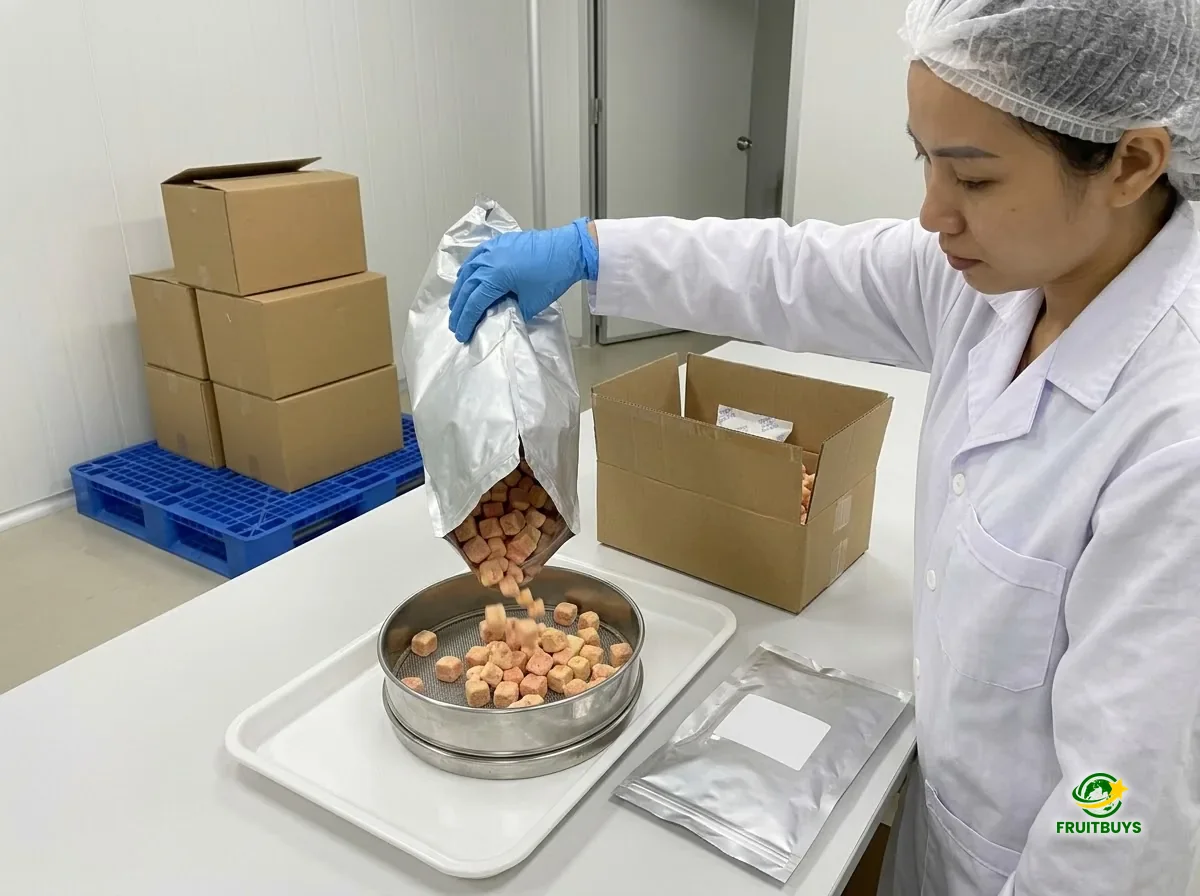
- Sieve 100 g. Pieces under 2 mm should stay at or below 5% in dice and slices.
- Compare with the approved sample. Hold a piece from each carton next to the pre-shipment sample for colour and cut, and keep the second sealed pouch of that sample for your lab.
Record the results against the lot number on the COA. If a reading sits above contract, the retained sample of the same lot shows whether the lot left out of specification or picked up moisture after unloading.
One honest note on use: freeze-dried papaya keeps these numbers in a sealed foil bag, and it softens in anything moist. In yogurt, overnight oats or a soft bar, it performs best packed in a separate topping cup or dry sachet, or bound in as granules with a shelf-life pilot run in your own base.
Get the specification for your line
Send us your application, target cut and any market tests, and we return a contract specification with release and arrival limits, the COA template and a loading plan.
FAQ
What water activity should freeze-dried papaya have?
At or below 0.30 on arrival, and at or below 0.25 when the lot is packed. Below 0.30 the sugars stay glassy and the pieces stay crisp.
Why is my freeze-dried papaya sticky?
The water activity has risen above about 0.30, usually after a bag stood open in humid air. Papaya’s high natural sugar turns tacky first; keep bags sealed and open one bag per batch.
Is moisture content the same as water activity?
No. Moisture is how much water the product holds; water activity is how freely that water behaves. Two lots at the same moisture can differ in aw, and aw predicts stickiness and microbial stability.
Does freeze-drying kill bacteria?
No. It stops growth by removing water, but it is not a kill step, which is why Salmonella is tested on every container lot.
Do you send a COA with every shipment?
Yes, for every full-container lot: moisture, water activity, TPC, yeasts and moulds, E. coli and Salmonella. Trial orders ship with the in-house QC log per batch.
Can you test heavy metals on my lot?
Yes. ICP-MS testing for lead, arsenic, cadmium and mercury is available for each lot on request, before the container is sealed.
How long do I have to raise a claim?
14 days from unloading for packaging, appearance, breakage or water activity, and 30 days for lab results.