How many kilograms of fresh papaya make 1 kg of freeze-dried papaya?
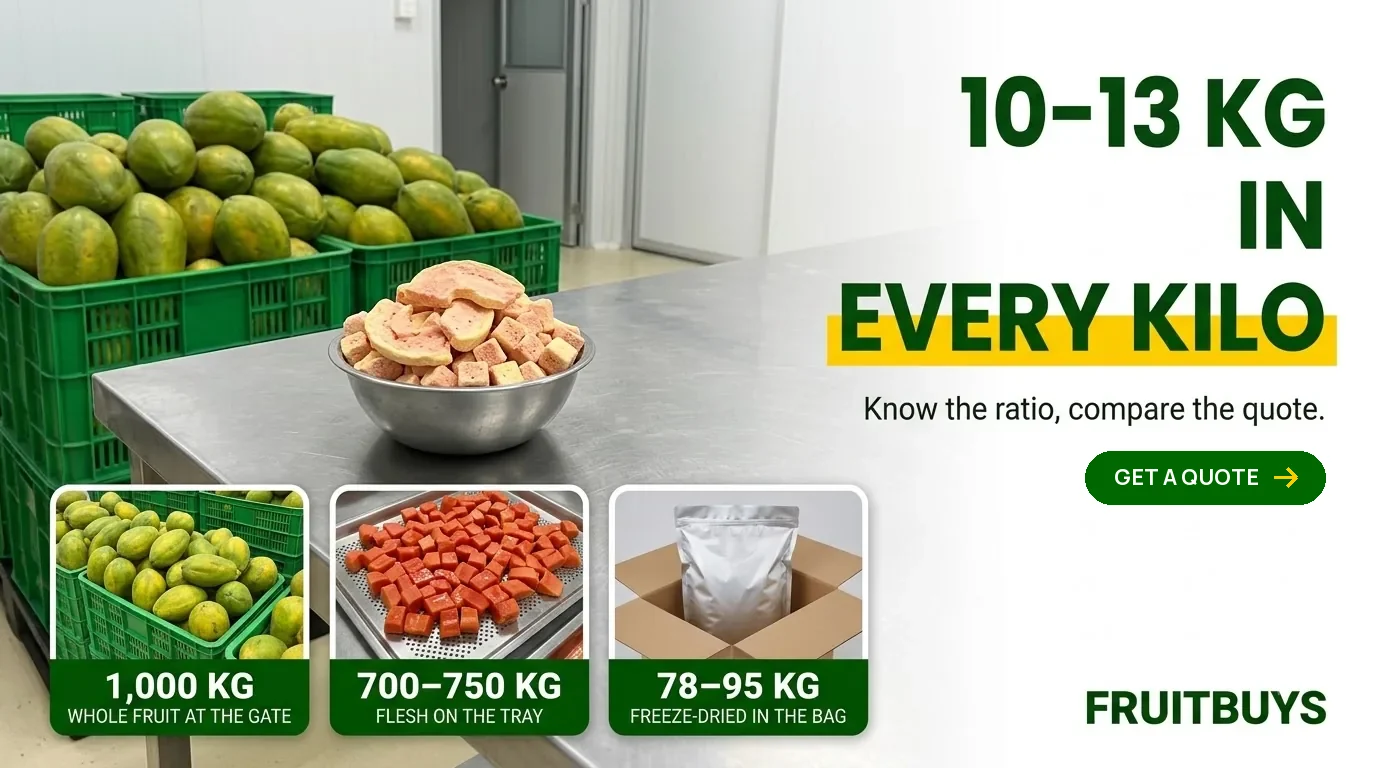
About 10–13 kg of whole fresh papaya, or 8–9 kg of peeled, deseeded flesh, make 1 kg of freeze-dried papaya. Papaya flesh is 87–89% water, and the peel and seeds take another quarter of the fruit before anything reaches the dryer. In the dry season the number sits near 10.5–11.5 kg; in the rainy months it climbs to 12.5–13 kg. That ratio is the single biggest line in the price of freeze-dried papaya, and it is the first thing to check when one quote looks far cheaper than the rest.
Why does 1 kg of freeze-dried papaya take 8–9 kg of flesh?
Freeze-drying removes water and keeps the fruit solids, so the ratio follows from two moisture figures: the water in fresh flesh and the water left in the finished product.
kg of flesh per kg freeze-dried = (100 − moisture of the finished product) ÷ (100 − moisture of the fresh flesh)
| Fresh flesh moisture | Solids in fresh flesh | Flesh for 1 kg at 4% moisture |
|---|---|---|
| 87% | 13% | 7.4 kg |
| 88% | 12% | 8.0 kg |
| 89% | 11% | 8.7 kg |
The same arithmetic works backwards for your QA team. Divide any result measured on freeze-dried papaya by about 8 and you have the fresh-fruit equivalent, which is how residue results on the dry product are compared with limits set for fresh fruit.
How much whole fruit is lost between the farm gate and the drying tray?
A quarter or more. Red Lady-type papaya is a large fruit, commonly 1.2–2.5 kg, with thick flesh, so peeling and deseeding remove about 25–30% and leave a flesh recovery of 70–75%. Fruit that arrives green or overripe is rejected at intake before it costs anything further.
| Step | From 1,000 kg of whole fruit |
|---|---|
| Peel and seeds removed | 250–300 kg |
| Peeled, deseeded flesh | 700–750 kg |
| Water removed in the dryer | about 620–660 kg |
| Freeze-dried papaya | about 78–95 kg |
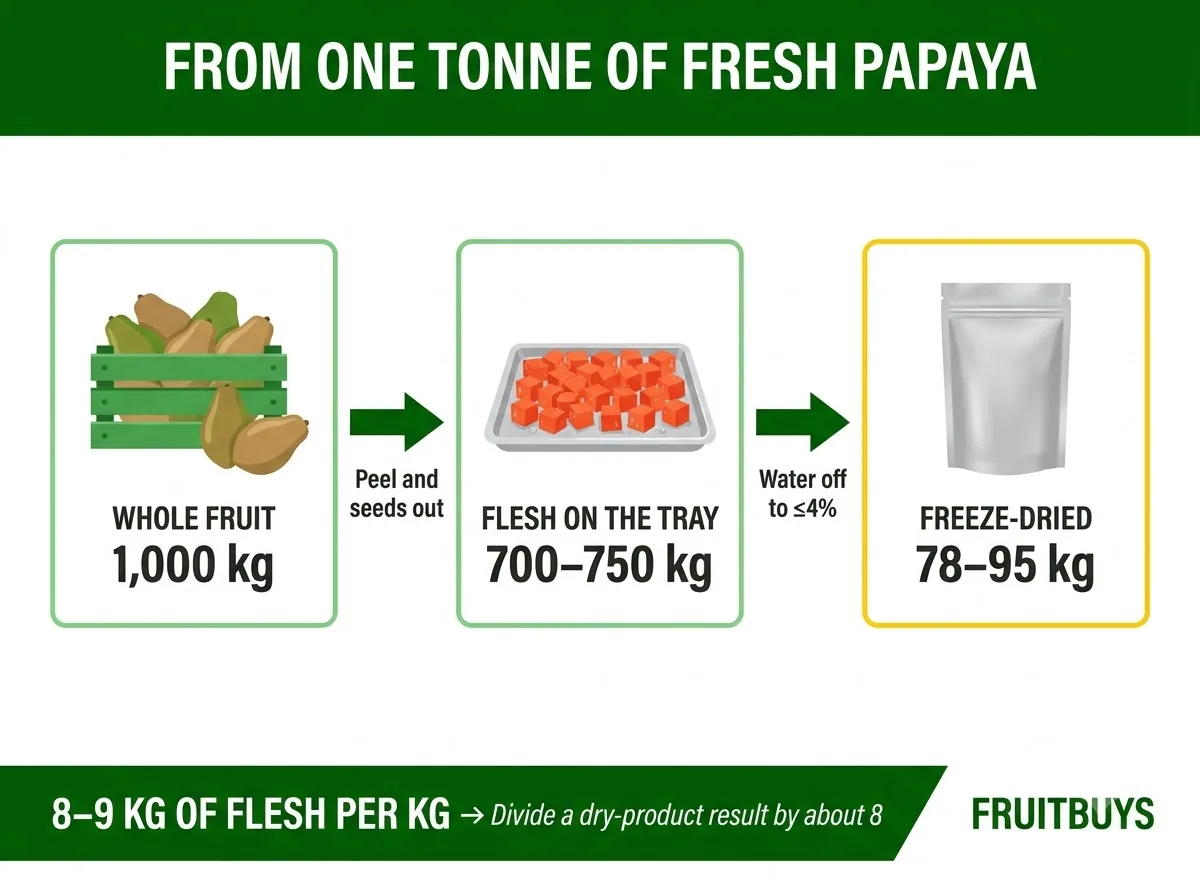
So one tonne of fruit becomes roughly 78–95 kg of finished product, and a 20 ft container of dice at 4.4–5.5 t carries the flesh of roughly 35–50 t of fresh papaya. The numbers also explain why freeze-dried papaya ships so cheaply per unit of fruit: you pay sea freight on about one-twelfth of the fresh weight, in a dry container with no reefer. Per kilogram, slices carry roughly 1.3–2 times the sea freight of dice because they pack lighter, and powder about half; carton weights and container loads by cut are in how long freeze-dried papaya stays crisp, and how it should be packed and loaded.
Why do ripeness and season change yield, colour and price?
Because sugar and solids change with the weather. We check every truckload at intake on a refractometer, sign in only fruit at 11–13 °Brix and reject anything outside that window, which keeps colour and sweetness even from lot to lot. Within that window the season still moves the ratio.
| Season | Whole fruit per kg freeze-dried | What we see in the fruit |
|---|---|---|
| Dry season, December to April | ~10.5–11.5 kg | Higher Brix, firmer flesh, deepest orange-red colour |
| Rainy season, May to November | ~12.5–13 kg | More water in the flesh, slightly paler colour |
Stand at the intake scale in March and again in September, and the difference is about two kilograms of fruit for every kilogram of finished product. Rainy-season papaya needs roughly 10–25% more fruit per kilogram, so fruit cost per kilogram moves with it. If your product photo depends on the deepest colour, we reserve dry-season lots for your SKU; if colour matters less than continuity, the year-round crop of the Mekong Delta lets one annual contract run on fresh fruit every month.
What happens at each step from intake to sealed carton?
Every step below runs under FruitBuys’ processing protocol at one qualified partner facility, locked for the length of your contract.
- Intake and sorting. Every truckload from the growers is checked at the gate: our QC cuts 3–5 fruits from the load and reads their juice on a handheld refractometer. Only loads at 11–13 °Brix are signed in; green and overripe papaya is rejected before it is weighed into production.
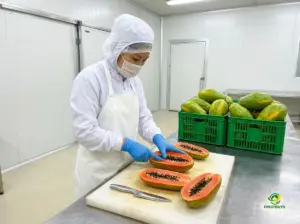
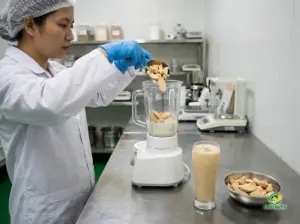
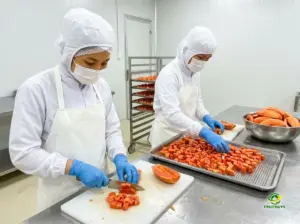
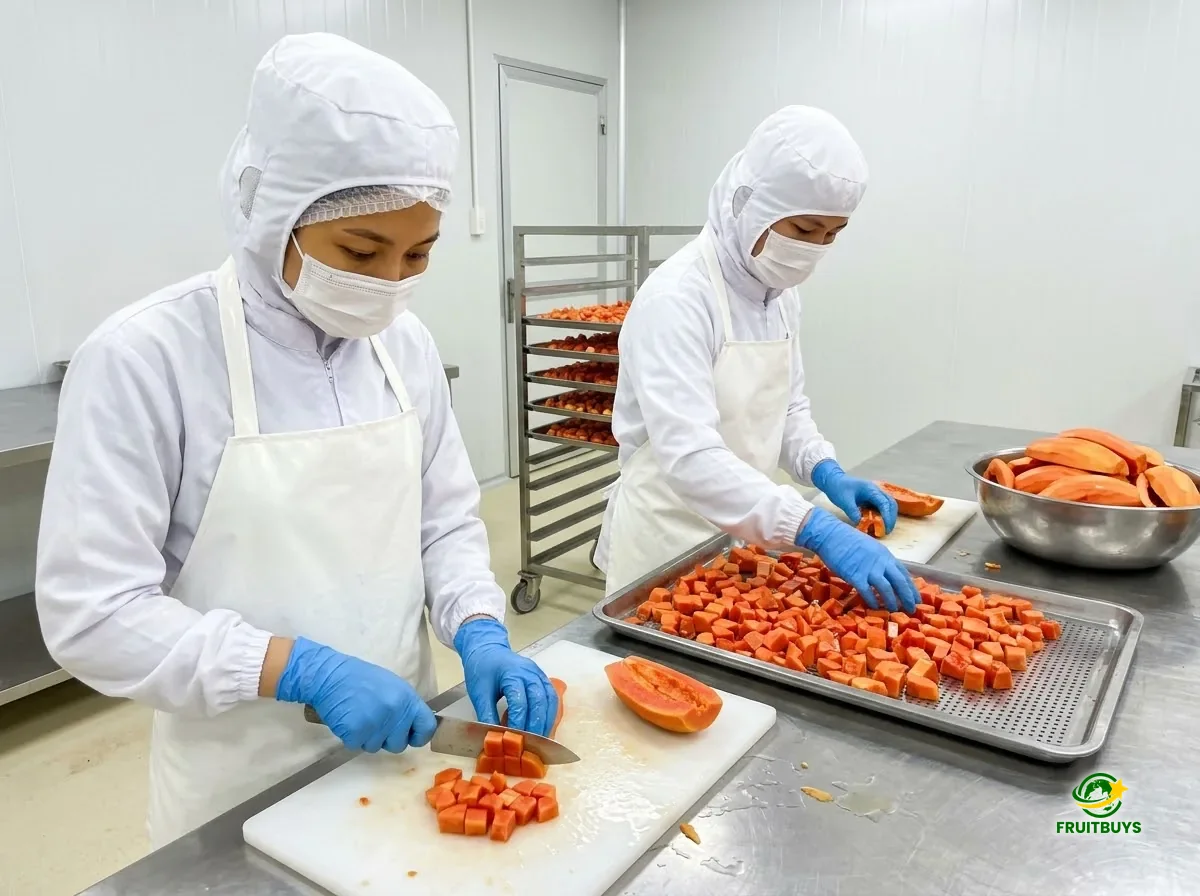
- Wash, peel and deseed. The fruit is washed, peeled and halved, and the seeds and their membrane are scooped out by hand with stainless-steel spoons under clean running water, fruit by fruit. Ripe papaya flesh is too soft for a machine to clean without tearing it, and any membrane left behind brings a bitter note into the finished dice.
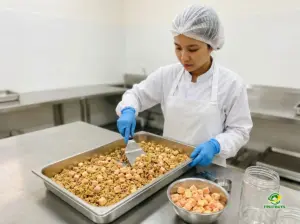
- Cut. The flesh is cut to 5 × 5 mm or 10 × 10 mm dice, 3–7 mm slices or 2–5 mm granules, and spread in a single layer on trays.
- Freeze. The trays are frozen at −30 to −40 °C, which locks the cut shape before any water leaves.
- Freeze-dry. Under vacuum the ice turns straight to vapour, so the piece keeps its shape and colour without being heated the way hot-air drying heats it.
- Grade. The dried pieces are sieved for fines and passed through metal detection.
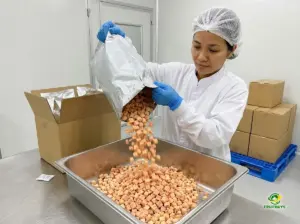
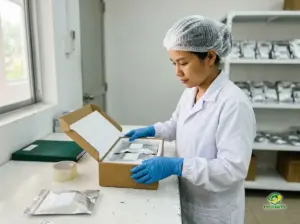
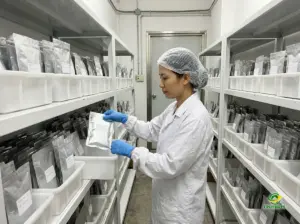
- Pack. Pieces are packed in a dehumidified room at ≤40% RH into foil bags with food-grade silica gel, and we release the lot only when moisture is at or below 4.0% and water activity at or below 0.25.
The cycle profile of step 5 is the partner facility’s process know-how and is not published; what FruitBuys commits to is the result on the COA. The limits behind that release, and how to check them on arrival, are in what moisture, water activity and microbiology limits a freeze-dried papaya contract should set.
How do you compare two quotes on the same basis?
Convert both to the price of the papaya you actually use. Moisture, added sugar and fines all reduce the fruit you get per kilogram, and a lower price per kilogram can hide a higher price per kilogram of usable papaya.
Illustrative cost-in-use example (not a quotation). Prices are shown as an index, Quote A = 100.
| Line | Quote A | Quote B |
|---|---|---|
| Price per kg (index) | 100 | 85 |
| Moisture | 4% | 8% |
| Added sugar or infusion | None | 20% |
| Papaya solids per kg | 0.96 kg | 0.74 kg |
| Usable pieces after fines (fines ≤5% vs 15%) | 95% | 85% |
| Cost per kg of usable papaya solids (index) | 110 | 136 |
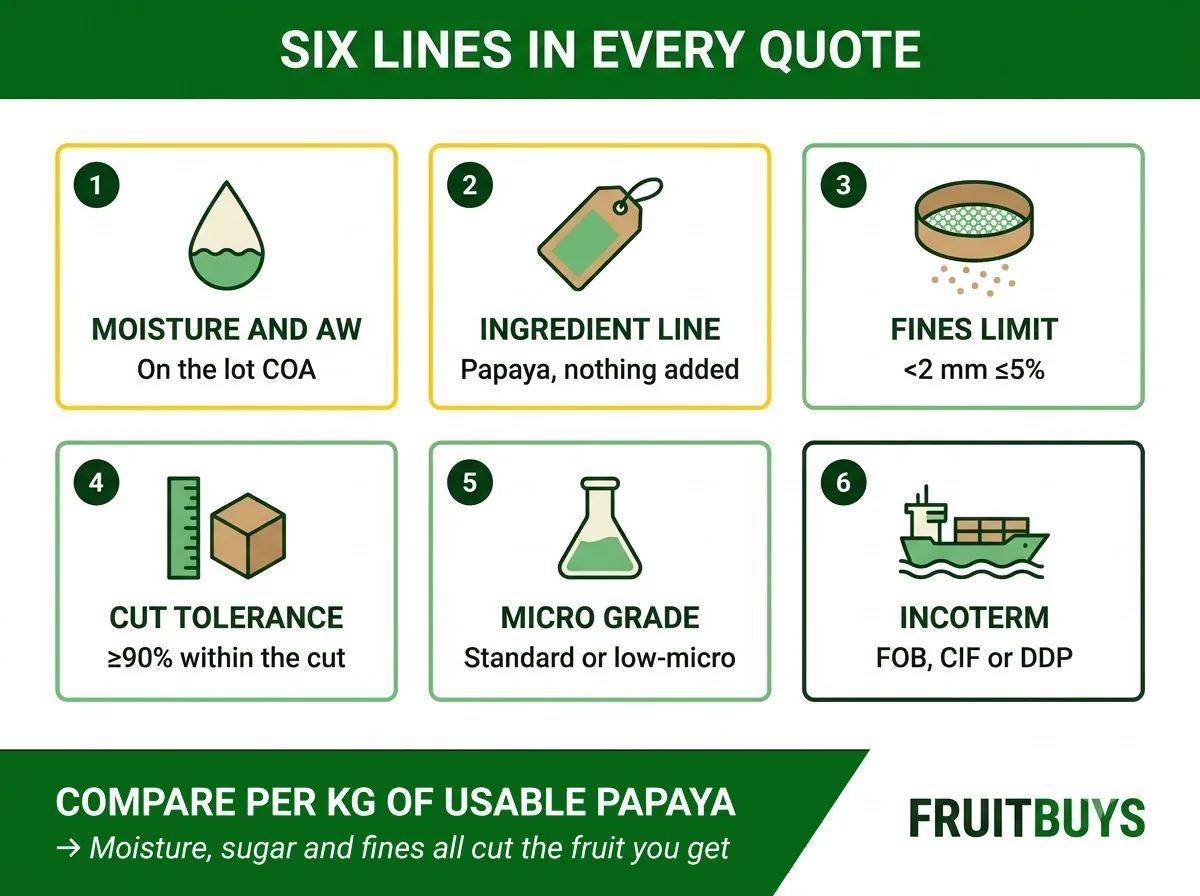
Quote B looks 15% cheaper and costs about 24% more for the fruit that reaches your product. Ask every supplier, including us, for six things in writing: the moisture and water activity on the COA, the ingredient line, the fines limit, the cut tolerance, the microbiology grade, and the Incoterm the price is quoted on. With those six lines filled in, two quotes can be compared on the same basis.
Where the fruit is baked in, choose the cut by cost per finished unit. If papaya disappears into a muffin, cookie or bar, granules or freeze-dried papaya powder deliver the same fruit for less per finished unit than dice cut for show. Dice and slices earn their price where the piece is seen.
Can a home dehydrator make the same product?
No. A dehydrator or hot-air dryer heats the fruit and usually stops at around 10–20% moisture, so the papaya comes out chewy, darker and with a shorter shelf life. Freeze-drying takes the same flesh to ≤5% moisture without heating it, so it stays crisp, keeps its orange-red colour and rehydrates in 2–5 minutes in milk or yogurt. For a product that has to stay crisp on a shelf for 12 months, the difference is the moisture, not the recipe. The cuts, carton weights and container loads are on the freeze-dried papaya product page.
Get a quote on the same basis
Tell us your cut, season preference and annual volume, and we return a quote with the moisture, ingredient line, fines limit, micro grade and Incoterm written out, so you can set it beside any other.
FAQ
How much fresh papaya does it take to make 1 kg of freeze-dried papaya?
About 10–13 kg of whole fruit, or 8–9 kg of peeled, deseeded flesh: near 10.5–11.5 kg in the dry season and 12.5–13 kg in the rainy season.
How is papaya freeze-dried?
Ripe fruit is peeled, deseeded and cut, frozen at −30 to −40 °C, then dried under vacuum so the ice turns straight to vapour. The pieces keep their shape and colour and end at ≤5% moisture.
Why is freeze-dried papaya more expensive than fresh papaya?
Because each kilogram carries the solids of 10–13 kg of fruit, plus peeling, deseeding, freezing and drying. Per kilogram of fruit delivered, it ships far more cheaply than fresh or frozen papaya.
Does the season change the price?
It changes the fruit needed: rainy-season papaya takes roughly 10–25% more fruit per kilogram of finished product than dry-season fruit.
How do I compare fresh-fruit residue limits with results on freeze-dried papaya?
Divide the result on the freeze-dried product by about 8, the ratio of fresh flesh to finished product, to get the fresh-fruit equivalent.
Can freeze-dried papaya be made into powder?
Yes. FruitBuys mills freeze-dried papaya to 60–80 mesh with nothing added; about 10 g of powder carries the fruit of 75–90 g of fresh flesh.
Does freeze-drying keep the vitamin C of fresh papaya?
It keeps far more of it than heat drying, because the fruit is never heated; typical values are 300–450 mg per 100 g of freeze-dried papaya.