How much papaya powder should you use, and what should the powder spec say?
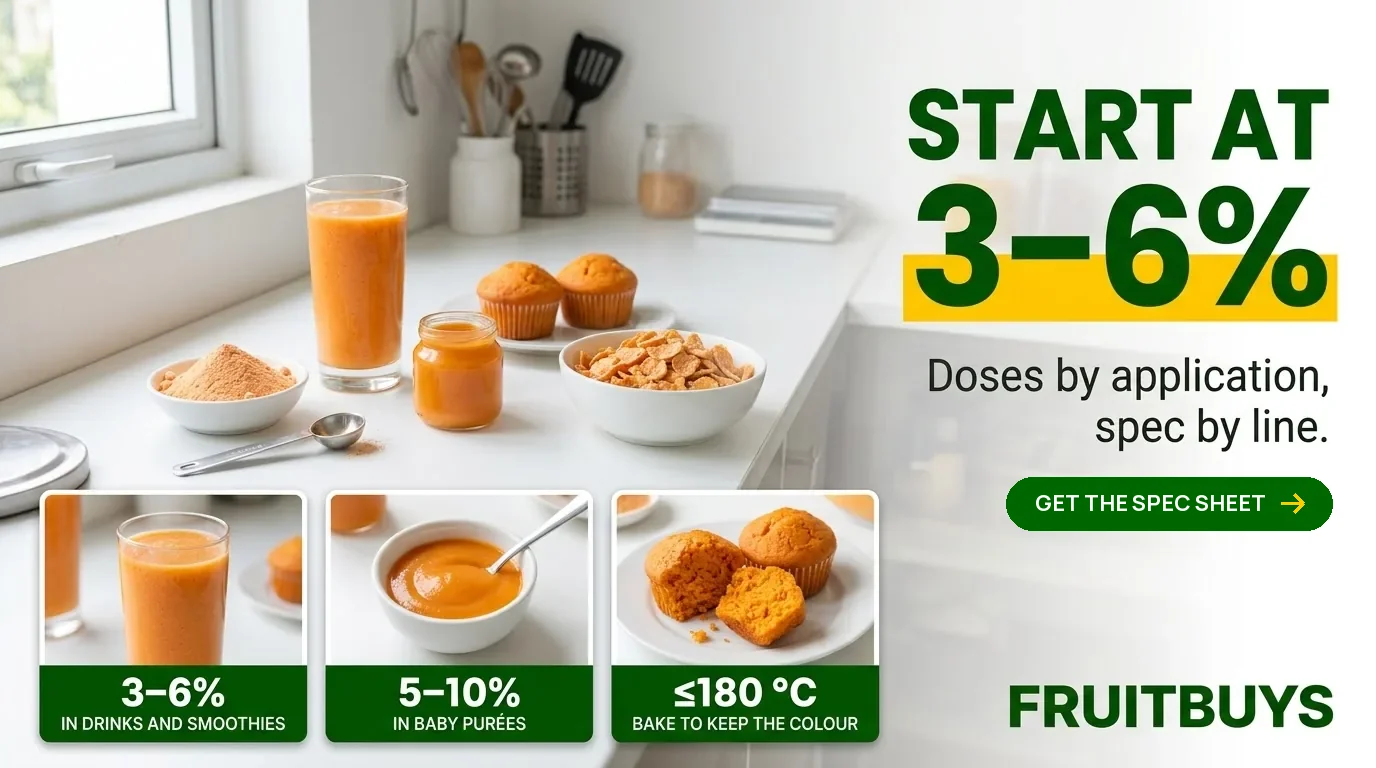
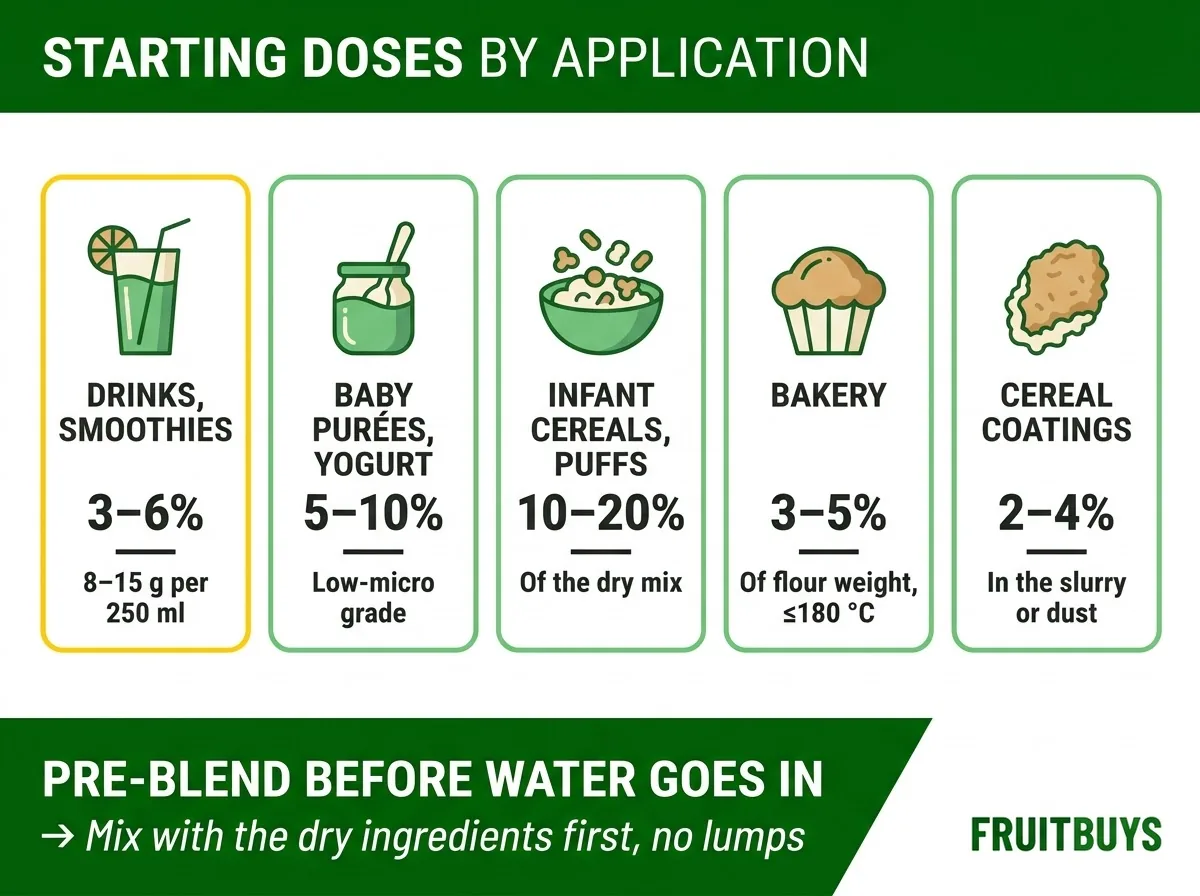
Start at 3–6% in drinks and smoothie mixes, 5–10% in baby purées and yogurts, 10–20% in puffs and infant cereals, 3–5% of flour weight in bakery and 2–4% in cereal coatings. Those doses apply to freeze-dried papaya powder: 100% papaya, milled to 60–80 mesh, with no carrier. Then write four lines into the specification: mesh, version (standard or free-flowing), microbiology grade and the lot tests your market needs. Get those right and the powder doses cleanly, colours your product at a low inclusion, and keeps flowing until the last bag.
How much papaya powder goes into a smoothie, drink mix or bowl?
3–6% of the dry mix, or about 8–15 g per 250 ml serving. At that dose the drink turns papaya orange and tastes of ripe fruit without added flavouring, because 10 g of powder carries the fruit of about 75–90 g of fresh papaya.
Two things to plan for:
- It disperses, it does not dissolve. Freeze-dried powder keeps the fruit fibre, so the drink has a cloudy, real-fruit body. That body is the point in smoothies, milk drinks, protein shakes and bowls, so position the product there.
- Pre-blend before water goes in. Mix the papaya with the sugar, protein or other dry ingredients of your recipe first; lumps form when fruit powder meets liquid on its own. For instant drink mixes, specify 80–100 mesh for faster wetting.
What dose works in baby purées, cereals and puffs, and which tests will your QA team ask for?
| Product | Starting dose | Why this dose |
|---|---|---|
| Baby purées and yogurts | 5–10% | Colour and natural sweetness without thickening the purée |
| Infant cereals | 10–20% of the dry mix | Fruit flavour that survives reconstitution |
| Puffs and teething biscuits | 10–20% of the dry starch mix | Flavour and colour blended in before extrusion or baking |
Baby-food teams ask about lead before they ask about price. FDA’s guidance on lead in processed food for babies and young children (final, January 2025) sets action levels of 10 ppb for fruits, mixtures and yogurts and 20 ppb for single-ingredient root vegetables and dry infant cereals, for packaged food intended for children under two. Papaya is a tree fruit, with the flesh well above the soil, and it falls in the fruit category at 10 ppb.
The arithmetic your QA file needs:
- Concentration: freeze-drying concentrates whatever the fresh flesh carries about eight times, so a powder result is read on a dry basis.
- Dilution: at 5–10% in a purée, the powder is diluted 10–20 times in the finished food; at 10–20% in a dry cereal, 5–10 times.
- Your number: finished-food lead ≈ lead in the powder × dose. Run it with the lot result, not with an assumption.
That lot result is what we provide: ICP-MS testing for lead, arsenic, cadmium and mercury on each lot on request, before the container is sealed, at an accredited laboratory of your choice, such as Eurofins or SGS in Vietnam. The same panel gives you data for California’s AB 899, which requires baby-food makers selling there to test their finished products monthly for those four metals and publish the results. Specify the low-micro grade (TPC <1,000 CFU/g) for every baby-food line.
Can papaya powder go into bakery, fillings and gummies without browning or caking?
Yes, with three adjustments.
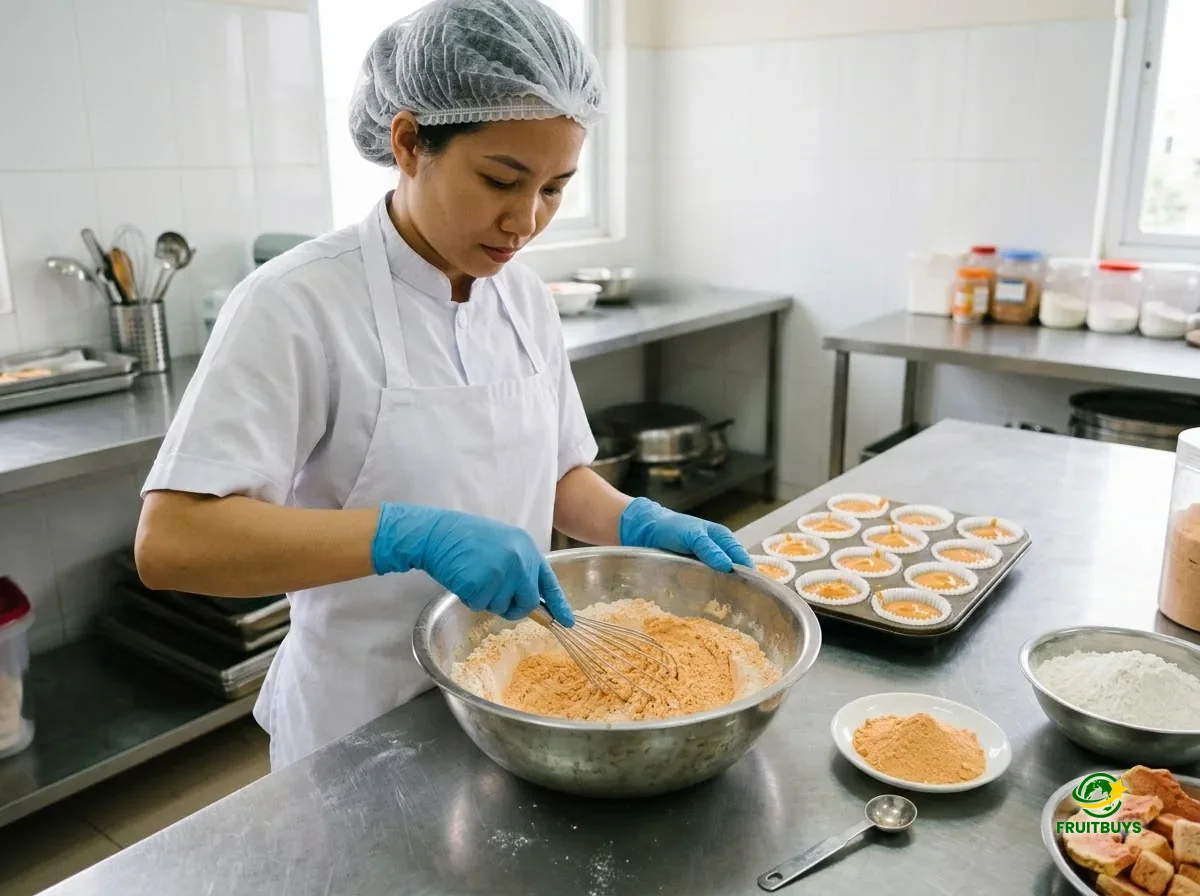
- Bakery: 3–5% of flour weight in muffins, cookies, bread and crackers. Bake at ≤180 °C; the fruit sugars brown faster than flour, and lower heat keeps the crumb orange instead of tan.
- Fillings and creams: 3–6% in a cream, ganache or fat-based filling. Fat carries papaya colour well and keeps the powder away from free water.
- Gummies and bars: add the powder with the dry phase, never into hot syrup on its own, and run a shelf-life pilot. The natural sugars draw moisture, so bars and gummies should be tested through their full shelf life in your own packaging.
- Ice cream and yogurt: 3–6% of the mix for colour and flavour; use the low-micro grade.
| Application | Common failure | Fix |
|---|---|---|
| Drink mix | Lumps on mixing | Pre-blend with dry ingredients; 80–100 mesh |
| Bakery | Brown, dull crumb | Bake at ≤180 °C; add powder with the flour |
| Gummies, bars | Sticky surface over shelf life | Add with the dry phase; shelf-life pilot in final pack |
| Baby food | Lead question from QA | Lot ICP-MS panel; dose arithmetic above |
| Sachets, stick packs | Bridging in the hopper | Free-flowing version |
Which mesh and which version should the specification name?
| Line | Options | Choose by |
|---|---|---|
| Mesh | 60–80 mesh standard (≥95% through); 80–100 mesh for drinks | Finer for instant drinks; standard for bakery, coatings, dairy |
| Version | Standard: papaya only. Free-flowing: + up to 1% silicon dioxide (E551) | Standard for batch mixing and clean-label ranges; free-flowing for augers, sachets and stick packs |
| Micro grade | Standard TPC ≤10⁴ CFU/g; low-micro TPC <1,000 CFU/g | Low-micro for baby food, dairy and ready-to-eat lines |
| Lot tests | ICP-MS heavy metals, multi-residue pesticides, Listeria and Enterobacteriaceae, nutrition panel | Your market and customer requirements |
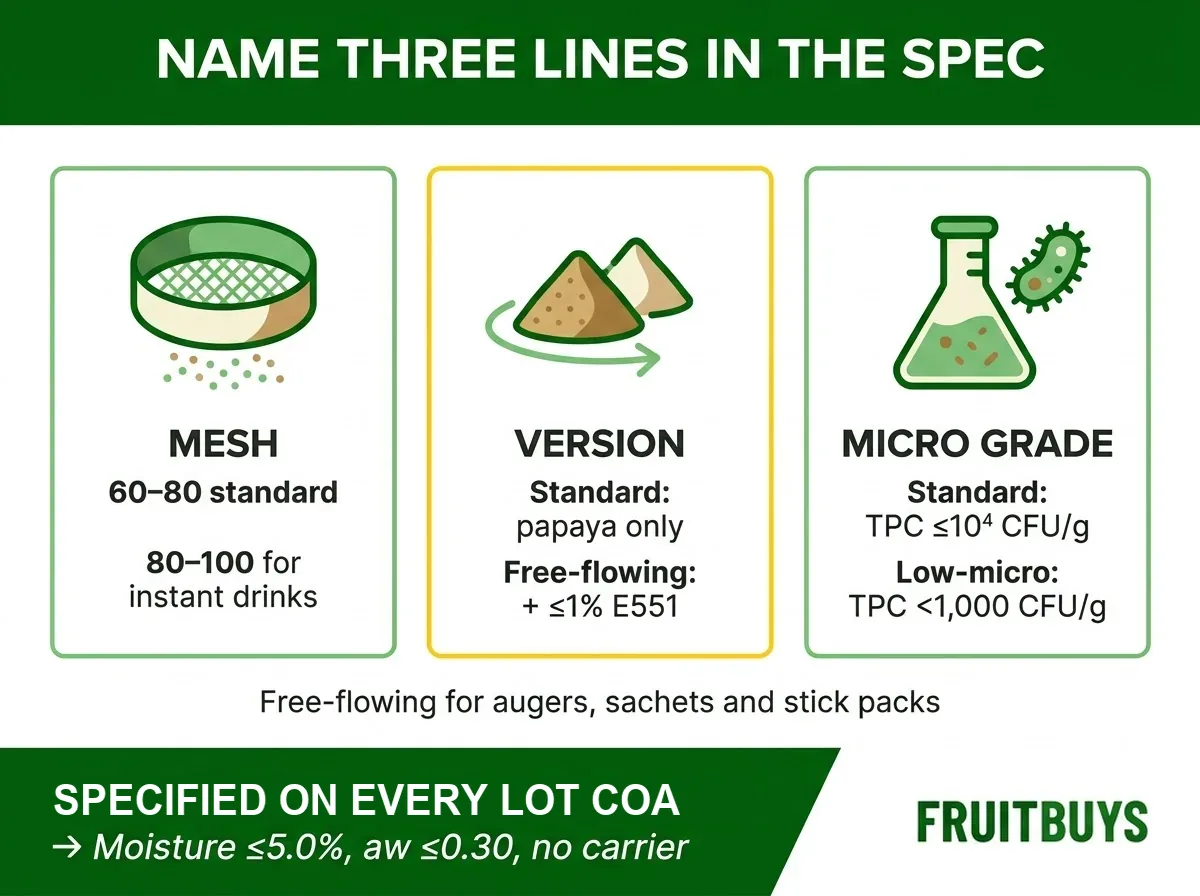
Guaranteed specifications: moisture ≤5.0% and water activity ≤0.30 on every lot COA; no maltodextrin carrier, no added colour, no added sugar.
The version also decides your label. The standard powder reads “papaya”; the free-flowing version adds “anti-caking agent (silicon dioxide)” and may change the customs classification, which your broker confirms before the first shipment. The full product specification is on the freeze-dried papaya powder page.
Why does papaya powder cake, and how do you keep it free-flowing on your line?
Papaya powder is about 63% natural sugar on a dry basis, and milling gives that sugar a large surface to pick up humidity. Below water activity 0.30 the particles stay glassy and the powder flows. Once humid air reaches it, the particle surfaces turn tacky, bridge together and, given time, set hard.
The fix is handling, not an additive:
- One 5 kg bag per batch. Bulk bags are sized to a production batch, so each bag is opened, used through and never left half-full.
- Open bags below 40% RH. The powder is milled and packed in a dehumidified room at ≤40% RH; keep the same condition where your team weighs it.
- Let cold cartons warm up before opening, so no condensation forms inside the bag.
- Reseal at once with a fresh desiccant sachet if a bag must be reopened.
- Break soft clusters with a stir or a sieve. They come from fruit sugar, not from spoilage, and disappear on mixing.
If your line runs an auger or stick-pack filler for hours with an open hopper, choose the free-flowing version rather than fighting the room. How water activity behaves in papaya, and how to test it on arrival, is covered in what moisture, water activity and microbiology limits a freeze-dried papaya contract should set.
What does papaya cost per finished unit compared with spray-dried powder?
Compare the cost of the dose, not the price per kilogram. Spray-dried papaya powder is usually made with 30–50% maltodextrin carrier, and its inlet air at 160–200 °C drives off aroma and dulls colour. Two effects follow:
- Fruit solids: with 30–50% carrier, a spray-dried powder needs about 1.4–2 times the dose to deliver the same papaya solids.
- Sensory dose: in R&D bench work, 3–4% freeze-dried powder commonly gives the colour and flavour that takes 8–10% of a carrier-based spray-dried powder, often with added flavouring.
Illustrative cost-in-use example (not a quotation). Per 1,000 kg of finished drink mix, with the spray-dried price set as index 100:
| Freeze-dried powder | Carrier-based spray-dried powder | |
|---|---|---|
| Dose for the same colour and flavour | 3.5% → 35 kg | 9% → 90 kg |
| Price per kg (index) | 200 | 100 |
| Cost per 1,000 kg of finished mix (index) | 7,000 | 9,000 |
| Ingredient line | Papaya | Papaya, maltodextrin, often flavouring |
In this example the freeze-dried powder costs twice as much per kilogram and about 22% less per finished batch. Across the dose ranges above, it stays cheaper per finished unit whenever its price per kg is below about 2 to 3.3 times the spray-dried price, and it gives you the shorter label in every case. Run the side-by-side bench test in your own base; that is what our sample is for. How the fruit itself drives the price per kilogram is explained in how many kilograms of fresh papaya make 1 kg of freeze-dried papaya.
Use it as fruit, and label it as fruit. Ripe papaya powder is a flavour, colour and fibre ingredient; papain sits mainly in the latex of green papaya, so enzyme and digestion claims do not belong on a ripe-fruit powder. The details are in does papaya powder contain papain.
Request a sample for your bench test
Tell us your application, target dose, mesh and version, and we send the powder in two sealed foil pouches: one for your bench test, one kept sealed for your lab.
FAQ
How much papaya powder should I add to a smoothie?
About 8–15 g per 250 ml serving, or 3–6% of a dry smoothie mix.
How is papaya powder used in baby food?
At 5–10% in purées and yogurts and 10–20% in infant cereals, puffs and teething biscuits, with the low-micro grade and a lot heavy-metal panel.
Does papaya powder dissolve in water?
It disperses into a cloudy, fibre-rich drink rather than dissolving clear. Pre-blend it with other dry ingredients for an even mix.
Can I bake with papaya powder?
Yes, at 3–5% of flour weight. Bake at ≤180 °C to keep the colour.
Why does my papaya powder clump?
Its natural sugar picks up humidity once a bag is open. Open one bag per batch in a room below 40% RH, and choose the free-flowing version for automatic filling lines.
What mesh should I order?
60–80 mesh for most uses; 80–100 mesh for instant drink mixes.
Is freeze-dried papaya powder better value than spray-dried?
Per kilogram it costs more; per finished unit it is often cheaper, because 3–4% freeze-dried powder commonly matches 8–10% of a carrier-based powder, and the label reads only “papaya”.