Freeze-Dried Mango Container Planning for Export Buyers
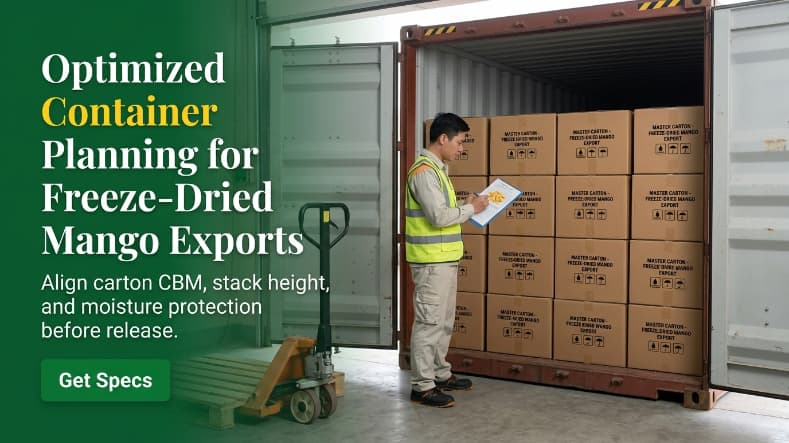
Freeze-dried mango container planning looks like a carton-count exercise. It is not. A buyer can calculate CBM perfectly and still receive crushed cartons, broken pieces, softened product, mixed lot codes or documents that do not match the shipment. Freeze-dried mango is usually a volume-sensitive cargo: cartons can fill container space long before physical weight becomes the main constraint. That makes carton size, loading pattern, packaging strength and release documents more important than a headline container number.
Container planning only protects the buyer when carton count connects to product format, pack structure, moisture protection, lot identity and receiving conditions. FruitBuys manages this through Export Logistics Coordination, Quality Control and Documentation, so the container plan supports the supplied product instead of becoming a spreadsheet illusion.
Container Planning Starts with the Carton, Not the Container
Freeze-dried mango container planning starts with carton size, carton strength, net weight and product format.
A 20ft or 40ft HC estimate has no value until the buyer confirms whether cartons are floor-loaded, palletized or packed under a specific receiving requirement.
Buyers should treat carton-count figures as planning ranges until a stuffing trial and release file confirm them.
The working carton input for FruitBuys freeze-dried mango is:
| Carton Field | Working Input |
|---|---|
| Carton length | 600 mm |
| Carton width | 390 mm |
| Carton height | 390 mm |
| Carton volume | 0.09126 CBM |
| Net product weight | 5–7 kg/carton |
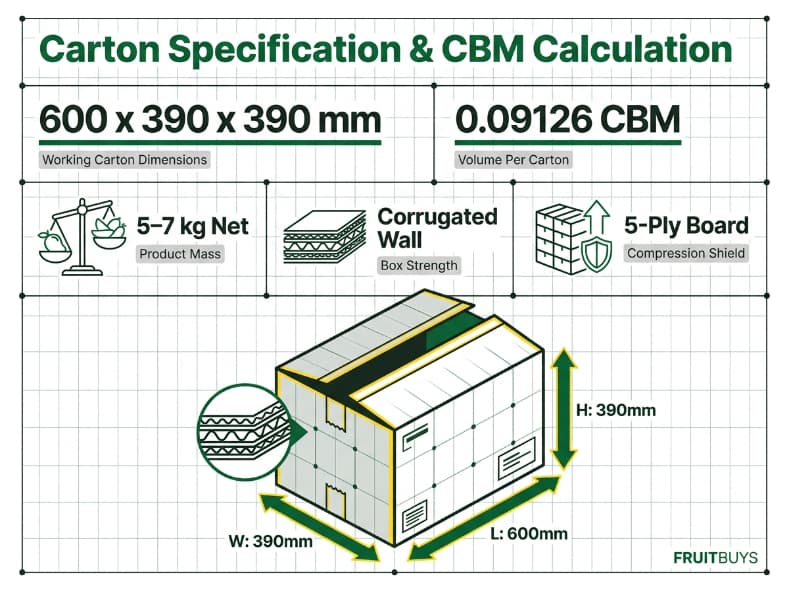
Carton CBM is simple:
0.60 × 0.39 × 0.39 = 0.09126 CBM/cartonThat number only answers space. It does not answer compression, breakage, humidity exposure, carton quality, seal condition, storage route or receiving method. A buyer should connect this article to the wider freeze-dried mango supplier Vietnam path before turning a loading estimate into a shipment decision.
Hapag-Lloyd notes that container specifications serve as examples because containers vary by manufacturer, which means buyers should confirm equipment-specific constraints when shipment requirements are tight. The same source lists a 20ft standard container capacity of 33.2 CBM and inside dimensions around 5,900 × 2,352 × 2,393 mm in its container specification data. (Hapag-Lloyd container specification)
Why Freeze-Dried Mango Is Usually Cube-Limited
Freeze-dried mango carries low product density because the drying process removes most of the water and leaves a porous structure. That makes container planning different from heavy agricultural goods. The buyer usually runs into usable container space, carton strength and handling limits before approaching dry-container payload limits.
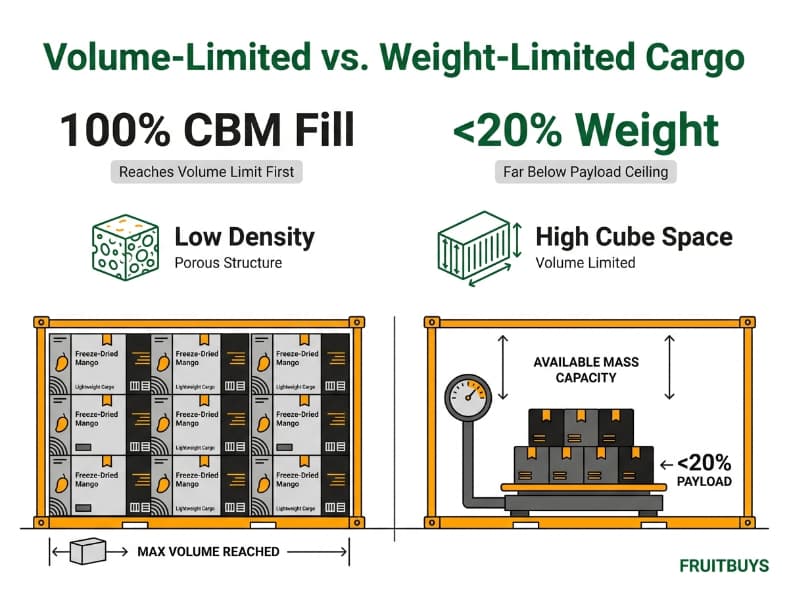
Maersk describes the 20ft dry container as designed for heavier cargo and the 40ft dry container as more suitable for voluminous cargo, while 40ft High Cube containers add height for lighter cargo where additional cargo can fit within weight limits. (Maersk guide to shipping container sizes) (Maersk)
For freeze-dried mango, that means the buyer should ask:
- How many cartons fit physically?
- How many cartons can stack without damaging the product?
- Does the format increase breakage risk?
- Does the package protect moisture and Aw after loading?
- Does the receiver require palletized handling?
- Do all cartons carry the correct lot code?
- Does the packing list match the release file?
This is why moisture-barrier packaging for freeze-dried mango and sample-to-bulk consistency controls belong inside the container plan. Logistics cannot repair weak packaging or undefined product format.
20ft Container Planning Estimate
A 20ft container estimate should separate geometric capacity from practical loading range.
The working carton can theoretically fit 324 cartons under a tight floor-loaded layout, but that number needs physical validation.
Buyers should use a conservative planning range until carton compression, clearance and loading method are approved.
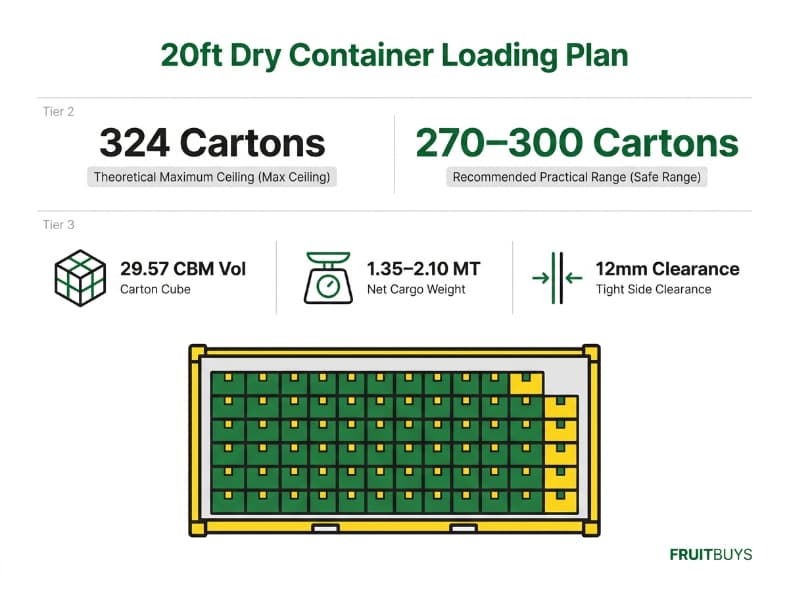
Using the working carton size of 600 × 390 × 390 mm, a tight geometric layout in a 20ft standard dry container can be modeled as:
| Dimension | Container Planning Basis | Carton Side Used | Cartons |
|---|---|---|---|
| Length | 5,900 mm | 600 mm | 9 |
| Width | 2,352 mm | 390 mm | 6 |
| Height | 2,393 mm | 390 mm | 6 |
| Theoretical total | 324 cartons |
The theoretical carton volume is:
324 × 0.09126 CBM = 29.57 CBMThe product net weight range is:
| Carton Count | At 5 kg/carton | At 7 kg/carton |
|---|---|---|
| 270 cartons | 1.35 MT | 1.89 MT |
| 300 cartons | 1.50 MT | 2.10 MT |
| 324 cartons | 1.62 MT | 2.27 MT |
The 324-carton layout uses only about 12 mm side clearance across width when six cartons of 390 mm sit across a 2,352 mm interior width. That is a tight plan. It may fail if cartons bulge, dimensions vary, loading needs air gaps, receivers require easier unloading or the container interior differs.
FruitBuys should therefore treat 270–300 cartons as a conservative planning range until a physical loading trial confirms higher density. The 324-carton figure should remain a theoretical ceiling, not a published capacity promise.
40ft High Cube Planning Estimate
Hapag-Lloyd lists a 40ft Standard High Cube with capacity of 76.3 CBM, inside dimensions of 12,032 × 2,350 × 2,700 mm and max payload of 28,600 kg, while also warning that specifications vary by container manufacturer. (Hapag-Lloyd 40ft Standard High Cube) (Hapag-Lloyd)
Using the same working carton:
| Dimension | Container Planning Basis | Carton Side Used | Cartons |
|---|---|---|---|
| Length | 12,032 mm | 600 mm | 20 |
| Width | 2,350 mm | 390 mm | 6 |
| Height | 2,700 mm | 390 mm | 6 |
| Theoretical total | 720 cartons |
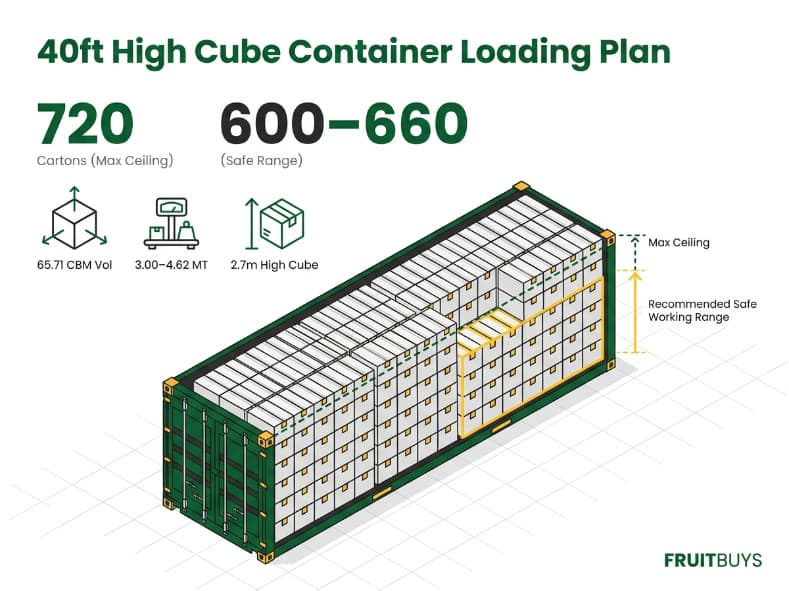
The theoretical carton volume is:
720 × 0.09126 CBM = 65.71 CBMThe product net weight range is:
| Carton Count | At 5 kg/carton | At 7 kg/carton |
|---|---|---|
| 600 cartons | 3.00 MT | 4.20 MT |
| 660 cartons | 3.30 MT | 4.62 MT |
| 720 cartons | 3.60 MT | 5.04 MT |
The 720-carton layout is a geometric ceiling. It assumes tight floor-loading, stable carton shape, usable height, consistent carton dimensions and acceptable handling. In real export planning, 600–660 cartons gives a more cautious working range until loading validation confirms the exact configuration.
A buyer should not treat 40ft HC as automatically better. If the buyer requires pallets, inspection access, fragile slices or lower stack height, the practical count falls. Container type selection must follow the product and receiving requirement, not only the spreadsheet.
Floor-Loaded Cartons vs Palletized Loading
Floor-loading usually uses more container cube. Palletized loading usually improves handling, warehouse movement and receiving control. Neither method is automatically correct.
| Loading Method | Advantage | Buyer Risk |
|---|---|---|
| Floor-loaded cartons | Better cubic utilization | Harder unloading, higher handling pressure, carton deformation risk |
| Palletized cartons | Easier handling and warehouse control | Lower carton count, pallet height limits, pallet-condition risk |
| Mixed loading | Can support split SKU or lot handling | Higher document and segregation risk |
For freeze-dried mango, floor-loading can work when the buyer accepts manual unloading or receiver unloading conditions. Palletizing can work when the buyer needs warehouse efficiency, retail SKU segregation or stricter receiver handling. The missing data point is pallet size, pallet height, wrapping method and receiver unloading requirement. Without those inputs, a palletized count should not be published.
Use OEM freeze-dried mango packaging before selecting a final carton and pallet route for private label products. Retail pouches, bulk bags and powder packs do not carry the same carton behavior.
Product Format Changes Loading Risk
Container planning must follow the mango format.
Slices, Bites, Cubes, Granules and Powder do not carry the same breakage, compression or moisture risk.
Buyers should approve format-specific carton rules before confirming the loading plan.
A freeze-dried mango carton is not only a box. It is the last physical shield around a fragile dried product. Format changes the load risk.

| Format | Loading Risk | Carton Control Needed |
|---|---|---|
| Slices | Breakage, crushed visual grade | Lower compression risk, stronger carton support |
| Cubes | Edge breakage and fines | Stable carton fill and inner pack control |
| Bites | Fragment increase | Fines limit and carton handling review |
| Granules | Dusting and settlement | Inner bag closure and movement control |
| Powder | Caking and compression | Moisture barrier, seal integrity, bulk-density review |
Use mango slices, cubes, bites and powder before confirming carton count. A high carton count may look efficient on paper but damage the format that the buyer approved. This is especially important for retail slices. A container may fit more cartons physically, but overstacking can convert slices into broken pieces. That creates a sample-to-bulk mismatch and can trigger downstream rejection.
Moisture, Aw and Container Route
Freeze-dried mango must keep its dry condition after packing. A container plan that ignores moisture protection weakens the product file. FDA explains that water activity relates to water available for microbial growth, which makes Aw different from moisture content and important for food stability review. (FDA water activity guide) (U.S. Food and Drug Administration)
For FruitBuys freeze-dried mango, the current working targets are 3–5% moisture and Aw <0.30, subject to lot COA. The container plan should therefore protect the product’s release condition through:
- Moisture-barrier inner packaging
- Seal integrity
- Carton protection
- Storage condition
- Loading cleanliness
- Lot code control
- Receiving instruction
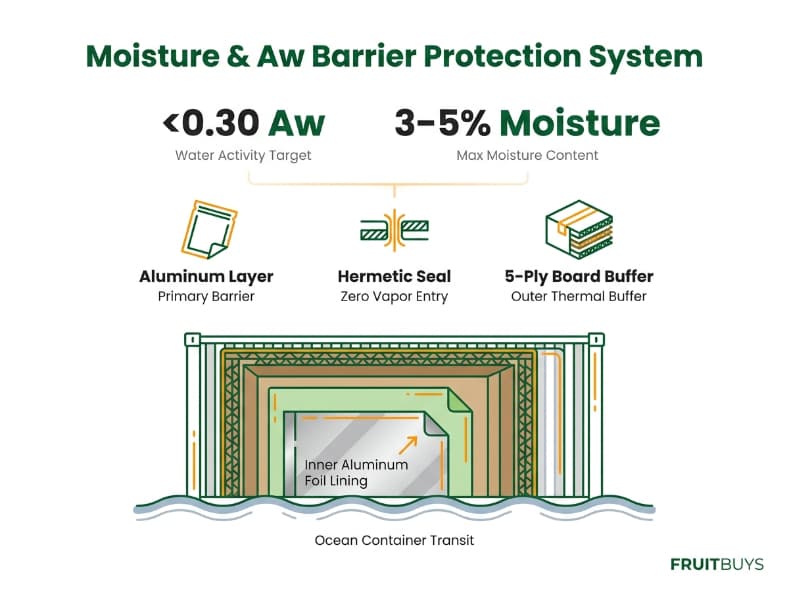
Use freeze-dried mango moisture and Aw and freeze-dried mango COA requirements before shipment release. The COA confirms the lot at release. Packaging and logistics protect that result through movement.
Cargo Packing and Securing Discipline
Container loading must avoid turning cartons into a moving wall of fragile cubes. The CTU Code, jointly published by IMO, ILO and UNECE, gives advice on safe packing of cargo transport units for people responsible for packing and securing cargo. (IMO/ILO/UNECE CTU Code) (International Labour Organization)
For freeze-dried mango, practical loading control should confirm:
| Control | Why It Matters |
|---|---|
| Clean container condition | Reduces contamination and odor risk |
| Dry interior | Reduces moisture exposure risk |
| Floor condition | Reduces carton puncture and instability |
| Loading pattern | Controls movement and compression |
| Stack height | Controls carton deformation |
| Void management | Reduces carton movement |
| Lot segregation | Prevents mixed release files |
| Seal number | Supports shipment traceability |
| Loading photos | Supports buyer review and claims defense |
| Packing list | Links carton count, lot code and document file |
Do not overstate this as a guarantee. A loading plan reduces risk when the cartons, package, container and receiver route support it. It does not replace packaging quality.
Carton Count, Lot Code and Document Matching
A container plan becomes dangerous when the carton count and documents do not match. The buyer may receive the right number of cartons with the wrong lot code, the right lot code with mixed formats or the right format with missing COA linkage.
The release file should match:
- Product format
- Carton count
- Net weight
- Lot code
- COA
- Packing list
- Carton labels
- Container number
- Seal number
- Loading photos
- Market document file

Use market documentation for freeze-dried mango when shipment files must support US, EU, UAE or another destination route. Container planning is not separate from market readiness. If the documents do not match the goods, the container plan fails even when the loading pattern is neat. For private label, also connect to freeze-dried mango Nutrition Facts if retail cartons carry a SKU label. Label file and packed goods must match.
Container Planning Table for RFQ Review
The buyer should not ask only, “How many cartons fit?” The RFQ should request the full logistics basis.
| RFQ Field | Required Buyer Input |
|---|---|
| Product format | Slices, Cubes, Bites, Granules or Powder |
| Pack type | Bulk bag, retail pouch or private label pack |
| Carton size | Length × width × height |
| Net weight/carton | Product weight only |
| Gross weight/carton | Product plus packaging |
| Loading method | Floor-loaded or palletized |
| Pallet specification | Required if palletized |
| Stack height | Approved loading height |
| Carton strength | Compression and handling basis |
| Lot code plan | Single lot or multiple lots |
| Document scope | COA, lab reports, packaging file and market file |
| Receiving condition | Manual unload, pallet unload or warehouse requirement |
| Container type | 20ft standard, 40ft standard, 40ft HC or other |
Use the freeze-dried mango RFQ checklist to collect these inputs before FruitBuys confirms a container plan. A weak logistics brief produces a fragile loading estimate.
Application Mapping
| Buyer Type | Application | Required Format | Proof Needed | FruitBuys Delivery |
|---|---|---|---|---|
| Importer | Bulk distribution | Bites, Slices, Granules or Powder | Carton count, COA, packing list, loading photos and lot code match | Export Logistics Coordination and Documentation |
| Distributor | Multi-SKU stock | Bites, Slices or Powder | SKU segregation, carton labels and receiving plan | Lot-based packing and document alignment |
| Private label brand | Retail pouch cartons | Slices, Bites or Powder | Case configuration, label file, COA, packaging file and carton plan | OEM/Private Label Delivery |
| QA manager | Shipment release | All formats | COA, Aw, moisture, lot identity, seal number and packing list | Quality Control and controlled release |
| Logistics manager | Container planning | All formats | Carton CBM, loading method, stack height and container type | Export Logistics Coordination |
| R&D developer | Market trial shipment | Cubes, Bites, Granules or Powder | Small-lot packing, sample identity and application notes | Market Trial Support with document control |
Why FruitBuys Delivers This
FruitBuys supplies freeze-dried mango through an Integrated Product Supply Model that connects product configuration, packaging, QC, documents and export logistics. The buyer does not receive a carton-count guess separated from the product file.
The Export Logistics Coordination pillar aligns carton configuration, loading method, container planning, packing list, seal number and document handover. The Quality Control pillar links product format, moisture, Aw, breakage, fines and carton protection. The Documentation pillar connects COA, laboratory reports, packaging file, lot code and shipment documents. The OEM/Private Label Delivery pillar aligns retail pouch, case packing, label file and SKU release when the buyer needs a private label route.
FruitBuys treats container planning as part of the supplied product, not an afterthought after packing.
Buyer Checklist
Before confirming freeze-dried mango container planning, verify:
- Product format
- Carton size
- Net weight per carton
- Gross weight per carton
- Inner pouch or bag structure
- Carton strength basis
- Floor-loaded or palletized method
- Pallet size and height if palletized
- Stack height
- Container type
- Theoretical carton count
- Practical carton range
- Moisture and Aw release values
- COA linkage
- Lot code plan
- Packing list
- Loading photo requirement
- Seal number
- Receiver unloading requirement
- Market document file
Do not approve container count without packaging and release documents.
Freeze-Dried Mango Container Planning
Freeze-dried mango container planning should begin with carton size, net weight, format and loading method. Using a 600 × 390 × 390 mm carton, a 20ft dry container has a theoretical tight-fit ceiling of 324 cartons, while a 40ft High Cube has a theoretical ceiling of 720 cartons.
Practical planning should remain conservative until carton strength, clearance, loading method, moisture protection, lot identity, COA and receiving conditions are confirmed. FruitBuys aligns container planning with QC, Documentation and Export Logistics Coordination.
FAQ
How many freeze-dried mango cartons fit in a 20ft container?
Using the 600 × 390 × 390 mm carton, the theoretical tight-fit ceiling is 324 cartons. A conservative planning range is 270–300 cartons until loading validation confirms more.
How many cartons fit in a 40ft High Cube?
Using the same carton, the theoretical tight-fit ceiling is 720 cartons. A conservative planning range is 600–660 cartons before physical validation.
Why is the theoretical number not final?
Cartons can bulge, crush, vary in dimension or require clearance. Receiver handling, palletization, stack height and container condition can reduce actual loading.
Is freeze-dried mango weight-limited or volume-limited?
It is usually volume-sensitive because the product is light and porous. The buyer should still confirm gross weight and container-specific limits.
Should buyers choose floor-loading or pallets?
Floor-loading can use more space. Pallets improve handling and receiving control. The right choice depends on buyer warehouse requirements and product format.
What documents must match the container plan?
The packing list, lot code, COA, carton labels, container number, seal number and market document file must match the packed goods.
Does container planning affect shelf life?
Yes. Poor packaging, humidity exposure or carton damage can weaken texture and Aw control. Packaging and logistics must work together.
Conclusion
Freeze-dried mango container planning is not a carton-count contest. The buyer must connect carton size, net weight, product format, packaging strength, loading method, moisture protection, lot identity and document release before confirming shipment readiness. A theoretical number can guide planning, but only a validated loading file protects the buyer.
Submit the carton size, pack format and loading method before confirming the container plan.
References
- Hapag-Lloyd. Container Specification. Official container specification PDF. (Hapag-Lloyd container specification)
- Hapag-Lloyd. 40′ Standard High Cube. Official container fleet specification page. (Hapag-Lloyd 40ft Standard High Cube)
- Maersk. A Guide to Shipping Container Sizes and Types. 28 August 2023. (Maersk guide to shipping container sizes)
- International Labour Organization, International Maritime Organization and United Nations Economic Commission for Europe. IMO/ILO/UNECE Code of Practice for Packing of Cargo Transport Units. (IMO/ILO/UNECE CTU Code)
- U.S. Food and Drug Administration. Water Activity (aw) in Foods. (FDA water activity guide)