
Freeze-Dried Cashew Nutrition Data: Which Reference Fits Which Raw Route?
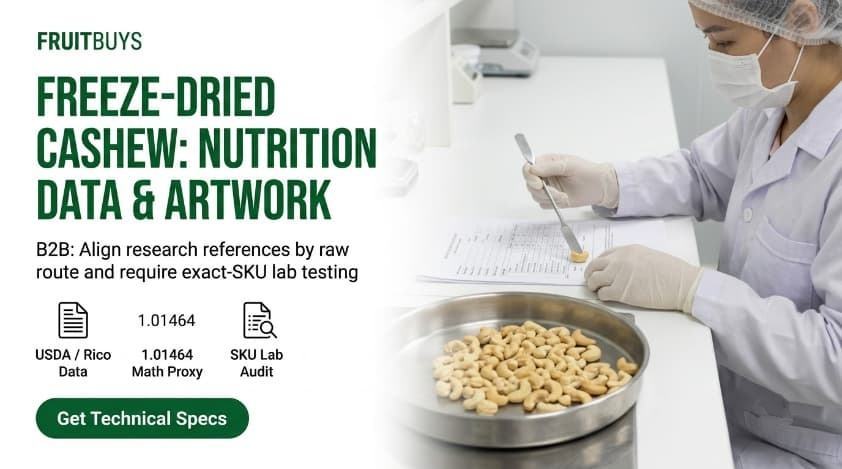
The available cashew composition datasets describe different samples and raw-material states, so they must not be merged into one finished Freeze-Dried Cashew Nutrition Facts profile. For a low-moisture reference, USDA reports 4.81 g water per 100 g edible portion, while the Rico Vietnam sample reports 4.4 g water, 21.0 g protein, 45.05 g total fatty acids and 23.6 g carbohydrate per 100 g. A 1.01464 normalization factor can support research context only; exact-SKU laboratory analysis remains necessary before label artwork. [1] [2]
Why one blended nutrition profile is not defensible
Nutrition data are meaningful only when the buyer can identify the sample, product state, analytical basis and intended use of the number. A reference value from a commercial low-moisture raw kernel does not automatically describe a finished freeze-dried SKU. A value from a different raw-material state should not be inserted merely because the product category has the same name.
The raw-material route must be locked before the nutrition basis is selected. The current architecture distinguishes a fresh mature kernel route from a commercial low-moisture kernel route. Their starting moisture states and research references are not interchangeable. Use the raw-material route definition before treating any composition dataset as relevant to the project under review.
The central distinction is between reference data and finished-SKU evidence. Reference data can help R&D frame a sample, assess which nutrients may require testing or prepare questions for a laboratory. It cannot establish the Nutrition Facts values of an exact product that has a defined process, format, package and lot.

USDA reference: useful context for a low-moisture raw-kernel route
The USDA FoodData Central Foundation Foods record for raw cashews reports 4.81 g water per 100 g edible portion. [1]
This record is useful as an official food-composition reference for a commercial low-moisture raw-kernel context. It does not represent a fresh mature kernel at a high physiological moisture state, and it does not represent the final composition of a FruitBuys freeze-dried cashew SKU.
| USDA reference characteristic | Permitted interpretation |
|---|---|
| Raw cashew reference food | Use as a composition reference for a low-moisture commercial raw-kernel context. |
| 4.81 g water per 100 g edible portion | Keep the unit, edible-portion basis and source identity beside the value. |
| Foundation Foods record | Use for R&D context and reference comparison, not as exact finished-SKU laboratory evidence. |
| Finished freeze-dried cashew label | Not established by this record. Exact-SKU laboratory analysis remains required. |
The appropriate question is not whether the USDA record is authoritative in general. The question is whether its sample and product state match the decision being made. If the buyer is evaluating a low-moisture raw-kernel route, the record may provide useful context. It still does not unlock artwork.
Rico Vietnam sample: a peer-reviewed low-moisture reference
Rico, Bulló and Salas-Salvadó reported composition data from raw cashew kernels from different origins, including a Vietnam-origin sample. For that Vietnam sample, the reported values include 4.4 g water, 21.0 g protein, 45.05 g total fatty acids and 23.6 g carbohydrate per 100 g. [2]
These values are a peer-reviewed research sample, not a FruitBuys finished-product result. The sample origin is part of the study context; it does not establish FruitBuys commercial sourcing, continuity or the composition of every Vietnam-origin kernel.
| Rico Vietnam sample value | Basis | Permitted use |
|---|---|---|
| Water | 4.4 g/100 g | Low-moisture research reference for route-specific R&D context. |
| Protein | 21.0 g/100 g | Research reference; not exact-SKU label data. |
| Total fatty acids | 45.05 g/100 g | Research reference; do not automatically relabel as Nutrition Facts total fat. |
| Carbohydrate | 23.6 g/100 g | Research reference; not exact-SKU label data. |
The distinction between total fatty acids and a regulatory Nutrition Facts total fat declaration also matters. A laboratory and labeling review must confirm the analytical method, applicable jurisdiction and rounding rules before an artwork value is created. This article does not create that final label basis.

What the 1.01464 normalization factor can and cannot do
The Rico Vietnam sample reports 4.4% water. A simple dry-solids normalization to a hypothetical 3% moisture basis uses:
Normalization factor = (1 − 0.03) / (1 − 0.044)
                     = 0.97 / 0.956
                     = 1.01464
The factor can show how a research value would change mathematically if the same dry solids were expressed on a hypothetical 3% moisture basis. It is a calculation, not a measurement of a freeze-dried product.
| The normalization factor may support | The normalization factor cannot establish |
|---|---|
| A transparent R&D comparison on a stated hypothetical moisture basis. | Exact finished-SKU nutrient values. |
| A dry-solids calculation linked to the Rico Vietnam sample. | Nutrient retention through freeze-drying. |
| A discussion of why moisture basis changes the reported concentration. | Process losses, formulation changes, analytical variation or label rounding. |
| A request for exact-SKU laboratory work. | A finished Nutrition Facts panel or health claim. |
The factor does not model nutrient retention, thermal or process effects, solids loss, formulation inputs, analytical uncertainty or the requirements of a specific destination label. It must remain a research proxy with its sample and assumptions visible.

Research reference versus exact-SKU artwork
| Development stage | Appropriate evidence | What the team may decide |
|---|---|---|
| Early R&D scoping | USDA or Rico reference data matched to the relevant raw-material state. | Which nutrients, route questions and test items deserve attention. |
| Route and format lock | Defined raw-material route, finished format and sample identity. | Which exact sample should enter laboratory and application work. |
| Exact-SKU qualification | Laboratory analysis on the relevant finished product and identified lot or SKU basis. | Whether the measured composition can proceed to label and specification review. |
| Artwork preparation | Exact-SKU results plus the applicable destination review. | Whether values can be rounded and presented in the required label format. |
Reference data should stop being treated as a product declaration when the project moves from research framing to formal SKU approval. At that point, the sample, process, format, package and destination become part of the evidence chain.
The current evidence does not establish exact finished-SKU values for calories, fat, saturated fat, carbohydrate, sugars, protein, minerals or vitamins. It also does not establish a fixed percentage of nutrient retention. Those claims require exact product testing and the appropriate review.

What must happen before Nutrition Facts artwork?
Before artwork or a formal SKU declaration, the buyer should require an exact-SKU laboratory report after the raw route, process and finished format have been locked. The request should identify the product and the evidence basis clearly.
| Required control | What to confirm |
|---|---|
| Raw-material route | Fresh mature kernel or commercial low-moisture kernel, without using an undefined “fresh cashew” label. |
| Finished product identity | Exact SKU, format and preparation state. |
| Sample or lot identity | Traceable reference connecting the laboratory report to the product under review. |
| Analytical scope | Nutrients required for the intended product declaration and application. |
| Method and basis | Method, unit, edible portion or finished-product basis and any relevant moisture basis. |
| Label review | Applicable destination review after the market and product state are formally selected. |
| Change control | Re-test or review trigger when route, formulation, process, format or package changes materially. |
Destination-specific labeling rules are outside this article’s authorized scope because the target market is not locked in the governing architecture. The lab report is necessary, but it does not independently settle every destination-label question.
Buyer-forwardable answer capsule
Cashew nutrition references must remain tied to their raw-material state and sample identity. USDA reports 4.81 g water per 100 g for its raw-cashew reference, while the Rico Vietnam sample reports 4.4 g water, 21.0 g protein, 45.05 g total fatty acids and 23.6 g carbohydrate per 100 g. A 1.01464 dry-solids normalization factor can support a hypothetical 3% moisture comparison, but it does not measure nutrient retention or create finished-SKU Nutrition Facts values. Use the references for R&D scoping, then require exact-SKU laboratory analysis before artwork.
Frequently asked questions
Can the Rico Vietnam sample be used as final Nutrition Facts artwork?
No. It is a peer-reviewed research sample, not the exact finished SKU. It can support route-specific R&D context, but artwork requires exact-SKU laboratory analysis and the relevant review for the intended product declaration.
Can USDA and Rico values be averaged into a product range?
No. The values belong to different source records and sample contexts. Preserve each dataset’s identity rather than creating a blended range that appears to describe the finished FruitBuys product.
Does moisture normalization prove nutrient retention through freeze-drying?
No. The 1.01464 factor is a dry-solids calculation based on the Rico Vietnam sample’s reported water value and a hypothetical 3% moisture basis. It does not measure pre- and post-process nutrient retention.
Can the USDA record describe a fresh mature cashew kernel?
Not automatically. The USDA record is used here as a low-moisture raw-cashew reference. The raw-material state must be identified before a composition value is applied to a project.
Does the article provide a finished Nutrition Facts panel?
No. The article explains how to use research references and where they stop. Exact-SKU laboratory analysis is required before artwork or a formal finished-product declaration.
Next step for buyers
Use the raw-material route definition to confirm which evidence basis applies. Then define the exact SKU, finished format and sample or lot identity before commissioning laboratory analysis.

For product-level context, review the freeze-dried cashew product guide. Treat every research value on this page as route-specific reference data until exact-SKU laboratory evidence and the applicable label review are complete.
References
- USDA Agricultural Research Service: “FoodData Central Foundation Foods, FDC ID 2515374: Nuts, cashew nuts, raw” (https://fdc.nal.usda.gov/food-details/2515374/nutrients )
- Rico, R.; Bulló, M.; Salas-Salvadó, J.: “Nutritional composition of raw fresh cashew (Anacardium occidentale L.) kernels from different origin” (https://onlinelibrary.wiley.com/doi/full/10.1002/fsn3.294 )