

Freeze-Dried Cashew Bulk Density and Carton Packing: How to Qualify Net Weight Without Guessing
A 60 × 39 × 39 cm carton has 91.26 L of external geometric volume, but that figure is not the usable internal fill volume. The cited conventional-cashew density range of 559.3–719.6 kg/m³ is context only and must not be substituted for freeze-dried cashew density. The current 15–20 kg/carton figure is an internal packing-trial target, not a validated net-weight specification; format-specific density, packing and transport tests are required before approval.
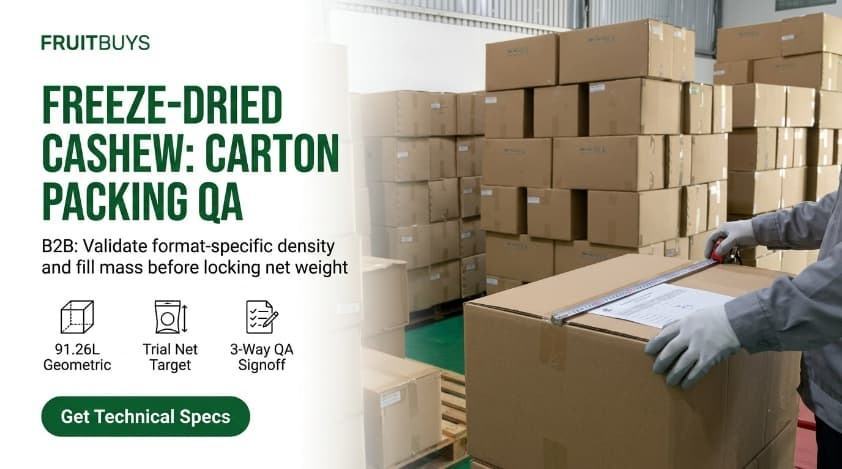
Why carton geometry is not carton capacity
The external dimensions calculate as follows:
60 cm × 39 cm × 39 cm
= 91,260 cm³
= 91.26 L
= 0.09126 m³
This is a geometric calculation based on the outside dimensions of the carton. It does not reveal the usable product volume inside the package.
Board thickness reduces the internal dimensions. The inner bag, closure, headspace and any protective arrangement reduce the volume available for product further. The finished format may also create voids or require a fill condition that leaves space for handling and package protection.
| Geometry fact | What it supports | What it does not support |
|---|---|---|
| 60 × 39 × 39 cm external carton dimensions | A calculation of 91.26 L external geometric volume. | Usable internal volume, fill mass or net carton weight. |
| External volume in litres | A starting geometry reference for package review. | A direct product-volume or capacity claim. |
| Carton dimensions without inner-pack data | A preliminary packing-trial parameter. | A validated commercial packing specification. |
The correct next step is a packing trial that records the actual package and product conditions rather than multiplying external volume by an unrelated density value.

Why conventional cashew density cannot determine FD carton weight
A cited 2019 engineering study measured conventional cashew kernels conditioned to 5% moisture and reported bulk-density values of 559.3, 640.6 and 719.6 kg/m³, or a range of 559.3–719.6 kg/m³. [1]
Those values are useful as conventional cashew-kernel engineering references. They are not measurements of freeze-dried cashew kernel. The finished FD format may differ in moisture condition, structure, breakage profile, particle distribution, packaging response and handling state.
| Density evidence | Product state | Permitted use |
|---|---|---|
| 559.3–719.6 kg/m³ | Conventional cashew kernel at 5% moisture in the cited engineering study | Context for why density matters; not a direct FD packing input. |
| Exact FD loose density | Exact finished format and SKU | Required direct measurement; current value is not established. |
| Exact FD tapped density | Exact finished format, test condition and tapping procedure | Required when the pack design depends on settled fill, current value is not established. |
A direct calculation using conventional density would answer a different question from the one the buyer needs answered. It would not account for the actual FD format, inner bag, headspace, handling or breakage. The result could look precise while using the wrong product-state basis.
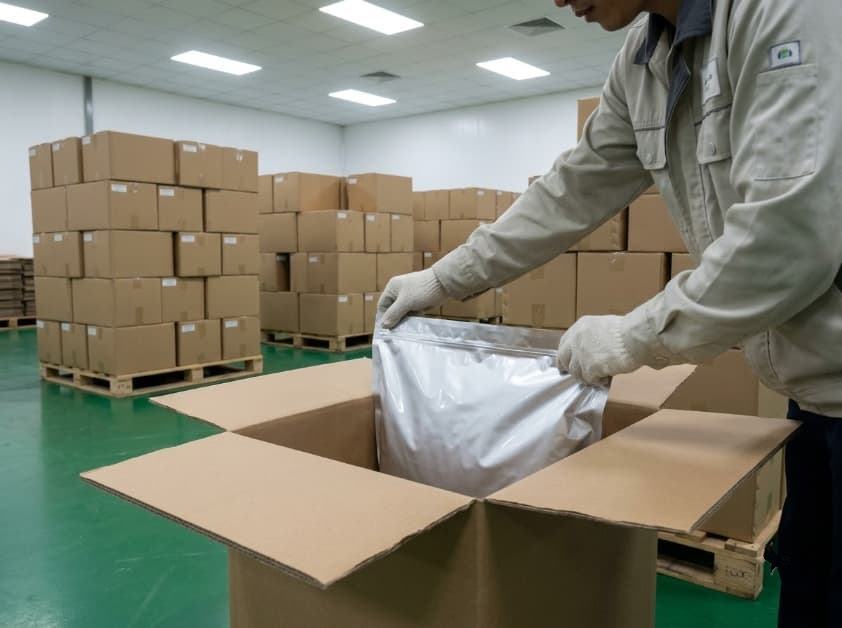
What is the status of 15–20 kg/carton?
The current 15–20 kg/carton figure is an internal packing-trial target for the 60 × 39 × 39 cm carton. It is not a validated capacity, fixed net weight, shipment result or finished-product specification.
| Statement | Correct status |
|---|---|
| 15–20 kg/carton | Internal packing-trial target. |
| 20 kg/carton as an approved standard | Not established by the current evidence. |
| Exact FD carton capacity | Not established. |
| Container-loading quantity | Not established and outside this article’s scope. |
| Approved net carton weight | Requires a completed format-specific packing and transport qualification. |
The target can help define a test point. It cannot replace the test. Packaging, procurement and QA should agree the trial conditions and the acceptance record before converting any result into a net-weight specification.
What a format-specific packing trial should measure
The packing trial should begin only after the finished physical format has been named and defined. Whole, Splits, Pieces, custom dice and powder do not automatically share one packing basis. Review the freeze-dried cashew grades and OEM formats article when the form or custom particle definition needs to be locked.
The trial record should capture the following fields:
| Trial field | What to record |
|---|---|
| Format and grade | Whole, Butts, Splits, Pieces category or a custom format with its agreed definition. |
| Loose bulk density | Measured mass and volume under the defined loose condition. |
| Tapped bulk density | Measured mass and volume under the defined tapped condition, if relevant to the pack design. |
| Inner-bag dimensions and material | Actual inner package used in the trial. |
| Fill mass | Trial mass at each intended fill point. |
| Fill height and headspace | Actual product height and remaining headspace in the selected package. |
| Seal state | Seal configuration and observed seal condition. |
| Breakage and fines before packing | Baseline physical condition before filling. |
| Breakage and fines after packing | Change in physical condition after filling and handling. |
| Transport simulation | Vibration, drop and compression response under the agreed test plan. |
| Residual oxygen | Record only if the package design controls and measures it. |
| Post-simulation condition | Visual and physical condition after the defined simulation. |
The current evidence does not supply an FD density value, inner-bag material, headspace target, breakage limit or residual-oxygen result. Those fields should be completed from the actual trial record, not from a conventional-kernel study or an unrelated freeze-dried product.

Loose density and tapped density answer different packing questions
Loose density describes the product in a defined undisturbed fill condition. Tapped density describes a settled condition after a defined tapping procedure. A pack may behave differently depending on how the product is filled, settled, transported and protected.
A buyer should define the measurement condition before comparing values. “Bulk density” without a loose or tapped condition can create avoidable disagreement between supplier and buyer, especially when the product format contains irregular pieces, fines or particles with different size distributions.
The method and equipment are not prescribed in the current evidence. The important control is to record the actual condition, volume, mass, procedure and format alongside the result so the number can be reproduced or compared later.
How format, headspace and breakage affect the decision
Format is not a cosmetic label in a packing trial. It changes the physical question that the package must answer.
Whole or larger pieces may create more voids between units. Smaller pieces, fines or powder may settle differently. A custom format may have a narrower particle distribution but still require its own measurement because no universal FD cashew density is established here.
Headspace also matters. The same nominal carton may perform differently when the fill height, inner bag and closure state change. A trial should therefore record the package configuration rather than report only a carton mass.
Breakage and fines should be measured before and after packing and after the agreed transport simulation. No breakage threshold is supplied in the current evidence. The buyer and supplier must define the acceptance criterion for the intended format before the trial result can support a specification.

When can net carton weight be locked?
Net carton weight can be considered for approval only after the selected format and package have passed the agreed packing and handling review. The decision should be documented by the relevant packaging, procurement and QA actors.
| Approval stage | Required evidence |
|---|---|
| Format lock | Recognized form or custom transformation with dimensions or particle definition. |
| Trial design | Defined carton, inner bag, fill points, loose/tapped density condition and headspace record. |
| Initial fill review | Fill mass, fill height, seal state and physical condition. |
| Handling review | Breakage and fines before and after the defined handling or transport simulation. |
| Package review | Package integrity and any controlled residual-oxygen record. |
| Cross-functional decision | Packaging, procurement and QA review the record against agreed criteria. |
| Net-weight lock | Approved net basis recorded for the defined format and package configuration. |
A net-weight decision belongs to the tested configuration. If the format, particle distribution, inner package, carton or handling condition changes materially, the buyer should review whether the qualification must be repeated.
Link packing evidence to stability evidence
Packing qualification and stability qualification are related but not identical. Package configuration can affect the product condition during storage, but a passing fill trial does not establish shelf life or oxidation performance.
After the package and fill basis are selected, buyers can review the freeze-dried cashew shelf-life and oxidation evidence article for the separate stability decision. This article does not assign a shelf-life period or oxidation result.
Buyer-forwardable answer capsule
A 60 × 39 × 39 cm carton provides 91.26 L of external geometric volume, not 91.26 L of usable product fill. Conventional cashew-kernel density data of 559.3–719.6 kg/m³ are context only and cannot determine freeze-dried cashew density or carton weight. The 15–20 kg/carton figure is an internal packing-trial target, not an approved capacity.
Buyers should define the finished format, measure loose and tapped density where relevant, record inner-bag dimensions, fill mass, headspace, seal condition, breakage, fines and transport response, then obtain a packaging, procurement and QA approval before locking net carton weight.
Frequently asked questions
Does 91.26 L mean the carton can be filled with 91.26 L of product?
No. It is the external geometric volume calculated from 60 × 39 × 39 cm. Board thickness, inner packaging, closure and headspace reduce usable internal fill volume, and the product format affects the packing result.
Can 559.3–719.6 kg/m³ be used as freeze-dried cashew density?
No. Those values are conventional-kernel engineering references at 5% moisture. They are not direct measurements of an exact freeze-dried cashew format and should not be used to calculate FD carton capacity.
Is 15–20 kg/carton approved?
No. It is an internal packing-trial target for the stated carton geometry. A validated net weight requires format-specific density, packing and transport evidence.
Should the buyer use loose or tapped density?
That depends on the package design and filling condition. If settlement affects the fill decision, define and record the tapped condition as well as the loose condition. The measurement procedure and format should remain visible beside the result.
Can carton weight be fixed before the finished format is fixed?
It should not be. Whole, Pieces, custom dice and powder may pack differently. Define the finished format first, then run the relevant packing and handling trial.
Does a passing packing trial prove shelf life?
No. Packing qualification confirms the tested fill and handling configuration against agreed criteria. Shelf life and oxidation require separate package-specific stability evidence.
Next step for buyers
Lock the recognized form or custom transformation before setting a carton trial. Record the finished format, loose or tapped density condition, inner-bag dimensions, fill mass, headspace, seal state, breakage and fines before and after handling, and any controlled residual-oxygen measurement.

For product-level context, review the freeze-dried cashew product guide. Then use the FD bulk-density and carton-packing qualification process described here as a buyer-side trial framework. Do not convert the 15–20 kg/carton target into a specification until Packaging, Procurement and QA have reviewed the actual record.