
Ri6 vs Monthong Freeze-Dried Durian: A Buyer Decision Guide
Choosing Ri6 or Monthong/DONA for freeze-dried durian is not a flavor preference. It is a product-control decision that affects raw-material intake, drying behavior, aroma profile, piece stability, yield recording, packaging risk and sample-to-bulk consistency. A buyer who approves “durian” without locking cultivar can receive a bulk lot that looks acceptable but performs differently in aroma, texture, powder behavior or retail pack appearance.
Cultivar name starts the decision, it does not finish the proof. This guide is for importers, distributors, QA managers, R&D developers and private label buyers who need to compare Ri6 and Monthong/DONA before sample approval. FruitBuys treats cultivar selection as part of Raw Material Sourcing Governance, Quality Control and Documentation, because the finished product must match the approved specification, not a loose market name.
Why Cultivar Must Appear in the Product Brief
Ri6 and Monthong/DONA should be declared in the product brief when the buyer needs consistent freeze-dried durian.
Cultivar can influence aroma, color, flesh behavior, maturity control, conversion logic and application fit.
Buyers should approve cultivar together with format, moisture, Aw, sensory criteria and lot-release evidence.
The draft Vietnamese fresh durian standard applies to Ri6, DONA and other durian varieties produced in Vietnam, and it defines pulp as the flesh surrounding the seed. That matters for freeze-dried durian because the buyer must know whether the supplier calculates from whole fruit, seeded aril or clean flesh.

The same draft standard also lists fresh durian quality expectations by cultivar, including characteristic variety identity, flesh color and basic biochemical indicators. For freeze-dried durian, cultivar declaration should appear in:
| Buyer File | Why It Matters |
|---|---|
| Product specification | Locks cultivar or approved cultivar range |
| Sample record | Ties sensory approval to exact raw material |
| Mass-balance sheet | Separates Ri6 and Monthong/DONA yield evidence |
| COA file | Links tested lot to approved product |
| Packaging brief | Aligns aroma and fragility risk |
| Private label label file | Prevents unsupported cultivar claims |
If the buyer wants the technical route before cultivar selection, read how freeze-dried durian is processed. If the buyer wants yield logic, read fresh-to-dry durian conversion.
Ri6 Freeze-Dried Durian: Product Considerations
Ri6 is a Vietnamese durian cultivar that often appears in domestic and export discussions. The draft Vietnamese fresh durian standard names Ri6 as one of the varieties covered and gives Ri6-specific harvest timing and physical-biochemical parameters in the draft framework.
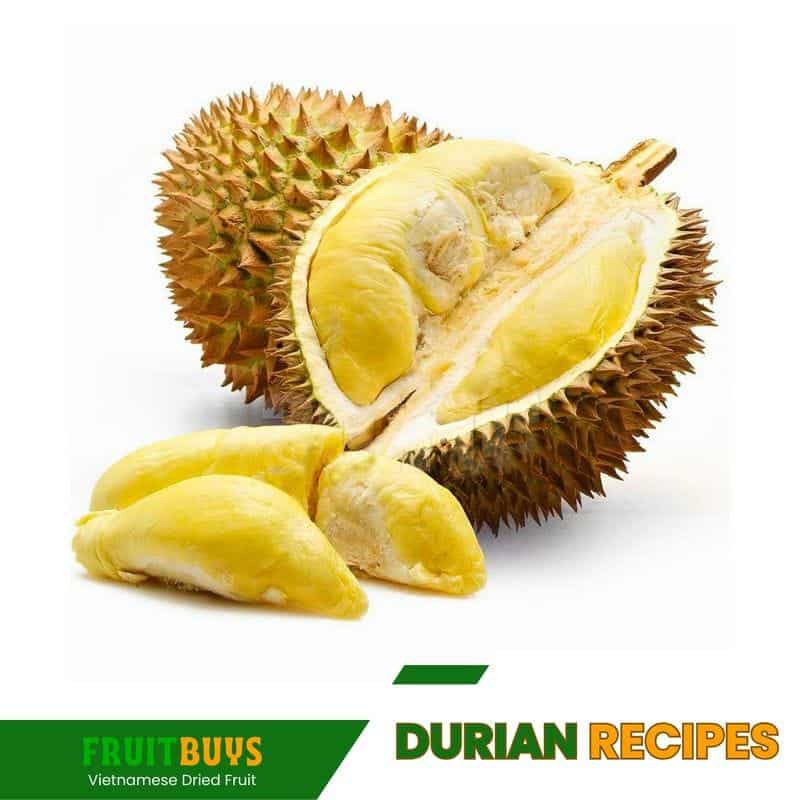
The document lists Ri6 flesh as yellow to deep yellow and uniform in color, with a described pulp taste profile of powdery, sweet and lightly fatty. For freeze-drying, Ri6 can be useful when the buyer wants a Vietnamese cultivar identity and a stronger local-origin story. But the buyer must not let that story replace evidence. Ri6 still needs:
- Maturity record.
- Clean-flesh definition.
- Cut-size control.
- Moisture result.
- Aw result.
- Broken-piece limit.
- Sensory approval.
- Lot-specific COA.
- Sample-to-bulk comparison.
The current working claim says Ri6 may need about 4–5 kg clean flesh for 1 kg freeze-dried product. Keep that as until FruitBuys records cultivar-specific mass balance across multiple lots.
A published claim needs input flesh weight, fresh moisture, finished moisture, Aw, total dried output, Grade A pieces, broken pieces, fines and rejects. For the mass-balance discipline, use fresh-to-dry durian yield calculation.
Monthong/DONA Freeze-Dried Durian: Product Considerations
DONA is commonly connected with Thai Monthong-type planting in Vietnam’s durian sector. The draft Vietnamese fresh durian standard covers DONA and gives cultivar-specific harvest windows, appearance parameters and dry-matter indicators. It describes DONA flesh as light yellow to yellow and uniform in color, with a similar “powdery, sweet, lightly fatty” taste description in the draft table.
Monthong/DONA can be useful when the buyer wants a familiar Southeast Asian durian profile and a broader cultivar reference for export-oriented applications. But the buyer must verify the exact product, not the cultivar reputation. A Monthong/DONA sample does not prove bulk repeatability unless the release system controls maturity, piece size, drying endpoint and packaging.
The current working claim says Monthong/Thai-type flesh may require about 5–6 kg clean flesh for 1 kg freeze-dried product. Keep this as. If the claim reflects stricter Grade A selection, higher water content, more trimming or broken-piece exclusion, the mass-balance sheet must show it. For format impact, read freeze-dried durian cubes, bites, slices and powder.
Cultivar Does Not Replace Maturity Control
A buyer who locks cultivar but ignores maturity still leaves the product exposed. Maturity affects pulp dry matter, sweetness, color, texture, drying behavior and yield interpretation. The draft Vietnamese fresh durian standard states that harvest timing differs by variety and growing region.
It lists Ri6 and DONA harvest windows after flowering for the Mekong Delta/Southeast and the Central Highlands/South-Central Coast, and it also states that postharvest handling, packing and transport must be managed carefully so the durian reaches market in good condition.

The draft also lists minimum dry-matter values for fresh Ri6 and DONA in its biochemical table: Ri6 at 32.29% or higher and DONA at 32.22% or higher. These values support raw-material governance for fresh durian, but they do not prove freeze-dried output from a FruitBuys lot.
A Monthong maturity study also shows why dry matter matters: immature Monthong pulp at 117 days after anthesis had lower dry matter than mature fruit at 124 days, based on the cited study summary (ScienceDirect).
For B2B approval, FruitBuys should define maturity through:
| Control Point | Required Buyer Handling |
|---|---|
| Growing region | Record source and harvest window |
| Cultivar | Ri6, DONA/Monthong or approved alternative |
| Maturity direction | Define harvest and processing suitability |
| Dry matter or equivalent measure | Use as raw-material indicator where available |
| Defect screening | Remove hardened pulp, wet core or abnormal flesh |
| Clean-flesh standard | Define what enters the dryer |
Cultivar is the nameplate. Maturity is the engine room.
How Cultivar Affects Fresh-to-Dry Conversion
Ri6 and Monthong/DONA conversion claims need recorded mass balance, not verbal ranges.
Fresh dry matter, trimming loss, cut size, final moisture, broken pieces and Grade A selection can change usable yield.
Buyers should compare cultivars only under the same trial rules.
The user-supplied working range is:
| Cultivar Direction | Working Claim | Publication Status |
|---|---|---|
| Ri6 | 4–5 kg clean flesh → 1 kg freeze-dried | [DATA NEEDED] |
| Monthong/Thai type | 5–6 kg clean flesh → 1 kg freeze-dried | [DATA NEEDED] |
| General clean flesh | 4–6 kg → 1 kg freeze-dried | Conditional, not locked |
This split may match operating experience in a factory context, especially if the final counted output includes only snack-grade pieces. But the claim cannot move into buyer-facing content until the starting point and final grade are defined.

FruitBuys should compare cultivars with the same trial design:
- Same clean-flesh definition
- Same maturity rule
- Same defect removal
- Same cut size
- Same drying target
- Same moisture method
- Same Aw target
- Same grading rule
- Same packaging delay
- Same output classification
Without those controls, the comparison measures the supplier’s sorting and recordkeeping, not the cultivar. The technical article is fresh-to-dry durian conversion.
How Cultivar Affects Format Selection
Ri6 and Monthong/DONA may behave differently across cubes, bites, slices and powder. The buyer should not approve one cultivar sample and assume the same performance across all formats.
Cubes
Cubes need dimensional control and uniform drying through the center. Dense or thick flesh can create endpoint risk if the cube size is too large.
Bites
Bites suit retail snack pouches, but irregular natural flesh shape can create inconsistent piece size. The buyer needs a size range and broken-piece limit.

Slices
Slices create strong visual presentation, but they expose edge breakage. Flesh texture and slice thickness matter.
Powder
Powder shifts the decision away from visual grade and toward mesh, carrier declaration, clumping, aroma retention and flow behavior. A cultivar with strong aroma may work well in formulation, but the powder still needs particle-size and ingredient control.
For all formats, link to freeze-dried durian format and size specifications. For moisture-sensitive format behavior, link to freeze-dried durian moisture and Aw.
How Cultivar Affects Applications
Cultivar choice should follow application. A retail snack buyer, a chocolate manufacturer and a beverage powder developer do not need the same durian expression.
| Application | Cultivar Decision Focus | Required Proof |
|---|---|---|
| Retail snack pouch | Visual color, aroma, crisp bite, low broken pieces | Sensory sample, moisture, Aw, retained sample |
| Chocolate inclusion | Aroma strength, small-piece stability, Aw compatibility | Particle size, Aw, application trial |
| Bakery use | Heat exposure, powder or granule behavior | Mesh, carrier declaration, flavor test |
| Ice cream or dairy | Aroma balance, dispersion, hydration behavior | R&D trial, ingredient statement |
| Cereal or granola | Breakage resistance and moisture migration | Packaging and format test |
| Private label pouch | Repeatable sensory identity and label-ready product | Product spec, packaging brief, COA |
A buyer choosing Ri6 for Vietnamese identity must still test application performance. A buyer choosing Monthong/DONA for familiar market profile must still verify the bulk lot. The product either performs in the buyer’s format or it does not. For the full use-case path, read freeze-dried durian food applications. For branded pack development, read freeze-dried durian private label delivery.
Sensory Criteria: Aroma, Color, Taste and Texture
Cultivar comparison often fails because buyers write “good aroma” or “nice yellow color” instead of measurable sensory criteria. That phrasing creates arguments after bulk production.

FruitBuys should define sensory approval through:
- Cultivar identity
- Color range
- Aroma intensity
- Off-odor rejection
- Taste profile
- Texture: crisp, brittle or powdery
- Defect categories
- Retained sample code
- Buyer approval date
- Bulk comparison method
The draft Vietnamese standard lists fresh Ri6 and DONA flesh color and taste descriptions, but freeze-drying changes structure and can alter aroma intensity through drying and post-drying handling.
Use the draft as a fresh-fruit reference, not as proof of finished freeze-dried sensory quality. If the buyer needs final retail consistency, sensory approval must connect to sample-to-bulk consistency for freeze-dried durian.
Cultivar Selection for OEM and Private Label
Private label buyers need more than a good sample. They need repeatable product identity across artwork, label, pack configuration, shelf-life support and bulk lots. For Ri6 private label, the brand story may lean into Vietnamese cultivar identity.
That can work only when the specification and document file support the claim. For Monthong/DONA private label, the buyer may position around a familiar Southeast Asian durian profile, but the same evidence burden applies.
The OEM file should include:
| OEM Field | Ri6 / Monthong-DONA Requirement |
|---|---|
| Product name | Avoid unsupported cultivar claims |
| Ingredient statement | Confirm pure fruit or added component |
| Cultivar statement | State only when verified |
| Format | Cubes, bites, slices or powder |
| Moisture and Aw | Lock release targets |
| Pack size | Match moisture and breakage risk |
| Artwork | Avoid unsupported claims |
| Lot code | Align with traceability |
| COA | Match finished lot |
| Retained sample | Support dispute control |
For OEM execution, link to freeze-dried durian OEM and private label delivery. For label data, link to freeze-dried durian Nutrition Facts development.
Application Mapping
| Buyer Type | Application | Required Format | Proof Needed | FruitBuys Delivery |
|---|---|---|---|---|
| Importer | Retail snack pouch | Ri6 or Monthong/DONA bites or slices | Cultivar declaration, sensory sample, moisture, Aw, COA | Quality Control and Documentation |
| Distributor | Tropical freeze-dried portfolio | Bites, slices or mixed pieces | Cultivar consistency and format tolerance | Raw Material Sourcing Governance |
| QA manager | Supplier approval | Any format | Cultivar record, COA, retained sample, certificate scope | Lot-based document review |
| R&D developer | Chocolate, bakery or dairy use | Broken pieces, granules or powder | Application trial, particle size, ingredient statement | Application-aligned sample route |
| Private label buyer | Branded consumer pouch | Cubes or bites | Cultivar claim support, packaging, label data, COA | OEM/Private Label Delivery |
| Ingredient buyer | Manufacturing input | Powder or granules | Mesh, carrier status, microbiology, sensory target | Specification and release file |
How to Run a Cultivar Comparison Trial
A valid Ri6 vs Monthong/DONA trial uses the same process conditions and the same release criteria.
If one cultivar receives better raw material, stricter sorting or different cut size, the trial no longer compares cultivars fairly.
Buyers should request a side-by-side sample file before choosing the cultivar for bulk supply.
FruitBuys should design the trial with one purpose: give the buyer a controlled decision. The trial should not chase a persuasive sample. It should expose the real operating differences.

A useful comparison trial includes:
- Same intended application
- Same target format
- Same piece size or mesh
- Same maturity rule
- Same trimming standard
- Same starting-material definition
- Same freeze-drying endpoint
- Same moisture target
- Same Aw target
- Same packaging
- Same exposure time before sealing
- Same sensory evaluation sheet
- Same retained sample method
- Same lab panel
- Same mass-balance format
FruitBuys should record outputs by category:
| Output Category | Why It Matters |
|---|---|
| Total dried output | Shows overall process recovery |
| Grade A pieces | Supports retail snack approval |
| Broken pieces | Supports ingredient-grade use |
| Fines | Exposes fragility and powdering |
| Rejects | Shows quality loss |
| Final moisture | Confirms drying endpoint |
| Final Aw | Confirms stability target |
| Sensory result | Confirms buyer preference |
Then the buyer can decide based on application fit, not cultivar folklore.
Highest-Risk Decision: Approving Cultivar Without Bulk Evidence
The highest-risk mistake is not choosing Ri6 or Monthong/DONA. The mistake is choosing either one from a single attractive sample.
A supplier can prepare a strong sample by selecting the best pieces from a small batch. Bulk production then introduces normal variation: different maturity, different flesh softness, different drying behavior, different broken-piece level and different aroma intensity. If the approved sample has no records, the buyer has no release standard.
The buyer should hold approval when:
- Cultivar is not declared
- Cultivar claim has no raw-material record
- Fresh-to-dry yield has no mass balance
- Sample has no retained reference
- Moisture and Aw are not linked to the sample
- Bulk lot uses a different cultivar
- Format tolerance is missing
- Packaging differs from the sample
- COA does not match the lot
- Sensory criteria are only verbal
This decision links directly to approved sample and bulk release and freeze-dried durian COA and laboratory testing.
Why FruitBuys Delivers This
FruitBuys supplies freeze-dried durian as one export-ready product under an Integrated Product Supply Model. Cultivar selection sits at the front of that model because the buyer needs a product that can repeat from approved sample to bulk lot.
FruitBuys applies Raw Material Sourcing Governance by aligning cultivar, maturity direction, clean-flesh suitability and raw-material records before processing. FruitBuys applies Quality Control by connecting cultivar choice with format, moisture, Aw, sensory criteria, breakage and retained sample comparison.
FruitBuys applies Documentation by tying cultivar, lot identity, COA, specification and packing file to the actual goods. For trial buyers, FruitBuys applies MOQ Flexibility/Market Trial Support by structuring cultivar comparison samples where operationally feasible.
For private label buyers, FruitBuys applies OEM/Private Label Delivery by aligning cultivar claim, pack format, label data and lot coding. FruitBuys does not sell a cultivar name. FruitBuys supplies a controlled finished product.

Buyer Checklist
Before choosing Ri6 or Monthong/DONA for freeze-dried durian, request:
- Target application
- Cultivar declaration
- Approved cultivar alternatives, if any
- Growing-region and maturity direction
- Clean-flesh definition
- Fresh dry-matter or moisture evidence where available
- Cut size or mesh
- Format: cubes, bites, slices or powder
- Moisture target
- Aw target
- Broken-piece limit
- Sensory criteria
- Side-by-side sample
- Retained sample code
- Mass-balance record
- COA and lab panel
- Packaging specification
- Bulk comparison rule
- Label claim review for private label
Do not approve cultivar from photos, supplier habit or a single good bite.
Summary
Ri6 and Monthong/DONA freeze-dried durian should be compared by cultivar declaration, maturity control, dry-matter evidence, format behavior, moisture, Aw, sensory criteria, mass balance and sample-to-bulk consistency. The draft Vietnamese fresh durian standard covers Ri6 and DONA and provides fresh-fruit quality indicators, but those indicators do not prove finished freeze-dried product performance.
FruitBuys manages cultivar choice through Raw Material Sourcing Governance, Quality Control, Documentation, OEM/Private Label Delivery and controlled sample comparison.
FAQ
Is Ri6 better than Monthong for freeze-dried durian?
Not automatically. Ri6 may support Vietnamese cultivar positioning, but the buyer still needs maturity, format, moisture, Aw, sensory and bulk evidence.
Is Monthong the same as DONA?
DONA is commonly treated as a Thai Monthong-type cultivar in Vietnam sourcing discussions. For buyer documents, use the cultivar name supported by raw-material records.
Does Ri6 give better freeze-dried yield?
Not as a locked claim yet. The Ri6 4–5 kg clean-flesh working range needs mass-balance records before publication as verified data.
Does Monthong need more flesh per kilogram of freeze-dried product?
The 5–6 kg working range remains. It may reflect moisture, trimming or Grade A selection, but the lot record must prove it.
Which cultivar should private label buyers choose?
Choose the cultivar that matches the intended aroma, format, packaging and label position, then verify it through sample-to-bulk controls and COA.
Can the supplier switch cultivars after sample approval?
Only if the specification allows it and the buyer approves the change. Otherwise, cultivar switching breaks sample-to-bulk control.
Which article should follow this one?
Read freeze-dried durian cubes, bites, slices and powder next for format selection, or fresh-to-dry durian conversion for yield control.
Conclusion
Request a cultivar comparison sample after defining aroma, texture, format, application, moisture, Aw and required lot-release evidence.
References
- Cục Trồng trọt và Bảo vệ thực vật, Bộ Nông nghiệp và Môi trường. “Dự thảo TCVN: Sầu riêng quả tươi.” 2025 draft standard. (Cục Trồng Trọt và Bảo Vệ Thực Vật)
- LWT – Food Science and Technology. “Minimally-destructive evaluation of durian maturity based on electrical impedance measurement.” Study summary on Monthong maturity and dry matter. (ScienceDirect)