

Freeze-Dried Dragon Fruit Conversion Ratio: How Buyers Should Validate Yield
Freeze-dried dragon fruit conversion ratio looks like a simple purchasing question, but it controls raw-material planning, sample approval and bulk release. A buyer may hear that one kilogram of finished product needs eight, nine or ten kilograms of fresh dragon fruit flesh. That number means little unless the supplier defines the starting material, fruit variant, moisture, cutting loss, drying endpoint, sorting loss and final saleable output. A red-flesh powder does not follow the same logic as white-flesh slices.
A beautiful sample does not prove production yield. If the buyer accepts one conversion number without a yield method, the bulk order starts with a blind spot. FruitBuys treats conversion as a measured product-control item tied to raw material, format, moisture, Aw, COA and sample-to-bulk release.
What Does Fresh-to-Dry Ratio Mean?
Fresh-to-dry ratio means how much fresh dragon fruit input produces one kilogram of finished freeze-dried product.
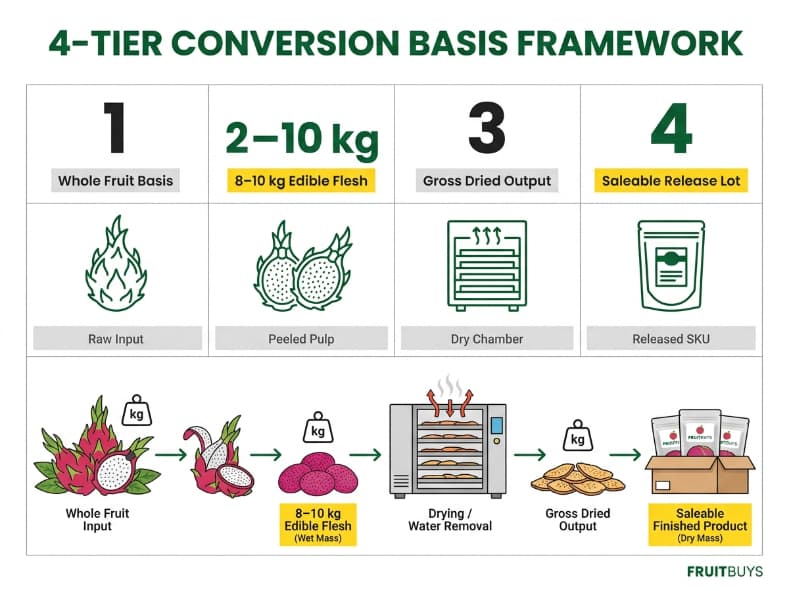
The ratio changes depending on whether the calculation starts from whole fruit, edible flesh, gross dried output or saleable released product.
Buyers should define the calculation basis before using any conversion number for procurement planning.
A conversion ratio is not one universal number. It is a measurement boundary. Buyers qualifying the wider category should first review the freeze-dried dragon fruit buyer guide. The buyer must know where the weighing starts and where it ends.
There are four common conversion bases:
| Conversion Basis | What It Measures | Buyer Risk If Confused |
|---|---|---|
| Whole fruit to dry | Fresh dragon fruit before peeling | Overstates raw requirement if compared with flesh-only data |
| Edible flesh to dry | Flesh after peel removal | Cleaner basis for processing yield |
| Gross dried output | Product after drying before final sorting | Hides breakage, fines and rejected pieces |
| Saleable finished product | Released product that meets specification | Best basis for B2B planning |
For freeze-dried dragon fruit, the safest B2B wording is:
A working conversion range is about 8–10 kg of edible dragon fruit flesh for 1 kg of finished freeze-dried product, subject to variant, maturity, moisture, format, drying endpoint, sorting loss, fines and release specification.
Do not split that statement into a fixed red-versus-white rule without production-lot evidence. The current working direction can guide early discussion. It cannot replace lot data.
Dragon fruit has high natural moisture. A drying-method study on dragon fruit notes that fresh and ripe dragon fruit is highly perishable because of high moisture content, and it measured high moisture in dragon fruit slice and pulp samples before dried-powder results were assessed. The same study reported freeze-dried slice powder moisture of 3.20% and freeze-dried pulp powder moisture of 5.38% under its conditions. (MDPI)
That research supports the logic behind conversion: most fresh mass leaves as water. The buyer still needs commercial yield data from actual production.
Why One Fixed Ratio Misleads Buyers
A fixed ratio can sound efficient. It can also hide the real losses.
The buyer should separate two questions:
- How much edible dragon fruit flesh contains enough solids to make one kilogram of dried product?
- How much of the dried product remains saleable after cutting, drying, sorting, packing and release inspection?
The first question uses mass balance. The second question uses production discipline.
A theoretical ratio assumes dry solids remain constant. The simple model is:
Fresh edible flesh required for 1 kg finished product =
(1 - finished moisture) ÷ (1 - fresh flesh moisture)
If the calculation includes saleable yield after sorting, the ratio increases:
Commercial saleable ratio =
theoretical flesh-to-dry ratio ÷ saleable yield
The buyer should not insert a guessed saleable yield. It must come from production records.
Scenario Model: Moisture Drives the Base Ratio
The table below shows theoretical edible-flesh input for one kilogram of finished freeze-dried dragon fruit. It does not include cutting loss, sorting loss, fines, breakage or rejection.
| Fresh Flesh Moisture | Finished Moisture 5% | Finished Moisture 3% | Meaning |
|---|---|---|---|
| 83% | 5.59 kg | 5.71 kg | Low theoretical ratio before loss |
| 85% | 6.33 kg | 6.47 kg | Still below common commercial planning figures |
| 87% | 7.31 kg | 7.46 kg | Moves closer to commercial range |
| 89% | 8.64 kg | 8.82 kg | Supports an 8–9 kg planning range before extra loss |
| 90% | 9.50 kg | 9.70 kg | Supports a 9–10 kg planning range before extra loss |
This table shows why the user-supplied working range of 8–10 kg edible flesh per kilogram finished product can be operationally plausible. It also shows why the buyer should not use it blindly. The number depends heavily on fresh flesh moisture and final accepted product condition.
The commercial ratio can rise when:
- Raw material has higher water content
- Fruit maturity shifts
- Brix decreases
- Flesh loses juice during cutting
- Slices break after drying
- Bites create excess fines
- Cubes fail dimension tolerance
- Powder loses material during milling and sieving
- Finished moisture target decreases
- Final sorting rejects more pieces
The ratio can fall when raw material has higher solids, better cut stability, lower sorting loss and stronger format control. A buyer who compares suppliers by one declared conversion figure sees only the top card in the deck. The useful proof sits underneath.

Red vs White Dragon Fruit: Do Not Use Color as a Yield Shortcut
Red-flesh and white-flesh dragon fruit can differ in application, color and buyer expectations.
Fruit color alone does not prove the fresh-to-dry conversion ratio.
Buyers should validate conversion through measured edible flesh input, moisture, finished output and saleable yield.
It is tempting to say white-flesh dragon fruit needs 8–9 kg and red-flesh dragon fruit needs 9–10 kg. That may match a working observation from specific batches, but it should not become a published rule without production-lot proof.
Dragon fruit species and preparation conditions vary. A study comparing drying methods for dragon fruit used slices and pulp, with equal slice and pulp thickness of 5–7 mm, and it reported different moisture behavior between slice and pulp samples under drying conditions. (MDPI) That confirms a key point for buyers: product preparation changes drying and yield behavior.
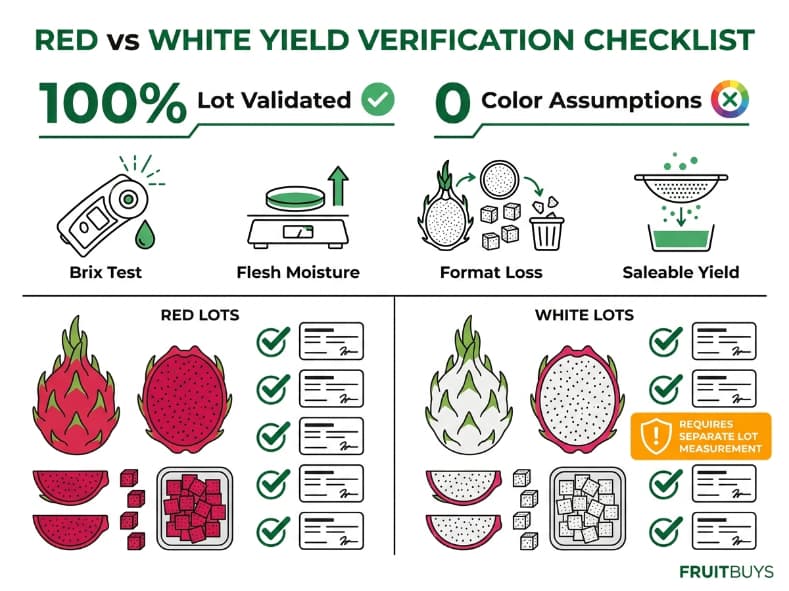
A red-versus-white conversion file should record:
| Data Point | Why It Matters |
|---|---|
| Fruit variant | Separates red-flesh and white-flesh material |
| Botanical or supplier identity | Avoids vague “dragon fruit” sourcing |
| Harvest window | Captures seasonal maturity and moisture changes |
| Brix | Supports solids and maturity review |
| Flesh moisture | Controls theoretical yield calculation |
| Edible yield | Separates whole fruit from processing input |
| Cut format | Changes drying and breakage behavior |
| Finished moisture | Changes final product mass |
| Saleable yield | Shows accepted product after sorting |
| Fines and rejects | Shows hidden loss |
A buyer can use red and white variants differently. Red-flesh powder may serve beverage and bakery color applications. White-flesh slices may serve topping and snack applications. The decision should follow the red and white dragon fruit comparison. The yield file must still come from measurement, not from color assumption.
Format Changes the Conversion Result
Freeze-dried dragon fruit format changes the commercial conversion ratio because each format creates different losses.
Slices preserve visible fruit identity but can break. Bites create irregular sorting decisions. Cubes need dimensional control and can lose edges. Powder adds milling, sieving, transfer and packaging loss. A conversion number that does not name the format has weak planning value.
| Format | Main Yield Pressure | Buyer Control |
|---|---|---|
| Slices | Cutting loss, breakage, visual rejection | Thickness, broken-piece limit, packaging |
| Bites | Irregular size, fines, sorting loss | Accepted-piece definition and size range |
| Cubes | Dimension rejection, edge breakage | Cube tolerance and fines limit |
| Powder | Milling loss, sieving loss, clumping risk | Mesh, carrier status, moisture and packing |
The drying-method study on dragon fruit reported different behavior between slices and pulp, and it noted that grinding and sieving in sample preparation affected particle uniformity and moisture behavior. (MDPI) Buyers should read that as a process warning, not a commercial promise. Once the product changes form, the yield method must follow the form.
For powder, the issue becomes sharper. A freeze-dried dragon fruit powder study reported moisture, Aw, solubility and hygroscopicity results, including a moderate tendency to absorb environmental moisture. That supports the need to treat powder as a separate yield and packaging case, not merely a ground version of slices. (Observatorio Latinoamericano)
The buyer should ask for format-specific yield records. If the supplier gives one conversion ratio for slices, cubes, bites and powder, the buyer should treat the number as a general planning note, not a release basis.
Finished Moisture Changes the Final Weight
A lower finished moisture target can increase the fresh input required for one kilogram of finished product. The effect looks small at first, but it matters when buyers scale product planning.
For example, at 89% fresh flesh moisture:
- Finished at 5% moisture needs about 8.64 kg edible flesh before losses
- Finished at 3% moisture needs about 8.82 kg edible flesh before losses
The difference is not dramatic in one kilogram. It becomes meaningful across a production run because sorting loss, fines and packaging reject can stack on top of the moisture difference.
Moisture should stay separate from Aw. FDA defines water activity as a ratio between the vapor pressure of the food and the vapor pressure of distilled water under the same conditions. FDA also states that water activity affects food stability and should reach a suitable level after drying and remain within an acceptable range during storage. (U.S. Food and Drug Administration)
This distinction controls the conversion conversation. Moisture affects final weight. Aw affects available water and stability conditions. Buyers should apply the moisture and Aw release requirements. A buyer should not use Aw to calculate mass yield. A buyer should not use moisture alone to release the product.

The finished lot should carry both:
| Release Item | Conversion Role | QA Role |
|---|---|---|
| Moisture | Affects final mass and ratio | Confirms drying endpoint |
| Aw | Does not calculate weight directly | Supports stability review |
| COA | Confirms tested lot values | Links result to release |
| Packaging | Does not create yield | Protects product after drying |
| Sample-to-bulk file | Checks consistency | Prevents sample-only assumptions |
A yield number without moisture and COA becomes a claim. A yield number with lot records becomes a planning tool.
Production-Lot Validation Protocol
A reliable conversion ratio requires repeated production-lot measurement.
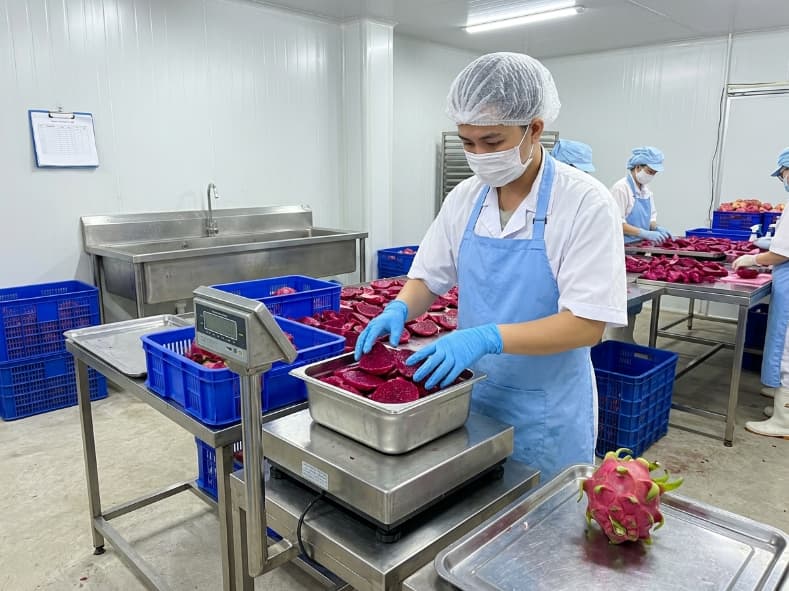
The buyer should compare fresh edible flesh input against saleable finished output, not just gross dried weight.
FruitBuys should use the measured ratio to support raw-material planning and sample-to-bulk control.
A buyer should validate freeze-dried dragon fruit conversion through a simple lot protocol. It does not need theatrical complexity. It needs disciplined weighing and clean boundaries.
A usable production-lot protocol should record:
- Fresh whole fruit weight
- Peel and trimming loss
- Edible flesh weight
- Fruit variant and harvest date
- Brix or maturity indicator
- Initial flesh moisture
- Cut format
- Tray loading weight
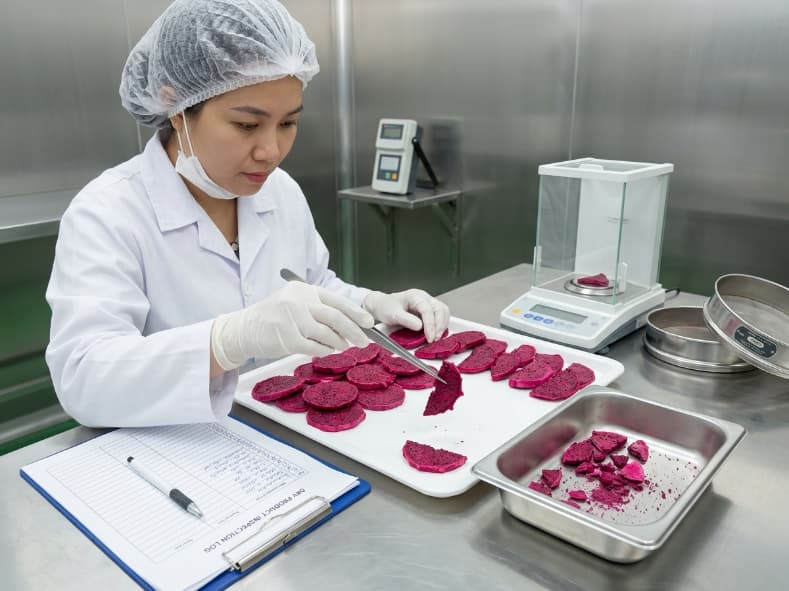
- Post-dry gross output
- Finished moisture
- Aw result
- Sorting reject
- Broken pieces
- Fines
- Saleable finished product
- Packaging loss where relevant
- COA lot code
- Retained sample
The key metric should use saleable finished product and connect to lot-specific COA and laboratory testing:
Saleable conversion ratio =
edible flesh input ÷ released finished product
If 900 kg of edible flesh produces 100 kg of released finished product, the saleable conversion ratio is 9:1. If 900 kg produces 110 kg gross dried product but only 95 kg meets specification after sorting, the buyer should use the 900 ÷ 95 figure for planning. Gross output gives comfort. Saleable output gives control.
The protocol should run across more than one lot. One trial can show direction. Several lots show stability. The buyer should separate red-flesh and white-flesh data, and should also separate slices, bites, cubes and powder. Bulk approval should then follow the sample-to-bulk consistency controls.

Procurement Risks When Yield Is Not Defined
Conversion errors create practical damage. They do not stay inside the spreadsheet.
The buyer can face:
- Unstable raw-material planning
- Inconsistent sample approval
- Different format behavior between lots
- Unexpected fines and breakage
- Weaker documentation review
- Delayed bulk release
- Poor private label readiness
- Supplier disputes over accepted output
- R&D application failure
- Inventory instability
The most common error starts with a good sample. The buyer approves color and texture. The supplier quotes a conversion number. Nobody defines edible flesh input, final moisture, sorting loss or accepted pieces. When bulk runs, the lot generates more fines than expected. The COA shows the moisture, but the yield file does not explain what happened. Now procurement, QA and production talk past each other. This is preventable.
FruitBuys should tie conversion to Raw Material Sourcing Governance, Quality Control and Documentation. Raw material records show the starting point. Moisture and Aw show the drying and stability condition. Sorting and fines records show the saleable output. COA and retained samples close the file.
The buyer should not ask only, “How many kilograms fresh for one kilogram dry?” The buyer should ask, “Which kilograms, measured where, released under which specification?”
Application Mapping
| Buyer Type | Application | Required Format | Proof Needed | FruitBuys Delivery |
|---|---|---|---|---|
| Importer | Bulk or retail distribution | Slices, bites, cubes or powder | Saleable conversion, moisture, Aw, COA and retained sample | Raw Material Sourcing Governance and Documentation |
| Procurement manager | Raw-material planning | Any approved format | Edible flesh input, finished output, sorting loss and lot history | Production-readiness review and specification control |
| QA manager | Bulk lot release | Any approved format | Moisture, Aw, COA, lot code, breakage and fines data | Quality Control and controlled product release |
| R&D developer | Formula scale-up | Powder or cubes | Yield basis, mesh or size, moisture, Aw and application sample | Application-ready specification alignment |
| Private label brand | Retail pouch SKU | Slices, bites or powder | Conversion basis, packaging file, sample-to-bulk criteria and release file | OEM / Private Label Delivery |
| Distributor | Multi-format inventory | Slices, bites and powder | Format-specific conversion and shelf-life support | Export-ready product supply and logistics coordination |
Why FruitBuys Delivers This
FruitBuys supplies freeze-dried dragon fruit as an export-ready product under one accountable supplier relationship. The buyer does not need a floating conversion number. The buyer needs a measured product route from raw material to released finished goods.
Under Raw Material Sourcing Governance, FruitBuys aligns fruit variant, maturity, harvest window and edible flesh suitability with the intended format. Under Quality Control, FruitBuys connects conversion to moisture, Aw, size, breakage, fines and accepted-piece criteria. Under Documentation, FruitBuys ties production records, COA, retained sample and lot identity to the actual goods. Under OEM/Private Label Delivery, FruitBuys connects conversion logic to pack size, format selection and SKU release. Under Export Logistics Coordination, FruitBuys aligns the released finished product with packing and shipment readiness.
Conversion works only when the buyer defines the boundary. FruitBuys controls that boundary through a locked specification, measured yield record and lot-based release file.
Buyer Checklist
Before accepting a freeze-dried dragon fruit conversion ratio, confirm:
- Red-flesh or white-flesh variant
- Whole fruit or edible flesh basis
- Edible flesh weight after peel removal
- Harvest window
- Brix or maturity indicator
- Initial flesh moisture
- Target format
- Cut size, thickness or mesh
- Finished moisture
- Aw result
- Gross dried output
- Rejected pieces
- Broken pieces
- Fines
- Saleable finished product
- Packaging loss where relevant
- COA lot code
- Retained sample
- Production-lot count behind the ratio
- Change-control triggers
Do not use one conversion figure across every variant and format. Use measured saleable yield.
Summary
Freeze-dried dragon fruit conversion ratio should be calculated from edible flesh input to saleable finished product, not from vague whole-fruit claims. A working range of 8–10 kg edible dragon fruit flesh for 1 kg finished product can guide early B2B planning, but red-versus-white ratios need production-lot validation.
Moisture affects final weight, while Aw supports stability review. FruitBuys controls conversion through raw-material governance, specification lock, COA review, sorting records and sample-to-bulk release.
FAQ
How many kilograms of fresh dragon fruit make 1 kg freeze-dried product?
A working planning range is about 8–10 kg of edible dragon fruit flesh for 1 kg finished freeze-dried product. The exact ratio needs production-lot validation.
Is the ratio based on whole fruit or flesh?
It should be stated clearly. Flesh-to-dry ratio starts after peel removal. Whole-fruit-to-dry ratio includes peel and trimming loss, so it will be higher.
Does red dragon fruit need more raw material than white dragon fruit?
Not automatically. The ratio depends on moisture, maturity, Brix, cut format, drying endpoint, sorting loss and saleable yield.
Why does finished moisture affect conversion?
Finished moisture changes final product weight. A lower finished moisture target can require more fresh flesh for the same finished weight.
Does Aw affect the conversion ratio?
Aw does not calculate mass yield directly. It supports stability review and should appear with moisture in the COA.
Can one trial prove the conversion ratio?
No. One trial shows direction. Buyers should review repeated production lots by variant and format before using the ratio for planning.
What is the best conversion metric for buyers?
Use edible flesh input divided by saleable finished product. That captures trimming, drying, sorting, fines and release loss better than gross output.
Conclusion
Submit the target variant, format, moisture limit and release criteria so FruitBuys can review the fresh-to-dry conversion basis before sample approval.
References
- A. Iqbal and co-authors. Impact of Different Drying Methods on the Phenolic Composition, In Vitro Antioxidant Activity, and Quality Attributes of Dragon Fruit Slices and Pulp. Foods, 2023. (MDPI)
- U.S. Food and Drug Administration. Water Activity (aw) in Foods. Content current as of 2014. (U.S. Food and Drug Administration)
- Vanessa Caroline de Oliveira and co-authors. Freeze-dried dragon fruit powder: characterization and incorporation in plant-based drink. Observatório de la Economía Latinoamericana, 2024. (Observatorio Latinoamericano)