
What should a freeze-dried cantaloupe COA show after the US cantaloupe recalls?
After the 2023 cantaloupe recalls, QA asks one question first. Rind sanitising, lot COA limits, Listeria on request and sample-to-bulk control.
A freeze-dried cantaloupe lot should arrive with a COA from an independent ISO/IEC 17025 accredited laboratory showing moisture ≤5.0%, water activity ≤0.30, total plate count ≤10⁴ CFU/g, yeasts and moulds ≤10² CFU/g, E. coli <10 CFU/g and Salmonella not detected in 25 g. If the fruit goes into chilled dairy, ice cream or chocolate, add Listeria monocytogenes and a lower-count inclusion grade.
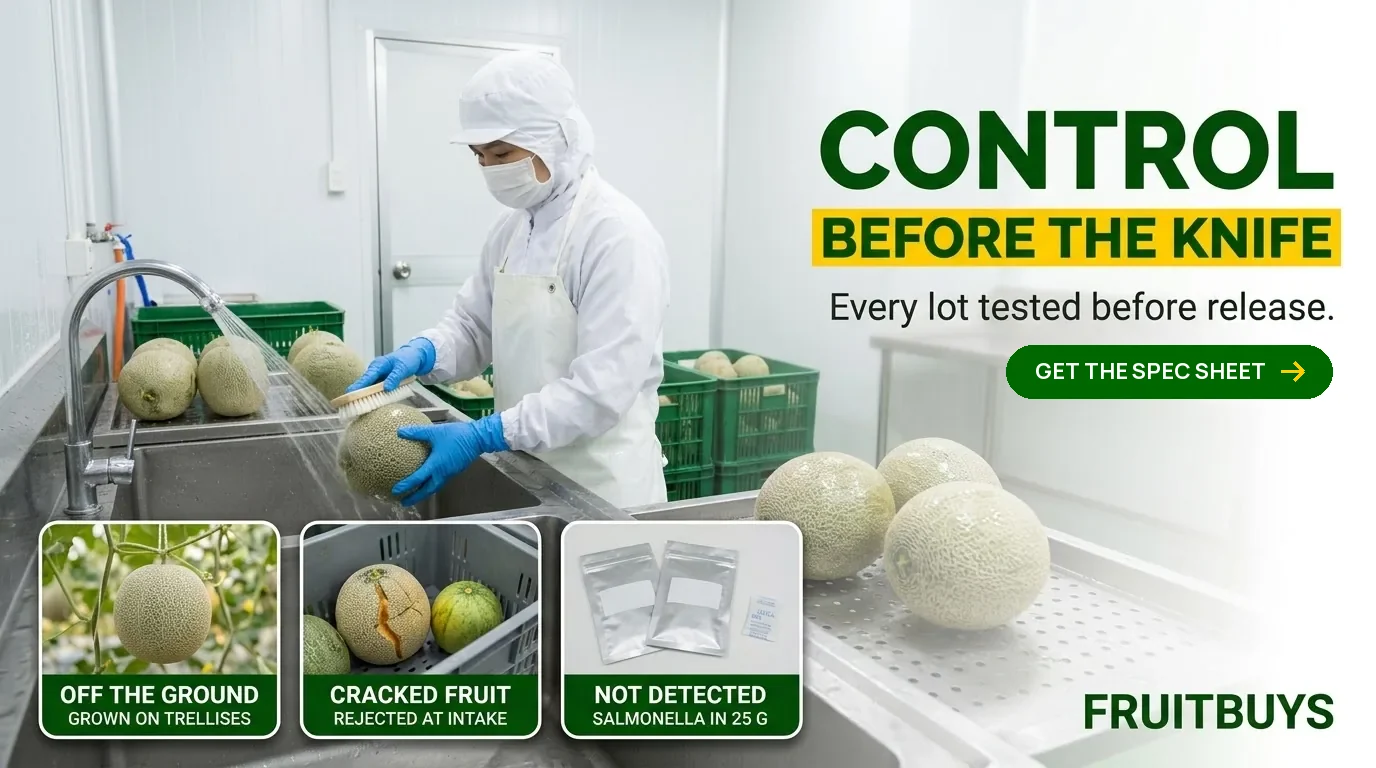
The COA is the last check, though, and an experienced QA team approves a cantaloupe supplier on what happens before the knife touches the fruit. That is where cantaloupe risk starts, and it is the first thing I check at a partner facility. Every limit below applies to freeze-dried cantaloupe and cantaloupe powder alike.
Why do QA teams ask about cantaloupe first?
Because cantaloupe has a recent outbreak record in the US. In late 2023, FDA’s outbreak investigation linked whole cantaloupes imported from Mexico to Salmonella illnesses: 407 cases, 158 hospitalisations and 6 deaths across 44 states. The recalls covered whole melons and the fresh-cut cups and trays made from them, and FDA closed the investigation in January 2024. FDA’s Import Alert 22-01 still allows detention without physical examination of cantaloupe from Mexico, whole or cut, unless the firm is on the alert’s Green List.
The mechanism explains where control has to sit. A netted rind holds soil and moisture in its grooves. When a knife goes through an unwashed rind, it carries whatever lives on the surface into moist, low-acid flesh, and every melon cut on that board afterwards shares it. In fresh-cut melon, those bacteria can then grow in the chiller.
Freeze-drying changes the second half of that story. At water activity ≤0.30, nothing can grow: most bacteria need Aw above 0.90, and no microorganism grows below about 0.60. Freeze-drying is still a drying step, though, and Salmonella can survive in dry foods. That is why rind hygiene comes first and every lot is tested for Salmonella before release.
Where is the risk controlled before the knife?
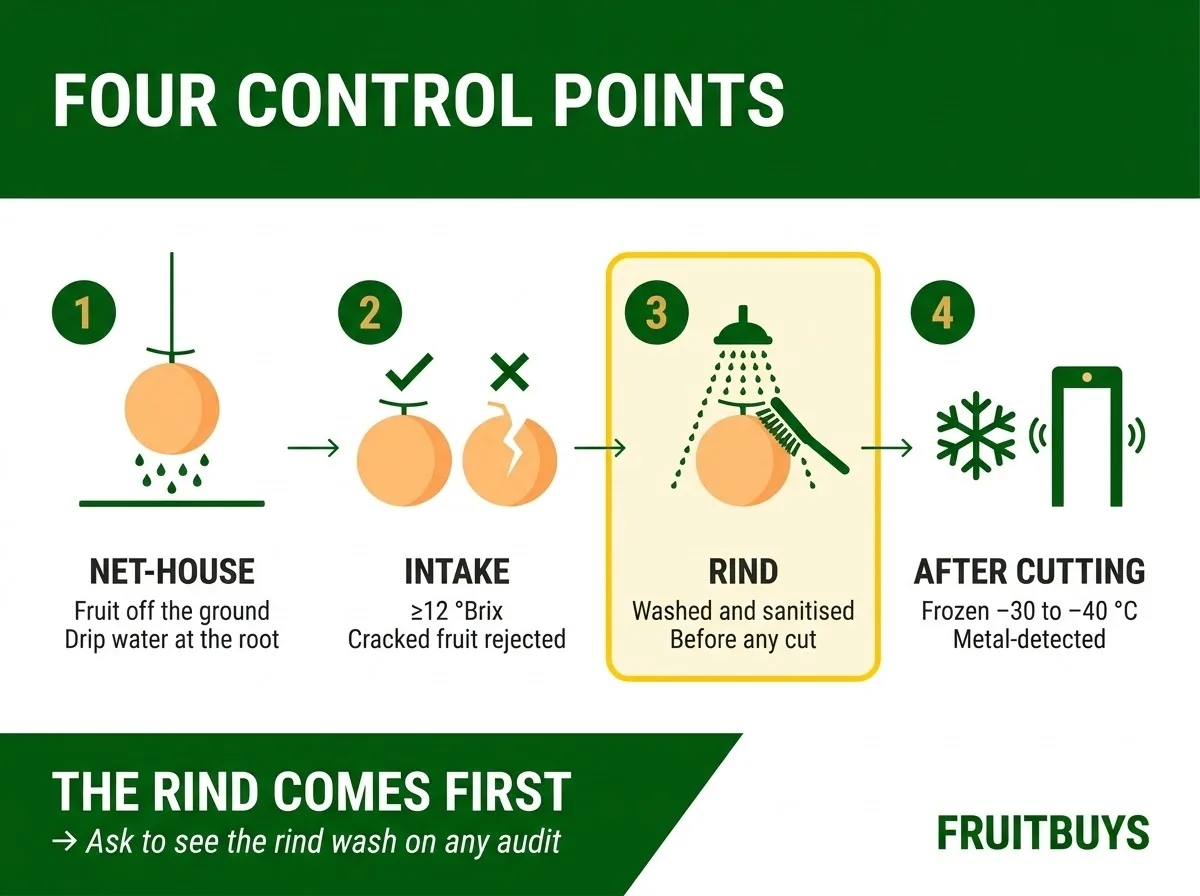
We control cantaloupe risk at four points, all before the fruit is cut.
In the net-house. Cantaloupe for drying is grown in net-houses on vertical trellises, so each melon hangs off the ground rather than lying on soil. Drip irrigation puts water at the root, not over the fruit, and insect netting keeps pests off the crop. A field melon resting on wet soil for weeks starts from a very different rind.
At intake. Fruit is accepted ripe, at ≥12 °Brix, and cracked, soft or damaged melons are rejected. A crack in the rind is an open route into the flesh.
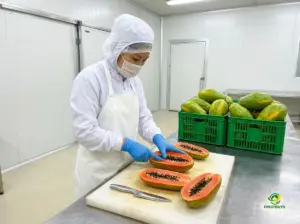
At the rind. Under FruitBuys’ processing protocol, the rind is washed and sanitised before the fruit is peeled, deseeded and cut. It is the step I ask to see first on any facility visit, and the one your auditor will ask you about.
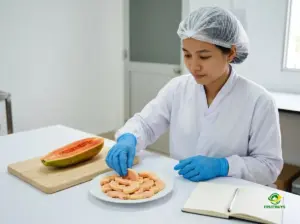
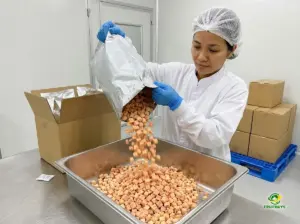
After cutting. The pieces are frozen at −30 to −40 °C and freeze-dried under vacuum, then metal-detected before packing into sealed foil bags. From that point the product is dry, sealed and stable at ambient temperature.
Each lot is traceable to its harvest region and raw-material intake batch, so if a question ever arises about a lot, it can be traced back to where and when the fruit came in.
What does every lot COA show, and at which limits?
| Parameter | Release target | Contract limit | How often | Notes |
|---|---|---|---|---|
| Moisture | ≤4.0% | ≤5.0% | Every lot | Crispness and stability |
| Water activity (Aw) | ≤0.25 | ≤0.30 | Every lot | Measured at 25 °C |
| Total plate count | ≤10⁴ CFU/g | Every lot | ||
| Yeasts and moulds | ≤10² CFU/g | Every lot | ||
| E. coli | <10 CFU/g | Every lot | ||
| Salmonella | Not detected/25 g | Every lot | ||
| Listeria monocytogenes | Not detected/25 g | On request | Chilled and ready-to-eat lines | |
| Enterobacteriaceae | Agreed in contract | On request | Hygiene indicator | |
| Inclusion grade | e.g. TPC <1,000 CFU/g | On request | Chocolate, dairy, ice cream, bars | |
| Lead, cadmium | Below EU and US limits | Routine third-party surveillance; per lot when your contract calls for it | ||
| Pesticide residues | Your market’s MRLs | Before stuffing when your contract calls for it | ||
| Sulphite, gluten | Agreed in contract | On request | Processed without sulphites |
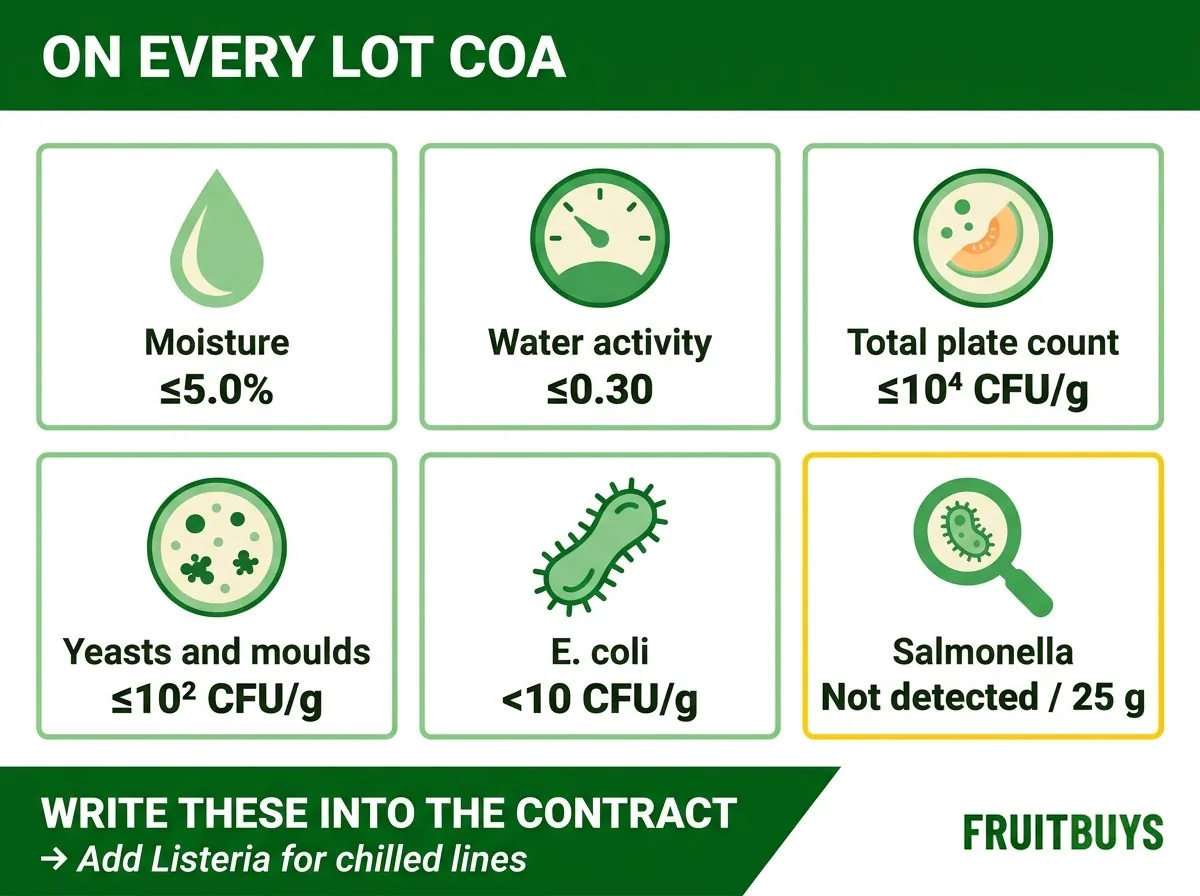
The every-lot set comes from an independent ISO/IEC 17025 accredited third-party laboratory. Lead and cadmium are monitored through routine third-party surveillance, with results below EU and US limits; pesticide-residue and heavy-metal testing to your market’s limits is completed before stuffing when your contract calls for it. Extended panels are available for each lot on request, before the container is sealed, and we arrange them at an accredited laboratory of your choice, such as Eurofins or SGS in Vietnam.
Write the every-lot set and its limits into the contract word for word. Add the on-request tests your own customers will ask you for, so the results arrive with the lot instead of after it.
When should you add Listeria, Enterobacteriaceae or an inclusion grade?
Add them when the fruit goes somewhere bacteria can grow again. Dry cereal, trail mix and retail snack pouches stay at low water activity until the consumer opens them, and the every-lot set covers them.
The picture changes when freeze-dried cantaloupe is rehydrated in a chilled, moist product. A yogurt topping cup, an ice cream ripple or a dairy dessert gives Listeria monocytogenes the conditions it likes, including refrigeration. For these lines, ask for Listeria not detected/25 g and Enterobacteriaceae as a hygiene indicator.
Chocolate, bars and dairy inclusions often carry a tighter count than snack fruit, because the brand owner’s own specification sets it. FruitBuys supplies an inclusion grade, for example TPC <1,000 CFU/g, confirmed on each lot COA. Name it in your RFQ and the sampling plan is set before production starts.
Moisture and water activity: why two numbers each?
The release target is tighter than the contract limit so that the lot still meets the contract after the journey. Freeze-dried cantaloupe is about 70% natural sugar, and sugar pulls in moisture whenever a bag is opened or a container heats up. Releasing at ≤4.0% moisture and Aw ≤0.25 leaves headroom against the ≤5.0% and ≤0.30 that your intake check measures.
Of the two, water activity is the number that matters most for a sugar-rich fruit. It tells you whether the product will stay crisp and whether anything can grow. Measure it at 25 °C within an hour of opening a bag, at devanning, and record it against the lot number. The packaging and shelf-life guide explains how bag size and carton weight keep that number low through transit.
How does the bulk lot stay the same as the approved sample?
Five clauses keep a container matching the sample your R&D team approved. They belong in every cantaloupe contract, with any supplier.
| Clause | What FruitBuys commits | What you check |
|---|---|---|
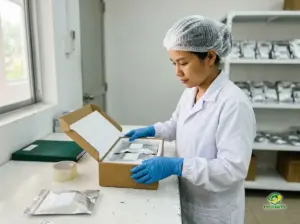
| Pre-shipment sample (PSS) | 100–200 g drawn from the packed lot, in two sealed foil pouches with desiccant, sent within 24–48 hours | Pouch one for sensory and rehydration; pouch two unopened for your laboratory |
| Locked facility | One qualified partner facility per contract; any change notified in writing, with a new PSS for approval | Audit access on request |
| Retained sample | Kept from every container lot for the full shelf life, up to 24 months | Reference in any dispute |
| Traceability | Each lot traceable to its harvest region and raw-material intake batch | Lot number on cartons, COA and packing list match |
| Claims window | 14 days from devanning for packaging, appearance, breakage and Aw; 30 days for laboratory results | Intake check within the window |
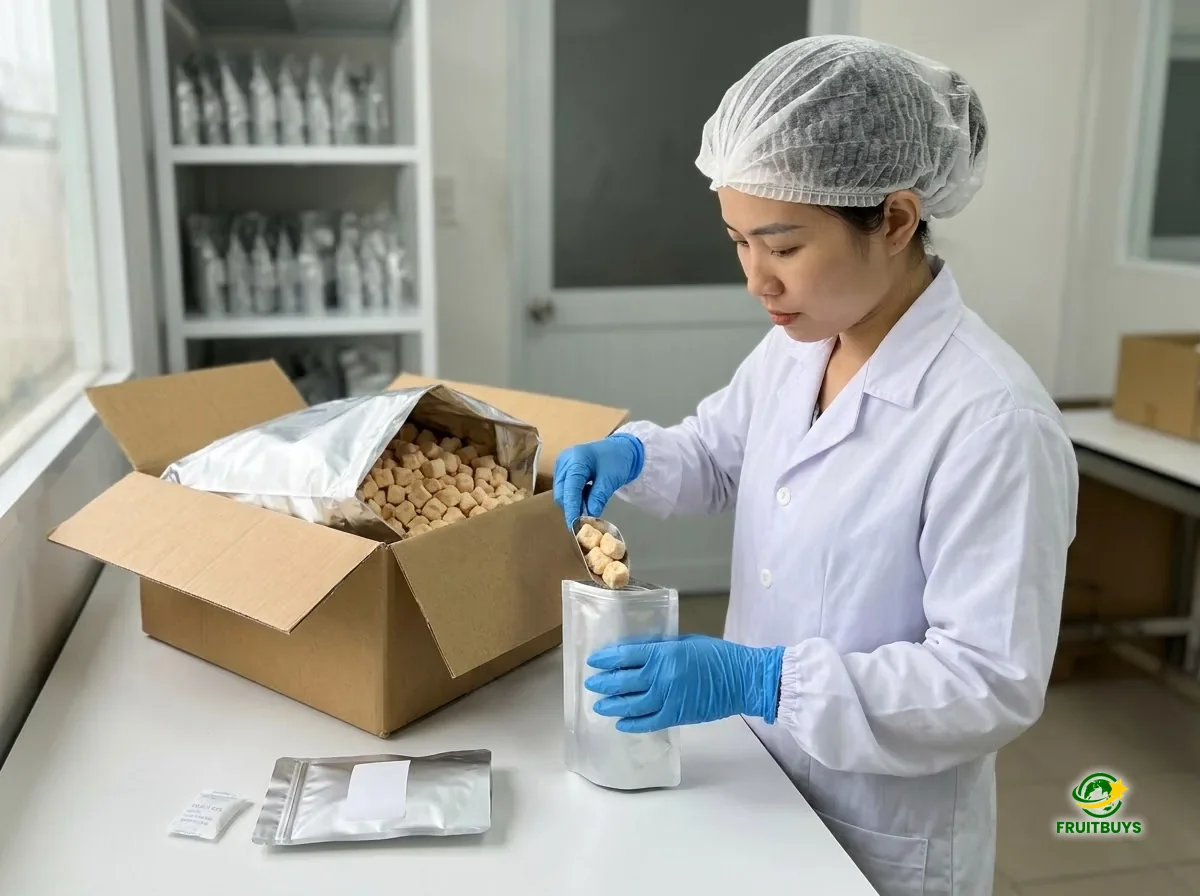
We approve the PSS against the specification before it reaches you, and we release the lot only against its COA. Your approval of the PSS then becomes the reference for the bulk lot.
For a first order, a trial lot ships with a release QC log covering moisture, Aw and sensory checks, and a third-party COA is available for each trial lot on request. The partner facility holds HACCP, ISO 22000, US FDA Facility Registration and BRC (qualified processing facility), and the product is metal-detected before packing.
FAQ
Is freeze-dried cantaloupe affected by cantaloupe recalls?
Recalls name specific growers, packers and lots of fresh melon. Freeze-dried cantaloupe from Vietnam is a different product from different sources, and each FruitBuys lot carries its own COA and traceability back to its harvest region.
Does freeze-drying kill bacteria?
No. Freeze-drying removes water so bacteria cannot grow, but it is not a kill step. That is why the rind is sanitised before cutting and every lot is tested for Salmonella.
Is Listeria tested on every lot?
Listeria monocytogenes is tested on request, for lines where the fruit is rehydrated in chilled, ready-to-eat products. Ask for it in your RFQ and it is reported on each lot COA.
Can I use my own laboratory?
Yes. The second PSS pouch stays sealed for your laboratory, and we can arrange testing at an accredited laboratory of your choice, such as Eurofins or SGS in Vietnam, before the container is sealed.
Can a trial lot ship with a third-party COA?
Yes. A third-party COA is available for each trial lot on request.
How long are retained samples kept?
A retained sample from every container lot is kept for the full shelf life, up to 24 months.
Is the product metal-detected?
Yes, every lot is metal-detected before packing.
Get the specification
Send your product line and destination market, and FruitBuys returns the full specification with the test set matched to your use: every-lot COA, the on-request tests your customers expect, and the contract clauses above.