
Why does freeze-dried cantaloupe go sticky, and how is it packed to stay crisp?
Cantaloupe is about 70% natural sugar, so it pulls in moisture. Batch-sized foil bags, 10–12 kg powder cartons, shelf life and container loads.
Freeze-dried cantaloupe is about 70% natural sugar, and sugar pulls moisture out of the air. Left open on a humid day, crisp slices turn tacky and powder starts to clump. Three packing decisions keep it crisp from the packing room to your production line: batch-sized foil bags with silica gel, 10–12 kg powder cartons, and a dry container with headroom.
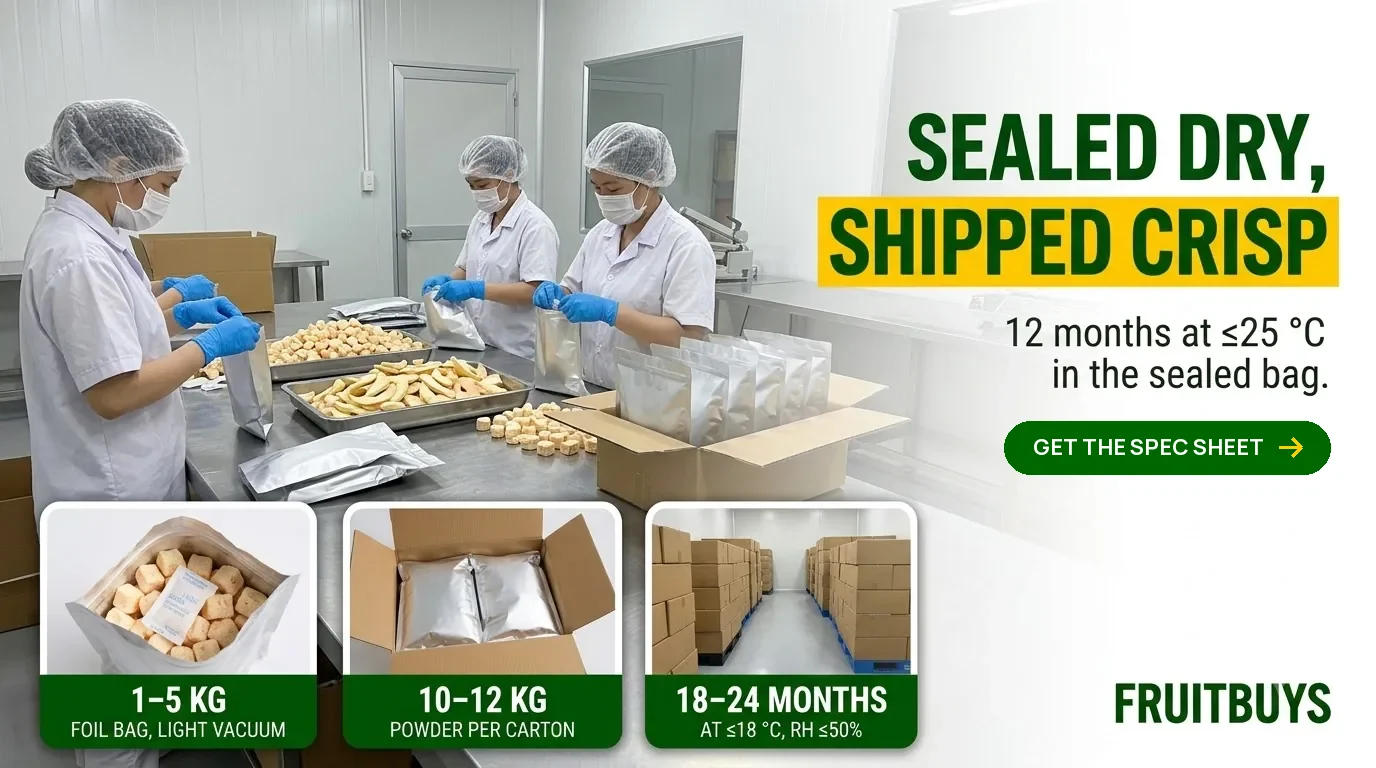
Packed that way and kept sealed, freeze-dried cantaloupe keeps for 12 months at ≤25 °C and ≤60% relative humidity, and 18–24 months in cool storage at ≤18 °C and ≤50% RH. This guide explains what drives those numbers and how to plan bags, cartons, containers and warehouse space around them.
Why does freeze-dried cantaloupe pull in moisture?
Two things make it thirsty. The first is sugar: cantaloupe solids are mostly natural sugars, and dry sugar attracts water vapour. The second is structure: freeze-drying leaves a porous, honeycomb piece with a very large internal surface, so moisture gets in fast.
While the product stays dry and cool, those sugars hold a glassy, brittle state, which is what gives the snap. As water creeps in, or as the temperature climbs, the sugars soften from glassy to rubbery. Slices go tacky first, then pieces stick together, and powder forms lumps that can harden into a cake under the weight of the cartons above.
For your business, that means two risk moments: a hot container on the way, and an open bag in your plant. Every packing choice below targets one of them. Water activity is the number that tells you where you stand; each lot is released at Aw ≤0.25 against a ≤0.30 contract limit, and the cantaloupe COA guide explains how to check it at intake.
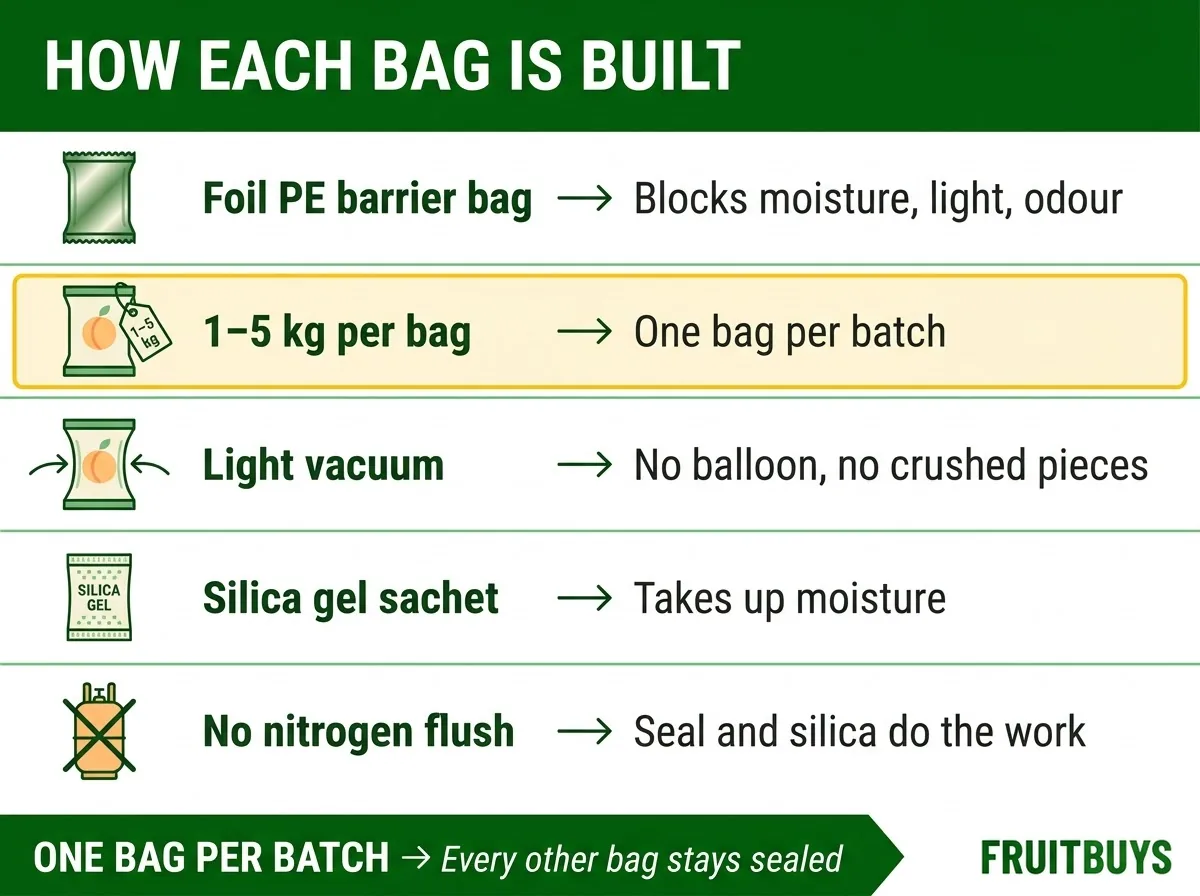
How is each bag built?
| Element | What we use | Why it matters for cantaloupe |
|---|---|---|
| Bag film | Aluminium-foil PE barrier bag | Blocks moisture, light and odour; cantaloupe aroma picks up foreign smells |
| Bag size | 1–5 kg, sized to one production batch | One bag opened per batch, every other bag stays sealed |
| Vacuum | Light vacuum | Removes the air so the bag does not balloon, without squeezing the porous pieces until they crack |
| Desiccant | Food-grade, dust-free silica gel sachet in every bag | Takes up the moisture that gets in during storage |
| Gas | No nitrogen flush | Silica gel and a tight seal do the work for a dry product |
| Powder | No iron-based oxygen absorber; never desiccant and absorber in the same bag | Keeps the bag simple and the powder free-flowing |
Retail packs of 30, 50, 100 and 500 g use foil zip pouches. For private label, high-barrier films, including pouches with a window, are available, and retail pouches are sealed in a dehumidified packing room at source.
The bag size is the decision that matters most in your plant. A 20 kg sack opened on Monday and finished on Thursday spends three days pulling moisture. A 5 kg bag opened for one batch never gets the chance.
Why does powder ship in 10–12 kg cartons?
Because the bottom carton carries the stack. A floor-loaded container stands seven cartons high, so the bottom carton carries six above it. At 10–12 kg per carton that is 60–72 kg of load; at 15–20 kg it would be 90–120 kg. A sugar-rich powder that warms up in a summer port and then sits under 100 kg for three weeks comes out as a block.
So cantaloupe powder ships at 10–12 kg per 58 × 28 × 34 cm carton as standard, in 2 × 5 kg or 10 × 1 kg bags. Blending plants with climate-controlled intake can order 15–20 kg cartons. Pieces are bulkier for their weight and pack 7–10 kg per carton depending on the cut. The cantaloupe powder page lists the full powder specification.
How long does it keep, and in what storage?
| Storage | Shelf life, sealed bag | What to do |
|---|---|---|
| Cool store, ≤18 °C and ≤50% RH | 18–24 months | Best choice for annual programmes and safety stock |
| Ambient, ≤25 °C and ≤60% RH | 12 months | Normal dry warehouse; rotate stock by lot number |
| Hot or humid warehouse, above 25 °C or 60% RH | Plan to use well inside 12 months | Move to cool storage, keep cartons on pallets off the floor, buy smaller bags |
| Opened bag | Use through in one batch or shift | If it must be reopened, reseal at once with a fresh desiccant sachet |
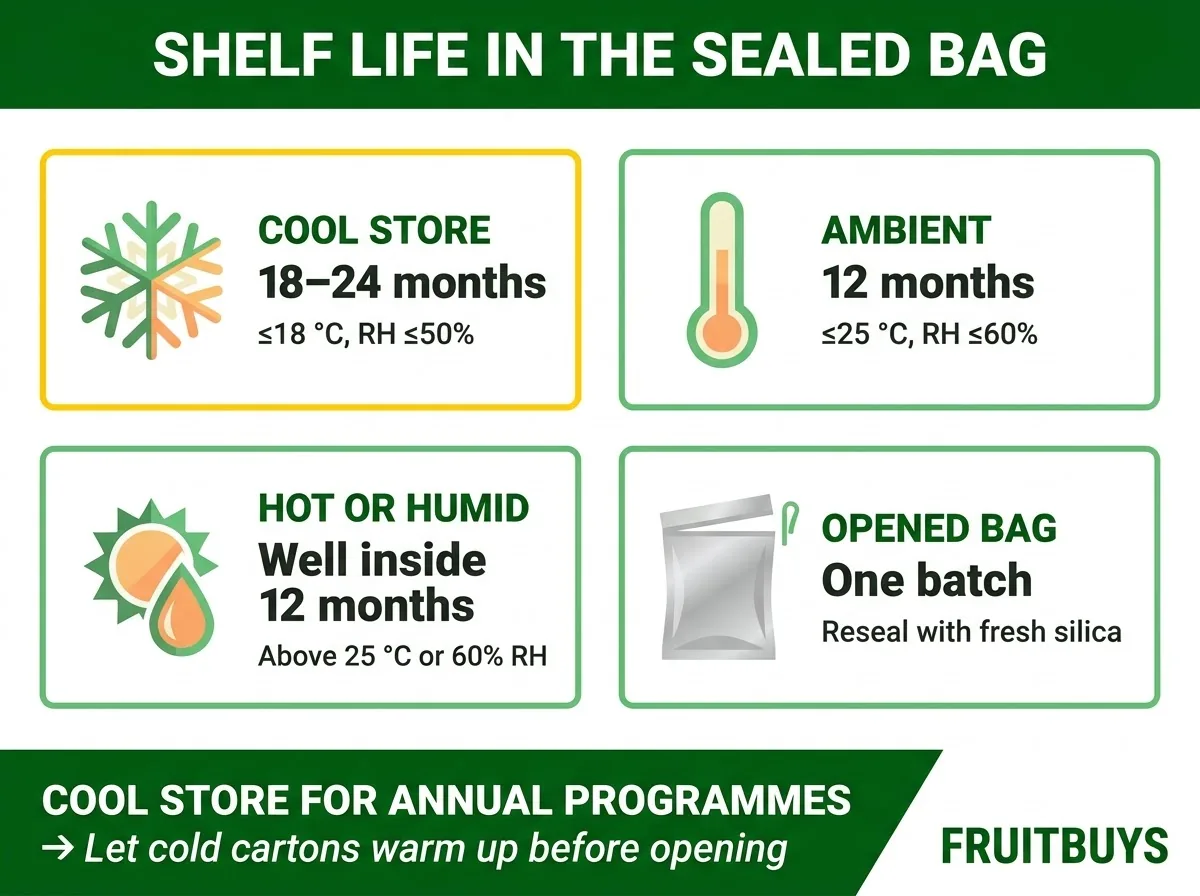
Two habits protect the shelf life you paid for. Let a carton that comes out of a cool store reach room temperature before you open it; a cold bag opened in a warm room collects condensation on the fruit. And keep cartons away from strong-smelling goods, because cantaloupe aroma picks up foreign odours.
Soft lumps in powder after opening break up by hand or through a sieve and do not change the quality. Hard caking in an unopened bag points to heat or moisture in storage or transit; report it with the Aw reading inside the 14-day claims window from devanning.
For private-label programmes that need a dated shelf-life claim on their own pack, FruitBuys offers an accelerated shelf-life study as a value-added service.
How much fits in a 20 ft or 40 ft HC, floor-loaded or palletised?
| Load | Pieces | Powder |
|---|---|---|
| 20 ft, floor-loaded, about 550 cartons | 3.85–5.5 t | 5.5–6.6 t |
| 40 ft HC, floor-loaded, about 1,100 cartons | 7.7–11 t | 11–13.2 t |
| 20 ft, palletised, about 10 pallets / 300–360 cartons | 2.1–3.6 t | 3.0–4.3 t |
| 40 ft HC, palletised, 20–21 pallets / 600–750 cartons | 4.2–7.5 t | 6.0–9.0 t |
Pallets are 1,200 × 1,000 mm with 30–36 cartons each. Floor-loading puts about 1.5–1.8 times as much fruit in the same box, so freight per kilogram is lower; pallets cost space but unload in minutes instead of hours. Choose by what your receiving dock is set up for.
On the floor, cartons stand 8 across, in straight columns. Seven layers fill the container to the ceiling, about 560 cartons in a 20 ft. Six layers, about 480 cartons, leave around 35 cm of headroom. For rainy-season sailings and long tropical routes, I recommend six layers, available on request: the gap lets air move and keeps the top layer clear of the condensation that forms under a container roof when it cools at night.
All loads travel in a standard dry container, with no reefer. Low water activity makes the product shelf-stable at ambient temperature, so you pay dry-box freight. A 20 ft of pieces carries the freeze-dried flesh of roughly 50–94 tonnes of fresh melon. For less than a container, FruitBuys combines cantaloupe with other freeze-dried fruit in one box, which typically saves 15–20% of logistics cost per kilogram against LCL.
What can go wrong on the route?
| Risk | What happens | How the packing answers it |
|---|---|---|
| Hot port in summer | Container air heats up; sugar-rich powder softens | 10–12 kg cartons limit pressure; sealed foil bags with silica gel |
| Container rain | Moisture condenses under the roof as the box cools at night and drips onto the top layer | Headroom on request; foil bags keep water off the fruit even if the carton gets damp |
| Customs inspection | Cartons opened at the port | Each bag stays sealed inside the carton, so an opened carton does not expose the fruit |
| Long dwell at destination | Container sits in the sun before devanning | Devan promptly, move to cool storage, check Aw on arrival |
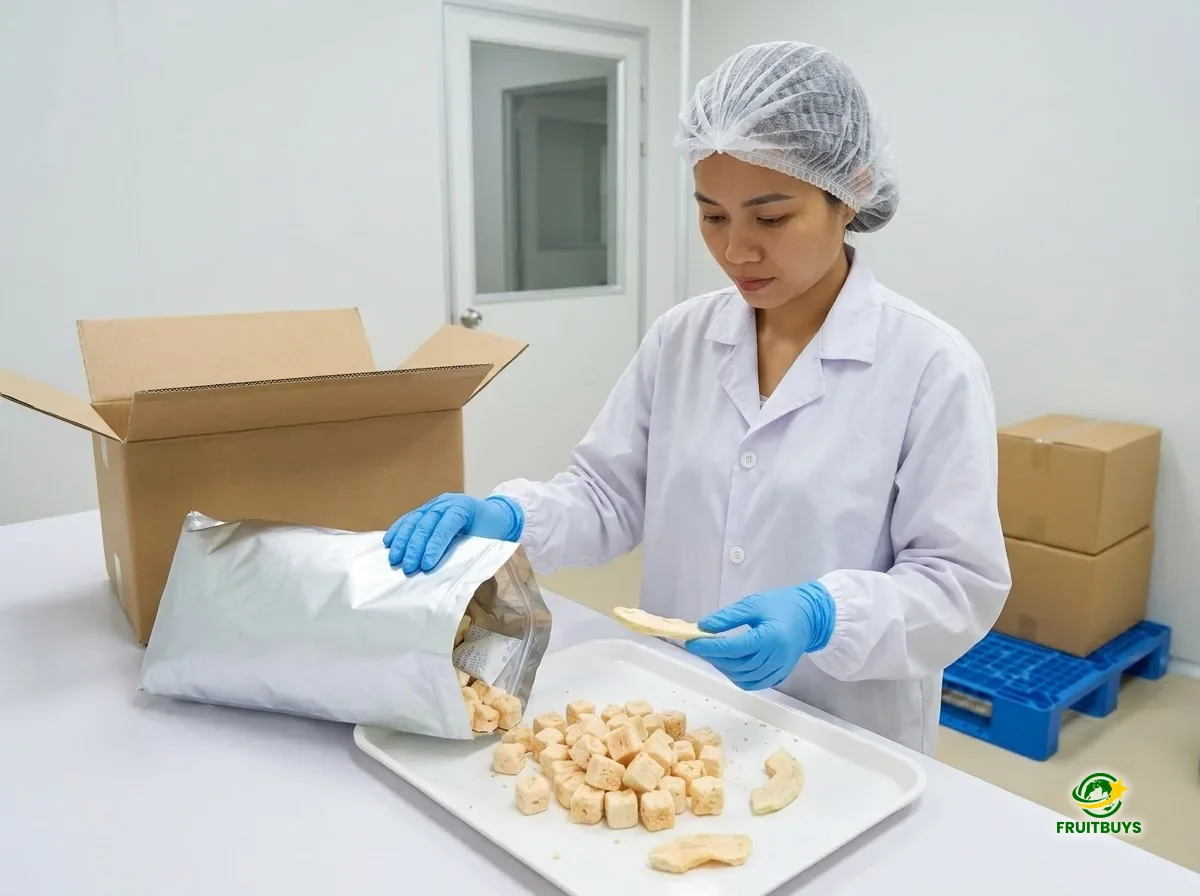
At devanning, open a bag from the top layer and one from the bottom of a stack, measure water activity at 25 °C within an hour, and record it against the lot number. That check, done inside the 14-day claims window, is the evidence both sides need if anything went wrong in transit. Codes and documents for the same shipment are in the HS code and import guide.
FAQ
Can I reseal an opened bag?
Yes. Squeeze out the air, add a fresh desiccant sachet and seal it straight away. Better still, buy bag sizes that match one batch, so bags are opened and used through.
Do soft lumps mean the powder has spoiled?
No. Soft lumps after opening are moisture pickup on a sugar-rich powder. They break up by hand or through a sieve and the quality is unchanged.
Do I need a reefer container?
No. Freeze-dried cantaloupe is shelf-stable at low water activity and travels in a standard dry container. Cool storage at destination extends shelf life to 18–24 months.
Can you pack 20 kg powder cartons?
Yes, 15–20 kg cartons are available for blending plants with climate-controlled intake. For hot ports and warehouses without air conditioning, the 10–12 kg standard carton is the safer choice.
Why is the vacuum only light?
A light vacuum removes the air so the bag stays compact, while leaving the porous pieces intact. A hard vacuum can crack them into fragments.
Get the specification
Tell us your destination port, warehouse conditions and preferred load, and FruitBuys sends the packing specification and container plan for your first shipment.