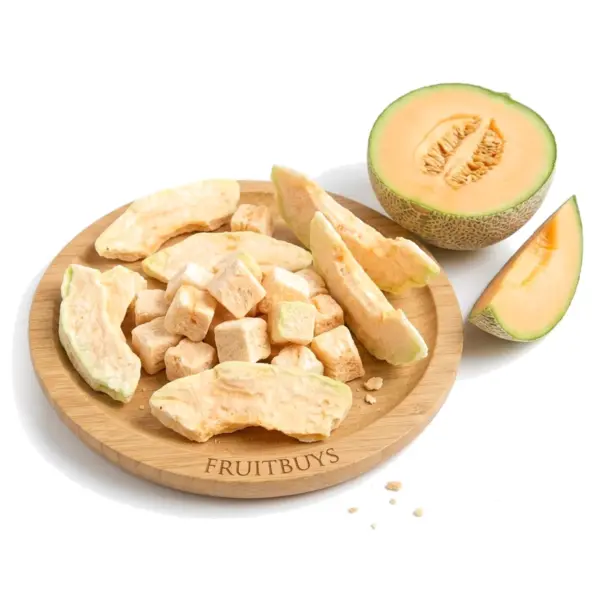
Freeze-Dried Cantaloupe
Freeze-dried cantaloupe from FruitBuys is 100% orange-flesh netted melon (Cucumis melo, reticulatus group), grown in Vietnamese net-houses, cut into slices, dice or granules and freeze-dried at a qualified partner facility to ≤5.0% moisture and water activity ≤0.30. The ingredient list reads one word: cantaloupe.
A 20 ft container of slices or dice holds the freeze-dried flesh of roughly 50–94 tonnes of whole fresh melon, and it travels in an ordinary dry container at ambient temperature. The rind, the seeds and almost all of the water stay in Vietnam, so your line receives crisp, ready-to-dose fruit at about one-fifteenth of the fresh weight, with no thawing, peeling or cold chain.
FruitBuys is an established Vietnamese B2B exporter specialising in freeze-dried fruits. FruitBuys sets the processing protocol, approves the pre-shipment sample and releases each lot against its certificate of analysis.
Product specification
| Parameter | Specification |
|---|---|
| Product | Freeze-dried cantaloupe, orange flesh (Cucumis melo L., reticulatus group) |
| Ingredients | 100% cantaloupe. No sugar, colour, flavouring, preservative or carrier; processed without sulphites |
| Cuts | Slices 5–8 mm (wedge cut) · dice 5 × 5 mm and 10 × 10 mm · granules 2–5 mm · custom cuts on request |
| Size tolerance | ≥90% within the stated cut; fines (<2 mm) ≤5% in slices and dice |
| Moisture | ≤4.0% at release · ≤5.0% contract limit |
| Water activity (Aw) | ≤0.25 at release · ≤0.30 contract limit |
| Fruit intake | Ripe fruit at ≥12 °Brix, typically 12–16 °Brix |
| Colour | Natural light orange to salmon, from the fruit’s own beta-carotene |
| Texture and flavour | Crisp and airy, melts on the tongue; sweet, musky-floral cantaloupe aroma with no cooked or fermented notes |
| Microbiology | TPC ≤10⁴ CFU/g · yeasts and moulds ≤10² CFU/g · E. coli <10 CFU/g · Salmonella not detected/25 g |
| Fresh-to-dry | 13–17 kg whole melon, or 8–10 kg peeled and deseeded flesh, per 1 kg |
| Shelf life | 12 months at ≤25 °C, RH ≤60% · 18–24 months in cool storage at ≤18 °C, RH ≤50%, in the unopened foil bag |
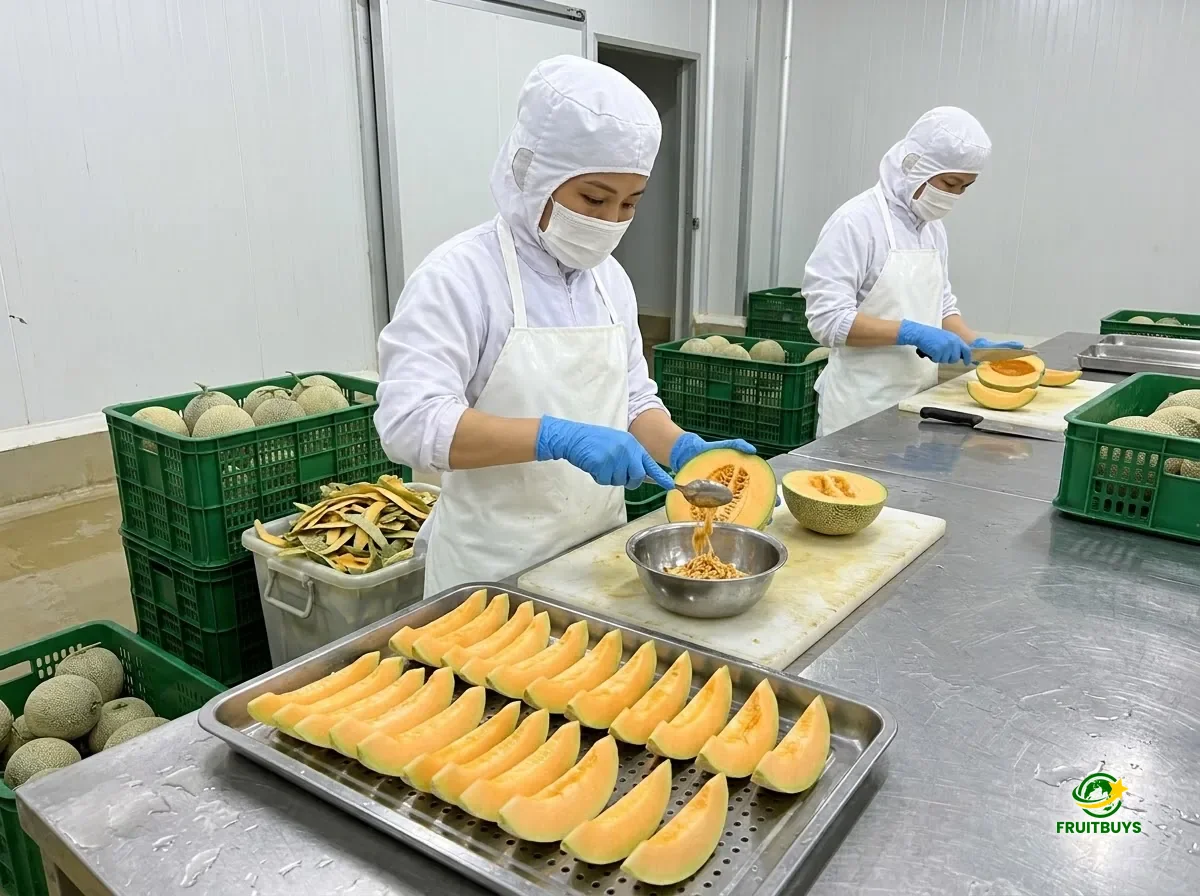
Guaranteed specifications: moisture ≤5.0% and Aw ≤0.30 on every lot COA; no added sugar, no added colour, no carrier.
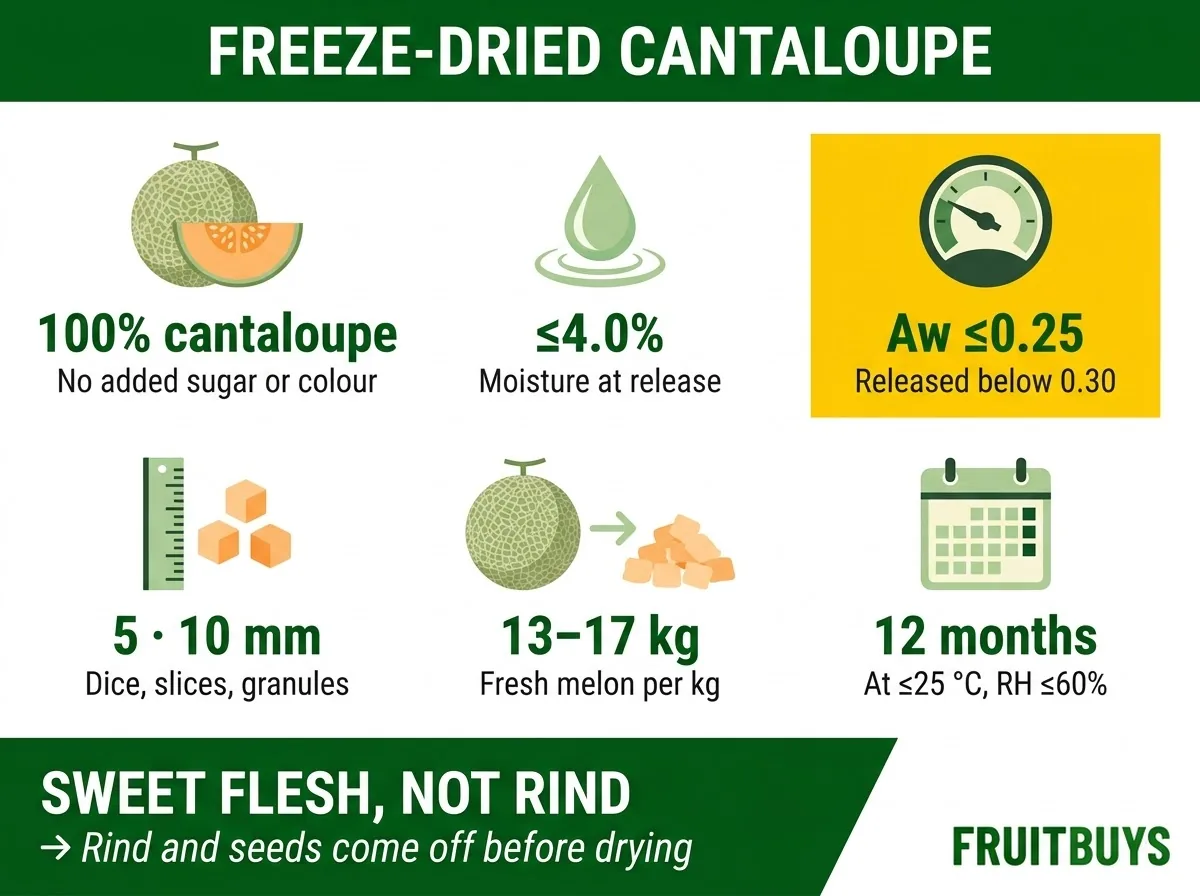
Fruit is selected on ripeness and Brix; rind netting and fresh-market size play no part. The rind is peeled away before drying, so your price pays for sweet flesh, and melons with an uneven net but full sugar go to drying instead of being wasted. The cantaloupe freeze-drying guide shows how the 13–17 kg ratio is built and why two quotes for the same product can differ. Brix follows the weather: lots from the dry season, December to April, run sweetest and most aromatic, and FruitBuys can reserve them for your drink and dessert SKUs where aroma matters most.
What does freeze-dried cantaloupe taste like, and how does it behave in your product?
It tastes like ripe summer cantaloupe, concentrated. The first bite snaps, then dissolves within seconds, releasing the musky-sweet note that tells a consumer “melon” before they read the pack.
That aroma is the reason to buy freeze-dried rather than hot-air dried melon. The fruit is frozen at −30 to −40 °C and the ice is removed by sublimation under vacuum, so the product stays cold through drying. Hot-air drying drives the volatile melon compounds off and leaves a generic sweet, cooked taste. The same applies in your plant: the aroma starts to fade above about 70 °C, so add cantaloupe after baking or pasteurisation.
In milk, yogurt or overnight oats, dice soften in 1–3 minutes into a soft, juicy piece of fruit. In dry cereal, trail mix and chocolate they stay crisp for as long as the pack stays sealed. For a side-by-side with dehydrated and candied melon, see freeze-dried vs dehydrated cantaloupe.
Slices, dice or granules: which cut fits your line?
| Your product | Cut | Starting dose | Why this cut |
|---|---|---|---|
| Breakfast cereal, granola, trail mix | Dice 5–10 mm or slices | 3–15% | Visible fruit pieces; add after baking and they stay crisp in the box |
| Yogurt topping cups, overnight oats, smoothie bowls | Dice 10 × 10 mm | Separate cup or dry sachet | Softens in 1–3 minutes once mixed, so it tastes fresh at the moment of eating |
| Chocolate bark, bars, white chocolate | Granules 2–5 mm | 3–8% | Small pieces sit in thin chocolate without breaking the bar; inclusion-grade microbiology on request |
| Ice cream ripple and toppings | Dice 5 mm or granules | 3–8% | Add after pasteurisation to keep the melon note |
| Retail snack pouches | Slices | 100% | The wedge shape looks like melon on the shelf |
| Milk tea, smoothies, drink mixes | Powder | 4–8% of the drink | See freeze-dried cantaloupe powder |
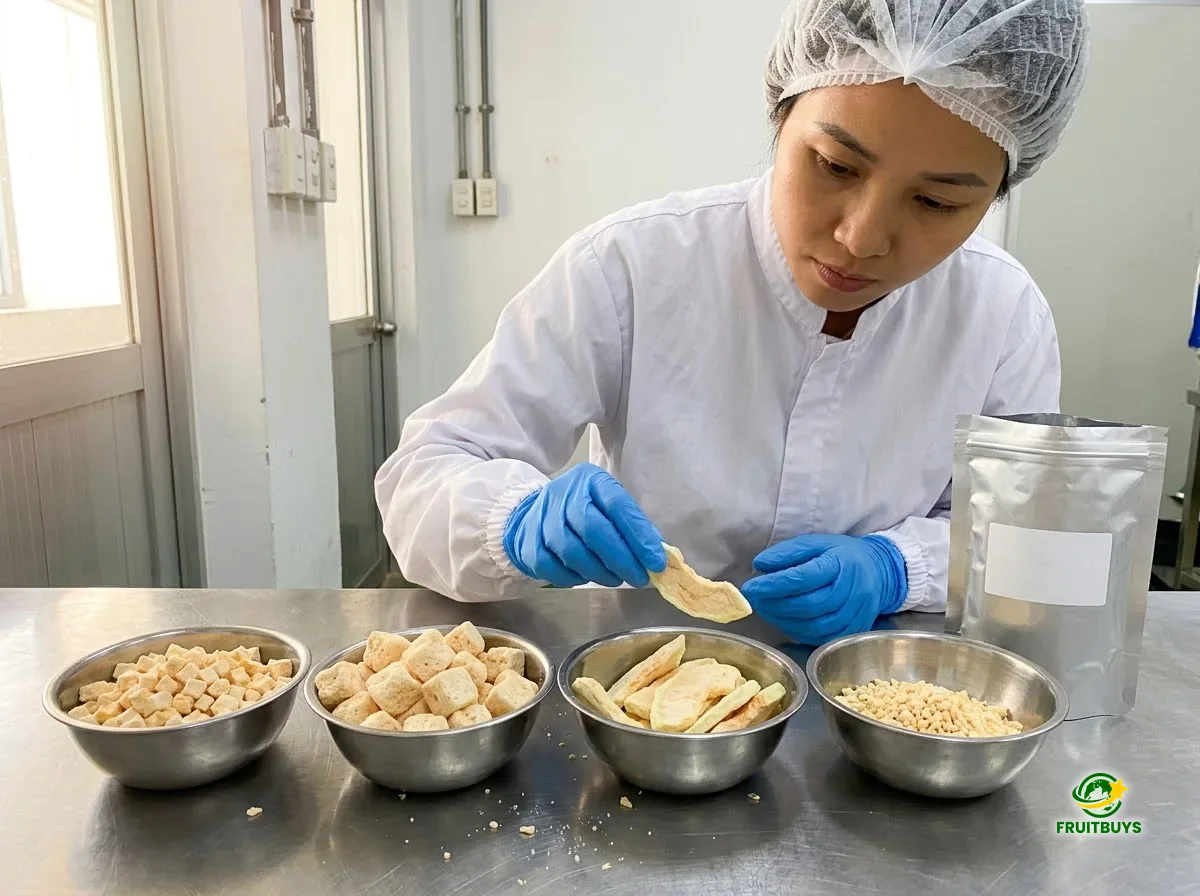
For a melon-ball look, FruitBuys supplies 10 × 10 mm dice. Round scoops lose their shape in drying and in the carton; dice give the same visible piece of fruit on a topping and pack evenly.
At 3–8% in a cereal or yogurt, cantaloupe reads clearly as melon. A 100–200 g sample is enough for one or two trial batches to set your dose.
Nutrition
| Per 100 g | US format | EU format |
|---|---|---|
| Energy | 350 kcal | 1,480 kJ / 350 kcal |
| Fat | 2 g (saturated 0.5 g, trans 0 g) | 1.9 g (saturates 0.5 g) |
| Cholesterol | 0 mg | not declared |
| Carbohydrate | 80 g total | 71 g |
| Sugars | 70 g, includes 0 g added sugars | 70 g |
| Fibre | 9 g | 8.8 g |
| Protein | 8 g | 8.2 g |
| Sodium / salt | 160 mg | 0.4 g salt |
| Potassium | 2,620 mg | 2,620 mg (131% NRV) |
Typical values for 100% freeze-dried cantaloupe; natural variation by origin, season and ripeness applies. Lot nutrition panel available for label artwork.
Freeze-dried cantaloupe also carries vitamin C (typically 200–350 mg per 100 g) and vitamin A from beta-carotene (typically 1,000–1,600 µg RAE). Typical values reach the EU “high fibre”, “high in potassium”, “high in vitamin C” and “high in vitamin A” levels, which gives a single-ingredient product four front-of-pack nutrition claims. FruitBuys arranges a nutrition panel on your commercial lot before you print, so the figures on your label are your own. The sugar is the fruit’s own; the label shows 0 g added sugars. For a fresh-versus-freeze-dried comparison, see is cantaloupe good for you.
How is it packed?
Each bulk bag holds 1–5 kg in an aluminium-foil PE barrier bag, sealed under a light vacuum with a food-grade silica gel sachet and no nitrogen flush. Bags go into a 5-ply carton of 58 × 28 × 34 cm, at 7–10 kg per carton depending on the cut. Retail pouches run at 30, 50, 100 and 500 g.
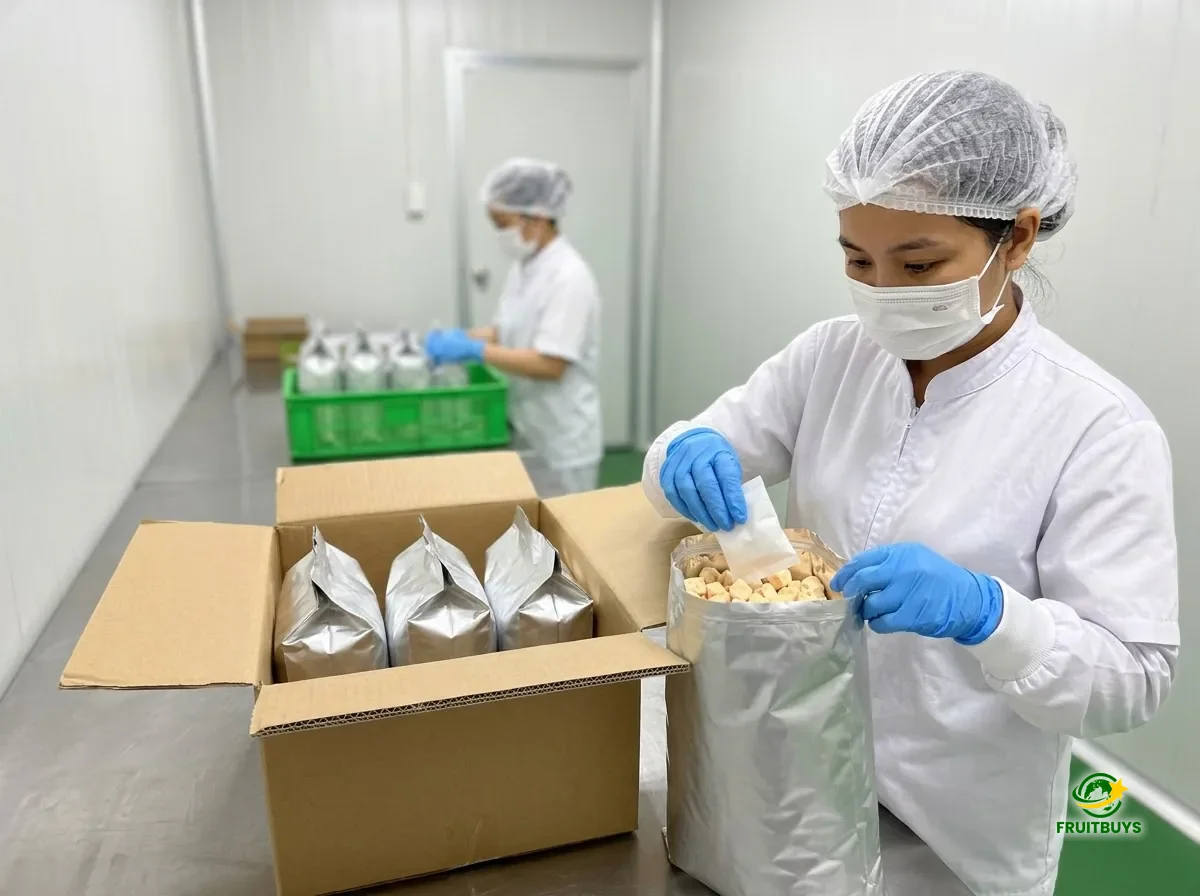
Bag size is a quality decision. Freeze-dried cantaloupe is about 70% natural sugar, so it picks up humidity quickly once a bag is opened. Bags sized to one production batch let your team open a bag, use it through, and keep every other bag sealed and crisp until its turn. If a cold carton comes out of a cool store, let it reach room temperature before opening so no condensation forms inside. The packaging and shelf-life guide covers storage in hot, humid warehouses.
Commercial terms
| Item | Terms |
|---|---|
| 20 ft container, floor-loaded | About 550 cartons, 3.85–5.5 t net depending on cut |
| 40 ft HC, floor-loaded | About 1,100 cartons, 7.7–11 t net |
| Palletised (1,200 × 1,000 mm, 30–36 cartons per pallet) | About 10 pallets / 300–360 cartons per 20 ft · 20–21 pallets / 600–750 cartons per 40 ft HC |
| Container type | Dry container, no reefer |
| Capacity | 100 tonnes per year |
| Sample | 3–5 working days to dispatch; courier time depends on the carrier |
| Production | 20–30 days for a 20 ft container after deposit |
| OEM / private label | MOQ 500 kg; retail pouch printing from 3,000–5,000 pouches per SKU (digital, 7–10 working days) or from 500 kg per SKU (rotogravure, 15–20 working days) |
| Payment | T/T 40% deposit, 60% before shipment or against copy of B/L; L/C at sight |
| Shipping terms | FOB Cat Lai, CIF · sea, or air from Tan Son Nhat |
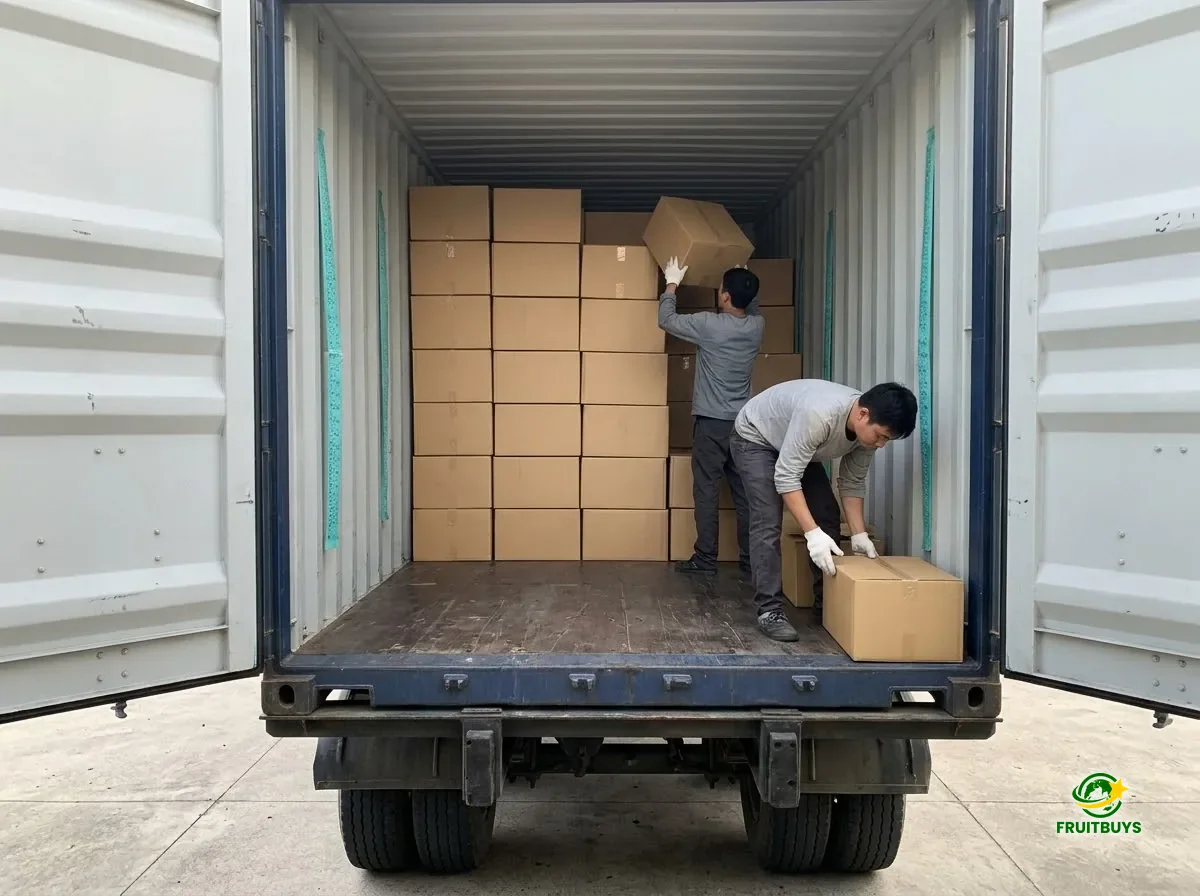
For orders below a full container, FruitBuys combines cantaloupe with other freeze-dried fruit lines in one container, which typically saves 15–20% of logistics cost per kilogram against LCL shipping.
Supply runs all year. Cantaloupe for drying comes from net-house grower networks in the Central Highlands, the Mekong Delta, the Southeast and the South Central Coast. A crop takes about 70–75 days, net-houses run 3–4 crops a year, and sourcing moves between these climate zones so one region’s dry season covers another’s rains. One annual contract can run on fresh fruit every month. The Vietnamese cantaloupe guide has the regional calendar.
Quality and documents
Every lot ships with a COA from an independent ISO/IEC 17025 accredited third-party laboratory covering moisture, water activity, total plate count, yeasts and moulds, E. coli and Salmonella. Lead and cadmium are monitored through routine third-party surveillance, with results below EU and US limits; pesticide-residue and heavy-metal testing to your market’s limits is completed before stuffing when your contract calls for it. Available for each lot on request, before the container is sealed: Listeria monocytogenes, Enterobacteriaceae, sulphite, gluten and an inclusion grade (for example TPC <1,000 CFU/g) for chocolate, dairy and bar lines.
QA teams usually ask about cantaloupe first, because of past recalls of fresh whole melons in the US. The control sits before the knife. Net-house melons grow on vertical trellises, hanging off the ground, and under FruitBuys’ processing protocol the rind is washed and sanitised before the fruit is peeled and cut. The cantaloupe COA guide sets out each limit and test option.
The partner facility holds HACCP, ISO 22000, US FDA Facility Registration and BRC (qualified processing facility); Halal certification available on request. FruitBuys locks one partner facility for each contract: any change of facility is notified in writing and a new pre-shipment sample is approved before production. You have audit access. Each lot is traceable to its harvest region and raw-material intake batch, and a retained sample from every container lot is kept for the full shelf life, up to 24 months.
Every shipment carries the standard export dossier: commercial invoice, packing list, bill of lading, certificate of origin (Form EUR.1 for the EU and UK, Form CEPA for the UAE), phytosanitary certificate and COA, so your broker clears without chasing papers.
Trial lots ship with a release QC log for moisture, Aw and sensory checks, and a third-party COA is available for each trial lot on request.
Import and labeling
Freeze-dried cantaloupe ships under HS 0813.40 (“other dried fruit”): US HTS 0813.40.90.00 and EU CN 0813 40 95. Plain freeze-dried melon stays in Chapter 08 because nothing is added; sugared, infused or coated melon moves to heading 2008.99.
- United States: the general (MFN) duty on 0813.40.90.00 is 2.5% in the US Harmonized Tariff Schedule; additional Chapter 99 duties may apply, and your broker confirms the final duty at entry.
- EU and UK: CN 0813 40 95 enters the EU at 0% with C/O Form EUR.1 under EVFTA, against the 2.4% MFN rate, and Form EUR.1 claims the UKVFTA preference for the UK. The rate that applies is set by the code declared at entry, shown in the EU TARIC tariff database.
- UAE: Form CEPA travels with every lot under the Vietnam–UAE CEPA.
- FDA traceability: freeze-dried cantaloupe is not on the FDA Food Traceability List, which names fresh melons, so the extra FSMA 204 records required for fresh melon do not attach to it. If your current fresh-cut melon cups or toppings could move to freeze-dried, that is paperwork and cold storage you no longer carry for that line.
On the label, the ingredient line is “cantaloupe”. In the US the panel shows 0 g added sugars. In the EU, a “no added sugars” claim carries the line “contains naturally occurring sugars”. Under FDA’s updated “healthy” rule, fruit with nothing added qualifies automatically; compliance with the new definition becomes mandatory on 25 February 2028, and your label team confirms the final wording. Codes, duty by market and the documents checklist are in the HS code and import guide.
Verify the sample
Your pre-shipment sample (PSS) arrives as 100–200 g from the packed lot, split between two sealed foil pouches with desiccant: one for your sensory and rehydration checks, one kept sealed for your laboratory. Five checks take under an hour:
- Water activity: measure within an hour of opening, at 25 °C. Expect ≤0.30.
- Snap: break a slice. It should crack cleanly and show an open, honeycomb interior in even light orange.
- Smell: open the pouch and smell straight away. Expect musky, sweet melon with no cooked or fermented note.
- Rehydration: drop a 10 mm dice into milk or yogurt. It should soften within 1–3 minutes.
- Fines: sieve 100 g through a 2 mm screen. Fines should be ≤5% by weight.
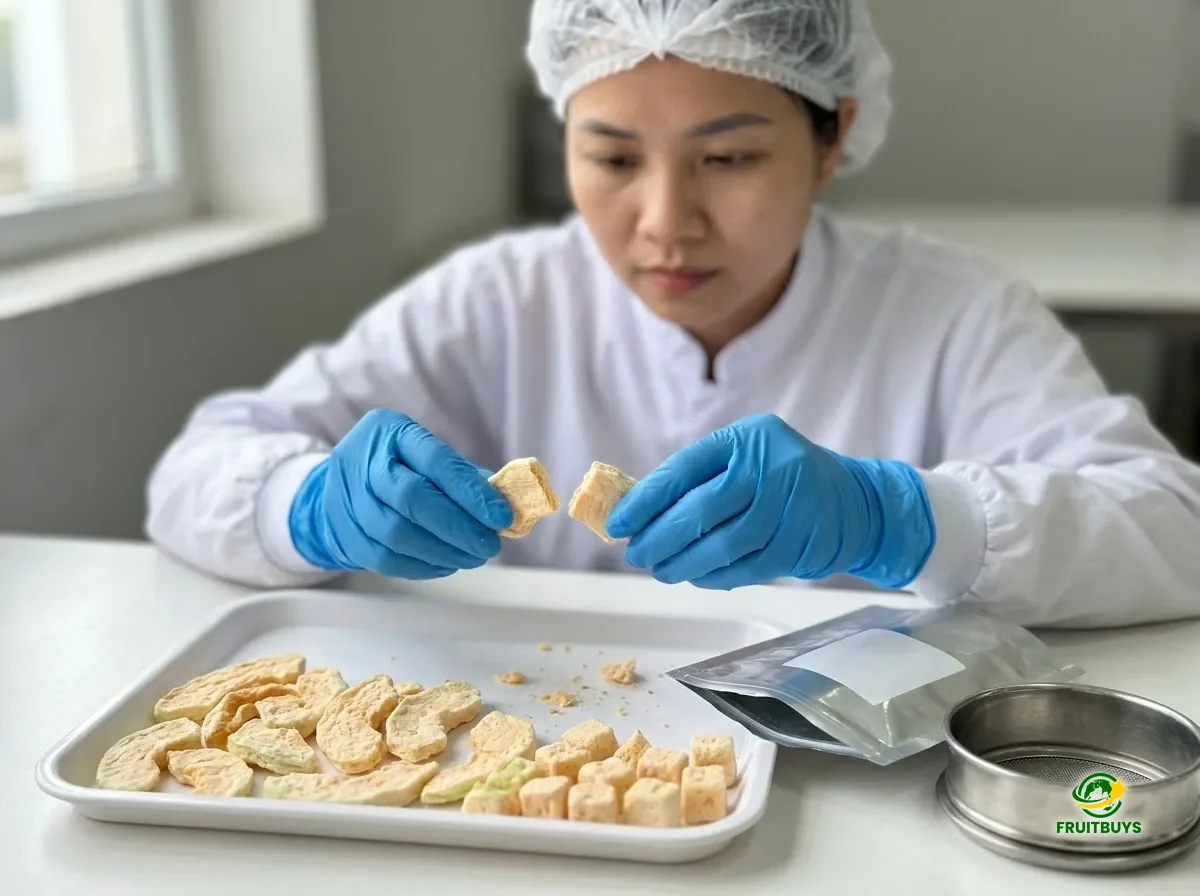
The approved PSS becomes the reference for the bulk lot, and the retained sample from each container lot stays on file for the full shelf life.
FAQ
Is freeze-dried cantaloupe good to eat on its own?
Yes. It is crisp, sweet and melts quickly, which is why slices sell as a retail snack. With nothing added, the sweetness comes from the fruit itself.
What does freeze-dried cantaloupe taste like?
It tastes like ripe cantaloupe with the water taken out: sweet, musky and floral, with a light crunch that dissolves on the tongue.
Can I get melon balls?
FruitBuys supplies 10 × 10 mm dice instead. Round scoops lose their shape in drying and cartons; dice give the same visible fruit piece and pack evenly.
Is freeze-dried cantaloupe the same as dried cantaloupe?
No. Dehydrated and candied melon are dried with heat and often sugared, which leaves a chewy texture and a cooked taste. Freeze-dried cantaloupe stays crisp and keeps its melon aroma; see the comparison.
Is cantaloupe available all year from Vietnam?
Yes. Net-house melons are grown in four climate zones with 3–4 crops a year, so sourcing moves between regions as the seasons change.
Is freeze-dried cantaloupe on the FDA Food Traceability List?
No. The list names fresh melons, and freeze-dried cantaloupe is no longer in fresh form, so the extra FSMA 204 records for fresh melon do not attach to it.
Can you print our brand on retail pouches?
Yes. Private-label pouches start from 3,000–5,000 pouches per SKU on digital print, or from 500 kg per SKU on rotogravure for repeat runs.
How fast can I get a sample?
A sample is dispatched within 3–5 working days of your request; courier time depends on the destination.
Request a quote
Tell us what you need and FruitBuys replies with a quote on the same basis you will compare:
- Cut and size: slices, dice 5 or 10 mm, granules, or custom
- Quantity per order and per year
- Bulk bag size (1–5 kg) or retail pouch format
- Destination market and port
- Incoterm: FOB Cat Lai or CIF
- Extra tests your market or customer requires
- First delivery date and call-off schedule
- Private label: number of SKUs and print method