
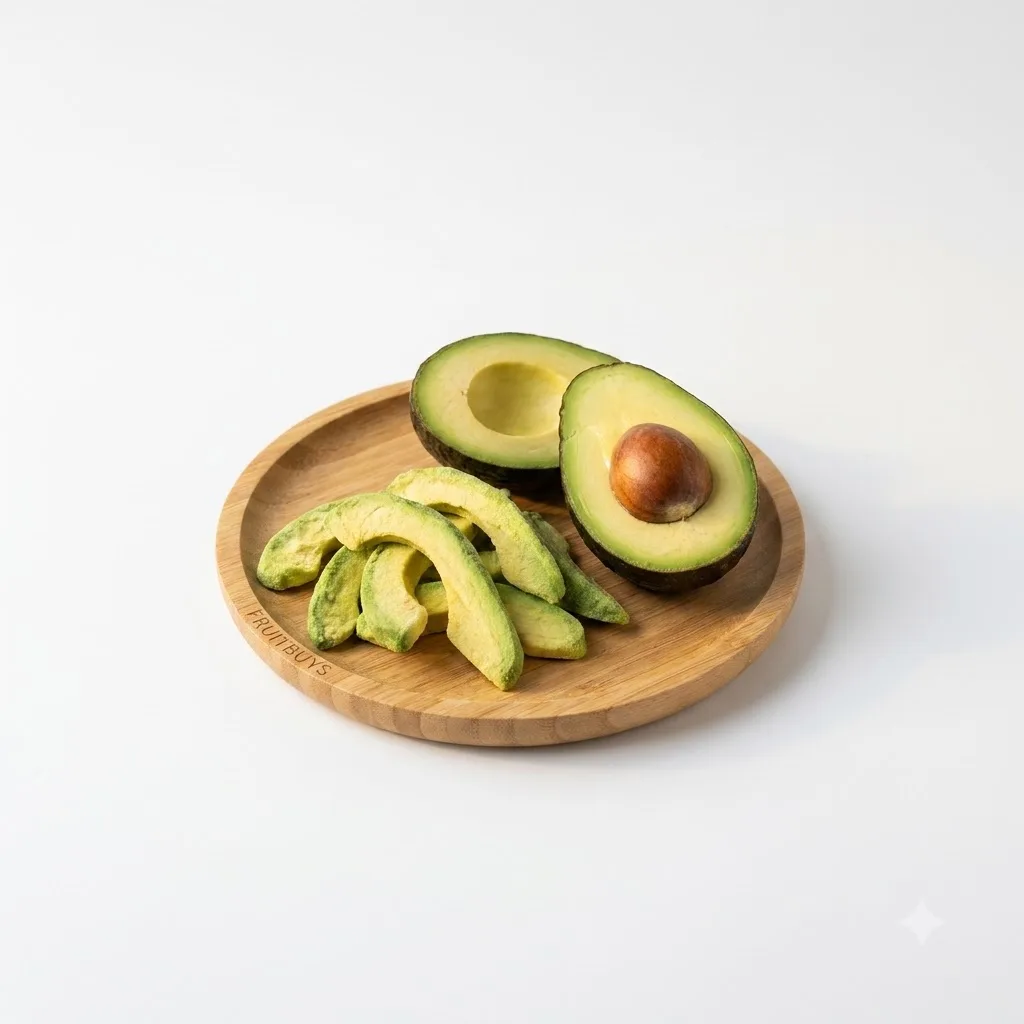
What do freeze-dried avocado nutrition facts give a keto or clean-label product?
A fruit ingredient that breaks the rules of dried fruit. Most freeze-dried fruits carry 50–70 g of sugar per 100 g; freeze-dried avocado carries 3 g. In its place it brings 46 g of fat, more than half of it monounsaturated, 26 g of fibre and 1,610 mg of potassium, with one ingredient on the label: avocado. That leaves about 10 g of net carbs per 100 g, or 1.5 g in a 15 g serving. For a keto snack, a low-sugar smoothie or a clean-label mix, those numbers are the front-of-pack story. This guide gives you the full profile, what it lets your pack say, how the Central Highlands crop shapes the numbers, and how to go from typical values to your printed label.
How does freeze-dried avocado compare with other dried fruit?
On almost every line that matters to a low-sugar or keto range, it sits on the other side of the table.
| Per 100 g | Freeze-dried avocado | Typical freeze-dried fruit (e.g. banana, longan) |
|---|---|---|
| Total sugars | 3 g | 50–70 g |
| Dietary fibre | 26 g | 6–10 g |
| Fat | 46 g, more than half monounsaturated | under 1 g |
| Net carbs (carbohydrate minus fibre) | about 10 g | 75–85 g |
| Ingredient line | Avocado | Fruit |
That contrast is the commercial point. A shopper scanning the keto or low-sugar shelf rarely finds a fruit ingredient that fits. Freeze-dried avocado lets your product carry real fruit, a fresh colour and a creamy taste without moving the sugar line.
Full nutrition per 100 g and per 15 g serving
| Nutrient | Per 100 g | Per 15 g serving | % Daily Value per 100 g* |
|---|---|---|---|
| Calories | 550 kcal | 83 kcal | |
| Total fat | 46 g | 6.9 g | 59% |
| Saturated fat | 9 g | 1.4 g | 45% |
| Trans fat | 0 g | 0 g | |
| Cholesterol | 0 mg | 0 mg | 0% |
| Sodium | 10 mg | 1.5 mg | 0% |
| Potassium | 1,610 mg | 242 mg | 34% |
| Total carbohydrate | 36 g | 5.4 g | 13% |
| Dietary fibre | 26 g | 3.9 g | 91% |
| Total sugars | 3 g (naturally occurring) | 0.5 g | |
| Protein | 10 g | 1.5 g | |
| Net carbs | about 10 g | about 1.5 g |
*Based on a 2,000 calorie diet.
Typical values for 100% freeze-dried avocado; values typically move within ±5–10% with season, origin and ripeness. Lot nutrition panel available for label artwork. A 15 g serving is a generous handful of dices or a scoop of granules, the amount that goes into a single snack pouch, a smoothie or a portion of dip.
What a serving equals in fresh avocado. Freeze-drying takes out the water and keeps everything else, so each gram stands for more than four grams of fresh flesh.
| Serving | What it looks like | Fresh avocado flesh it replaces | Fat | Fibre | Net carbs |
|---|---|---|---|---|---|
| 15 g | A snack pouch handful or one smoothie scoop | about 69 g | 6.9 g | 3.9 g | 1.5 g |
| 30 g | A generous snack serving or a portion of dip base | about 138 g | 13.8 g | 7.8 g | 3 g |
For your pack, that is a line shoppers understand at a glance: one 15 g pouch carries the flesh of about 69 g of fresh avocado, with nothing to peel and nothing to brown.
What does 46 g of fat, more than half monounsaturated, mean on a pack?
It means avocado fat, not added oil. More than half of it is monounsaturated, mostly oleic acid, the same fat profile shoppers already know from fresh avocado. Per 100 g that is roughly 25 g of monounsaturated fat, supplying more than 40% of the energy in the product.
For your range, that fat does three jobs at once. It gives the creamy melt that makes the product taste indulgent. It carries the energy in a keto snack, where fat, not sugar, is the fuel. And it lets your team build a “good fats” story around a whole-food ingredient rather than an oil blend.
What do 26 g of fibre and 1,610 mg of potassium add?
Fibre is where freeze-dried avocado quietly outperforms most snack ingredients. At 26 g per 100 g, a 15 g serving adds almost 4 g of fibre, which helps a bar, a cereal or a trail mix reach a fibre claim without adding inulin or chicory root to the ingredient list.
Potassium at 1,610 mg per 100 g gives sports and active-nutrition brands a natural mineral line to talk about. In a 15 g serving it adds about 240 mg, from the fruit itself.
Which claims can freeze-dried avocado support?
In the EU, nutrition claims are set per 100 g, and freeze-dried avocado clears several on its own. In the US, claims are set per serving, so your serving size decides the wording.
| Claim (EU, per 100 g) | Condition | Freeze-dried avocado |
|---|---|---|
| Low sugars | ≤5 g sugars per 100 g | 3 g: qualifies |
| No added sugars | No sugars or sweetening foods added | 100% avocado: qualifies |
| High fibre | ≥6 g fibre per 100 g | 26 g: qualifies |
| High monounsaturated fat | ≥45% of fatty acids from monounsaturated fat, and >20% of energy from it | More than half of the fat; over 40% of energy: qualifies |
| High in potassium | ≥600 mg per 100 g (30% of the reference intake) | 1,610 mg: qualifies |
United States. “Good source” means 10–19% of the Daily Value per serving and “excellent source” 20% or more. With fibre at 26 g per 100 g, most serving sizes reach at least “good source” of fibre; your label team confirms the wording against the reference serving for your product category.
Keto. “Keto” has no regulated definition in the US or the EU, so brands back it with the numbers: about 1.5 g net carbs per 15 g serving and fat as the main energy source. Health claims about the heart or weight are a separate, authorised list and need their own review; the nutrition claims above are the ones the profile supports directly.
How do Central Highlands ripeness and variety shape the numbers?
Avocado is a living crop, and its oil builds the longer the fruit stays on the tree. Early-season fruit from the Lam Dong and Dak Lak highlands sits toward the lower end of the 44–50% fat range, and late-season fruit, including the late-ripening 034, toward the top. Sugar stays low across all of them, which is why the low-sugar and keto story holds through the whole season.
FruitBuys plans for that natural movement. Fruit is cut firm-ripe, and annual stock is packed at peak season, when flesh quality is at its best, so the profile your team approves in the sample is the profile that runs through the year. The variety and harvest period for each lot sit on the specification and the batch traceability record. The variety comparison is in 034 and Booth 7 vs Hass.
How do you go from typical values to your printed label?
In three steps, run in parallel with your product development.
- Draft now. Use the typical values above to build formulations, calculate per-serving numbers and draft pack artwork while samples are on their way.
- Panel on your lot. FruitBuys runs a full nutrition panel on your commercial lot at an independent ISO/IEC 17025 accredited laboratory, matched to the label format of your market: US Nutrition Facts, EU per 100 g, or GCC.
- Print with confidence. Your label carries the numbers from your own lot, and the panel report sits in your technical file for retailers and auditors.
The panel runs alongside your sample approval, so it does not add time to your launch. For a private-label launch, it sits inside the same timeline as artwork and pouch printing; see launching freeze-dried avocado under your own brand.
Fit note. These numbers belong to 100% freeze-dried avocado. If your recipe adds a colour-hold treatment, salt or seasoning, your finished product’s panel will reflect it; FruitBuys can run the panel on your final blend as well as on the ingredient.
Build your nutrition story with the full specification
Ask for the specification pack and your team receives the full nutrition profile, the product specification and the panel options for your market in one file. Uses and doses by application are in how to use freeze-dried avocado; full product details are on the freeze-dried avocado product page; and the supplier checklist is in what to check before buying freeze-dried avocado in bulk.
FAQ
How many calories are in freeze-dried avocado?
About 550 kcal per 100 g, or 83 kcal in a 15 g serving. Most of the energy comes from avocado fat.
Is freeze-dried avocado keto-friendly?
Yes. It carries about 10 g net carbs per 100 g, or 1.5 g in a 15 g serving, with fat as the main source of energy and only 3 g sugar per 100 g.
How much sugar is in freeze-dried avocado?
About 3 g per 100 g, all naturally occurring. Nothing is added.
How much fibre does it contain?
26 g per 100 g, about 4 g in a 15 g serving. It clears the EU “high fibre” threshold of 6 g per 100 g many times over.
What kind of fat is in freeze-dried avocado?
Avocado’s own fat: 46 g per 100 g, more than half monounsaturated, mostly oleic acid, with 9 g saturated.
Can I print these numbers on my label?
Use them to formulate and draft artwork. For the printed label, FruitBuys runs a nutrition panel on your commercial lot at an independent ISO/IEC 17025 accredited laboratory.
Do the numbers change through the season?
Fat moves within 44–50% as the fruit matures on the tree, and sugar stays low throughout. Stock packed at peak season keeps the profile steady through the year.



