
Which Vietnamese jackfruit makes good freeze-dried jackfruit, and how do you lock it into the contract?
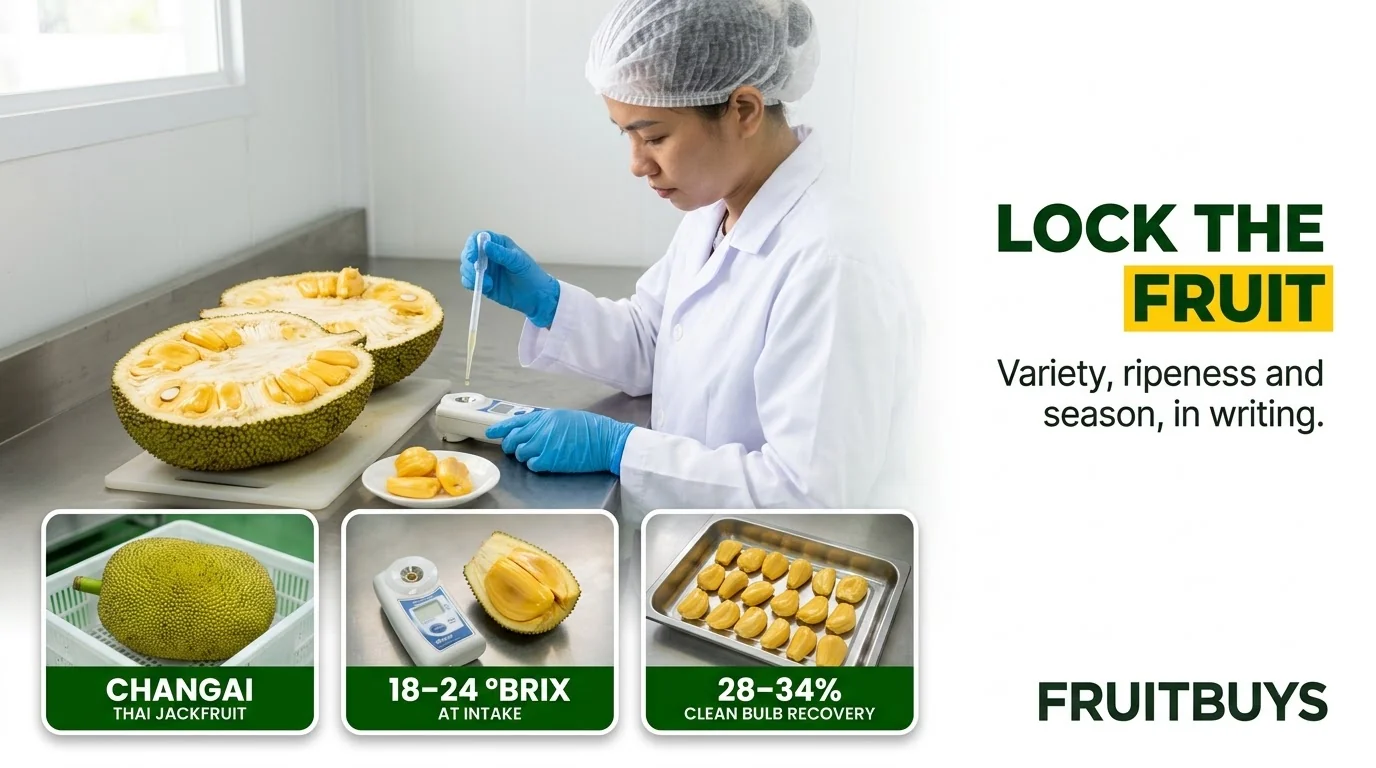
Good freeze-dried jackfruit starts with ripe Thai jackfruit at 18–24 °Brix: golden, fragrant bulbs that keep their crunch. Under-ripe fruit dries chalky, over-ripe fruit collapses under vacuum, and rainy-season fruit carries more water. None of it can be fixed in the dryer, so the raw material belongs in your contract. The full supplier checklist is in the bulk buying guide.
This guide is for the QA and procurement team writing the specification. It covers the variety, ripeness, growing areas and seasons behind Vietnamese freeze-dried jackfruit, and gives you a raw material clause you can copy.
Which jackfruit variety is used for freeze-drying?
Vietnamese export freeze-dried jackfruit is made from Thai super-early jackfruit, sold in southern Vietnam and the Central Highlands as the Changai type (Artocarpus heterophyllus Lam.). Dryers choose it over traditional local types such as honey jackfruit (mít mật), firm-flesh jackfruit (mít dai) or red-flesh jackfruit for four reasons:
- Thick, firm flesh. The bulbs are meaty and crisp with little loose fibre, so they keep their shape through freezing and drying.
- Less latex. Lower surface latex means cleaner bulb separation and faster, cleaner preparation.
- Sweet when ripe. Bulbs reach 18–24 °Brix.
- Year-round fruit at scale. The trees flower continuously, and by 2020 the Mekong Delta alone had more than 30,000 hectares of Thai jackfruit.
What this means for you: name the variety and the fruit part in the specification: “ripe Thai jackfruit (Changai type) bulbs, deseeded”. A supplier who cannot say which variety goes into your product cannot hold its colour and taste from one order to the next.
Where in Vietnam is it grown, and does the region matter?
FruitBuys draws on four growing areas: Tien Giang and Hau Giang in the Mekong Delta, Dong Nai in the south-east, and the Central Highlands. Their harvest peaks and weather do not line up, which is the point: when rain hits one area, ripe fruit is coming in from another.
For freeze-drying, ripeness and season matter more than the province. A bulb at 22 °Brix from Dong Nai and one from Tien Giang dry to the same product; a bulb at 16 °Brix from either does not. You choose between two supply models:
| Standard multi-region allocation | Dedicated single-origin programme | |
|---|---|---|
| How it works | Intake balanced across the four areas week by week | Volume locked with designated partner cooperatives in one province |
| What it protects | Year-round supply and a steady 18–24 °Brix | A provenance claim on your label, such as Tien Giang jackfruit or Central Highlands-grown jackfruit |
| Documents | Growing areas stated per lot | Traceability dossier from the partner cooperatives |
| Best for | Ingredient buyers, cereal and snack manufacturers | Retail brands selling on origin |
| Plan at | Standard order | RFQ, so the cooperative volume is reserved before the season |
Vietnam or Thailand: does the origin change the product?
Less than the specification does. Thailand and Vietnam are the two main Southeast Asian sources of freeze-dried jackfruit, and Vietnam’s processing variety is known locally as Thai jackfruit, after the early-bearing lines it came from. Bulbs at the same 18–24 °Brix, sorted to the same standard, dry to the same golden, crisp product.
What differs between suppliers is control, not geography: which variety goes in, how hard intake is sorted in the rainy season, and whether one processing facility is locked to your contract. For EU and UK buyers, freeze-dried jackfruit enters at 0% duty from either origin, so the decision rests on the raw material clause below and the sample, not on the flag on the carton.
How ripe does jackfruit need to be?
Ripe, but not soft: 18–24 °Brix. A truckload of whole jackfruit cannot be cut open fruit by fruit, so ripeness is graded in three passes:
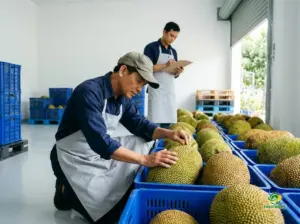
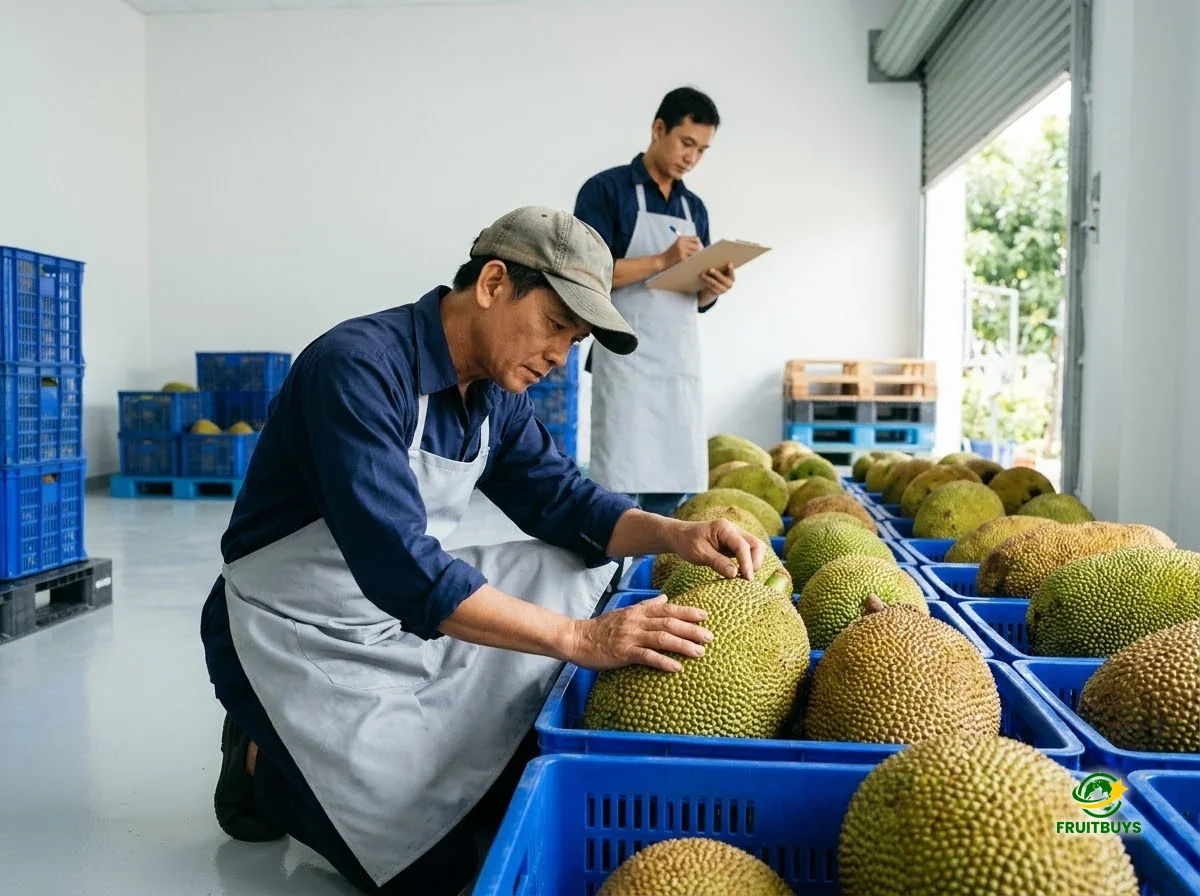
- At the gate, by experienced graders: spines flattened and spread apart, rind turning from deep green to bright yellow-brown, a slight give under the thumb, a dull, full sound when the fruit is tapped, and natural aroma rising from the stem end.
- On the lot: refractometer Brix readings on bulbs from a representative sample of each delivery.
- At the bulb-separation table: under-ripe bulbs with hard, pale tips and over-ripe, soft or fermenting bulbs are pulled out before freezing.
Fruit that slips past these checks fails in predictable ways:
| Fruit at intake | What happens in the dryer | What you see in the carton |
|---|---|---|
| Under-ripe (below 18 °Brix) | Starch has not turned to sugar; little aroma develops | Chalky, pale bulbs; flat, starchy taste |
| Ripe (18–24 °Brix) | Structure holds; sugars and aroma concentrate | Golden yellow, fragrant, clean snap |
| Over-ripe (soft, fermenting) | Cell walls give way under vacuum | Collapsed, sticky pieces, darker colour, more fines |
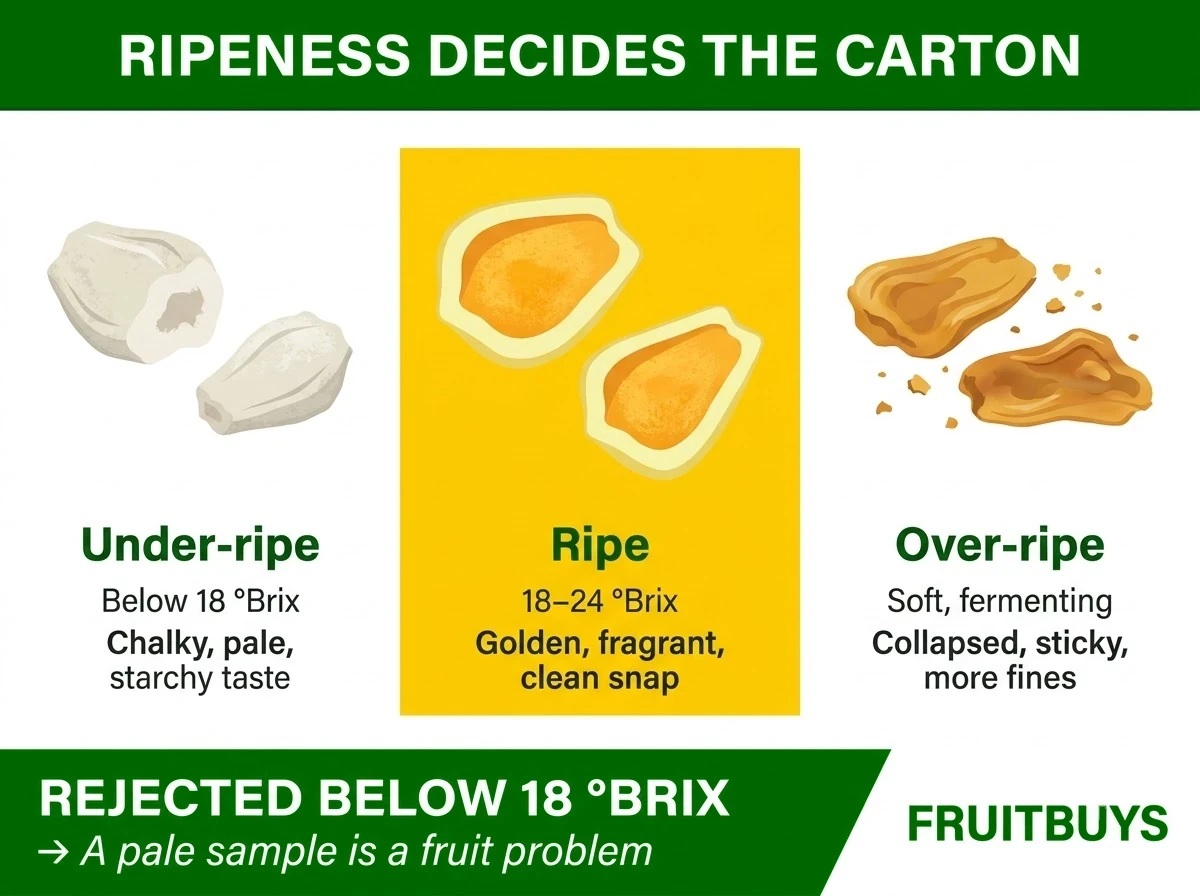
Bulbs below 18 °Brix are rejected at intake. Under-ripe jackfruit is also a different product from the green jackfruit sold as a meat substitute: that is harvested immature on purpose and never reaches a freeze-dried fruit line.
What this means for you: a pale, bland sample is a raw material problem, not a drying problem. Reject it on ripeness and ask for a sample from ripe fruit, rather than negotiating the drying process.
How do dry-season and rainy-season jackfruit differ?
Southern Vietnam has two seasons, and the same orchard delivers different fruit in each:
| Dry season (November–May) | Rainy season (June–October) | |
|---|---|---|
| Brix | 20–24° | Drops to 17–19° |
| Fruit rejected at intake | 5–8% | 12–18% |
| Bulb water content | Lower; firmer bulbs | Higher, around 82% |
| Effect on output | More finished product per tonne of fruit | Ratio moves toward 6 kg of bulbs per kg of product |
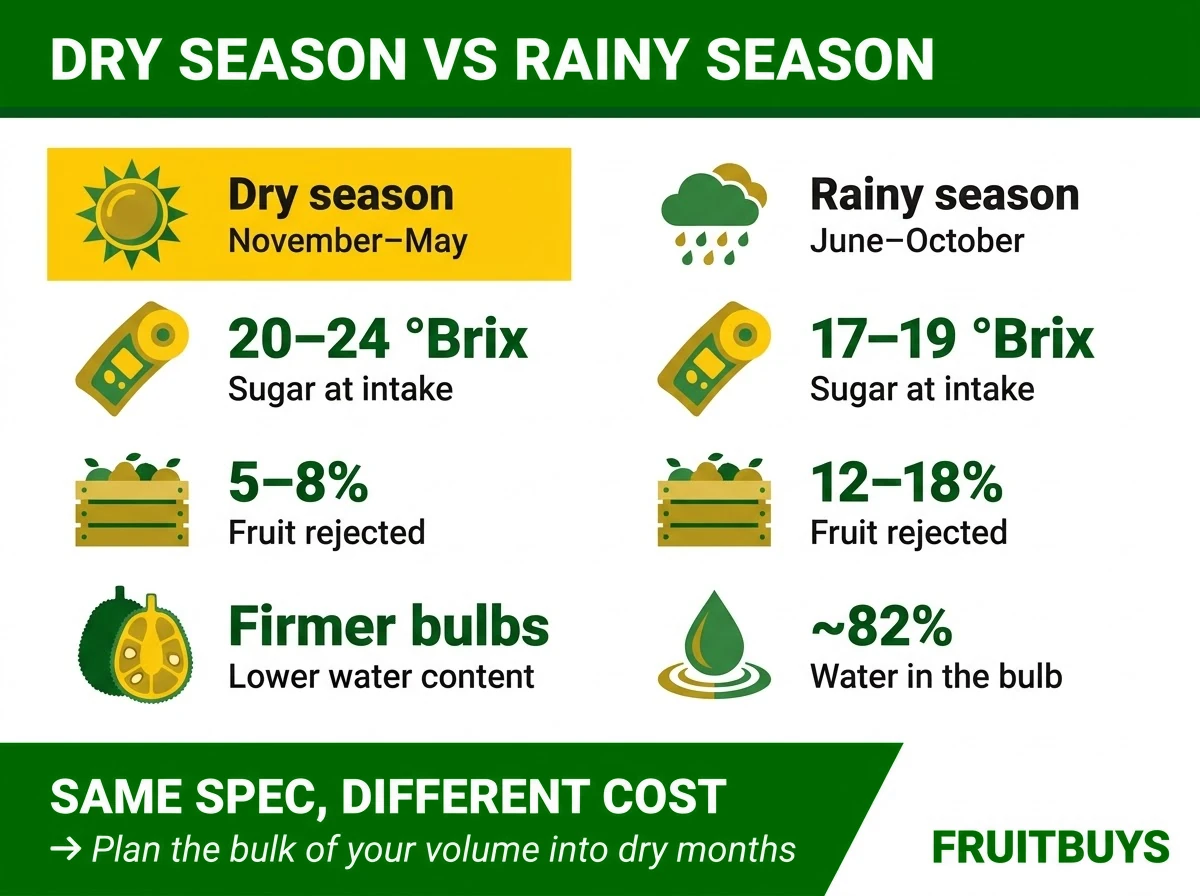
The rainy season does not change the specification you receive. It changes how hard the factory has to sort to meet it, and therefore what each kilogram costs to make. The fresh-to-freeze-dried conversion guide works through that effect on the per-kilogram cost.
What this means for you: plan the bulk of an annual volume into the dry months where you can, or agree a framework contract priced on dry-season fruit with a defined rainy-season adjustment. Either way, hold every lot to the same approved sample.
How much of a jackfruit ends up as usable bulb?
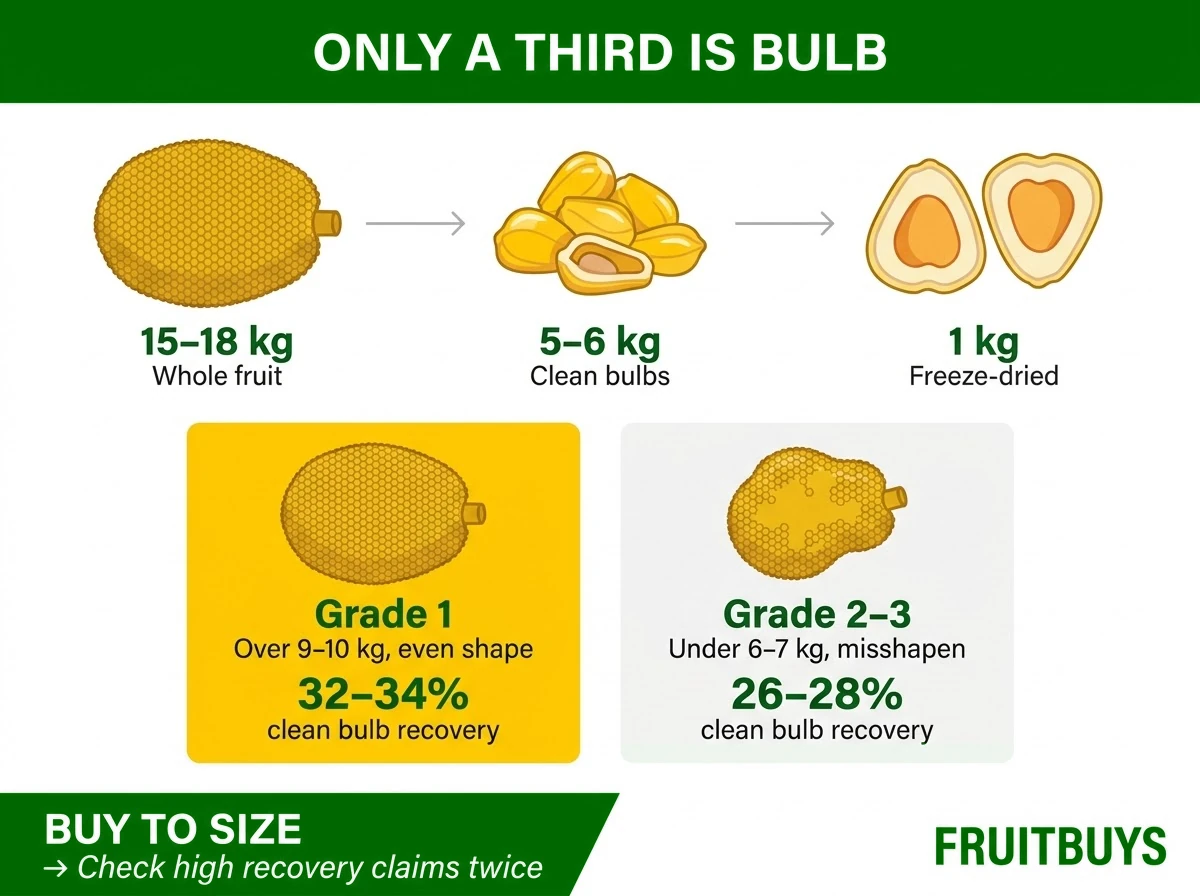
Only about a third. A whole jackfruit is mostly rind, core, rags and seeds. Clean, deseeded bulbs make up 28–34% of whole fruit weight at FruitBuys intake, so one kilogram of freeze-dried jackfruit starts from 15–18 kg of whole fruit, or 5–6 kg of clean bulbs.
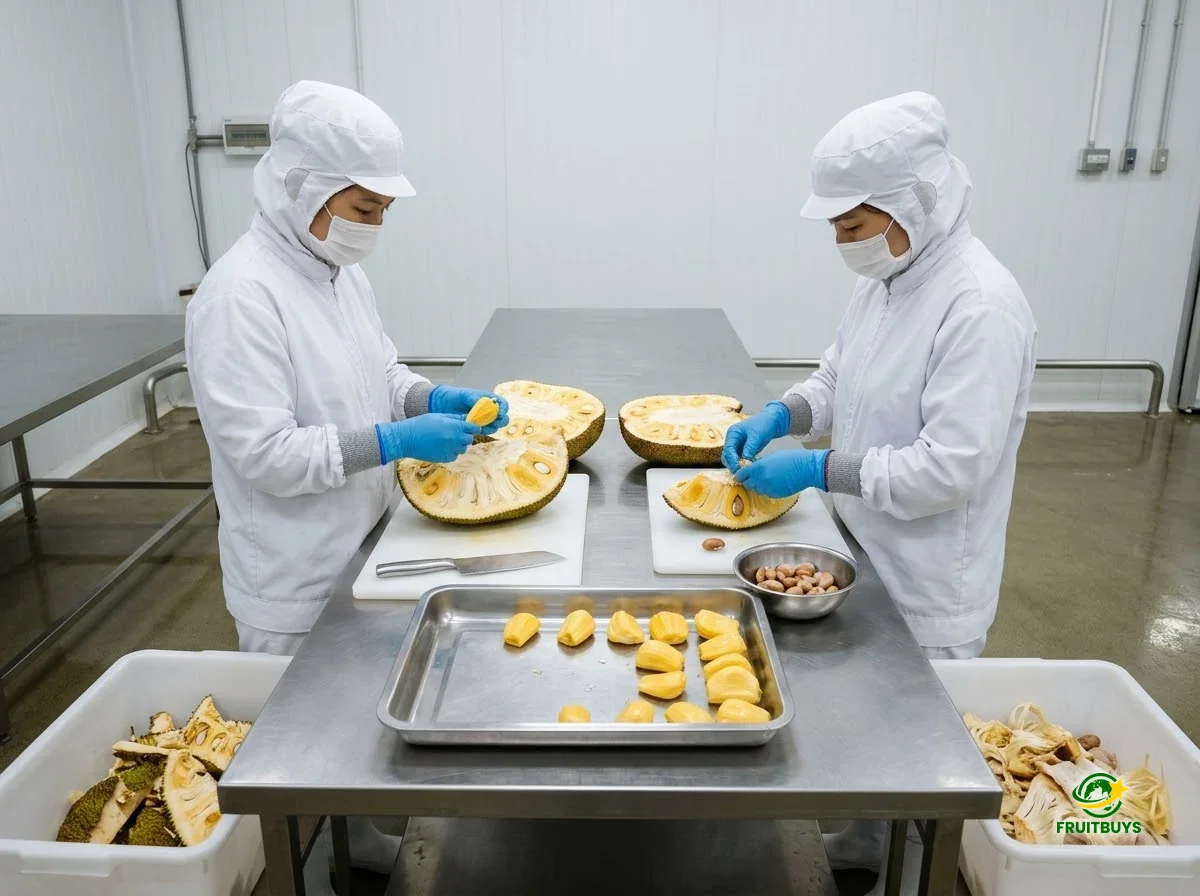
Fruit size moves recovery more than anything else:
| Fruit grade | Typical fruit | Clean bulb recovery | Effect on cost |
|---|---|---|---|
| Grade 1 | Over 9–10 kg, round and evenly shaped | 32–34% | Most bulb per kilogram bought; fast, clean separation |
| Grade 2–3 | Under 6–7 kg, misshapen, unevenly pollinated | 26–28% | Thicker rind, larger seeds, more labour per kilogram of bulb |
Older trees, rainy-season fruit and uneven ripeness push recovery down further. That is why export lines buy to size, and why a quote resting on an unusually high recovery deserves a second look at the moisture, fines and trimming standard behind it.
What raw material clause should go into the contract?
Copy this into your specification and adapt the values to your product:
| Clause | Suggested wording | How you verify it |
|---|---|---|
| Variety and part | Ripe Thai jackfruit (Changai type, Artocarpus heterophyllus Lam.) bulbs, deseeded; no rind, core, rags or seeds | Approved reference sample; visual check at arrival |
| Ripeness | Intake Brix 18–24°; bulbs below 18° rejected | Intake Brix log for the production lot, on request |
| Freshness | Bulbs prepared from fresh fruit and blast-frozen for the same production run; no long-stored frozen pulp | Production record linking intake date to drying date |
| Origin | Vietnam; growing areas stated per lot, or one province under a single-origin programme | Lot traceability record, or the cooperative traceability dossier |
| Season | Production month stated on the COA and carton label | Lot code and production date |
| Sensory | Golden yellow, ripe jackfruit aroma, crisp; no chalky, fermented or burnt notes | Pre-shipment sample against the reference sample |
| Change control | Any change of variety, growing area mix or processing facility notified in writing and re-approved by sample | Written notice before production |
The last line is the one buyers skip. FruitBuys locks one qualified processing facility to each contract, and a change of facility or raw material base needs written notice and a re-approved sample before production. Ask every supplier for the same commitment, including us.
To turn the clause into release limits for moisture, water activity and microbiology, use the freeze-dried jackfruit specification guide. The step-by-step controls from intake to packing are in how freeze-dried jackfruit is produced and controlled.
When does the raw material clause matter less?
- Powder for flavour blends. Powder is milled from clean sorted pieces and broken bulbs of the same ripe fruit, so bulb shape does not matter, but Brix and aroma still do. See the freeze-dried jackfruit powder guide.
- Inclusions where jackfruit is a minor note. At low dose in a mixed cereal, colour variation between seasons is hard to see. Ripeness still matters for taste.
It never stops mattering for retail snack packs, where the bulb itself is the product.
Start with the fruit, then the price
Send us your target use, cut and annual volume. We will propose the raw material clause, production months and reference sample before you compare quotes, so every supplier you shortlist is quoting the same fruit. Specifications are on the freeze-dried jackfruit product page.
Email [email protected] · WhatsApp Export +84 919 739 589
FAQ
Which jackfruit variety is used for freeze-dried jackfruit in Vietnam?
Thai super-early jackfruit of the Changai type, grown across the Mekong Delta, Dong Nai and the Central Highlands. It has thick, firm flesh, fruits year-round and reaches 18–24 °Brix when ripe.
Is Vietnamese jackfruit available all year?
Yes. Thai jackfruit flowers continuously, so fruit is available every month. Quality and yield are best in the dry season, November to May.
Why does some freeze-dried jackfruit look pale or white?
It was made from under-ripe fruit. Below about 18 °Brix, jackfruit dries chalky and pale with little aroma.
Does the rainy season affect freeze-dried jackfruit?
Rainy-season fruit carries more water and less sugar, so more fruit is rejected at intake, 12–18% against 5–8% in the dry season. The specification stays the same; production cost per kilogram rises.
How much fresh jackfruit makes 1 kg of freeze-dried jackfruit?
About 15–18 kg of whole fruit, or 5–6 kg of clean, deseeded bulbs.
Can I specify a single growing region?
Yes. A dedicated single-origin programme locks volume with partner cooperatives in one province and comes with a traceability dossier. Set it up at RFQ so the volume is reserved before the season.
About the author. Udo Nguyen is CEO of FruitBuys Vietnam. He coordinates freeze-dried fruit sourcing, qualified partner facilities and export documentation for importers, food manufacturers and private-label brands.



