Where does Vietnam’s cantaloupe come from, and why is it available all year?
Vietnam grows cantaloupe in net-houses across four climate zones, 3–4 crops a year. Regions, dry-season Brix, harvest calendar and lot traceability.
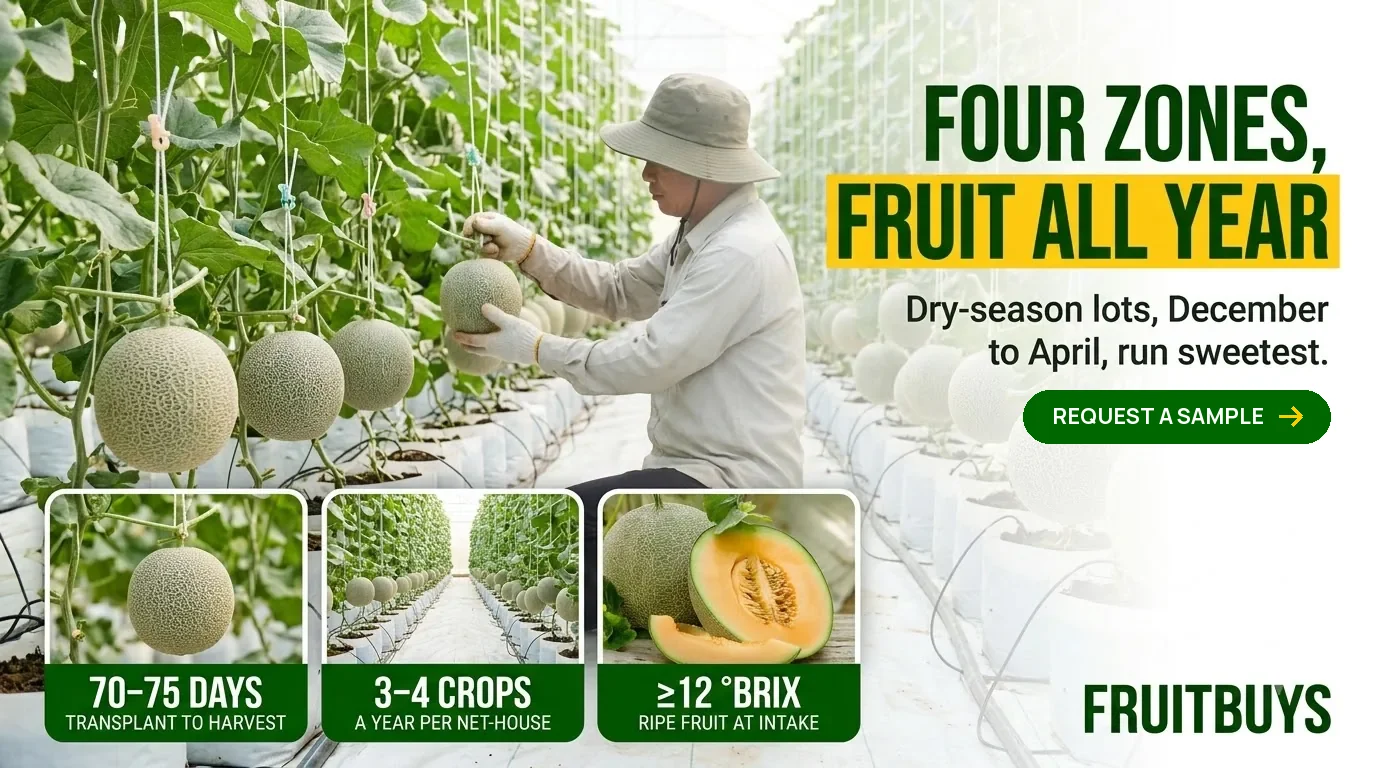
Vietnam’s cantaloupe grows in net-houses across four climate zones: the Central Highlands, the Mekong Delta, the Southeast and the South Central Coast. A crop takes about 70–75 days from transplanting to harvest, so a net-house runs 3–4 crops a year, and the zones have their dry and rainy seasons at different times of year. When one region is in its rains, another is dry and sunny.
For a buyer, that adds up to one practical fact: an annual contract for freeze-dried cantaloupe can run on fresh fruit every month, with no off-season gap to bridge with old stock. The sweetest, most aromatic fruit comes in the southern dry season, December to April, and those lots can be held for the products where melon flavour matters most.
What is “dưa lưới”, and which melon is it?
“Dưa lưới” is the Vietnamese name for cantaloupe, and it means “net melon”, after the raised net pattern on the rind. Among Vietnamese melons, it is the netted type grown in net-houses for supermarkets, gifting and processing. Botanically it is Cucumis melo, reticulatus group, the same netted, orange-fleshed melon sold as cantaloupe or muskmelon in North America.
In Vietnam the name covers several netted melons grown under cover. The common net-house varieties are F1 hybrids from Japanese and Asian breeders, such as Taki and TL3, with a green-grey netted rind and orange flesh, and Kim Hoang Hau, with a yellow rind and orange flesh. Growers choose them for firm flesh, a good balance of sugar and acidity, and fruit that ripens evenly under a net-house roof. They are conventional, non-GMO hybrids.
FruitBuys freeze-dries orange-flesh netted cantaloupe. That orange flesh carries beta-carotene, which gives the dried slices and powder their natural light orange colour without any added colour.
How is cantaloupe grown in Vietnam’s net-houses?
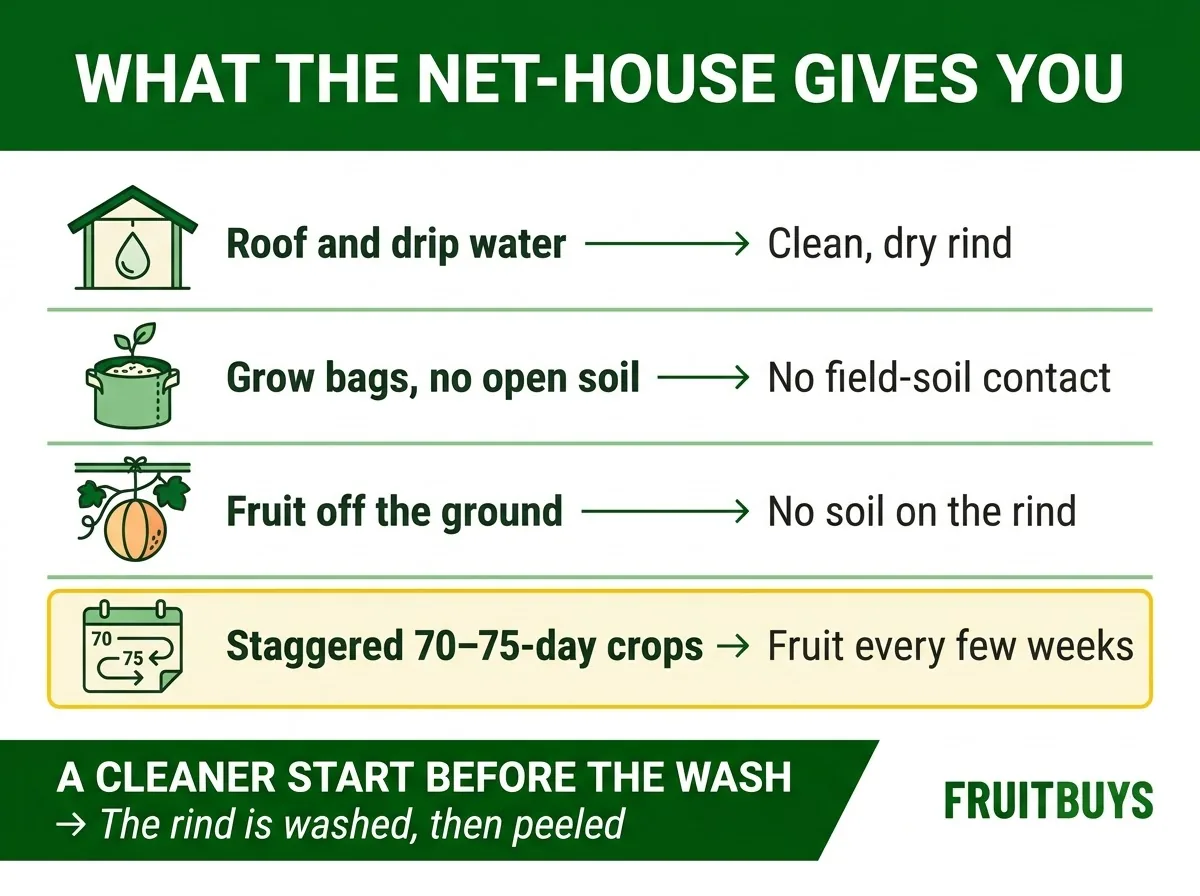
A Vietnamese melon net-house is a covered growing hall: a plastic roof against rain, insect netting on the sides, and rows of plants trained up vertical strings. FruitBuys’ partner growers plant in grow bags of treated coco-peat substrate rather than open ground, and feed each plant through drip irrigation. Each melon hangs off the ground on its own trellis until harvest.
Four things follow for a buyer of dried fruit:
| Net-house practice | What it means for freeze-dried cantaloupe |
|---|---|
| Roof against rain, drip water at the root | Rind stays clean and dry; less splitting and rain damage than field melons in the wet season |
| Grow bags of substrate instead of open soil | Roots sit in a clean, controlled medium, apart from field soil and its soil-borne diseases |
| Fruit hanging off the ground | No soil contact on the rind, a cleaner starting point before the rind wash (see the cantaloupe COA guide) |
| Staggered planting, 70–75-day cycles | Harvests every few weeks somewhere in the network, so raw fruit arrives steadily instead of in one seasonal flush |
When I walk a net-house before a programme starts, the things I look at are the fruit’s ripeness, the condition of the rind and how the planting is staggered, because those decide what reaches the drying line over the following months.
Which regions supply it, and when?
The four zones sit under different rain patterns, which is what keeps fresh fruit coming all year.
| Region | Main dry months | Main rainy months | What it brings |
|---|---|---|---|
| Mekong Delta | December–April | May–November | Long, sunny dry season and high Brix |
| Southeast | December–April | May–November | Short haul to processing near Ho Chi Minh City |
| Central Highlands | November–April | May–October | Cooler upland nights; a long dry season |
| South Central Coast | January–August | September–December | Dry and sunny while the south is in its rains |
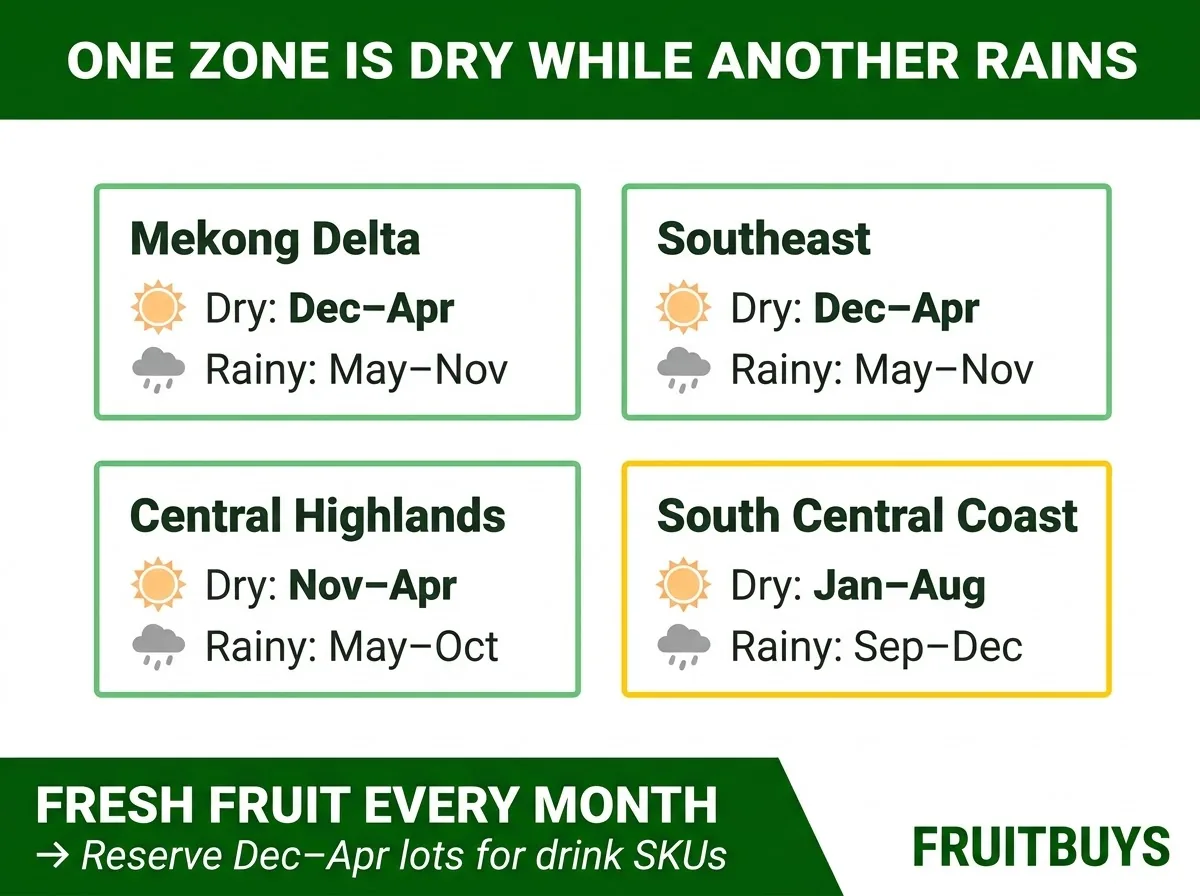
Sourcing moves between these zones through the year, so a dry, sunny region carries supply while another is in its rainy season. Net-house roofs take the edge off the rain, but sunlight and humidity still shape sugar and aroma, which is why the dry-season lots stand out.
That seasonality is worth building into a contract. For a milk tea powder or a dessert where the melon note sells the product, ask for dry-season lots and plan volume around them. For cereal, trail mix or chocolate inclusions, year-round lots work well and keep stock even.
Year-round supply does have a limit worth knowing. FruitBuys supplies orange-flesh netted cantaloupe; if your recipe calls for a green-fleshed honeydew or a Hami melon, the cantaloupe vs honeydew vs Hami guide explains how the three melons differ in flesh, aroma and the colour they give a drink.
How is fruit chosen for freeze-drying?
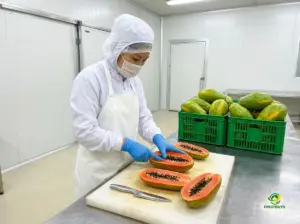
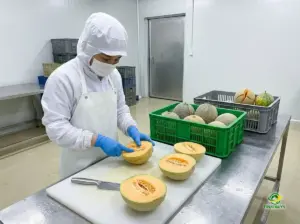
Fruit is accepted ripe, at ≥12 °Brix, typically 12–16 °Brix, and cracked, soft or under-ripe melons are rejected. Selection is made on ripeness and Brix; rind netting and fresh-market size play no part, because the rind is peeled away before drying.
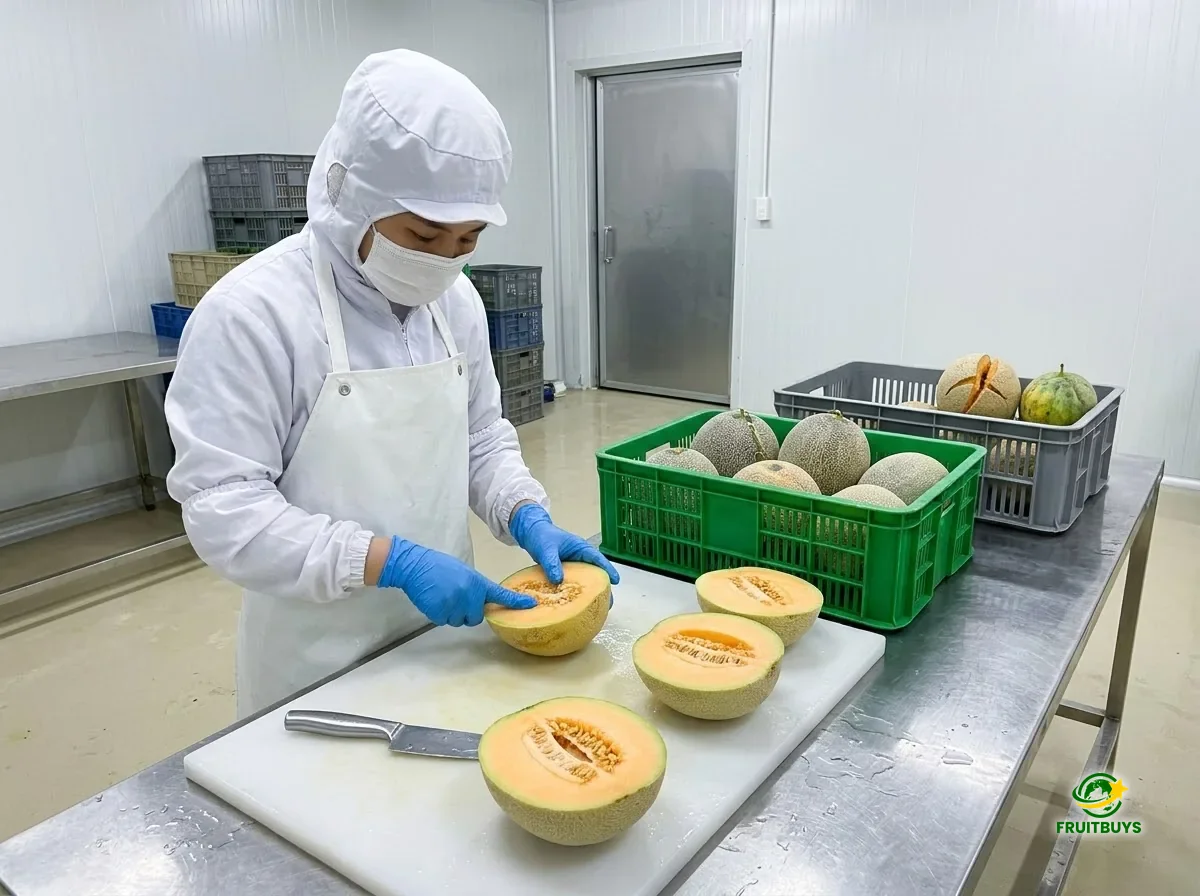
That rule matters to your cost. A supermarket buyer of fresh cantaloupe pays for an even net and a perfect shape; a buyer of freeze-dried cantaloupe pays only for the flesh. Melons with an uneven net or an off-size shape but full sugar go to drying instead of being wasted, and the dried product carries the same sweetness and aroma.
Season shows up in the yield as well. Dry-season fruit carries more solids, so it takes about 13 kg of whole melon to make 1 kg of freeze-dried cantaloupe; wetter fruit needs closer to 17 kg. The freeze-drying and conversion guide shows the full mass balance.
Why is processing growing in Vietnam’s fruit trade?
Vietnam’s fruit and vegetable exports reached an estimated USD 8.4 billion in 2025, up 18%, according to VINAFRUIT. In the first five months of 2026 they came to nearly USD 3 billion, up 29.4%, and processed products made up 35.8% of the value in the first four months, against 29.3% a year earlier, according to Vietnam’s Ministry of Agriculture and Environment as reported by The Star in June 2026.
Cantaloupe shows why. In Ia Phi commune in Gia Lai, in the Central Highlands, net-house melon grew from a start in 2020 to nearly 300 net-houses on about 15 ha, with most fruit sold fresh in the domestic market and processing named as the missing link (Nhân Dân, 2025). Fresh melon has to sell within days. Freeze-drying turns the same fruit into a shelf-stable export ingredient that ships in a dry container and keeps for 12–24 months, which gives growers a second outlet and gives buyers abroad a steady supply.
Can every lot be traced back to its region?
Yes. Each FruitBuys lot is traceable to its harvest region and raw-material intake batch. The lot number on the cartons matches the packing list and the COA, so your QA team can follow any carton back to where and when its fruit came in.
For a brand selling into the US or EU, that link is what your own customers’ auditors ask for. It also lets you request lots from a given season and check a dry-season reservation against the records.
FAQ
What is cantaloupe called in Vietnamese?
Cantaloupe is “dưa lưới”, which means “net melon”, after the net pattern on its rind.
When is cantaloupe in season in Vietnam?
Net-house cantaloupe is harvested all year, with 3–4 crops a year per net-house. The sweetest, most aromatic fruit comes in the southern dry season, from December to April.
Which cantaloupe varieties are grown in Vietnam?
Common net-house varieties are F1 hybrids from Japanese and Asian breeders, such as Taki and TL3 (green-grey netted rind, orange flesh) and Kim Hoang Hau (yellow rind, orange flesh).
Is Vietnamese cantaloupe genetically modified?
No. Vietnamese net-house cantaloupe is grown from conventional F1 hybrid seed.
Does Vietnam export fresh cantaloupe?
Most Vietnamese net-house cantaloupe is sold fresh in the domestic market. Freeze-drying turns it into a shelf-stable export ingredient for food and drink manufacturers.
Request a sample
Tell us your product and the season you plan to launch, and FruitBuys sends a sample from current production with the specification, so you can taste the fruit your programme will run on.