Vietnamese Strawberries: Why Da Lat Fruit Makes Good Freeze-Dried Strawberries
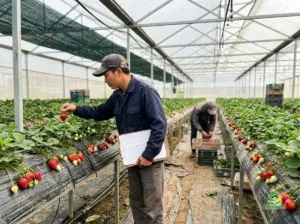
Vietnamese strawberries for freeze-drying come from the Da Lat highlands in Lam Dong province, at about 1,400–1,600 m. Cool nights and a 10–12 °C daily swing give firm, deep-red berries of 8–10 °Brix in the December–April dry season. FruitBuys Vietnam buys mainly the firm My Da variety and has the fruit in the freezer within 24 hours of picking.
For an importer, the origin decides three things: how the fruit behaves in the freeze dryer, which month gives which format at the best yield, and what the certificate of origin is worth at the border. Vietnamese-grown strawberries enter the EU and UK at 0% duty with a Form EUR.1. This guide covers where the fruit grows, the varieties, the 12-month calendar, how fruit is accepted at the gate and how to plan a year of supply. The buying guide is freeze-dried strawberries in bulk.
| Key numbers | |
|---|---|
| Growing area | Da Lat and Don Duong, Lam Dong, Central Highlands |
| Altitude | About 1,400–1,600 m |
| Main varieties | My Da, plus New Zealand, Japanese and Korean types |
| Best season | December–April, 8–10 °Brix |
| Rainy season | May–November, 6–8 °Brix |
| Picking to freezer | Within 24 hours |
| Duty into EU and UK | 0% with Form EUR.1 |
What is “strawberry” in Vietnamese?
Strawberry in Vietnamese is “dâu tây”, literally the “Western berry”, because strawberries were brought to the Da Lat plateau in the French colonial period. On its own, “dâu” can mean mulberry, so Vietnamese buyers, growers and traders say dâu tây for strawberry and dâu tây Đà Lạt for strawberries from Da Lat. On a Vietnamese specification, packing list or market report, dâu tây sấy thăng hoa means freeze-dried strawberries.
Where do Vietnamese strawberries grow?
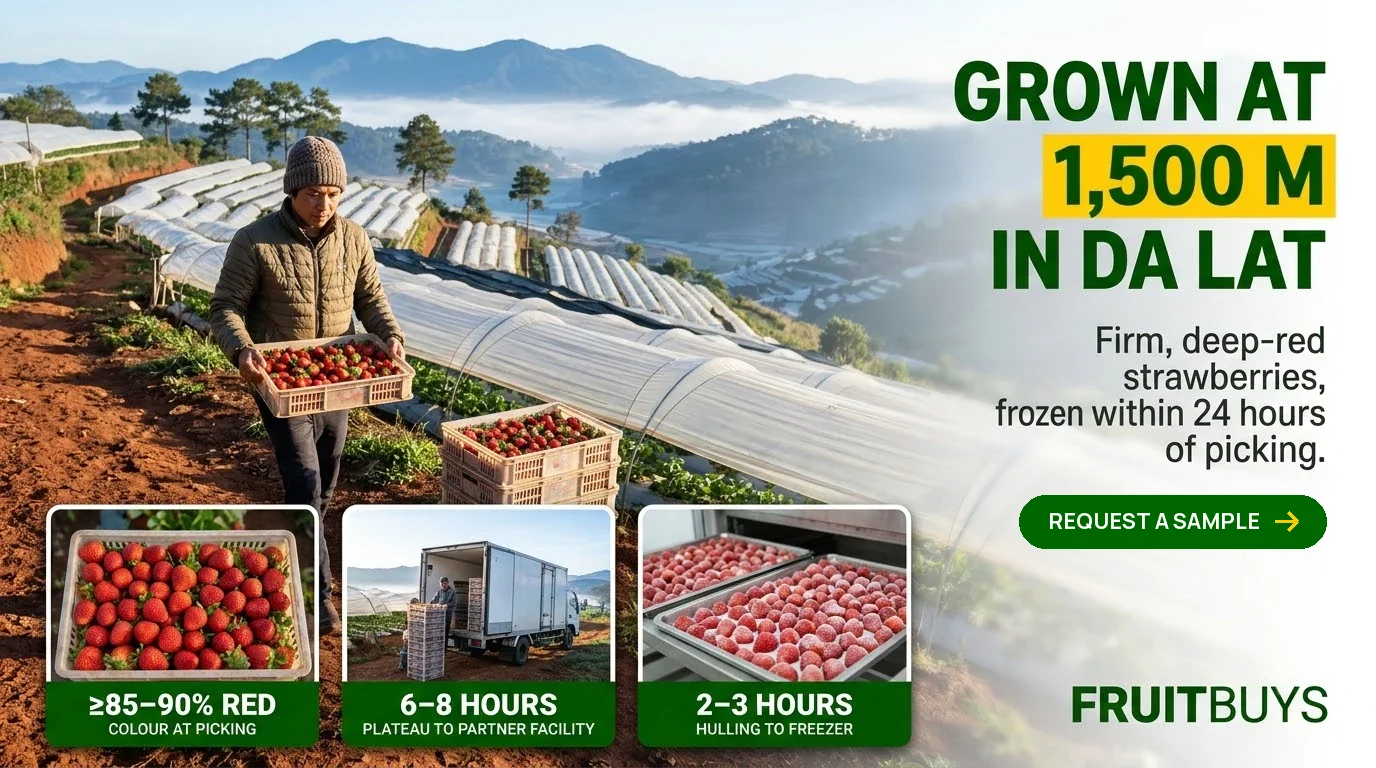
On the Lang Biang plateau around Da Lat and Don Duong in Lam Dong province, about 300 km north-east of Ho Chi Minh City. At about 1,500 m, the plateau has a temperate climate in the tropics: mild days, cool nights and no frost. Strawberries have been a signature crop there for decades, and most fruit grown for export is raised under polytunnels and net-houses that keep rain off the berries and pests out.
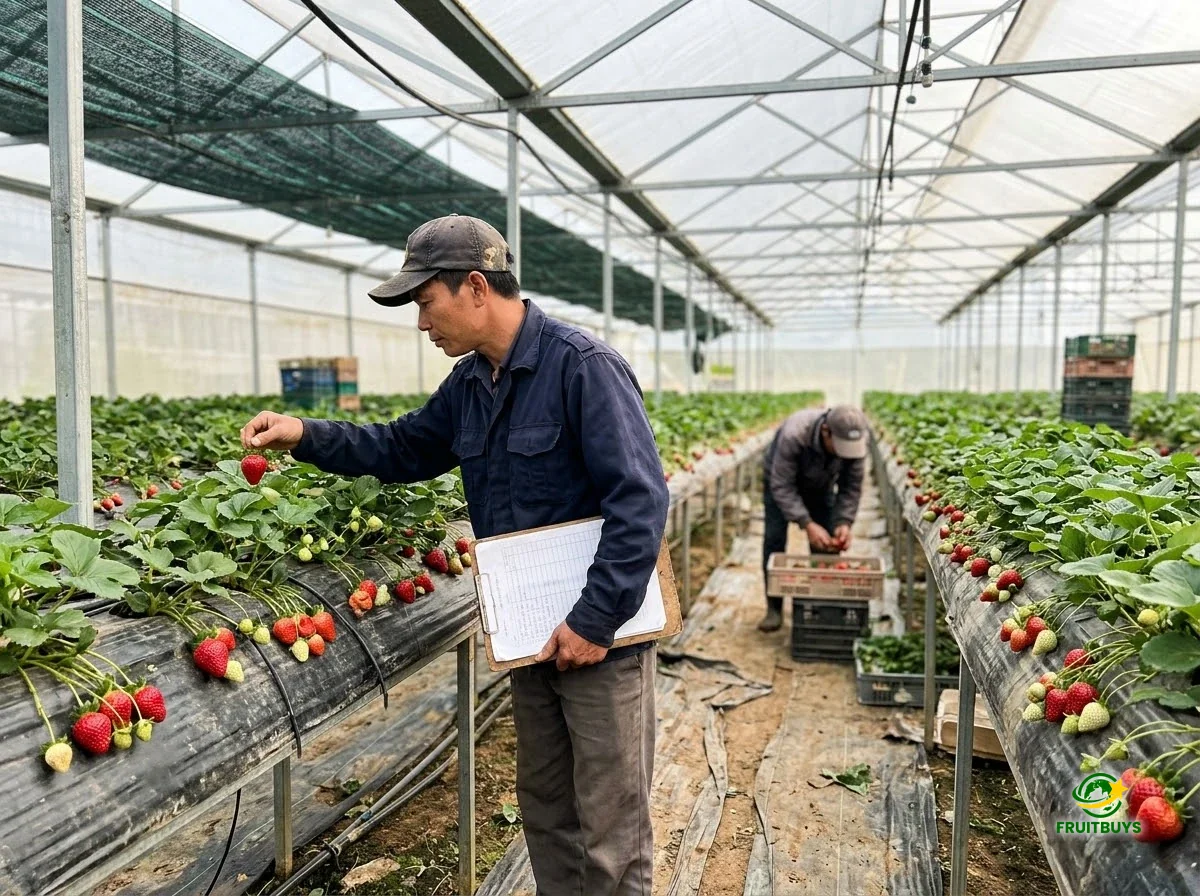
From January to April, days run in the low to mid 20s °C and nights drop to 12–15 °C, a swing of about 10–12 °C every day. Warm, bright days build sugar; cold nights slow the berry’s respiration, so the sugar stays in the fruit. The berry ripens slowly and builds aroma and red colour deep into the flesh before it softens. That is the strawberry a freeze dryer rewards: firm enough to hold its shape, red through the centre, with a sharp sweet-tart taste.
FruitBuys Vietnam works with contracted grower networks and harvest areas booked against annual plans in the Lam Dong highlands. For your pack, “grown on a highland plateau at 1,500 m in Vietnam” is an origin line that explains why the strawberry tastes like a strawberry.
Which varieties go into freeze-drying?
The variety mix is chosen for firmness and colour, and stated on the lot file:
| Variety | What it brings | Best used for |
|---|---|---|
| My Da | Firm, crunchy flesh; holds its shape best through freeze-drying | Whole, halves and slices: the main variety |
| New Zealand types | Aromatic, sweet | Slices, dice, powder blends |
| Japanese types | High sweetness | Dice, powder |
| Korean types | High sweetness | Slices, dice |
If your specification names one variety, put it in the RFQ, and FruitBuys plans supply for it before the season starts. Colour, Brix and cut size are fixed on the pre-shipment sample, so the variety mix serves the specification rather than changing it.
Want samples from the current harvest? Email [email protected] or WhatsApp +84 919 739 589 with the formats you need. REQUEST SPEC SHEET / SAMPLE →
When is strawberry season in Da Lat?
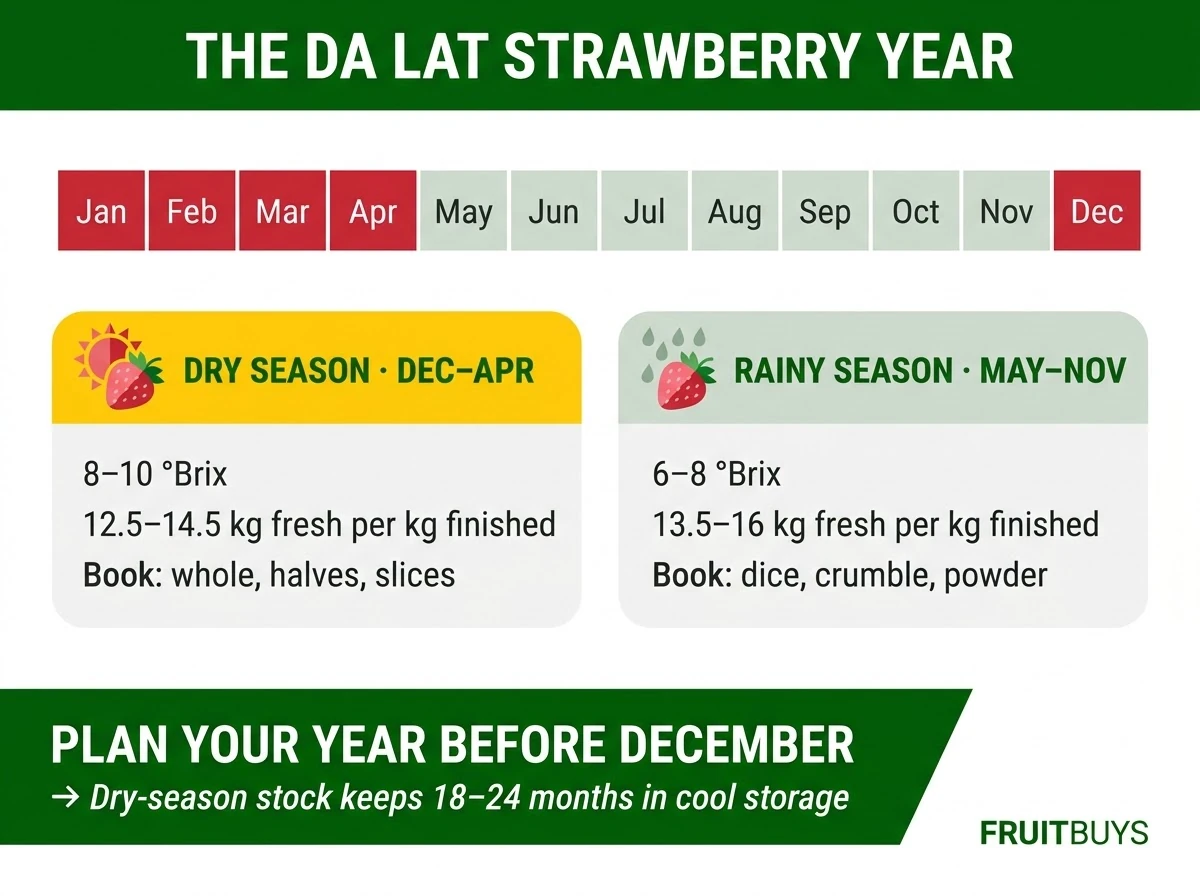
Year-round, with two distinct seasons that suit different formats:
| Months | Fruit in Da Lat | Brix | Fresh fruit at the gate per kg finished | Book |
|---|---|---|---|---|
| December–January | Dry season begins; colour and sweetness rising | 8–10 | 12.5–14.5 kg | Whole and sliced for the year’s retail programme |
| February–April | Peak firmness, colour and sweetness | 8–10 | 12.5–14.5 kg | Whole, halves, slices; approve the sample that sets your colour standard |
| May–June | Rains start; faster ripening | 6–8 | 13.5–16 kg | Dice and crumble for bars, bakery and chocolate |
| July–September | Height of the rains; brightest, most tart fruit | 6–8 | 13.5–16 kg | Dice, crumble, powder |
| October–November | Rains ease | 6–8 | 13.5–16 kg | Dice, crumble, powder; confirm next year’s plan |
In the rainy months, warmer nights narrow the daily swing to about 7–8 °C, rain pushes more water into the berry, and the share of soft and split fruit sorted out at the gate rises by about 5–10 percentage points. Whole berries feel that most, because every piece has to look right on its own; dice, crumble and powder are made very well from the same fruit, because shape no longer matters and colour and flavour carry through.
Booking whole and sliced fruit in the dry season saves about 1–1.5 kg of fresh fruit per finished kilo. Bought in February and held in cool storage at ≤18 °C and RH ≤50%, it keeps 18–24 months in the original sealed bulk bag, so one dry-season container can carry a full year of retail sales; once repacked into retail pouches, it is dated at 12 months. How the gate weight turns into a fair quote is worked through in freeze-dried strawberry conversion ratio and chart.
How is fruit accepted for freeze-drying?
At the gate, against a short list that every lot has to pass:
| Check | Standard | Why it matters to you |
|---|---|---|
| Ripeness | ≥85–90% red surface colour | Full colour and sugar, still firm enough to travel and hull |
| Condition | No bruising, mould or split fruit | A soft berry dries dull and uneven |
| Sweetness | 8–10 °Brix dry season, 6–8 rainy season | Sets taste and yield by season |
| Size | Sorted for the format (whole berries 20–35 mm) | Whole fruit matches your pouch and sample |
| Growing area | Recorded per lot | Traceability and certificate of origin |
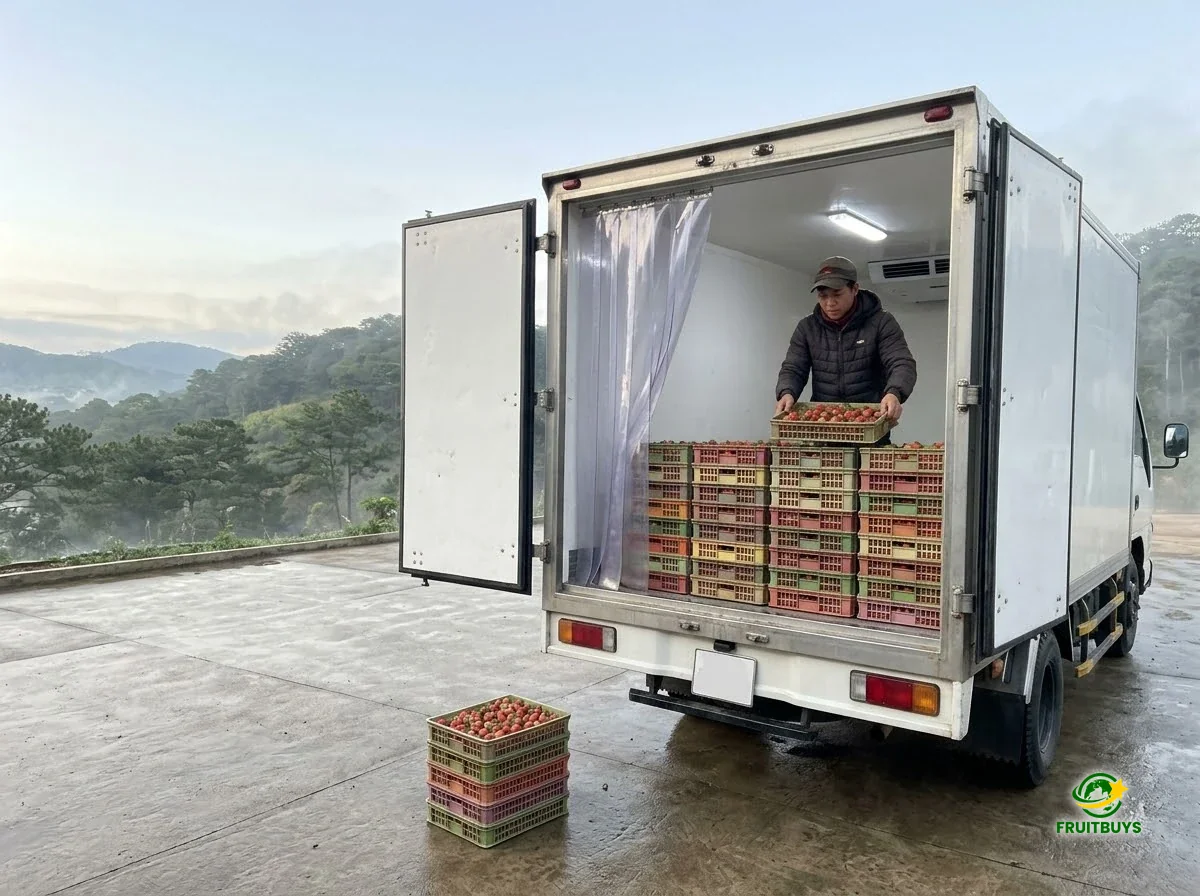
Picked early in the morning, the fruit travels down from the plateau in refrigerated trucks, a run of about 6–8 hours, to the partner facility the same day. Accepted fruit is washed in chlorinated water (50–100 ppm) or ozone, hulled, and in the freezer within 2–3 hours of hulling and within 24 hours of picking. That speed is what keeps drip low, colour bright and microbial load down. Each step from cutting to the dryer is covered in how freeze-dried strawberries are made.
Why are some freeze-dried strawberries sour?
Because freeze-drying concentrates everything in the fruit, the acid as well as the sugar. A strawberry is about nine-tenths water; take the water out and the sweet-tart balance of the fresh berry becomes about ten times as intense on the tongue. Three things decide where that balance lands:
- Season: rainy-season fruit at 6–8 °Brix is brighter and more tart than dry-season fruit at 8–10 °Brix.
- Ripeness: fruit picked under-ripe carries more acid and less sugar; that is why acceptance starts at 85–90% red.
- Variety: sweeter Japanese and Korean types soften the tartness in a blend.
Many brands want that tartness: it is the fresh-strawberry taste in a yogurt or a white-chocolate bar. If your product needs a sweeter profile, specify dry-season fruit, or set a small sugar step in your base between seasons.
Are Vietnamese strawberries tested for pesticides?
Yes, against the rules of the market you sell into. Every full-container lot ships with a COA from an independent ISO/IEC 17025 accredited third-party laboratory for moisture, water activity and microbiology, and lead, arsenic and aflatoxin are covered by periodic surveillance testing. For EU and UK retail programmes, a pesticide multi-residue panel is booked before the container is sealed, at an accredited laboratory of your choice such as Eurofins or SGS in Vietnam. Results on the dried product are read against fresh-fruit limits through a processing factor of about 9–11. Strawberries from Vietnam are not on the EU list of foods under increased border controls, so containers move through routine checks. Limits and testing are set out in freeze-dried strawberry specs: moisture, aw and COA.
What does Vietnamese origin do for your paperwork?
It keeps it simple. FruitBuys freeze-dries fresh strawberries grown in Lam Dong, so the product is wholly obtained in Vietnam and carries a straightforward Vietnamese certificate of origin. For EU and UK buyers, that is the basis for 0% duty with a Form EUR.1 under the EU and UK trade agreements with Vietnam, on every container.
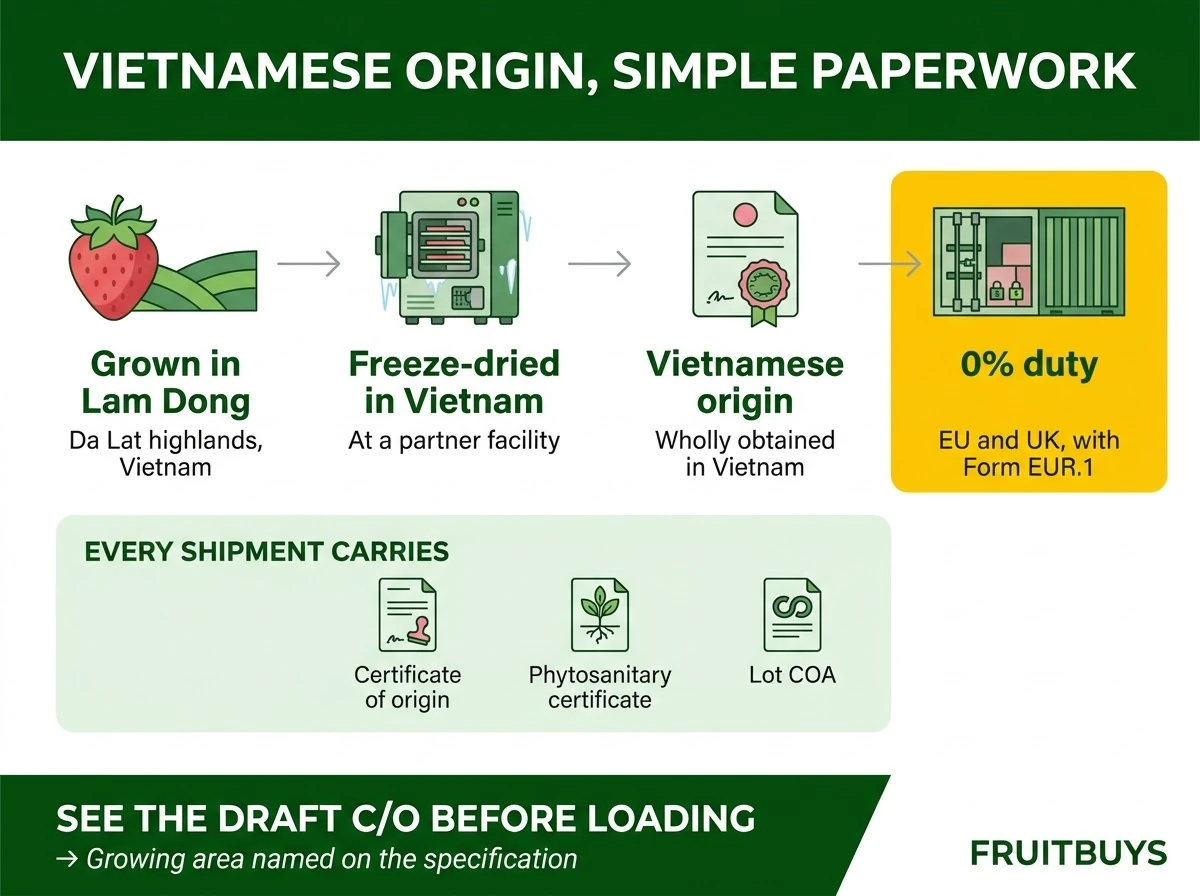
A product made from imported frozen strawberries is a different case: its origin depends on where the fruit was grown, and an importer who assumed Vietnamese origin can lose the preference at the border. FruitBuys names the growing area on the specification and shows the draft certificate of origin before loading. Every shipment carries the standard export dossier: certificate of origin, phytosanitary certificate and lot COA. Market-by-market clearance is in importing freeze-dried strawberries: HS code, US, EU.
How do you lock a year of supply?
Plan before December. Across the industry, freeze-drying capacity, not fruit, is the bottleneck: drying cycles run 18–36 hours and dryer slots in the best months fill early. FruitBuys coordinates about 100 t of freeze-dried finished product a year, and drying slots and Da Lat harvest area go first to partners with an annual plan confirmed before December.
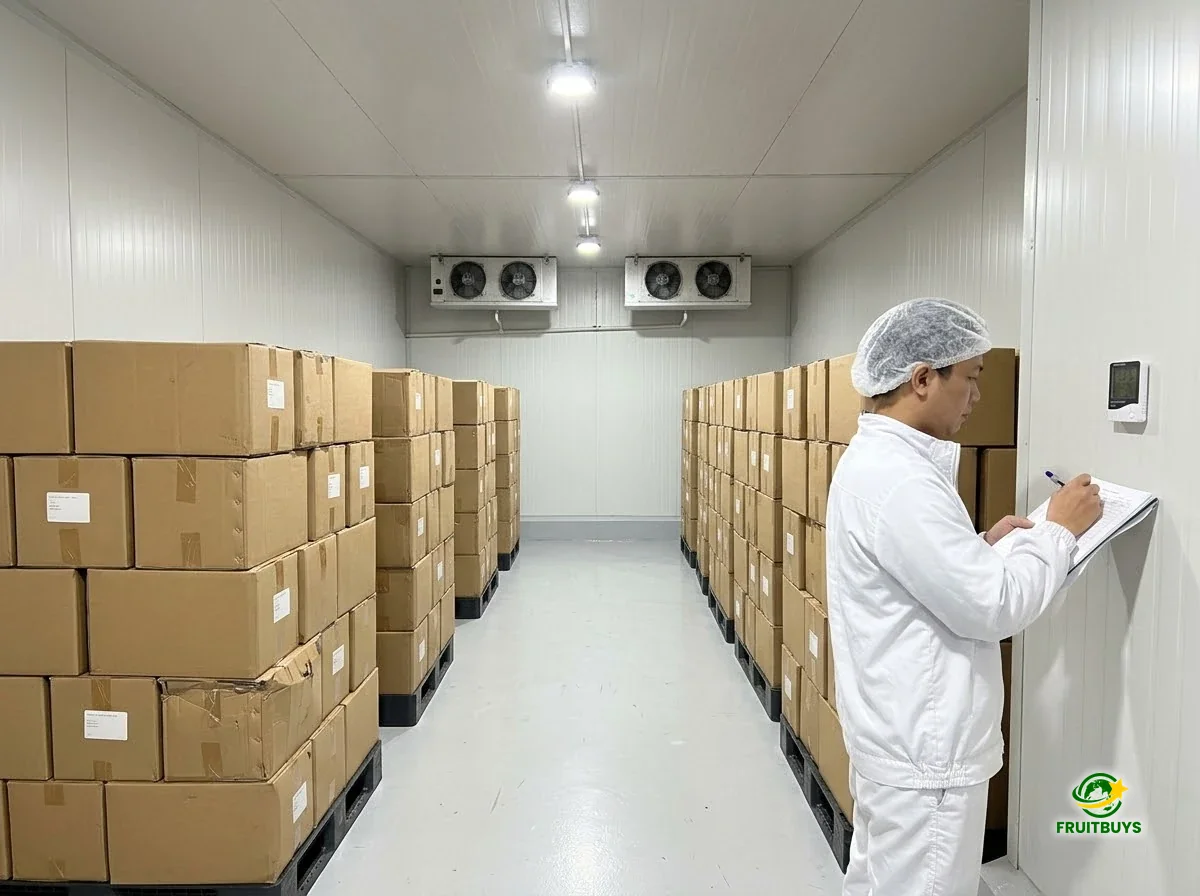
A plan is a forecast by format and quarter, not one large order. It sends dry-season fruit to the whole and sliced volume you need and rainy-season fruit to dice, crumble and powder. Samples are prepared in 3–5 working days, and production runs 20–30 days per 20ft after deposit, at one locked partner facility per contract, so the fruit you approved in February is dried the same way in August.
| Your product | The plan that fits |
|---|---|
| Retail pouch of whole or sliced berries | Book the year’s volume December–April; hold in cool storage |
| Cereal, granola or bars | Slices in the dry season; dice year-round |
| Bakery, chocolate, ice cream | Dice and crumble from rainy-season fruit, at the better cost per kilo |
| Colour and flavour in a base | Powder from rainy-season fruit, milled with no carrier |
Insisting on dry-season whole berries in September costs sorting loss and lead time; the same budget buys excellent dice that month, while the whole berries come from dry-season stock in cool storage.
Plan your strawberry year with FruitBuys
Send your formats, annual volume by quarter and destination market. FruitBuys returns a season plan that matches each format to the right harvest window, a sample schedule and the container timing. Product details are on the freeze-dried strawberries page.
REQUEST SPEC SHEET / SAMPLE →
Email [email protected] · WhatsApp Export +84 919 739 589
FAQ
What is strawberry in Vietnamese?
“Dâu tây”. Strawberries from Da Lat are called “dâu tây Đà Lạt”, and freeze-dried strawberries are “dâu tây sấy thăng hoa”. On its own, “dâu” can also mean mulberry, so traders always say dâu tây for strawberry.
Does Vietnam grow strawberries?
Yes. Vietnam grows strawberries year-round in the Da Lat highlands of Lam Dong province, at about 1,400–1,600 m, where cool nights give firm, deep-red fruit. The main varieties for freeze-drying are My Da, with New Zealand, Japanese and Korean types.
When is strawberry season in Da Lat?
Strawberries are harvested year-round. The best quality is December to April, the dry season, at 8–10 °Brix; May to November is the rainy season, with brighter, more tart fruit at 6–8 °Brix that suits dice, crumble and powder.
Why are some freeze-dried strawberries sour?
Freeze-drying removes the water and concentrates the fruit’s acid along with its sugar. Rainy-season fruit, under-ripe picking and some varieties are more tart. Specify dry-season fruit at 8–10 °Brix and ≥85–90% red at picking for a sweeter profile.
Are Vietnamese strawberries tested for pesticides?
Yes. For EU and UK retail programmes, a pesticide multi-residue panel is booked at an accredited laboratory before the container is sealed, with results read against fresh-fruit limits. Every container lot also ships with a third-party COA for moisture, water activity and microbiology.