Soursop tea, juice or fresh fruit: what are you actually drinking?
Reviewed 9 November 2026. General information, not medical advice.
Two very different things share the name. “Soursop tea” usually means an infusion of the leaves, a folk drink often sold with health promises that the evidence does not support. Soursop juice, batido and smoothies are made from the fruit pulp: a sweet-sour, creamy tropical fruit eaten across Latin America, the Caribbean and Southeast Asia. If you want the flavour of guanábana in a cup, the fruit is what you are after. This guide separates the two, then shows how to make the classic fruit drinks from fresh pulp or freeze-dried powder, and how to eat the fruit itself.
What is in your cup?
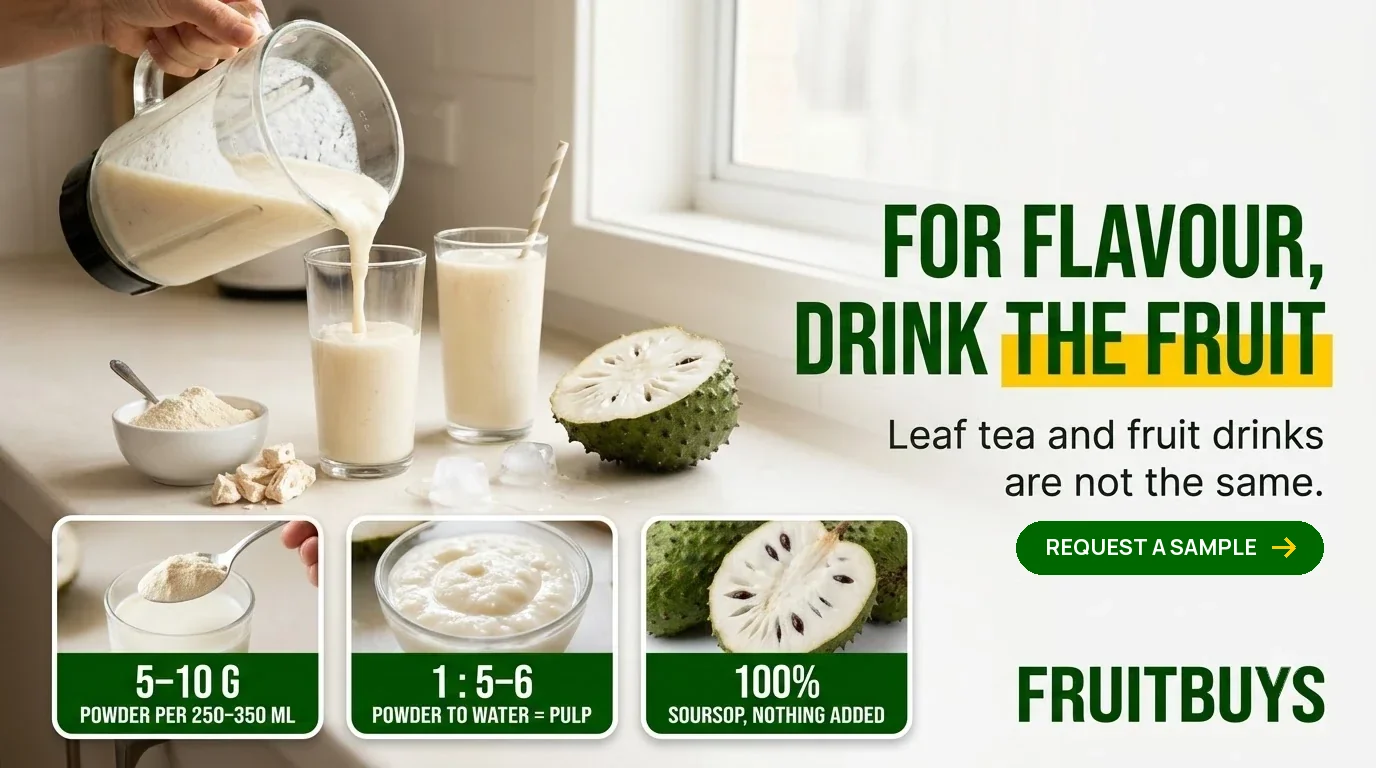
| Drink | Made from | What you get | What to know |
|---|---|---|---|
| Soursop leaf tea, “graviola tea” | Dried leaves steeped in hot water | A mild herbal, grassy taste; no fruit flavour | A herbal product rather than a fruit drink; see who should avoid it below |
| Fresh soursop juice (jugo de guanábana) | Pulp blended with water and strained | The fruit’s flavour in a light drink | Remove every seed before blending |
| Batido, smoothie, sinh tố mãng cầu | Pulp blended with milk or ice | A thick, creamy fruit drink | The way most people drink the fruit |
| Drink made from freeze-dried powder | Freeze-dried pulp, milled | Fruit flavour any day of the year, no thawing | 100% pulp; it disperses into a creamy, cloudy drink |
| Canned nectar | Pulp, water and sugar | A sweetened, shelf-stable drink | Check the sugar; enjoy it as a treat rather than a daily habit |
| Capsules, extracts, bitters | Leaves or concentrated extracts | No food value | Supplements, not food; see who should take care below |
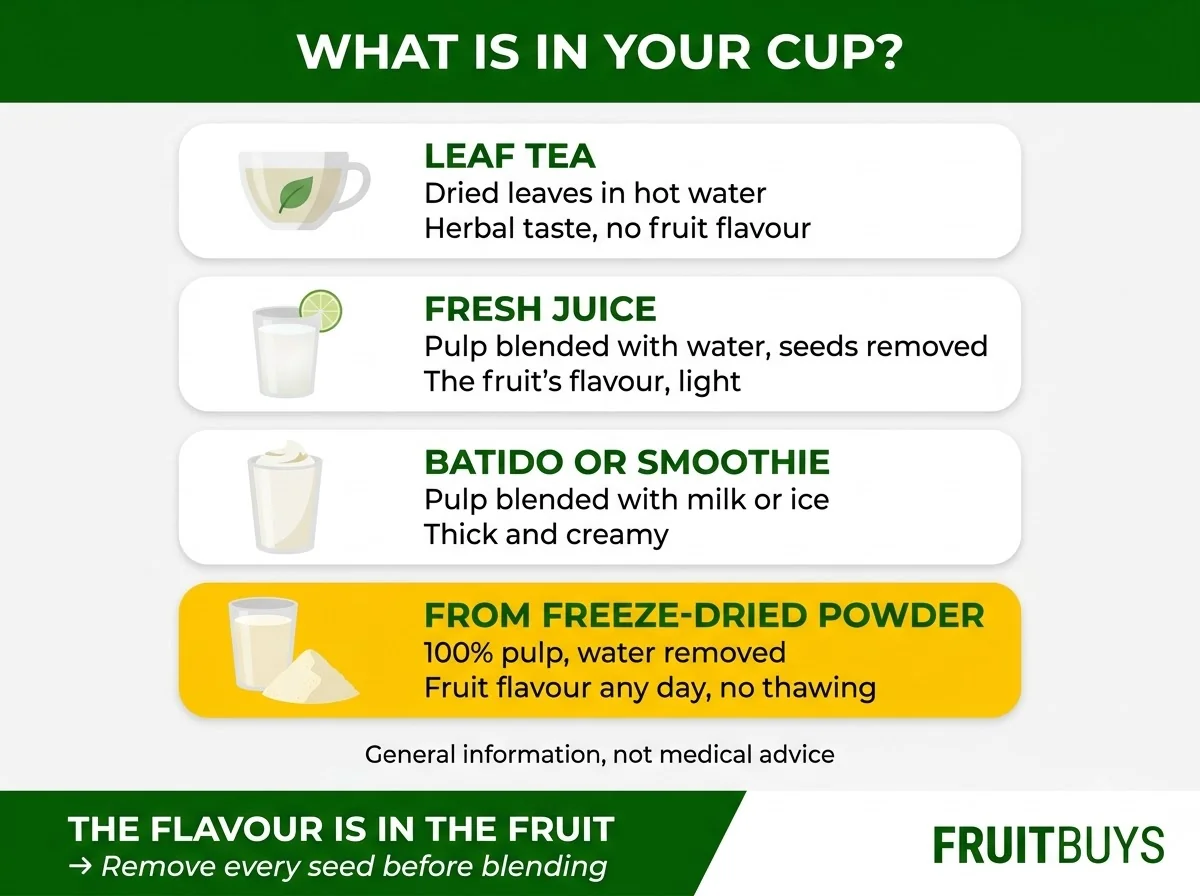
FruitBuys supplies the fruit only, as freeze-dried pieces, crumble and powder. It does not supply leaves, leaf tea, capsules or bitters.
What should you know about soursop leaf tea?
Leaf tea has a long folk history in the Caribbean and Latin America, and it is widely sold online with claims about cancer, infections and pain. None of those claims is backed by clinical trials in people. Laboratory and animal studies on leaf and extract preparations exist, but they do not show that drinking the tea treats any disease. In the US, a food or tea sold with a claim to treat or cure cancer is treated as an unapproved drug, and the FDA has acted against sellers of soursop and graviola products marketed that way.
Some people should not drink leaf tea, or should talk to their doctor first:
- People taking medicines for blood pressure or diabetes. Extracts lowered blood pressure and blood sugar in animal studies, so they could add to those medicines.
- Pregnant or breastfeeding women. Leaf products have not been tested for safety in pregnancy.
- People with Parkinson’s disease or another movement disorder. Annonacin, a natural compound found in the plant, has been studied in connection with an atypical form of parkinsonism.
- Anyone with a scan coming up. Graviola extracts affected the uptake of PET scan tracers in animals.
- Anyone being treated for cancer. Never use soursop products in place of treatment, and tell your oncology team about any supplement.
What the evidence says about each of these, with sources, is in what to know about soursop side effects.
How do you make soursop juice and batido from fresh fruit?
Start with a ripe fruit, take out every seed, and blend the white pulp. The seeds are hard, shiny and black, and they should never go into the blender: crushed seeds release compounds you do not want in a drink, and they turn the juice grey.
Preparing the pulp. Cut the ripe fruit lengthwise, pull the white segments away from the skin and the central core, and press the seeds out with your fingers or a spoon. Pushing the pulp through a coarse sieve catches anything you missed. A ripe fruit gives enough pulp for several drinks; freeze what you will not use today in portions, because ripe soursop ferments quickly.
Five classic drinks, each for one large glass:
| Drink | Where it comes from | How to make it |
|---|---|---|
| Jugo de guanábana | Latin America | Blend a cup of pulp with two cups of cold water, strain, add sugar and a squeeze of lime to taste |
| Batido de guanábana | Latin America | Blend a cup of pulp with a cup of cold milk, a little sugar and a handful of ice |
| Champola | Cuba | Blend pulp with cold milk and sugar; some families add vanilla or a pinch of cinnamon; serve over ice |
| Soursop punch | Jamaica, Trinidad | Blend pulp with milk or condensed milk, a little nutmeg and vanilla; strain and chill |
| Sinh tố mãng cầu | Vietnam | Blend pulp with sweetened condensed milk, a splash of fresh milk and crushed ice until thick |
Drink fresh juice the same day. The pulp darkens and starts to ferment within hours at room temperature.
How do you make it with freeze-dried soursop powder?
Use the powder the way you would use the pulp, without peeling, deseeding or thawing. Freeze-dried soursop powder is the fruit pulp with the water taken out: one gram carries the pulp of about five grams of fresh soursop, and the only ingredient is soursop.
| Drink | Powder | How |
|---|---|---|
| Batido or smoothie | 5–10 g per 250–350 ml | Blend with cold milk or a plant milk, ice and sweetener to taste; add more powder for a thicker drink |
| Soursop juice | 5–10 g per 300 ml | Shake or blend with cold water, add lime and sugar to taste |
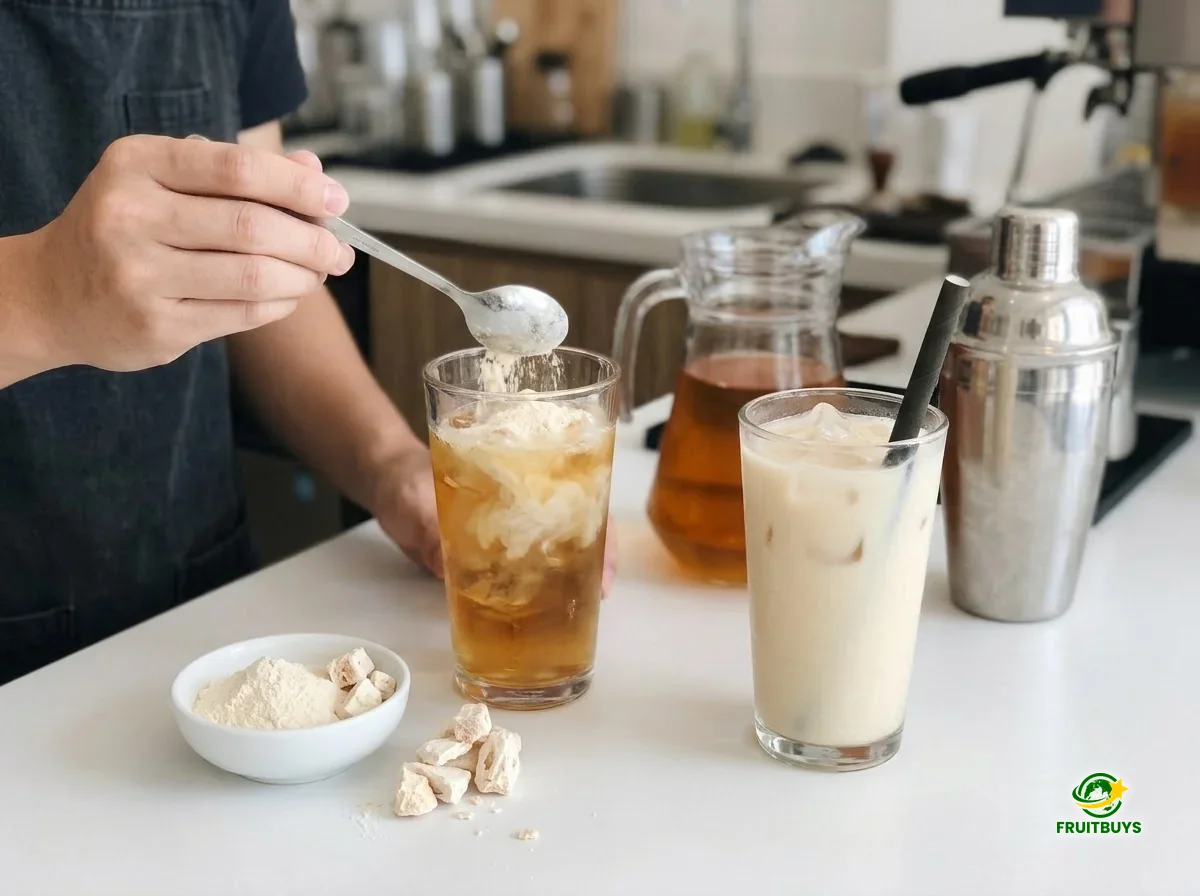
| Fruit tea or bubble tea | 5–10 g per cup | Brew black, green or jasmine tea, cool it, then shake with the powder, milk or ice |
| Ice cream or frozen yogurt | 3–8% of the mix | Whisk into the base before churning |
| A pulp you can portion like fresh | 1 part powder to 5–6 parts water | Stir and rest for a few minutes; use in any recipe above |
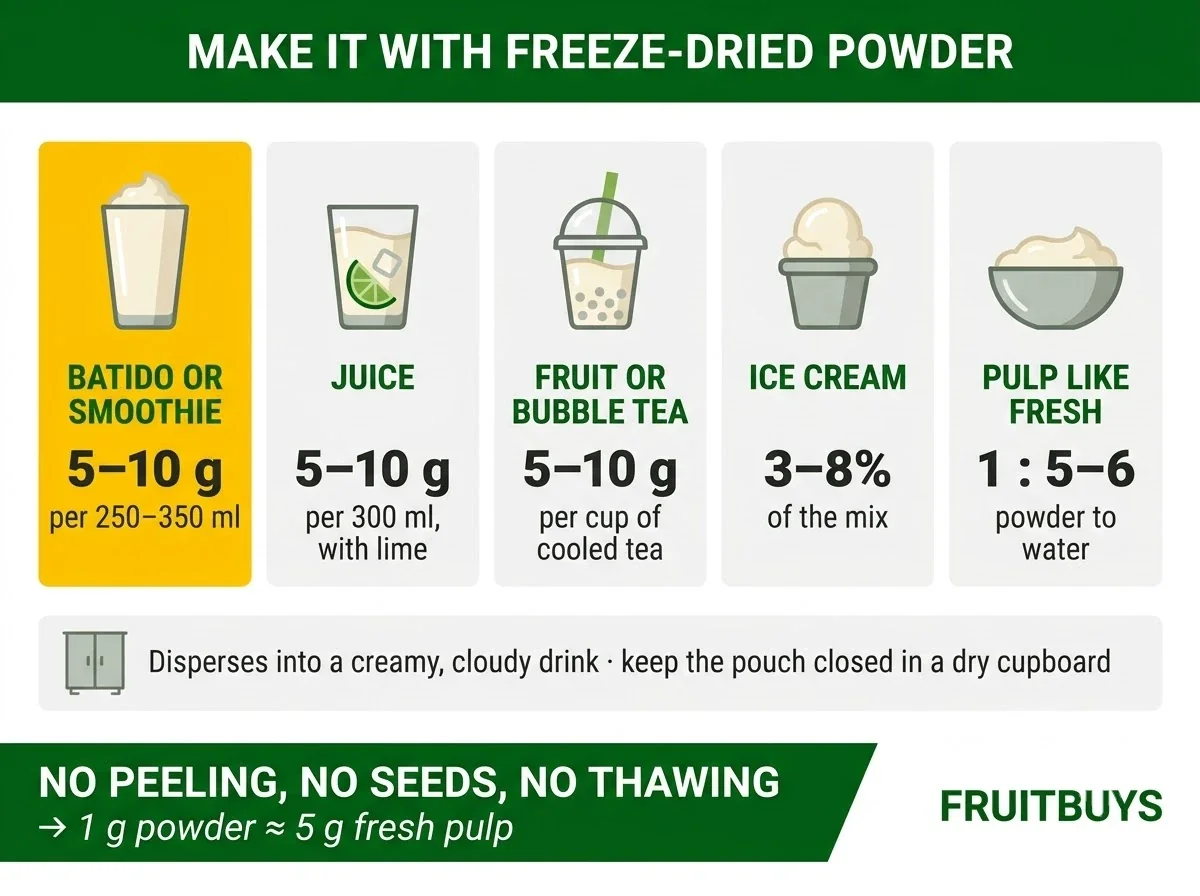
The powder disperses rather than dissolves, because the pulp fibre stays in it, so the drink comes out creamy and cloudy like a fresh-fruit smoothie. A short blend or a hard shake gives the smoothest result. Keep the opened pouch tightly closed in a dry cupboard, because the powder picks up moisture from humid air and turns lumpy.
This is also the honest answer to “how do I make soursop tea” if what you want is the taste of the fruit: brew your usual tea and add soursop fruit powder. You get guanábana flavour in the cup, which a leaf infusion does not give you.
How do you eat fresh soursop?
- Pick it ripe. A ripe soursop gives slightly under gentle pressure, like a ripe avocado, and its dark green skin turns a little yellowish while the soft spines flatten. A hard fruit will ripen on the counter within a few days.
- Chill it once ripe. Move it to the fridge and eat it within a day or two.
- Cut and pull. Cut it lengthwise, then pull or spoon out the white segments. The pulp is soft, juicy and slightly fibrous, with a taste somewhere between pineapple, strawberry and banana with a citrus edge.
- Spit out or press out the seeds. Eat the pulp, never the seeds. Discard the skin and the fibrous core.
- Keep portions normal. A cup of pulp or one glass of batido is a typical serving.
Unripe soursop is hard and sour. Wait until it softens before you eat it.
Running a café or juice bar?
Fresh soursop is hard to find outside the tropics, it ripens unevenly, and frozen pulp needs freezer space and thawing time before every batch. Freeze-dried powder changes that: it stores at room temperature, it goes straight into the blender at 5–10 g per drink, and every glass tastes the same. A counter that wants pulp to portion like fresh can rehydrate the powder at 1 part to 5–6 parts water.
The full specification, pack sizes and starting doses are on the freeze-dried soursop powder page. If you also serve bowls, toppings or ice cream, the pieces and crumble formats are compared in which freeze-dried soursop format fits your line.
Want to try soursop powder in your menu?
Tell us the drinks you plan to make and the volume you serve. We send freeze-dried soursop powder in two sealed foil pouches, one for your test drinks and one to keep sealed, within 3–5 working days.
FAQ
Is soursop tea made from the fruit or the leaves?
Usually the leaves. A drink made from the fruit is a juice, batido or smoothie. For fruit flavour in tea, add soursop fruit powder to brewed tea.
Can I drink soursop leaf tea every day?
It is a herbal product, not a fruit drink, and it has not been tested for long-term daily use. Treat it as a separate decision from eating the fruit, and talk to your doctor first if you take medicines for blood pressure or diabetes, are pregnant or breastfeeding, or have a movement disorder.
Does soursop tea cure cancer?
No. There are no clinical trials showing that soursop or graviola treats cancer in people. Never use it in place of medical treatment.
What part of the soursop is edible?
The white pulp. The seeds, skin and core are not eaten.
How much powder do I need for one smoothie?
Start at 5–10 g of freeze-dried soursop powder per 250–350 ml and adjust to taste.
Does freeze-dried soursop powder taste like the fresh fruit?
Yes. It is the fruit pulp with the water removed at low temperature, with nothing added, so the sweet-sour guanábana flavour and white-cream colour come back when you blend it.
Can I eat unripe soursop?
Unripe fruit is hard and sour. Let it ripen at room temperature until it gives slightly under gentle pressure.