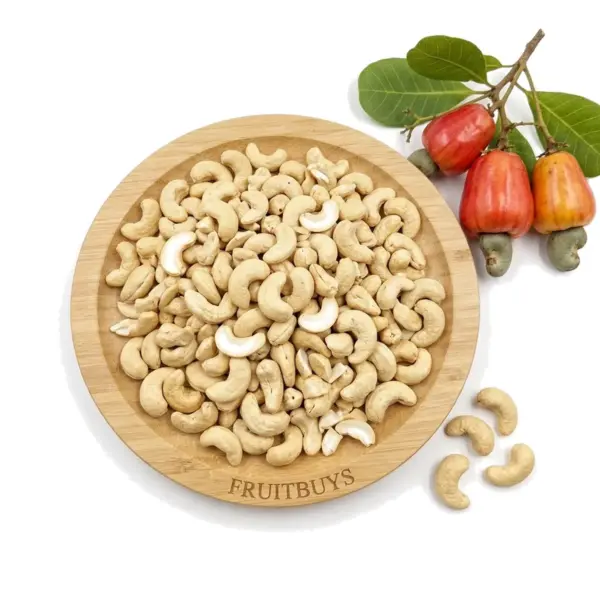
Freeze-Dried Cashew Nuts
Freeze-dried cashew nuts are Vietnam-grown cashew kernels that are moisture-conditioned and then vacuum freeze-dried to 2–4% moisture and water activity ≤0.30. The result is a light, porous kernel that snaps clean and melts in the mouth, with no oil, salt or roasting. FruitBuys supplies whole kernels (W240, W320 and W450 equivalents), splits, pieces and dice, from 500 kg for OEM and private label.
Pick one up and the first thing you notice is the weight: it feels lighter than any cashew you have handled. It is ivory white, it breaks with a soft crack, and the taste is clean, mildly sweet raw cashew with no roasted or oily note. For a snack brand that means a new bite in a nut everybody already knows, and a reason to open a “not roasted, not fried” line in a category that otherwise competes on price. Brand partners use it with a positioning target of a 30–50% higher shelf price than commodity roasted or fried cashews. It belongs to our freeze-dried fruit range and pairs with the fruit in the same container.
Product specification
| Parameter | Specification |
|---|---|
| Ingredient | 100% cashew kernels (Anacardium occidentale L.), shelled and peeled (testa removed); no salt, oil, sugar, flavourings or preservatives; not roasted, not fried |
| Guaranteed specifications | Moisture ≤5.0% and Aw ≤0.30, free fatty acids ≤1.0% and peroxide value ≤2.0 meq/kg at release on every lot COA; no salt, oil, sugar or preservatives |
| Grades | Whole kernels sorted to AFI size grades: W240, W320, W450 equivalents; splits and butts; large and small pieces; dice 2–4 mm or 4–6 mm |
| Grade tolerance (whole) | Lower size grade ≤10%; broken kernels and pieces ≤10% by weight |
| Colour | Natural white to ivory, uniform, no scorching |
| Texture / flavour | Light, crisp and porous; snaps clean and melts in the mouth. Clean, mildly sweet raw-cashew taste, no roasted or oily notes |
| Moisture | 2–4% typical at release; ≤5.0% contract ceiling |
| Water activity | ≤0.30 |
| Free fatty acids / peroxide value | ≤1.0% as oleic / ≤2.0 meq O₂/kg at release |
| Total plate count | ≤10⁴ CFU/g |
| Yeasts and moulds | ≤10² CFU/g |
| E. coli / S. aureus | Not detected / <10 CFU/g |
| Salmonella / Listeria monocytogenes | Not detected in 375 g / not detected in 125 g |
| Aflatoxin | To destination limits; EU ready-to-eat tree nuts B1 ≤2.0 µg/kg, total ≤4.0 µg/kg |
| Foreign matter | Nil; every lot passes a metal detector |
| Yield | About 1.5–1.9 kg of moisture-conditioned kernel (about 1.04–1.08 kg of dry kernel) per 1 kg freeze-dried |
| Shelf life | 18–24 months in the original sealed bulk foil bag with desiccant, stored cool at ≤18 °C, RH ≤50%; 12 months for the sealed bulk bag at ≤25 °C, RH ≤60%, and once repacked into retail pouches. |
| Allergen | Tree nut (cashew) |
| HS code | 0801.32 plain kernels; 2008.19 salted, seasoned, coated or roasted |
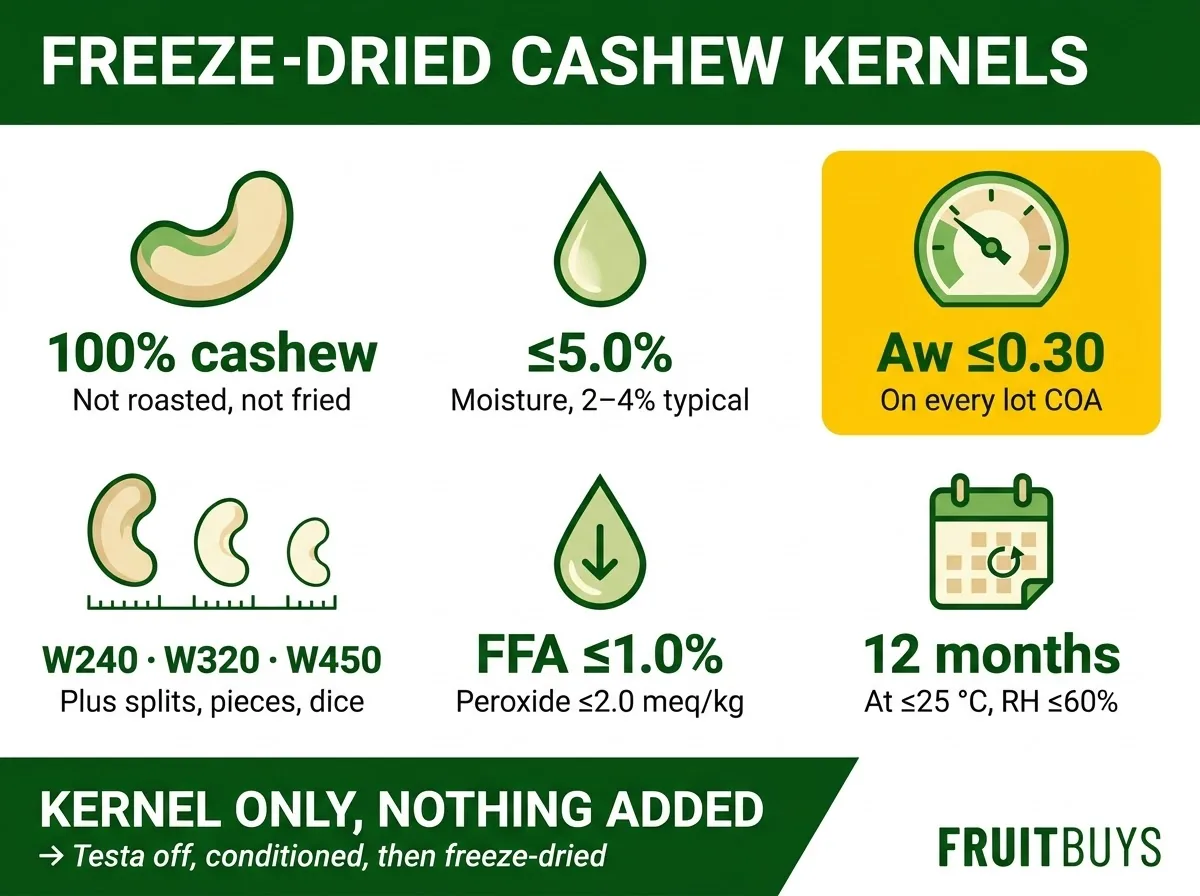
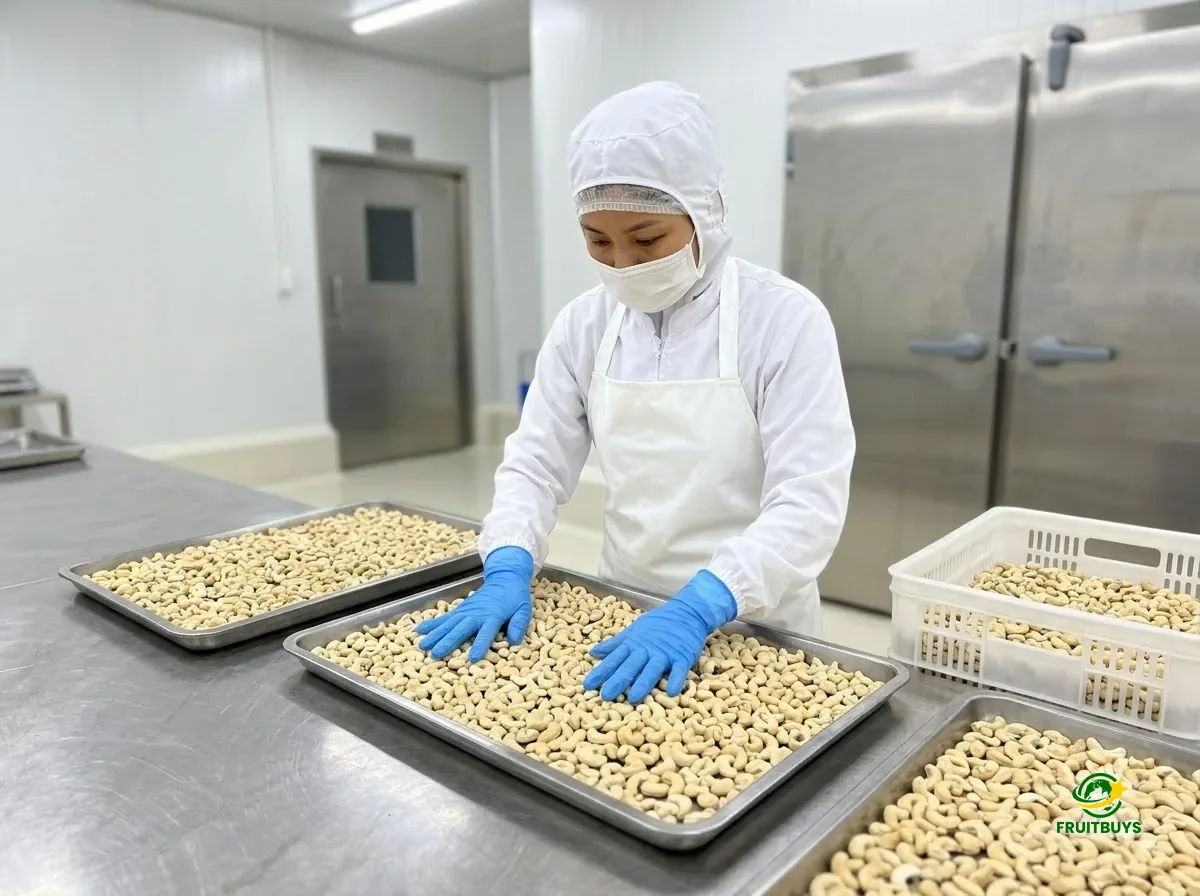
Why it snaps instead of crunching. A commercial cashew kernel already sits at about 5% moisture, so putting it straight into a freeze-dryer changes almost nothing. Under FruitBuys’ processing protocol, the kernel is first moisture-conditioned to about 35–45% in controlled conditions, deep-frozen at around −30 to −40 °C, and then vacuum freeze-dried. The ice crystals that form inside the kernel leave a fine porous structure as they sublimate, and that structure gives the airy, melt-in-the-mouth snap. Each kilogram of finished product starts as about 1.5–1.9 kg of conditioned kernel, made from about 1.04–1.08 kg of ordinary dry kernel. The step-by-step and the yield arithmetic are in how much cashew kernel goes into 1 kg freeze-dried.
Tighter oxidation limits, on purpose. A porous kernel shows more of its fat to the air than a dense roasted nut. FruitBuys therefore releases each lot at free fatty acids ≤1.0% and peroxide value ≤2.0 meq/kg, against the AFI kernel limits of 1.5% and 5 meq/kg. That headroom is what keeps an opened pouch smelling of fresh cashew six months into its shelf life. What each COA line should show, and what to add by market, is in the freeze-dried cashew specification.
Nutrition (per 100 g)
| Nutrient | Amount | % DV* |
|---|---|---|
| Calories | 570 kcal | |
| Total fat | 45 g | 58% |
| Saturated fat | 8 g | 40% |
| Trans fat | 0 g | |
| Cholesterol | 0 mg | 0% |
| Sodium | 10 mg | 1% |
| Potassium | 680 mg | 14% |
| Total carbohydrate | 31 g | 11% |
| Dietary fibre | 3 g | 12% |
| Total sugars | 6 g (0 g added) | |
| Protein | 19 g | 29% |
Typical values for 100% freeze-dried cashew kernels; natural variation by origin, season and grade applies. Lot nutrition panel available for label artwork.
About 80% of the fat is unsaturated, mainly oleic acid, and 100 g also carries roughly 300 mg magnesium, 600 mg phosphorus, 6.8 mg iron, 5.9 mg zinc and 2.2 mg copper. On an EU pack that meets the levels for “high unsaturated fat”, “high monounsaturated fat”, “source of protein” and “source of fibre”, plus “high” magnesium, phosphorus, copper, zinc and iron. A food high in unsaturated fat can also carry the authorised EU claim: “Replacing saturated fats in the diet with unsaturated fats contributes to the maintenance of normal blood cholesterol levels.” The EU panel shows about 2,490 kJ / 600 kcal, higher than the US figure, because EU labels use fixed energy factors.
A 28 g serving holds about 8 g net carbohydrate, which lets your R&D team set a per-serving carb budget for bars, clusters and trail mixes. The product is vegan and naturally gluten-free. Per-serving tables and claim wording by market are in freeze-dried cashew nutrition and label claims.
Formats and applications
| Format | Best for | Carton (58 × 28 × 34 cm) | Per 20 ft (550 cartons) | Per 40 ft HC (~1,100 cartons) |
|---|---|---|---|---|
| Whole W240 / W320 | Retail snacking, visible-nut packs, chocolate centres | 10–15 kg | 5.5–8.25 t | 11–16.5 t |
| Whole W450, splits, butts | Trail mixes, coated snacks, lower cost per kg | 10–15 kg | 5.5–8.25 t | 11–16.5 t |
| Pieces | Cereal, granola, muesli, bakery toppings | up to 20 kg | up to 11 t | planned at 20–21 t |
| Dice 2–4 mm / 4–6 mm | Protein and energy bars, clusters, coatings | up to 20 kg | up to 11 t | planned at 20–21 t |
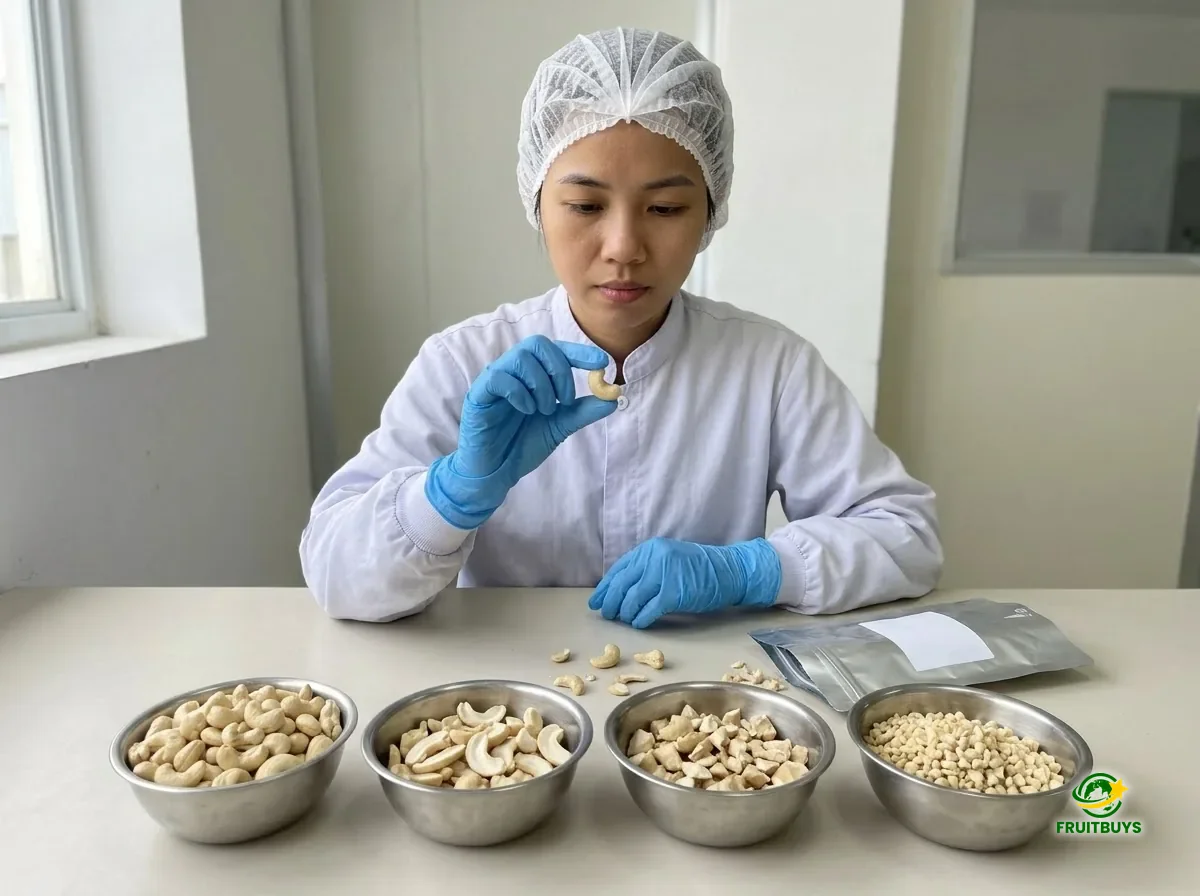
Custom R&D formats on request: larger dice (5–10 mm), fine granules and cold-milled cashew meal for bakery, ice cream, cashew-milk powder bases and plant-based cheese sauces. The dry, porous kernel mills without turning to paste when milling heat is kept down.
Where it works best:
- Snack and trail mixes with freeze-dried mango, jackfruit or pineapple. Every component sits at low water activity, so no moisture moves between nut and fruit and the whole bag stays crisp.
- Seasoned and coated snacks. The porous kernel takes salt, spice, honey, cheese, wasabi or chocolate after drying. Seasoned SKUs are declared under 2008.19.
- Chocolate panning and enrobing, with whole kernels as a crisp centre.
- Bars, clusters and cereal, using pieces and dice that keep their crunch in low-moisture recipes.
- Desserts and wet bases such as ice cream or yogurt: add at serving to keep the bite.
Grade definitions and the cut-by-product matrix are in which cashew grade and freeze-dried cut fits your line. For ready-made blends, see freeze-dried fruit and cashew mixes.
Packaging
| Item | Detail |
|---|---|
| Bulk | 1–5 kg sealed aluminium-foil PE bags with food-grade silica gel desiccant, in 5-ply export cartons; nitrogen flushing or an oxygen absorber on request |
| Carton | 58 × 28 × 34 cm; 10–15 kg whole kernels and splits, up to 20 kg pieces and dice |
| Retail (OEM) | 30 g / 50 g / 100 g / 500 g aluminium-foil zip pouches, or custom sizes; digital print from 3,000–5,000 pouches per SKU, rotogravure from 500 kg per SKU |
| Shelf life | 18–24 months in the original sealed bulk foil bag with desiccant, stored cool at ≤18 °C, RH ≤50%; 12 months for the sealed bulk bag at ≤25 °C, RH ≤60%, and once repacked into retail pouches. |
Cartons fill by volume. Whole freeze-dried kernels are light, about 0.25–0.40 kg per litre, so a carton holds 10–15 kg; pressing it to 20 kg would crack them past the broken-kernel tolerance. That is why each W240 or W320 kernel reaches your consumer whole and evenly curved. Pieces and dice pack tighter and fill the same carton to 20 kg, which lowers sea freight per kilogram by roughly 25–50%. The loading arithmetic is in how many kilograms fit in a 20 ft container.
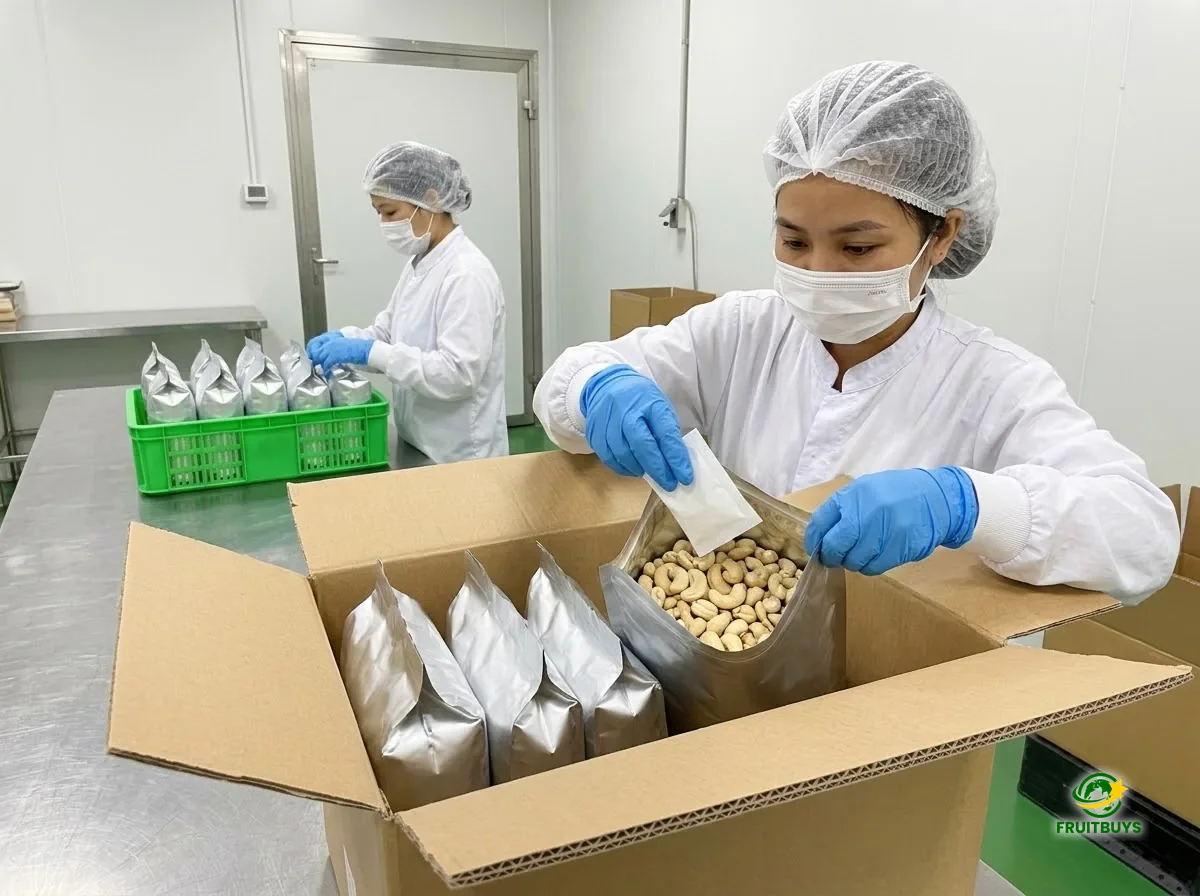
Heat, light and oxygen are what age a fat-rich kernel. Keep cartons cool, dry and dark at ≤25 °C, on pallets off the floor and away from strong odours, since nuts take up smells. Size bulk bags to one production batch; if a bag has to be reopened, squeeze out the air, reseal it with a fresh desiccant sachet and use the rest within the shift. More on storage and oxidation is in how long freeze-dried cashews stay fresh.
Commercial terms and container planning
| Term | Detail |
|---|---|
| Production capacity | 100 t/year |
| 20 ft, floor-loaded | 550 cartons (about 30 m³): 5.5–11 t net by format |
| 20 ft, palletised | 1,200 × 1,000 mm pallets, 30–36 cartons each, 10 pallets (300–360 cartons) |
| 40 ft HC, floor-loaded | About 1,100 cartons: whole kernels 11–16.5 t; pieces and dice planned at 20–21 t net within container and road weight limits |
| 40 ft HC, palletised | 20–21 pallets of 30–36 cartons (about 600–750 cartons), for forklift unloading |
| Container type | Standard dry container; no reefer |
| Mixed loads | Share a container with FruitBuys freeze-dried fruit; a full container costs about 15–20% less in logistics per kg than LCL |
| Production lead time | 20–30 days per 20 ft after deposit |
| Samples | Prepared in 3–5 working days, then courier |
| OEM / ODM / private label | MOQ 500 kg |
| Payment | T/T 40% deposit, 60% before shipment or against copy of B/L; L/C at sight |
| Incoterms | FOB Cat Lai, CIF (sea and air) |
| Port of loading | Cat Lai Port or Tan Son Nhat International Airport, Ho Chi Minh City |
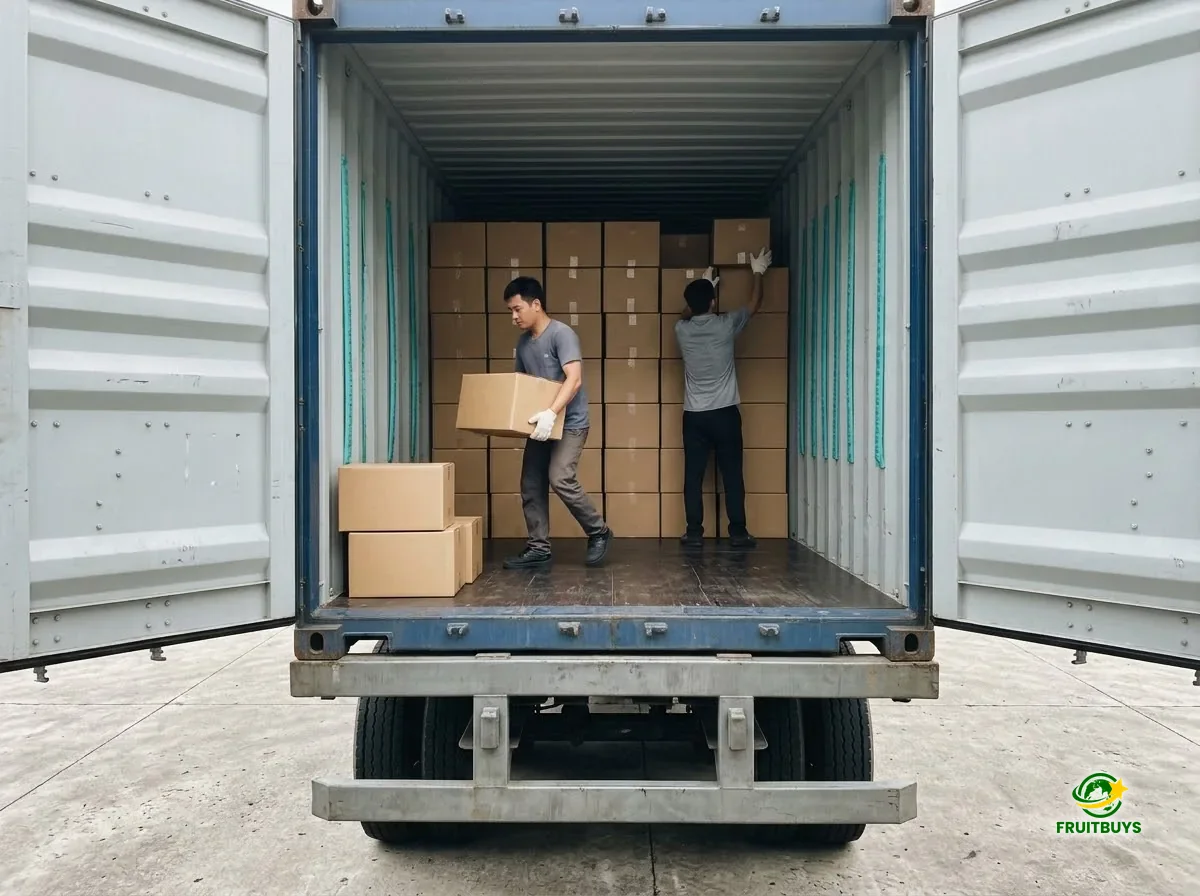
Vietnam-grown, traceable by lot. Vietnam exported about 767,000 t of cashew kernels in 2025 (Vietnam Customs, preliminary), yet most of the raw nuts its processors shell are imported. FruitBuys’ freeze-dried line starts from Vietnam-grown raw nuts as standard, from the Southeast (Dong Nai, including former Binh Phuoc, the country’s largest cashew-growing area) and the Central Highlands (Dak Lak, Gia Lai and Lam Dong). Each lot is traceable to its growing region and raw-material intake batch, and the C/O states Vietnam as the country of origin. The crop is harvested from February to May; raw nuts keep in shell, so kernels are shelled, graded and freeze-dried year-round. Book one annual contract and draw volume month by month. Regions, season and contract planning are in Vietnam cashew sourcing.
Quality and documents
- Every container lot: COA from an independent ISO/IEC 17025 accredited laboratory for moisture, water activity, free fatty acids, peroxide value, total plate count, yeasts and moulds, E. coli and Salmonella, tested before stuffing.
- EU-bound lots: aflatoxin B1 and total aflatoxins on the lot COA.
- On request or by market: Listeria, S. aureus, lead and cadmium, a pesticide multi-residue screen to EU or US limits, and a nutrition panel in FDA or EU format. FruitBuys arranges the testing at an accredited laboratory of your choice, such as Eurofins or SGS in Vietnam; each test is available for each lot on request, before the container is sealed.
- Trial and LCL lots: an in-house QC log for moisture, water activity and sensory with every trial lot; third-party testing available on request.
- Pre-shipment sample: 100–200 g from the packed lot in two sealed foil pouches with desiccant, one for your sensory check and one kept sealed for your lab, sent by courier within 24–48 hours.
- Retained sample: kept from every container lot for its full shelf life, up to 24 months.
- Facility control: FruitBuys locks one qualified partner facility per contract. Any change needs prior written notice and re-approval of the pre-shipment sample, and you keep audit access, including social-compliance audits you commission.
- Facility certifications: HACCP, ISO 22000, US FDA Facility Registration and BRC (qualified processing facility). Halal certification available on request.
- Shipment documents: commercial invoice, packing list, bill of lading, COA, Certificate of Origin Form EUR.1 for the EU and UK or Form CEPA for the UAE, and a phytosanitary certificate with every shipment as part of FruitBuys’ standard export dossier.
Claims on packaging, appearance, breakage or water activity are accepted within 14 days of unloading, and lab results within 30 days. The full approval path is in from sample to first container.
Import and labelling
Plain freeze-dried kernels stay under 0801.32, cashew nuts, shelled, because freeze-drying is a drying process. Salted, seasoned, coated or roasted kernels move to 2008.19, nuts otherwise prepared. FruitBuys prepares the invoice description, C/O, phytosanitary certificate and COA with your customs broker so the goods clear under the right code on the first filing.
In the US Harmonized Tariff Schedule, the MFN rate is Free for both 0801.32.00 and prepared cashews under 2008.19.10; your customs broker confirms the total duty on the entry. Into the EU, CN 0801 32 00 carries 0% duty; your broker can check the current measure for your code in the EU TARIC database. Lots for the EU carry aflatoxin results against the limits in EU contaminant rules for food, which for ready-to-eat tree nuts are five times tighter than the US action level of 20 µg/kg. Form EUR.1 also covers the UK, and a Form CEPA goes with every shipment to the UAE. The full market-by-market guide is in which HS code freeze-dried cashews ship under.
On your pack, declare cashew as a tree-nut allergen. Under FDA’s updated “healthy” rule, nuts with no added ingredients except water qualify automatically, so plain freeze-dried kernels fall in that group; your label review confirms the final claim, and the new rule applies from 25 February 2028.
Kernel, not the cashew apple
The cashew apple is the fleshy false fruit that grows above the nut. Dried cashew apple is a different product with its own customs code. FruitBuys supplies the kernel only, in the formats above.
Verify the sample in five steps
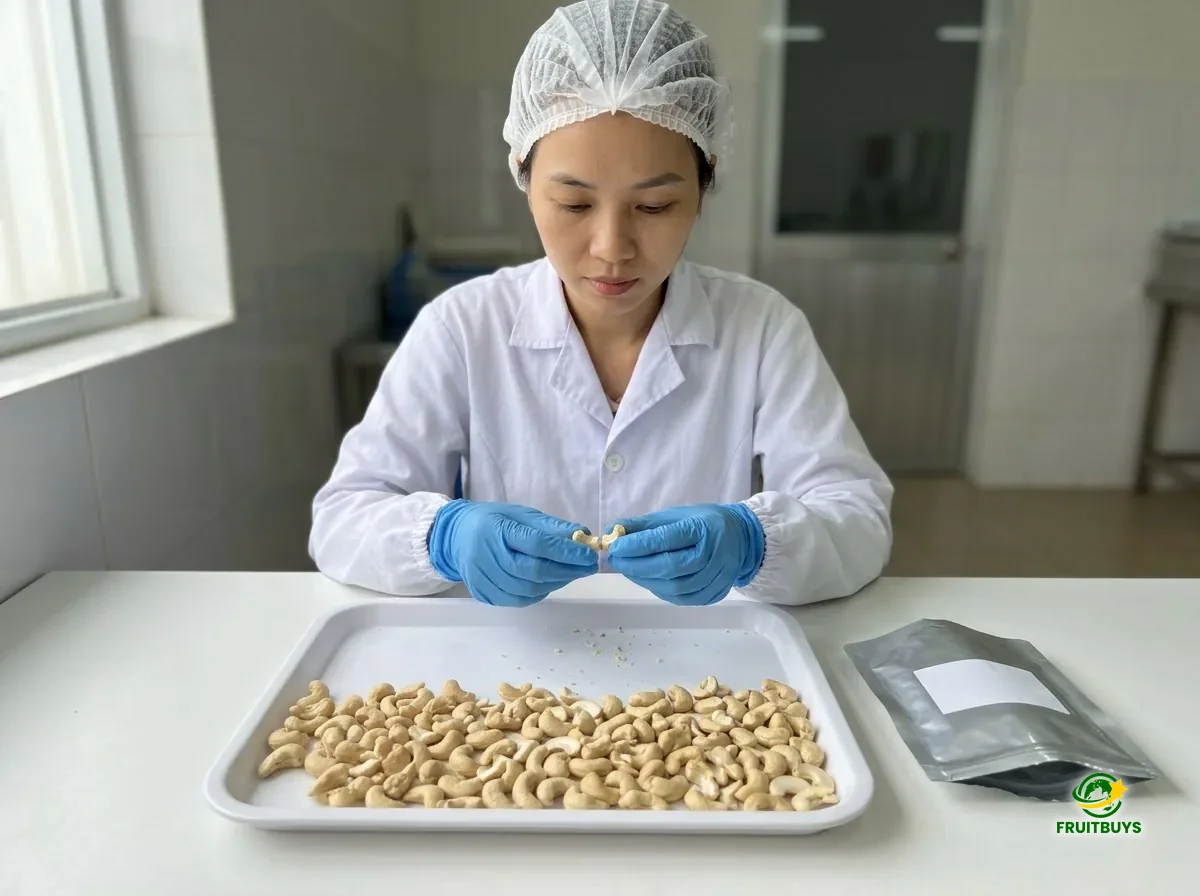
- Snap it. A good kernel breaks with a soft, clean crack and shows a fine porous cross-section. A dense, glassy core means the kernel was dried without conditioning.
- Check the colour. Ivory white and even across the bag, with no scorched tips or brown patches.
- Read the water activity within a minute. Seal kernels in the meter chamber within 60 seconds of opening the pouch; at or below 0.30 the lot was dried and sealed right. Keep the second sealed pouch for your own lab.
- Weigh one litre. Level a 1-litre cup of whole kernels and weigh it. Whole freeze-dried kernels typically weigh 250–400 g per litre, which is why a carton holds 10–15 kg. A sample well above 430 g per litre points to kernels dried without moisture conditioning or a high share of broken pieces; ask for the grade tolerance and the conditioning step in the batch record.
- Smell and taste. Fresh, mildly sweet cashew with no oily, stale or cardboard note, and a bite that melts. Approve the pre-shipment sample in writing; it becomes the quality reference for your container.
FAQ
Are freeze-dried cashews roasted or fried?
No. The kernels are moisture-conditioned and vacuum freeze-dried at low temperature, with no oil and no roasting. That keeps the ivory colour and the fresh cashew taste.
How are they different from raw cashews?
A raw cashew is dense and slightly waxy. The freeze-dried kernel is lighter, porous and snaps clean, then melts in the mouth. It also sits at Aw ≤0.30, so it stays crisp next to freeze-dried fruit in a mix.
Is this the dried cashew fruit?
No. This is the kernel. The cashew apple is a separate fruit and a separate product, which FruitBuys does not supply.
How long do freeze-dried cashews last?
18–24 months in the original sealed bulk foil bag with desiccant, stored cool at ≤18 °C, RH ≤50%; 12 months for the sealed bulk bag at ≤25 °C, RH ≤60%, and once repacked into retail pouches.
Can you supply seasoned or coated kernels?
Yes. Salt, spice, cheese, honey, wasabi or chocolate coatings are made to order from 500 kg per SKU and ship under HS 2008.19.
What is the minimum order and lead time?
500 kg for OEM, ODM and private label. A 20 ft container is produced in 20–30 days after deposit, and samples are ready in 3–5 working days.
Do you supply cashew meal or powder?
Yes, on request. Cold-milled cashew meal and fine granules are made to order for bakery, ice cream and plant-based dairy. Tell us the target particle size in your RFQ.
Request a sample and quote
Send these 11 details and we return a specification, sample and terms in one reply:
- Destination country and port
- Application: snack, trail mix, coated snack, bar, cereal or granola, bakery, chocolate, plant-based dairy
- Grade or cut: W240, W320, W450, splits, pieces, dice size, or meal
- Moisture / Aw or oxidation targets, if tighter than standard
- Seasoning or coating, if any
- First-order volume: trial, LCL, 20 ft or 40 ft HC, floor-loaded or palletised
- Annual volume and call-off rhythm
- Packaging: bulk bag size, nitrogen or oxygen absorber, or retail pouch size
- Private label: artwork status and labelling market
- Extra tests required by your market or customer
- Preferred Incoterm, payment term and target delivery date
Email [email protected] or message WhatsApp Export +84 919 739 589.