
How is cantaloupe freeze-dried, and how much fresh melon goes into 1 kg?
Yes, cantaloupe freeze-dries well. 13–17 kg of whole melon make 1 kg; see the industrial process, why quotes differ, and when to buy in bulk.
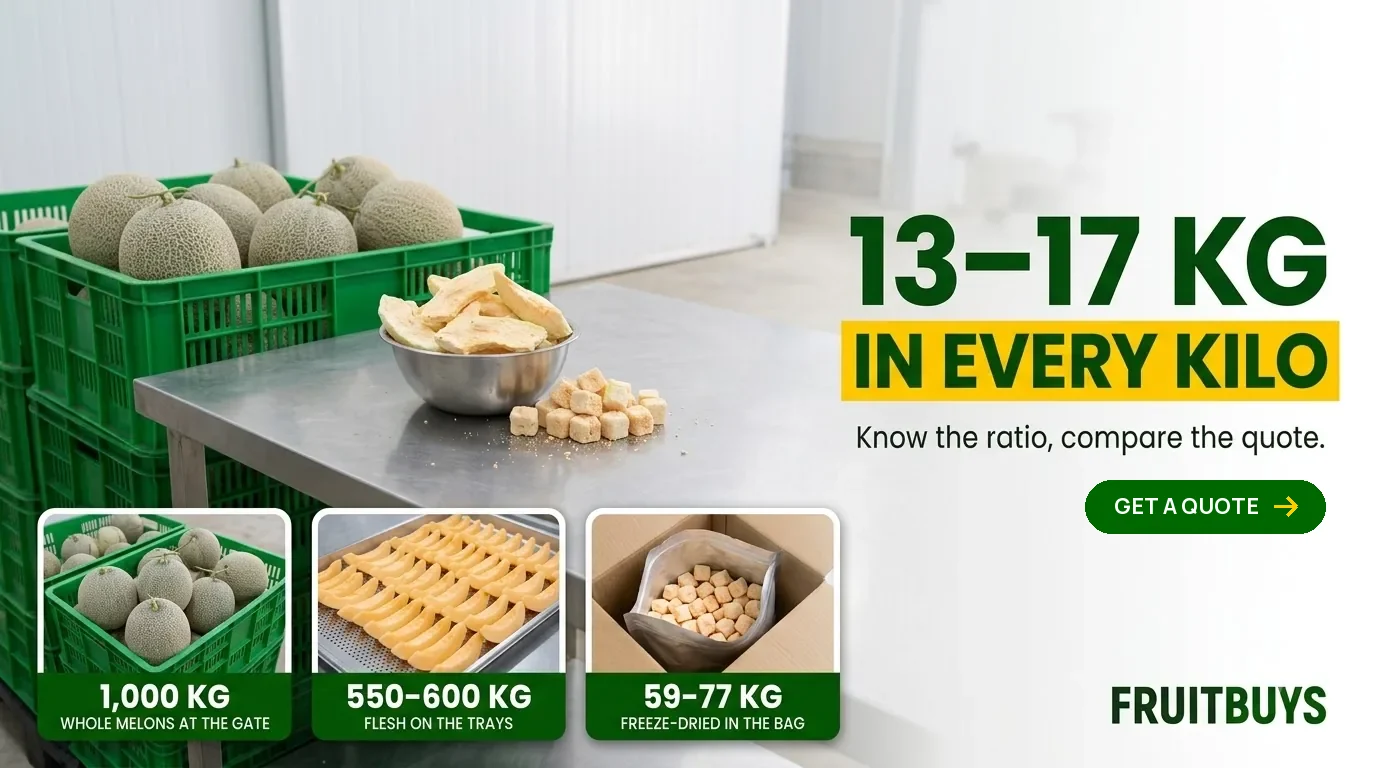
Cantaloupe freeze-dries well, at home or at scale: slice it evenly, freeze it solid, then dry it under vacuum until no cool, soft spot is left. The catch is the ratio. It takes 13–17 kg of whole fresh cantaloupe, or 8–10 kg of peeled and deseeded flesh, to make 1 kg of freeze-dried cantaloupe, because the rind and seeds are 40–45% of the fruit and the flesh is 88–91% water.
That ratio decides almost everything about the price of freeze-dried cantaloupe, and it is the first number I ask a buyer to check when two quotes look very different. This guide covers the home method briefly, then the industrial process behind freeze-dried cantaloupe, the mass balance of a tonne of melons, and when it makes sense to stop drying your own.
Can you freeze-dry cantaloupe at home?
Yes. Choose melons that are ripe and fragrant but still firm, then peel, deseed and cut slices or cubes of even thickness, around 1–1.5 cm. Spread them in a single layer, pre-freeze them solid, and run a full cycle in a home freeze dryer. A home cycle for cantaloupe usually runs 36–48 hours, because the fruit is about 90% water and rich in sugar, and a small machine has less shelf heat to work with.
Check every piece before you take the tray out: it should be crisp all the way through and snap cleanly. Then pack it straight away in a sealed jar or foil bag with a desiccant sachet. Cantaloupe is very sweet, and dried pieces left in open air turn sticky within hours on a humid day.
Home batches are a good way to test an idea. They are measured in kilograms of fresh fruit per cycle, though, which gives a few hundred grams of finished product.
How is cantaloupe freeze-dried at industrial scale?
The industrial process follows the same logic as a home dryer, with tighter control at every step. Under FruitBuys’ processing protocol it runs in eight steps:
- Intake. Ripe melons are accepted at ≥12 °Brix; cracked, soft or under-ripe fruit is rejected. We select on ripeness and sugar, and rind netting or fresh-market size play no part, because the rind never reaches the bag.
- Rind wash. The rind is washed and sanitised before any knife touches it, the main food-safety control for cantaloupe (see the cantaloupe COA guide).
- Peel and deseed. The rind, seeds and seed pulp are removed.
- Cut. Flesh is cut into 5–8 mm wedge slices, 5 or 10 mm dice, or 2–5 mm granules.
- Freeze. Pieces are frozen at −30 to −40 °C until solid all the way through.
- Sublimation. Under deep vacuum, the ice turns straight to vapour while the product stays cold. A full industrial cycle, from primary drying to the final low-moisture stage, runs 24–32 hours.
- Release check. Moisture is checked against ≤4.0% and water activity against ≤0.25 before the lot is packed.
- Pack. Pieces are metal-detected and sealed in foil bags with silica gel, 1–5 kg per bag.
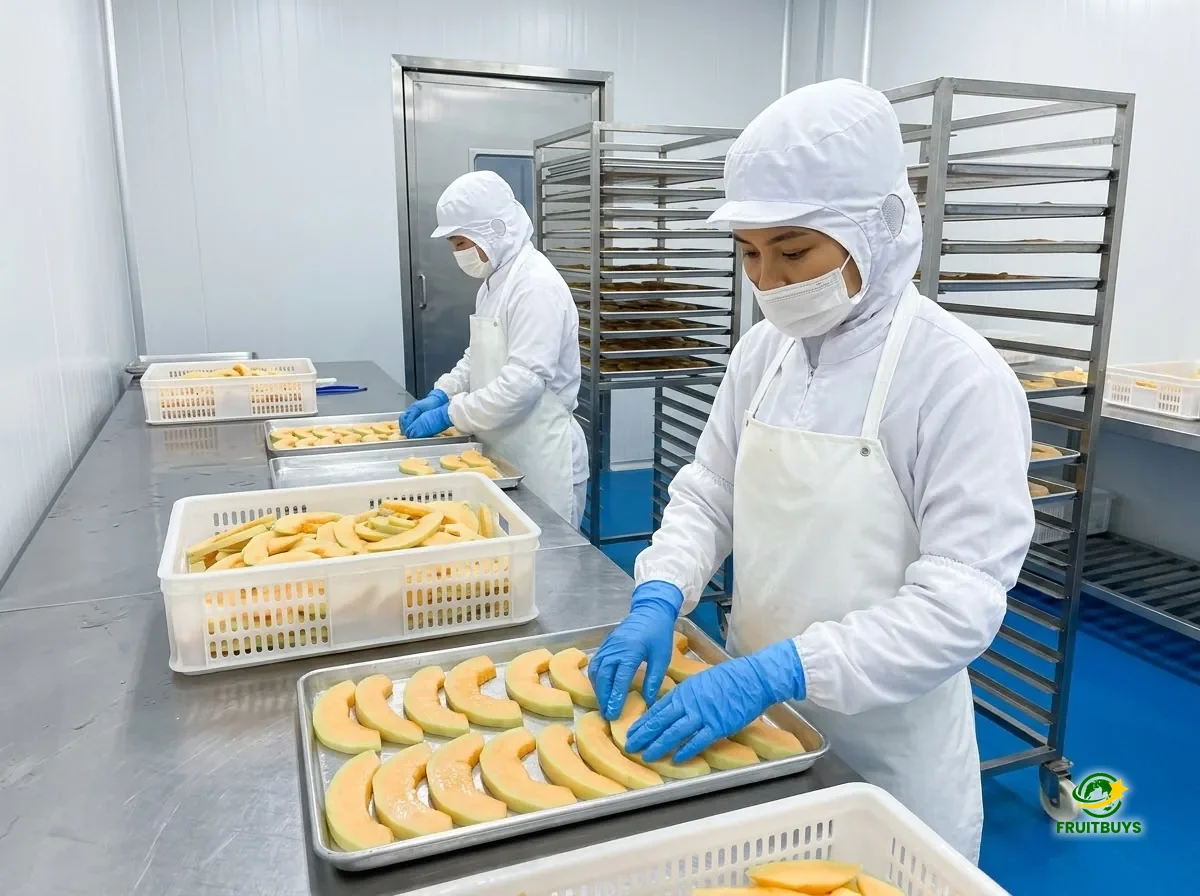
Powder is milled from the finished freeze-dried pieces, so it follows the same eight steps plus milling to 60–80 mesh.
Why does a high-sugar melon need a hard freeze first?
Because sugar lowers the temperature at which fruit freezes solid. Cantaloupe flesh carries a lot of sugar in its juice, and pockets of that sugary juice can stay soft well below 0 °C. If drying starts while any of it is still soft, those pockets melt and collapse: the piece shrinks, turns sticky and comes out chewy instead of crisp.
So the pieces are frozen hard at −30 to −40 °C, and the product is kept cold enough during sublimation that the structure holds. Sugar-rich fruit therefore dries more slowly than a low-sugar fruit of the same size: a cantaloupe cycle ties up the dryer for 24–32 hours. Dryer time per kilogram is one of the largest costs in freeze-dried fruit, and it is a second reason why cantaloupe costs more than its fresh price suggests.
How much fresh cantaloupe goes into 1 kg?
The table follows one tonne of whole melons from the gate to the packed bag.
| Stage | Weight | What happens |
|---|---|---|
| Whole melons received | 1,000 kg | Ripe fruit at ≥12 °Brix |
| Rind, seeds and seed pulp removed | 400–450 kg | 40–45% of the fruit; stays in Vietnam |
| Peeled, deseeded flesh to the trays | 550–600 kg | Flesh is 88–91% water |
| Water and line losses | about 470–540 kg | Removed in the dryer, plus trimming and fines |
| Freeze-dried cantaloupe packed | 59–77 kg | 13–17 kg whole melon per kg |
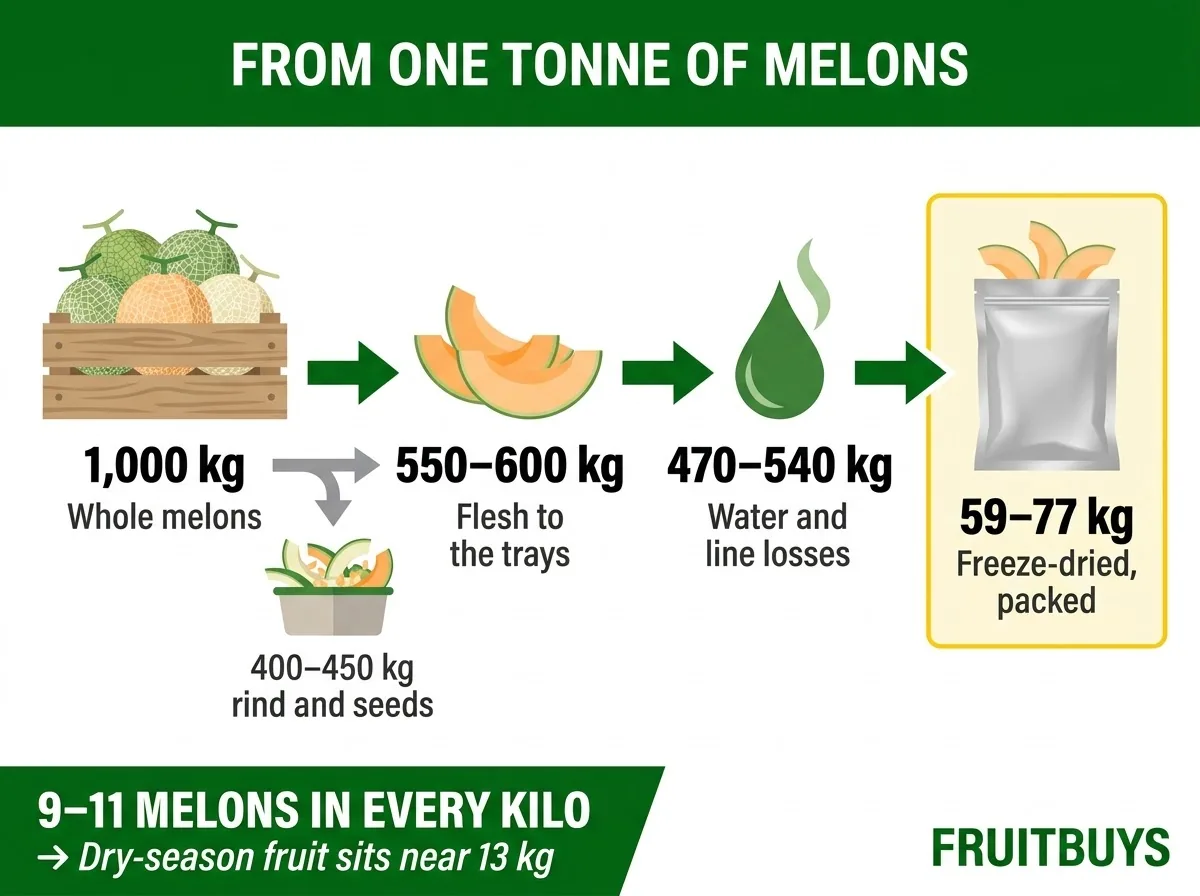
At an average melon of about 1.5 kg, one kilogram of freeze-dried cantaloupe holds the edible flesh of roughly 9–11 melons. A 20 ft container of freeze-dried slices or dice, at 3.85–5.5 t, represents roughly 50–94 tonnes of whole fresh melon.
The range is real, and the season moves it. Dry-season fruit, from December to April, is sweeter and carries more solids, so it sits near the 13 kg end. Fruit from rainy months holds more water and sits nearer 17 kg. A contract priced on a single fixed ratio all year is either padded in the dry season or under strain in the wet one.
Why do two quotes for the same product differ?
When one quote for freeze-dried cantaloupe comes in far below the rest, the difference is almost always in one of six lines. These are the checks every buyer should run, including on us:
| Quote line | What to ask | Why it changes the price |
|---|---|---|
| Ratio basis | Is the yield quoted per kg of whole fruit or per kg of peeled flesh? | 8–10 kg of flesh and 13–17 kg of whole fruit describe the same product; quoting on the flesh basis makes raw-material cost look about 40% lower |
| Moisture | What is the moisture limit on the COA? | At 8% moisture you buy 3–4 percentage points more water per kilogram than at ≤4–5%, and the product softens sooner |
| Water activity | Is Aw ≤0.30 on every lot COA? | Higher Aw means a shorter crisp life and caking in transit |
| Ingredient line | Is anything added: sugar, syrup, carrier, anti-caking agent? | Sugar-infused or carrier-based products cost less to make and change your label |
| Fines | What share of pieces under 2 mm is allowed? | A quote with loose fines limits ships broken fruit at whole-fruit prices; ours is ≤5% |
| Fruit intake | What Brix does the fruit enter at? | Low-Brix, watery fruit gives pale, weak-tasting product and a worse real yield |
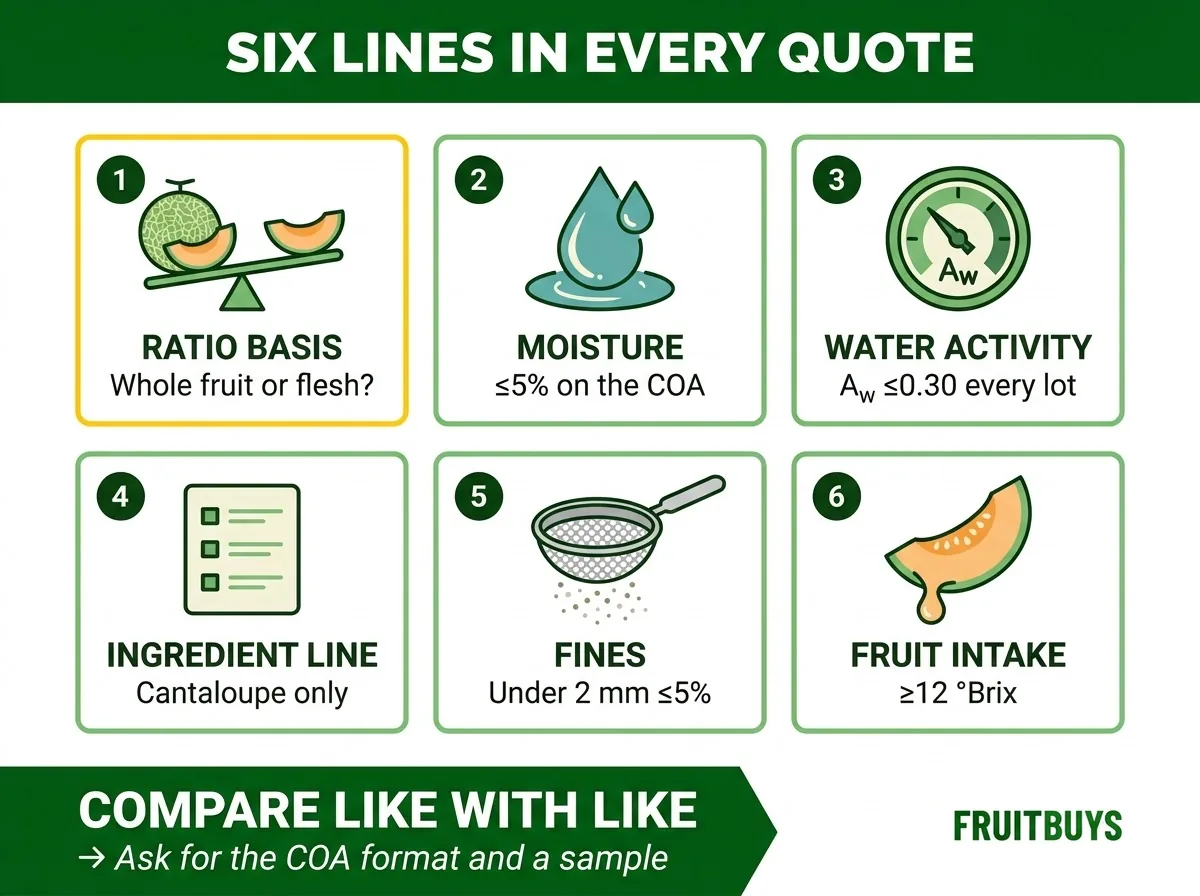
Ask for the COA format and a pre-shipment sample with every quote. When two suppliers answer all six lines the same way, their prices compare like with like.
Make it yourself or buy in bulk?
For a café, a test kitchen or a product idea measured in a few kilograms, a home or small-batch freeze dryer is a sensible start. You control the fruit and learn how cantaloupe behaves.
Once you need product every month, the numbers change. Every 100 kg of freeze-dried cantaloupe means peeling and deseeding 1.3–1.7 tonnes of melons, disposing of 520–765 kg of rind and seeds, running many dryer cycles, and testing each batch before it can go into a product sold to the public. At that point bulk supply is usually cheaper per kilogram and takes the food-safety file off your desk: each FruitBuys lot ships with a COA from an independent ISO/IEC 17025 accredited laboratory and is traceable to its harvest region.
A middle path works for many brands: develop the recipe on a 100–200 g sample, confirm the dose, then buy a trial lot before a full container. The freeze-dried cantaloupe product page lists cuts, packing and container loads, and powder is on the cantaloupe powder page.
FAQ
How long does it take to freeze-dry cantaloupe?
A home freeze dryer usually needs 36–48 hours for cantaloupe. An industrial cycle runs 24–32 hours, with tighter control of shelf heat and vacuum.
Does freeze-dried cantaloupe keep its vitamins?
It keeps heat-sensitive vitamins better than hot-air drying because the fruit stays cold. Typical values are 200–350 mg of vitamin C per 100 g of freeze-dried cantaloupe.
Why is my home-dried cantaloupe chewy?
Either the cycle stopped before the centre was dry, or the pieces picked up humidity after the tray came out. Dry until every piece snaps, then pack it at once with a desiccant.
How many melons make 1 kg of freeze-dried cantaloupe?
About 9–11 melons of around 1.5 kg each, or 13–17 kg of whole fruit.
Is anything added to FruitBuys freeze-dried cantaloupe?
No. The product is 100% cantaloupe with no sugar, colour, flavouring, preservative or carrier.
Request a sample
Send your product idea and expected monthly volume, and FruitBuys sends a sample with the specification and COA format, so you can compare it line by line with any other quote. Samples ship within 3–5 working days.