
Which HS code does freeze-dried cantaloupe ship under, and what does each market check?
Freeze-dried cantaloupe ships under HS 0813.40, the powder under 1106.30. US, EU, UK and UAE duty, documents and the FDA traceability rule.
Freeze-dried cantaloupe pieces ship under HS 0813.40, “other dried fruit”, and cantaloupe powder under HS 1106.30, powder of Chapter 8 fruit. The split matters more than it looks. In the US the general duty is 2.5% for the pieces and 9.6% for the powder, so the form you buy is a cost decision as much as a recipe decision. Into the EU, both codes enter at 0% with a Form EUR.1 under the EU–Vietnam trade agreement.
I see more delays at the port from a loose invoice description than from any rule on cantaloupe itself. This guide sets out the codes, the duty by market, the US checks, the FDA traceability rule for melons and the documents that travel with every FruitBuys lot of freeze-dried cantaloupe and cantaloupe powder.
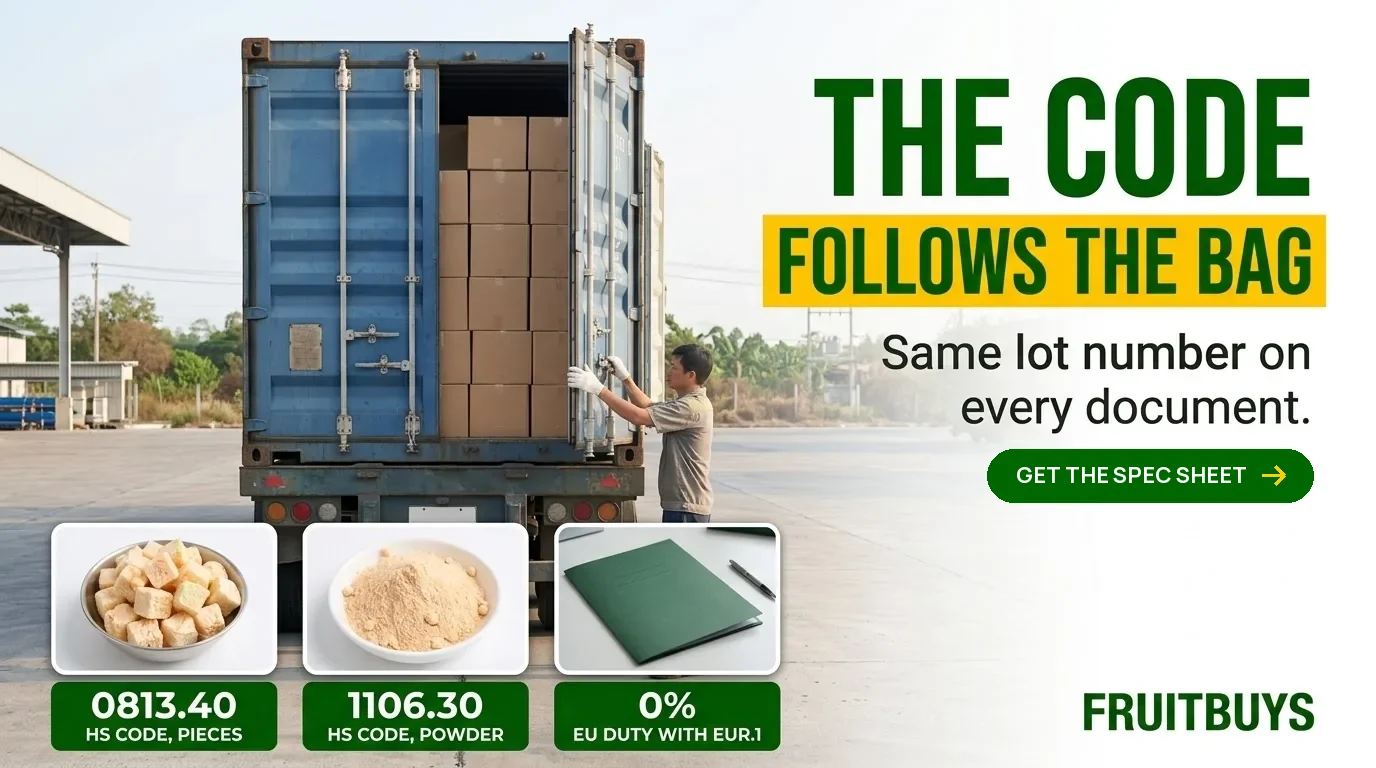
Which code: 0813.40, 1106.30 or 2008.99?
The code follows what is in the bag, and three cases cover cantaloupe:
| What you buy | HS heading | US HTS line | EU CN code | Why |
|---|---|---|---|---|
| Freeze-dried slices, dice, granules, nothing added | 0813.40 | 0813.40.90.00 | 0813 40 95 | Dried fruit; melon is not among the fruits named in heading 08.04, so it falls under “other” dried fruit |
| Powder milled from freeze-dried cantaloupe, nothing added | 1106.30 | 1106.30.40.00 | 1106 30 90 | Flour, meal and powder of Chapter 8 fruit |
| Sugared, syrup-infused or coated melon | 2008.99 | Varies | Varies | Added sugar or another ingredient takes the product out of Chapter 8 |
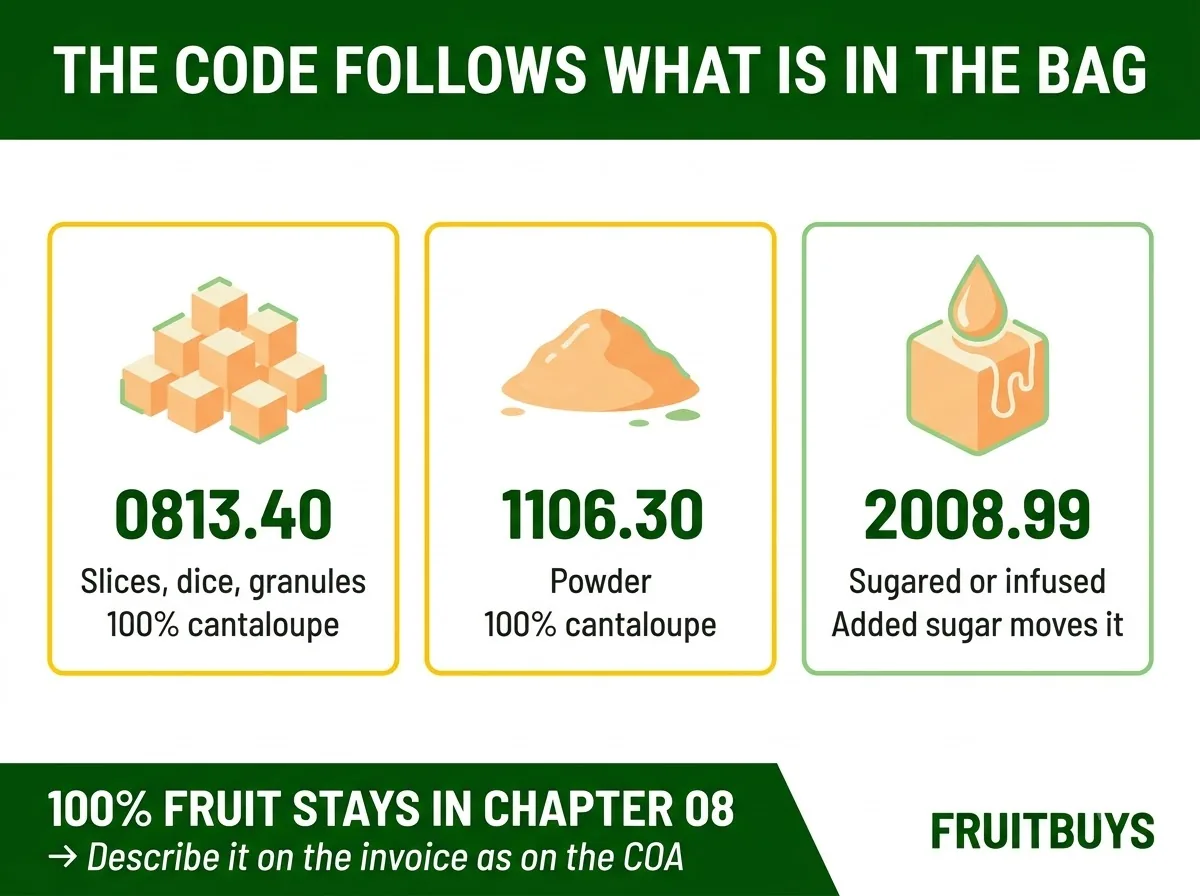
FruitBuys freeze-dried cantaloupe is 100% fruit, so the pieces stay in 0813.40 and the powder in 1106.30. The commercial invoice describes the goods exactly as the specification and the COA do, “freeze-dried cantaloupe dice, 100% cantaloupe, no added sugar”, which gives your broker nothing to query. If your company needs certainty for a long programme, a binding tariff ruling in your market settles the national line for good.
What duty applies in the US, EU, UK and UAE?
| Market | Pieces (0813.40) | Powder (1106.30) | Preference document | What your broker confirms |
|---|---|---|---|---|
| United States | MFN 2.5% | MFN 9.6% | None for Vietnam | Any additional Chapter 99 duty at entry |
| European Union | 0% with EUR.1, against 2.4% MFN | 0% with EUR.1, against 8.3% MFN | C/O Form EUR.1 (EVFTA) | The rate on the code declared at entry |
| United Kingdom | Preferential rate under UKVFTA | Preferential rate under UKVFTA | C/O Form EUR.1 (UKVFTA) | The UK Global Tariff line and preference |
| United Arab Emirates | Preferential treatment under CEPA | Preferential treatment under CEPA | C/O Form CEPA | The national 12-digit line |
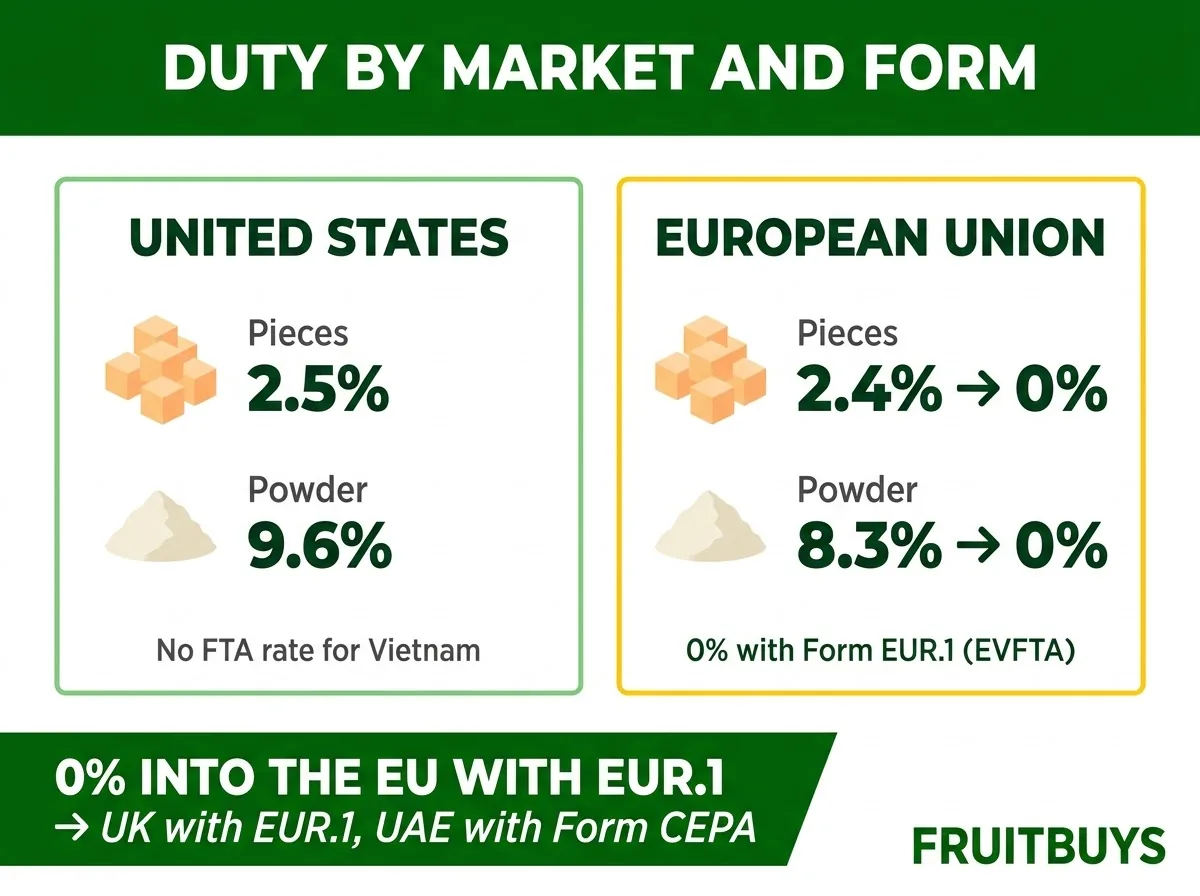
US rates come from the US Harmonized Tariff Schedule; EU rates from the EU TARIC tariff database. The Vietnam–UAE CEPA has applied since 3 February 2026, and FruitBuys issues Form CEPA with every lot bound for the UAE. In every market, the broker applies the national tariff line at entry, and that line sets the final duty.
Pieces or powder: which lands cheaper?
In the EU, with Form EUR.1, the duty is the same for both forms. In the US the 7.1-point gap between powder and pieces is real money on a large programme.
Illustrative cost-in-use example (not a quotation)
| Per tonne, at an illustrative customs value of USD 20 per kg | Pieces, 0813.40.90.00 | Powder, 1106.30.40.00 |
|---|---|---|
| Customs value | USD 20,000 | USD 20,000 |
| US general duty | 2.5% = USD 500 | 9.6% = USD 1,920 |
| Duty difference | USD 1,420 more for powder |
Put your own customs value into the same two lines, then set the duty difference against what it costs your plant to mill: a cold mill, a dry room below about 40% relative humidity, labour and yield loss. A plant that already mills other freeze-dried fruit can come out ahead by importing freeze-dried cantaloupe dice and milling on site. A drinks or bakery business without a dry room is better served by FruitBuys powder, milled and packed in batch-sized foil bags at source.
Freight points the other way. Powder packs denser: 5.5–6.6 t per 20 ft container against 3.85–5.5 t for pieces, so freight per kilogram is lower for powder. Run duty and freight together before you choose.
Is freeze-dried cantaloupe on the FDA Food Traceability List?
No. FDA’s Food Traceability List names fresh melons, including cantaloupe, and for foods containing a listed food the rule applies only while that food remains in the same form, such as fresh. Freeze-dried cantaloupe is no longer in fresh form, so the extra FSMA 204 records required for fresh melon do not attach to it. FDA will not enforce the rule before 20 July 2028.
For a US brand making fresh-cut melon cups or toppings, this changes the sourcing sums. Every fresh melon line carries the traceability record-keeping, the cold chain and the recall exposure of fresh produce. Moving a topping or an inclusion to freeze-dried cantaloupe takes that line out of the fresh-melon file. Each FruitBuys lot stays traceable to its harvest region and raw-material intake batch, which is what your own customers’ auditors will ask for.
What does the US check at entry?
Three checks apply to every freeze-dried cantaloupe shipment into the US:
- Facility registration. The partner facility holds US FDA Facility Registration. The registration details sit in the technical file FruitBuys shares with your import team before the contract is signed.
- Prior Notice. Your importer or broker files Prior Notice with FDA before the shipment arrives. FruitBuys supplies the product, facility and shipment details for it with the booking.
- Foreign Supplier Verification Program (FSVP). As the US importer, you verify your foreign supplier. FruitBuys provides the partner facility’s certificates (HACCP, ISO 22000, BRC as a qualified processing facility), lot COAs and audit access for your FSVP file.
FDA’s Import Alert 22-01 on cantaloupe applies to fruit from Mexico. Freeze-dried cantaloupe from Vietnam clears through normal FDA import screening, with the COA, documents and lot traceability that make a clean entry likely. The food safety controls behind that COA are in the cantaloupe COA guide.
Does the EU apply extra border checks to cantaloupe?
No. Cantaloupe from Vietnam, fresh or dried, is not among the products listed for increased official controls under Regulation (EU) 2019/1793, as last amended by Regulation (EU) 2026/1206, which applies from 30 June 2026. The list is revised about twice a year, so check the current consolidated version before each EU shipment.
Pesticide residues are judged against EU maximum residue levels set for fresh melon. For a dried product, the authority applies a processing factor: for cantaloupe it is roughly 8–10, because 1 kg of freeze-dried flesh carries the solids of 8–10 kg of fresh flesh. A residue result on the dried product is divided by that factor before it is compared with the fresh-fruit limit. Pesticide-residue testing to your market’s limits is available for each lot on request, before the container is sealed.
Which documents ship with every lot?
| Document | Purpose |
|---|---|
| Commercial invoice | Customs value and an exact product description |
| Packing list | Cartons, lot numbers and net weights, matching the cartons |
| Bill of lading or air waybill | Title and transport |
| Certificate of origin | Form EUR.1 for the EU and UK, Form CEPA for the UAE |
| Phytosanitary certificate | Part of FruitBuys’ standard export dossier |
| COA | Every-lot test results from an independent ISO/IEC 17025 accredited laboratory |
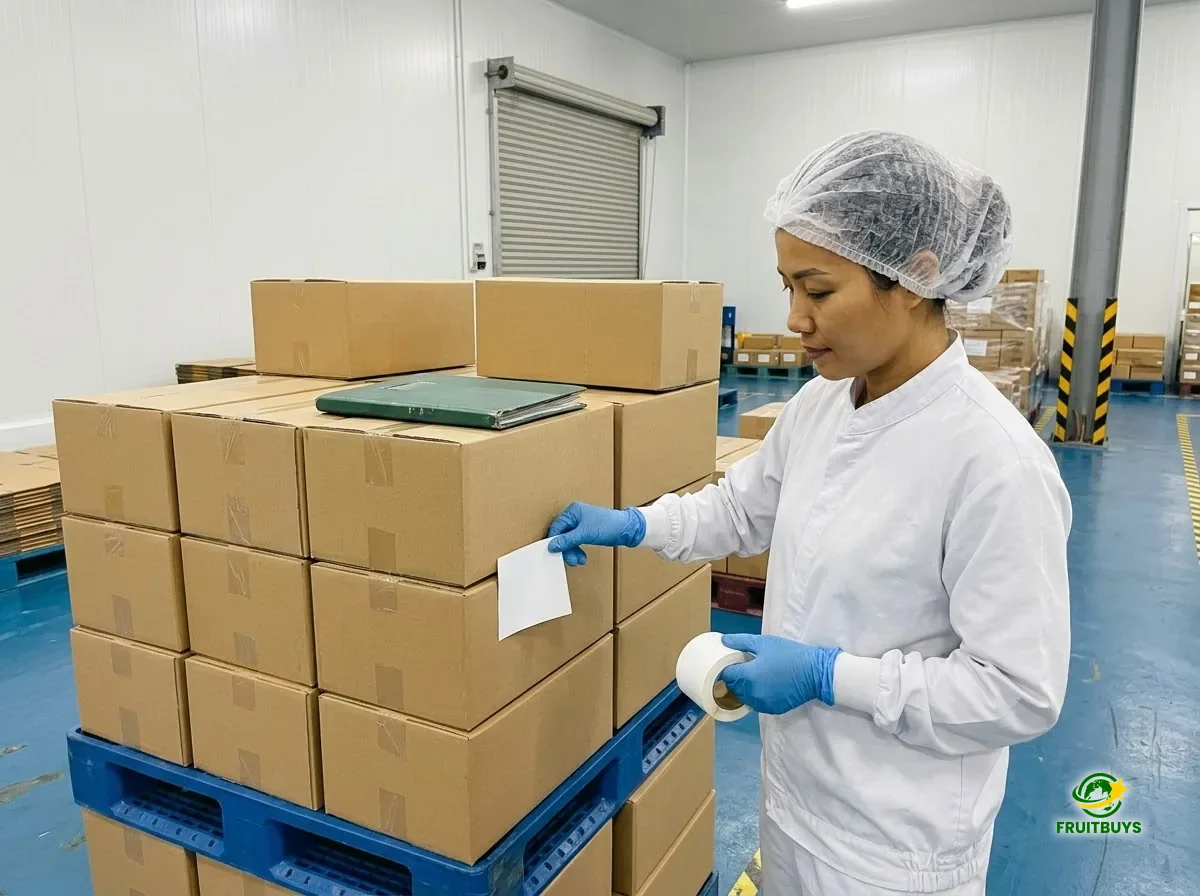
FruitBuys includes a phytosanitary certificate with every shipment as part of its standard export dossier, so your broker never has to argue about it at the port. Lot numbers on the cartons, the packing list and the COA match, which is the first thing a customs officer or your QA team checks.
FAQ
Is a phytosanitary certificate included for dried melon?
Yes. FruitBuys includes a phytosanitary certificate with every shipment as part of its standard export dossier, whatever the destination.
Do I need a binding tariff ruling?
Only if you want legal certainty on the national line for a long programme. For most buyers, an exact invoice description matching the specification is enough.
Does Form CEPA cover the powder as well as the pieces?
Form CEPA is issued for every FruitBuys lot bound for the UAE, pieces or powder. Your broker applies the preferential rate on the national line declared.
Who files Prior Notice for US shipments?
Your importer or customs broker files it. FruitBuys sends the product, facility and shipment details with the booking.
Can I import pieces and mill them myself?
Yes. In the US this avoids the 7.1-point duty gap between 0813.40 and 1106.30, provided your plant has a cold mill and a dry room for a sugar-rich powder.
Talk to us about your market
Tell us your destination, form and expected volume, and FruitBuys sends the code, the document set and the test plan for your first shipment.