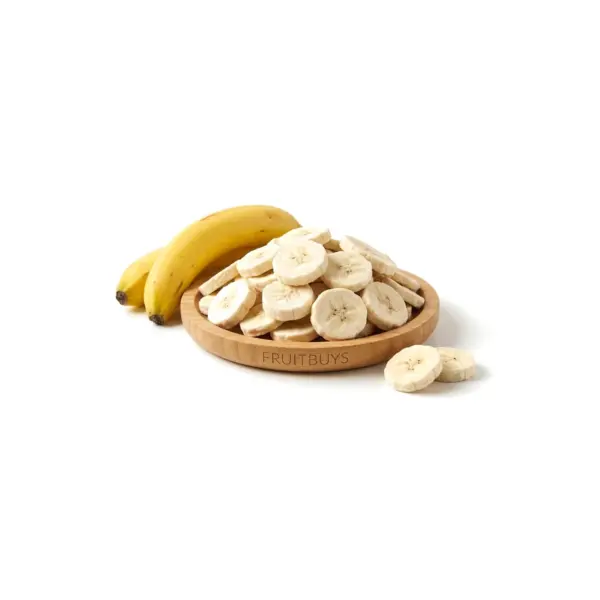
Freeze-Dried Banana
Freeze-dried banana is ripe banana that is sliced, given a vitamin C and citric acid dip, frozen at −35 to −40 °C and dried under vacuum. It ships at ≤5.0% moisture and water activity ≤0.30, with no added sugar and no added sulfites. A 20ft container of it travels in a standard dry box with no reefer and no freezer, and keeps 12 months on an ambient warehouse shelf.
Open a bag and the slices are cream-yellow, light as paper and loud when you bite them. A second later they melt into the taste of a banana picked on the right day. Banana is the fruit every buyer thinks is easy, and the one that most often arrives beige, soft or as crumbs. What decides the bag you open in Rotterdam, Chicago or Dubai happens in Vietnam: the day the bunch is cut, the minutes between the knife and the freezer, and how the slices sit in the carton. FruitBuys sets all three as working numbers with one locked partner facility per contract. Comparing suppliers? Start with the freeze-dried banana wholesale and bulk guide.
Product specification
| Parameter | Specification |
|---|---|
| Variety | Cavendish G9 (export standard) · Laba, Lam Dong highlands, 24–26 °Brix |
| Origin | Lowland Cavendish from Dong Nai, Binh Duong and the Mekong Delta, close to Cat Lai port · Highland Laba from Lam Dong · Harvested year-round |
| Ripeness at intake | Stage 5–6, 20–22 °Brix (Cavendish) |
| Colour protection | Dip in 1% ascorbic acid (vitamin C) + 1% citric acid, food grade E300 / E330 · No added sulfites · No-dip line (banana only, honey-gold colour) made to order from 500 kg |
| Formats | Round slices 5–7 mm · Dice 5×5 to 10×10 mm · Crumbles · Powder (separate product) |
| Fines at packing | ≤8–10% for slices · ≤3–5% for dice; broken pieces are screened out and milled into powder |
| Colour / taste | Cream to pale yellow, release target L* >70; sweet ripe-banana aroma |
| Texture | Crisp and porous, melts on the tongue |
| Moisture | Typically 2–4% off the dryer; released at ≤5.0% |
| Water activity | ≤0.30 |
| Total plate count | ≤10⁴ CFU/g |
| Yeasts & moulds | ≤10² CFU/g |
| E. coli | <10 CFU/g |
| Salmonella | Not detected / 25 g |
| Foreign matter | Visual sorting plus metal detection |
| Shelf life | 12 months at ≤25 °C, RH ≤60%; 18–24 months in cool storage at ≤18 °C, RH ≤50% |
| HS code | 0803.90 (bananas, fresh or dried); powder 1106.30 |
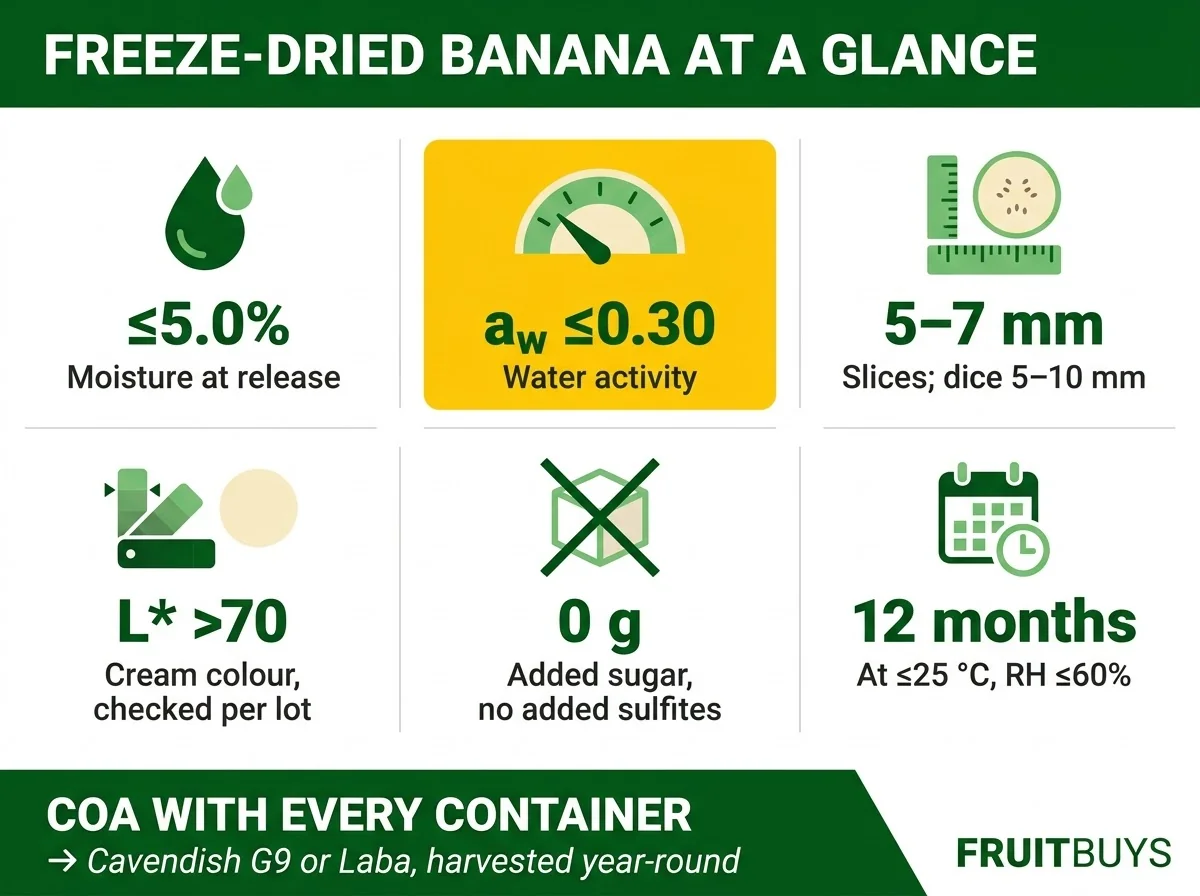
The taste is decided on the harvest day. Banana cut at stage 4 dries white and pretty, then tastes chalky and astringent with no aroma. Stage 7 fruit bleeds sugar on the trays, scorches and sticks. Stage 5–6, at 20–22 °Brix, carries just enough natural sugar for a slice that melts instead of crunching like a cracker. For a brand that sells on taste, Laba from the Lam Dong highlands goes further: dense flesh at 24–26 °Brix with a markedly stronger banana aroma that survives drying and sets a snack pack apart from everyday Cavendish. Varieties, growing areas and ripeness are compared in Vietnamese bananas for freeze-drying.
The colour is decided in the next twenty minutes. Cut banana starts browning almost at once. The vitamin C and citric acid dip stops it, which is why the slices you open look like fresh fruit rather than old stock. Every lot is checked against L* >70 and a browning index <0.60 before packing, so pale-grey or brown slices are pulled at the facility and never reach your cereal bowl or your shelf. Process detail is in why freeze-dried banana turns brown or breaks.
Crispness is decided by water activity. Banana is one of the sweetest fruits we dry, and sugar pulls moisture from the air. Lots leave the dryer at 2–4% moisture and are released against ≤5.0% and aw ≤0.30. That gap is the buffer that keeps slices crisp through four to six weeks at sea from Cat Lai, so you open crisp product instead of soft, caked bags and avoid returns from your own customers. How to write moisture and aw into a contract is in what limits freeze-dried banana should meet.
Slices, dice or crumbles
Slices 5–7 mm sell on sight. That thickness is the working window. Thinner than 4 mm and slices break into dust in the carton; thicker than 8 mm and the core can stay moist and soften the whole bag. A round, cream slice printed on the pouch tells the shopper exactly what is inside. Slices pack at about 7 kg per carton to protect the shape.
Dice is the working ingredient. At 5×5 to 10×10 mm, matched to your dosing hopper, dice flows without bridging, spreads evenly across every pack of cereal or granola, and fills a carton at 10 kg. Against 7 kg slice cartons, that cuts sea freight per kilogram by about 30%.
| Format | Best for | Working note |
|---|---|---|
| Slices 5–7 mm | Snack packs, trail mix, bowl toppings | Shape is the selling point |
| Dice 5×5–10×10 mm | Cereal, granola, muesli, bakery and chocolate inclusions | Even dosing; 10 kg cartons |
| Crumbles | Yogurt and ice cream toppings, bars, coatings | Lowest cost per kg |
| Powder | Smoothie, shake and baby-food bases | Separate product, 20 kg cartons |
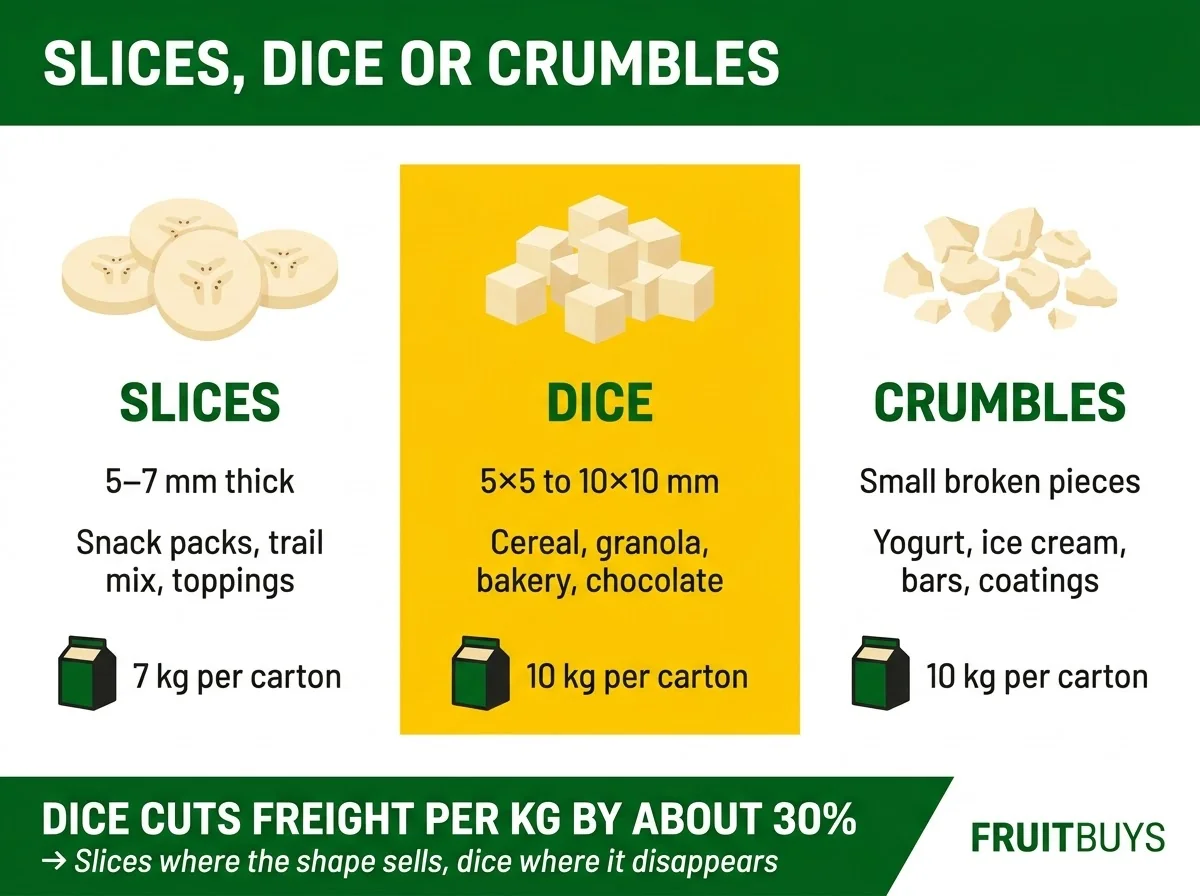
Dry in a granola, the pieces stay crisp; poured over with milk, slices soften within a minute or two without turning to mush. Add them at serving, after baking, or coated. Where the banana has to disappear into a shake, dairy base or chocolate, use freeze-dried banana powder, specified separately in what to specify before buying freeze-dried banana powder in bulk. Format choice by application is in freeze-dried banana slices, dice and crumbles, and doses for chocolate, ice cream and desserts in freeze-dried banana for confectionery.
What a kilo of freeze-dried banana is made of
It takes 5–6 kg of peeled banana flesh, about 8–10 kg of whole fruit, to make 1 kg of freeze-dried banana. Drying alone would need under 4 kg; the rest goes to the sort table, where broken slices, trim and off-colour pieces come out before packing. That sort is what you are paying for when every slice in the bag looks alike.
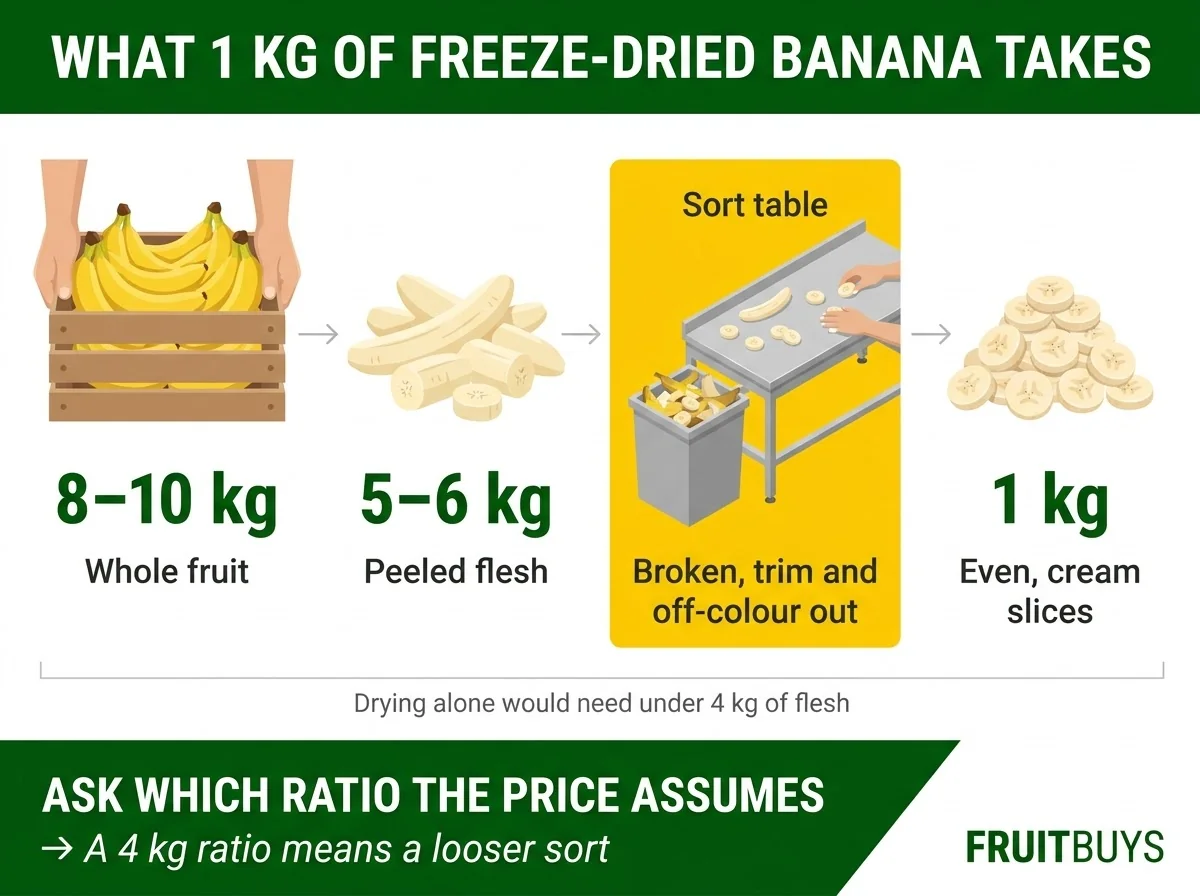
The ratio is also the fastest way to read a quote. A price built on 4 kg of flesh per kilo is not a better deal: it is a looser sort or a different grade. Ask any supplier, including us, which ratio their price assumes. Fresh-banana prices matter too: in 2026 fresh banana became Vietnam’s second-largest fruit export, and the best fruit now has buyers waiting in China, Korea and Japan. A supplier with its own growing areas in two regions is how you keep the same fruit in your bag all year. The arithmetic is in how many kilos of banana make 1 kg of freeze-dried.
Nutrition (per 100 g)
| Nutrient | Amount | % DV* |
|---|---|---|
| Calories | 370 kcal | |
| Total fat | 0.5 g | 1% |
| Saturated fat | 0.2 g | 1% |
| Sodium | 5 mg | 0% |
| Potassium | 1,600 mg | 34% |
| Total carbohydrate | 88 g | 32% |
| Dietary fibre | 7 g | 25% |
| Total sugars | 65 g (0 g added) | |
| Protein | 4 g |
Typical harvest values for freeze-dried banana; natural sugars and potassium move within ±5–10% with season and ripeness. Lot nutrition panel available for label artwork. %DV based on a 2,000 kcal diet.
1,600 mg of potassium per 100 g gives a sports, kids’ or breakfast brand a front-of-pack story, and every gram of the 65 g of sugar is the banana’s own. Laba runs sweeter than Cavendish. For your printed label, FruitBuys samples your commercial lot and arranges the panel at an independent ISO/IEC 17025 accredited laboratory, in US or EU format. Claim rules by serving are in freeze-dried banana nutrition facts.
Packaging
| Item | Detail |
|---|---|
| Bulk | 1–5 kg aluminium-foil PE bags, soft-vacuumed with a food-grade silica gel desiccant sachet, in 5-ply cartons |
| Carton | 58 × 28 × 34 cm: slices 7 kg, dice and crumbles 10 kg net |
| Retail (OEM) | 30 g / 50 g / 100 g / 500 g opaque foil zip pouches printed in full colour, or custom |
| Shelf life | 12 months at ≤25 °C, RH ≤60%; 18–24 months in cool storage at ≤18 °C, RH ≤50% |
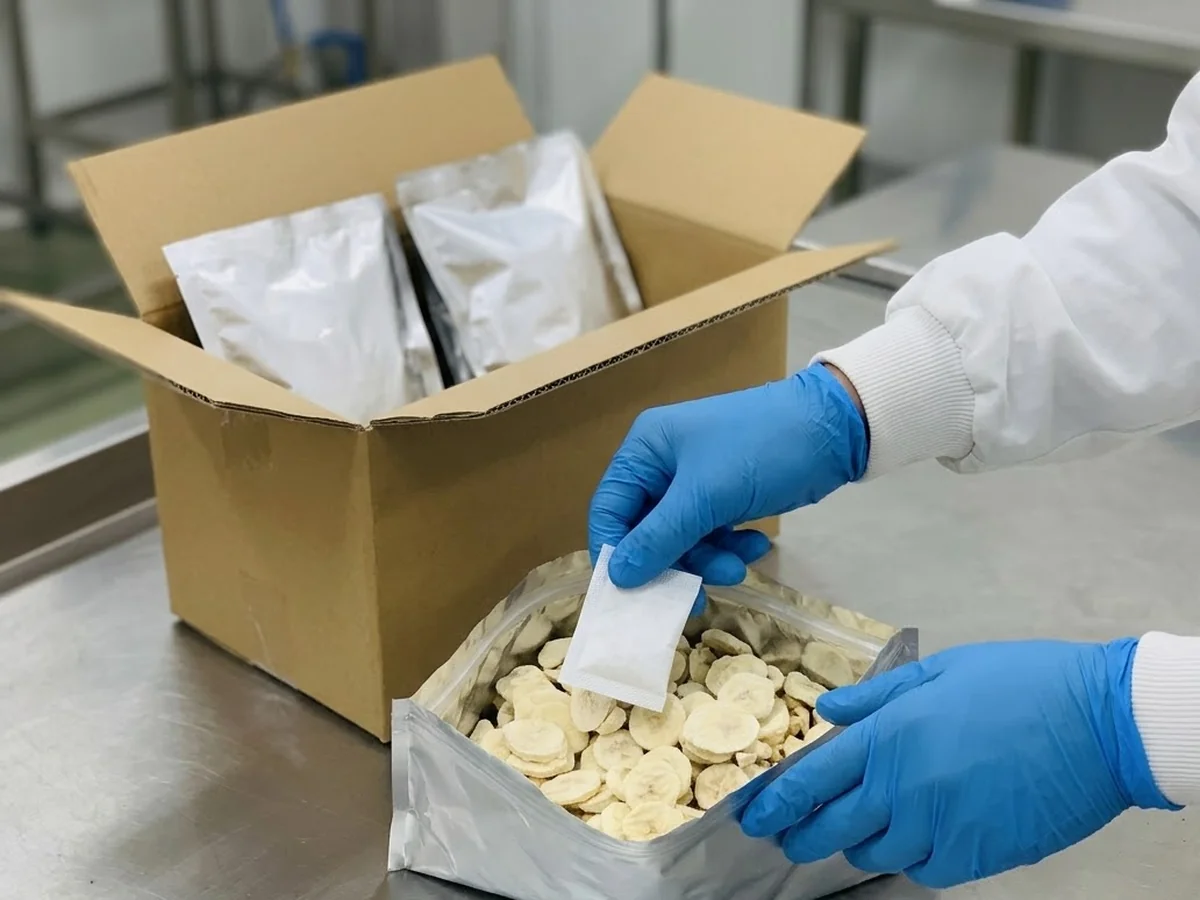
Every bag is soft-vacuumed, not nitrogen-flushed. The flat bag holds slices still through the voyage and fits the carton without paying to ship air. Bulk bags are sized to the batch your line runs in one shift: open a bag, use the whole bag, and nothing sits half-open in a humid store. If your warehouse runs at ≤18 °C, the slices keep their crunch and cream colour for 18–24 months. That gives your sales team room to move stock through several channels, or to hold buffer stock against a bad fresh-banana season, without short-dated pressure.
Commercial terms and container planning
| Term | Detail |
|---|---|
| Production capacity | 100 tons/year |
| 20ft, floor-loaded | 520–560 cartons: 3.6–3.9 t slices · 5.2–5.6 t dice |
| 40ft HC, floor-loaded | 1,050–1,150 cartons: 7.4–8 t slices · 10.5–11.5 t dice |
| Palletised option | About 240 cartons per 20ft (24 per 1,200 × 1,000 mm pallet), on request |
| Container type | Standard dry container; no reefer needed |
| Production lead time | 20–30 days per 20ft after deposit |
| Samples | Prepared in 3–5 working days; delivery time depends on the airline |
| OEM / ODM | MOQ 500 kg; no-dip line from 500 kg |
| Payment | T/T 40% deposit, 60% before shipment or against copy B/L; L/C at sight |
| Shipping terms | FOB Cat Lai, CIF or DDP |
| Port of loading | Cat Lai Port (sea) or Tan Son Nhat Airport (air) |
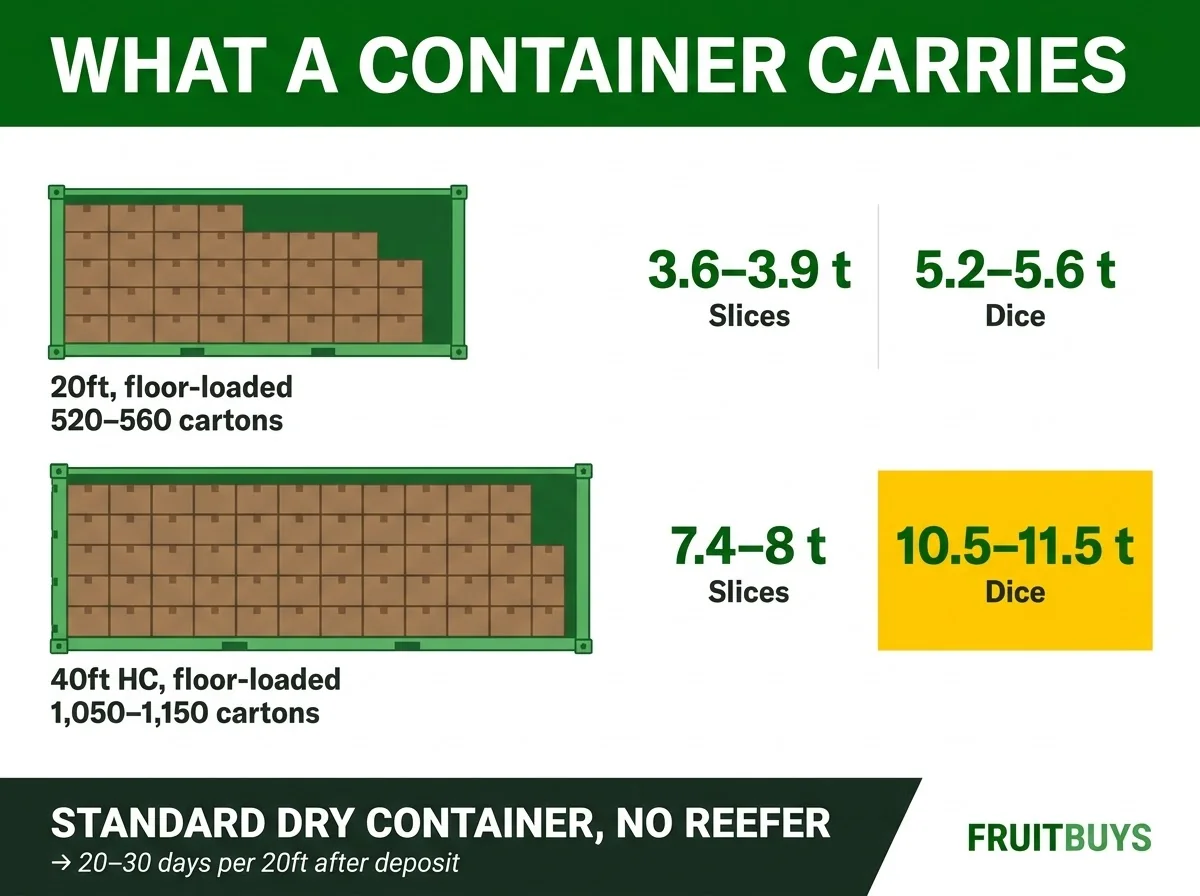
Format sets your freight per kilo. The same 20ft carries under 4 tonnes of slices or over 5 tonnes of dice. Put slices where the shape earns its shelf price and dice where the banana disappears into a recipe.
Quality and documents
- Every full-container lot: third-party COA for moisture, water activity, total plate count, yeasts & moulds, E. coli and Salmonella.
- Periodic surveillance: lead, arsenic and aflatoxin (total and B1) at an independent ISO/IEC 17025 accredited laboratory. Reports available on request.
- Trial and LCL orders: you receive the in-house release QC log (moisture, water activity, sensory) plus the surveillance report at no charge. If your QA wants an independent COA, it runs at net lab cost in 3–5 working days and is credited back in full on your first container.
- Market-specific panels: pesticide multi-residue, cadmium and extended microbiology, coordinated with an accredited laboratory in Vietnam before stuffing; paid by the buyer or shared by volume.
- Claims: 14 days from devanning for packaging, appearance, breakage and water activity; 30 days for laboratory results.
- Retained sample: kept from every container lot for its full shelf life.
- Facility control: one qualified processing facility locked per contract; any change needs prior written notice and re-approval of the pre-shipment sample. Your QA has audit access.
- Facility certifications: HACCP, ISO 22000, BRC (qualified processing facility) and US FDA Facility Registration, with Halal certification available on request.
- Shipment documents: commercial invoice, packing list, bill of lading, COA, Certificate of Origin Form EUR.1, and a phytosanitary certificate with every shipment as part of the standard export dossier.
Import and labelling
- Customs: dried banana sits in heading 0803 with fresh banana, not in 0813 with other dried fruit. In the US the line is HTS 0803.90.00, where the general rate is free; your broker confirms the line and any additional duties at entry.
- Plant-health papers: because 0803 is shared with fresh bananas, port systems check plant-health documents on that code by default. The phytosanitary certificate in every FruitBuys dossier lets your broker clear the container without explaining fresh versus dried.
- EU and UK: Form EUR.1 secures preferential duty under the EU–Vietnam Free Trade Agreement and the UK–Vietnam agreement, so Vietnamese dried banana enters the EU at 0%. Pesticide results on dried banana are read against the fresh-fruit limits in the EU pesticide residue rules through a processing factor. The lot COA states finished moisture, so your QA converts it in one line, and a pre-shipment multi-residue panel is the strongest protection at EU border checks.
- Clean label: many dried fruits are kept pale with sulfite, which must be declared as an allergen in the EU above 10 mg/kg. Vitamin C and citric acid do the same job with no added sulfites. A typical ingredient declaration reads Banana, antioxidant (ascorbic acid), acidity regulator (citric acid); the no-dip line reads banana. FruitBuys aligns the exact wording with your market at artwork approval.
- United States: the partner facility holds US FDA Facility Registration; FruitBuys prepares Prior Notice data and the supplier documents for your FSVP file.
- UAE: Arabic labelling and product registration are handled with your importer before the first shipment.
Market-by-market detail is in what freeze-dried banana needs to clear US, EU, UK and UAE customs.
Approving the sample
FruitBuys sends the pre-shipment sample as two sealed foil pouches drawn from the packed production lot, 100–200 g in total, by courier within 24–48 hours of packing:
- Pouch one is for your R&D and buying team. Taste it, hear the crunch, check the colour against your reference and look at the fines at the bottom of the bag.
- Pouch two stays sealed with its lot code. Your QA keeps it as the reference when the container arrives, or sends it to your own lab.
- Your recipe. A short trial in your real base, checked at week 1 and week 4.
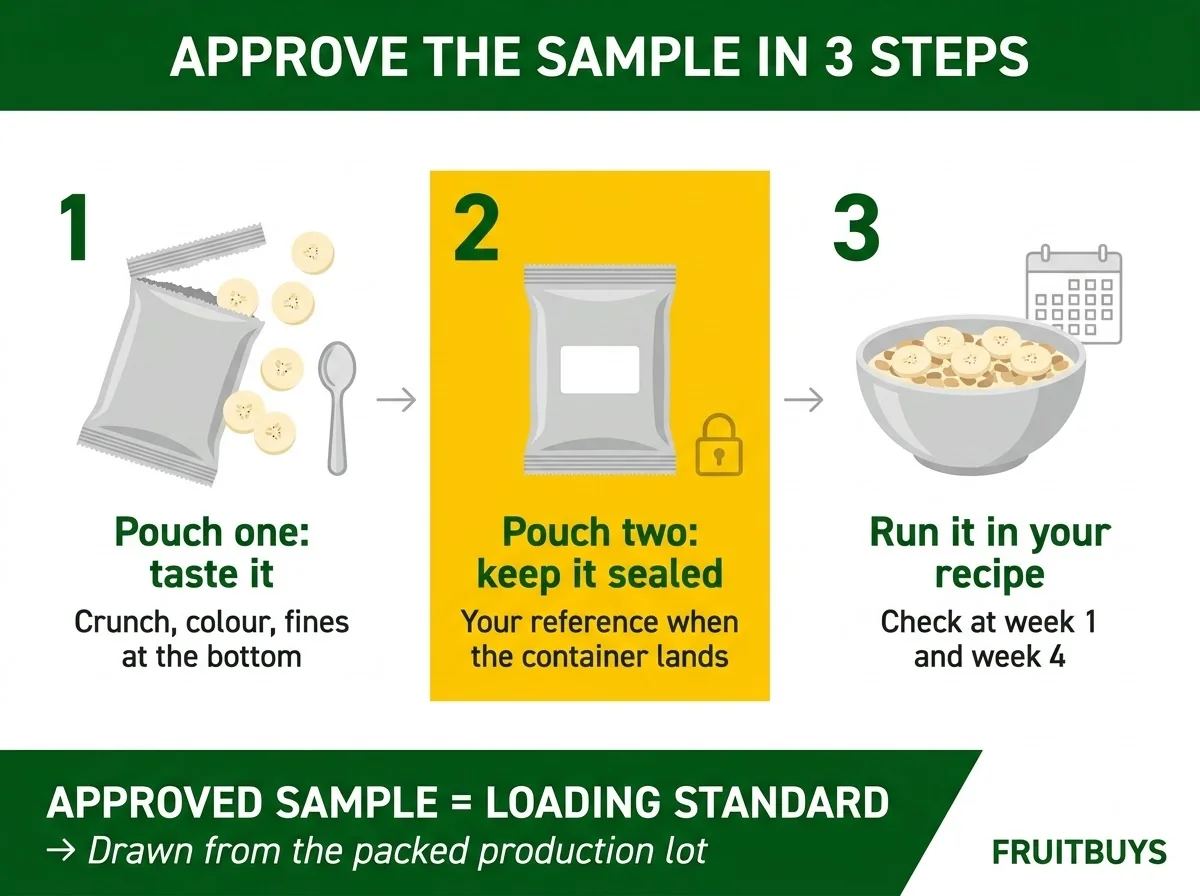
Approve the sample in writing and it becomes the standard the container is loaded against. The full approval route is in the freeze-dried banana RFQ and sample-to-bulk checklist.
FAQ
Is sugar added?
No. The 65 g of sugar per 100 g is the banana’s own, concentrated by drying.
Why ascorbic and citric acid?
They keep the slices cream-coloured with no added sulfites. Ascorbic acid is vitamin C; citric acid is the acid in lemons. If your label must read banana only, the no-dip line is made to order from 500 kg in a natural honey-gold colour.
Where are the bananas grown?
Cavendish comes from lowland farms in Dong Nai, Binh Duong and the Mekong Delta, close to Cat Lai port. Laba comes from the Lam Dong highlands. Both are harvested year-round.
Cavendish G9 or Laba?
Cavendish G9 is the steady choice for ingredient volumes. Laba is sweeter, with a markedly stronger aroma, and suits snack packs sold on taste.
How much fits in a container?
520–560 cartons in a 20ft and 1,050–1,150 in a 40ft HC, floor-loaded: under 4 t of slices or over 5 t of dice per 20ft.
How long does it keep?
12 months at ≤25 °C and RH ≤60%, and 18–24 months in cool storage at ≤18 °C and RH ≤50%, in the unopened bag.
Is this the same as banana chips?
No. Banana chips are fried in oil. Freeze-dried banana is never fried and stays crisp at under 5% moisture. The difference on the label is explained in are banana chips healthy.
What is the minimum order for private label?
500 kg for OEM, ODM and private-label packing.
Request a sample and quote
Send these details and we return a specification, sample plan and terms in one reply:
- Market: destination country and port, labelling market
- Product: Cavendish G9 or Laba; slices, dice, crumbles or powder; standard or no-dip
- Volume: first order (trial, LCL, 20ft, 40ft HC) and annual volume
- Packaging: bulk bag size or retail pouch size; private-label artwork status
- Terms: preferred shipping term (FOB Cat Lai, CIF or DDP) and payment term
- QA: any tests your market or customer requires
Prefer to talk it through? Email [email protected] or WhatsApp +84 919 739 589.