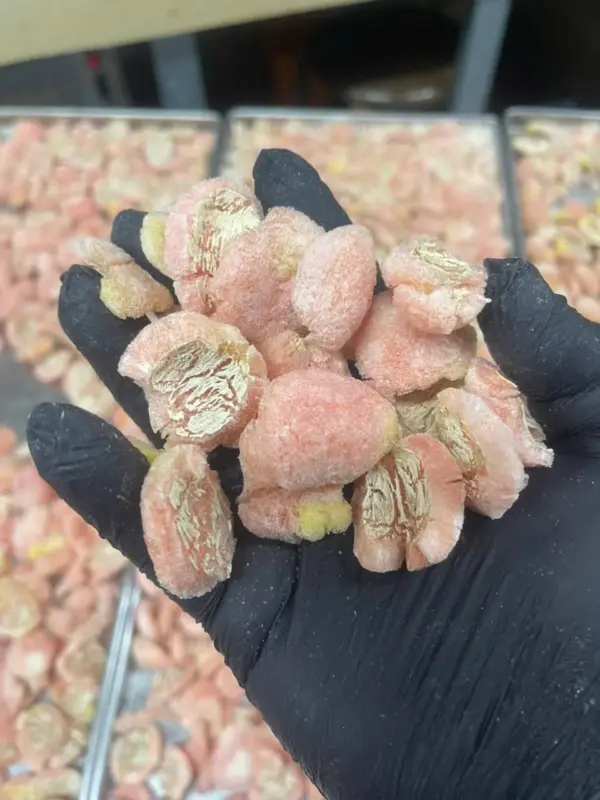
Freeze-Dried Rambutan Powder for Drinks, Dairy and Confectionery
Freeze-dried rambutan powder is the peeled, seedless aril of Nephelium lappaceum L., freeze-dried and cold-milled to 60–80 mesh: whole fruit milled cold, not juice spray-dried onto 30–50% maltodextrin. It is pale peach-cream, carries the floral, lychee-like aroma of fresh rambutan, and puts real fruit flavour into a drink, an ice cream or a chocolate filling at 3–8% of the recipe, with no synthetic flavouring.
Rambutan powder is harder to make than it looks. Milling multiplies the surface area of fruit that already carries 81 g of natural sugar per 100 g, so the powder grabs moisture from the air within minutes and heat from the mill can turn the sugar sticky and yellow. The figures below are how FruitBuys partner facilities keep it fine, pale and free of any burnt-sugar note. Before you compare suppliers, read what to specify before buying freeze-dried rambutan powder in bulk.
Product specification
| Parameter | Specification |
|---|---|
| Ingredient | Pure: 100% Rambutan. Free-flowing: + 1–2% silicon dioxide (E551). Carrier: + 5–10% maltodextrin or tapioca starch |
| Particle size | 60–80 mesh, ≥95% passing |
| Moisture | ≤5.0% (release range 3.0–4.5%) |
| Water activity | ≤0.30 (release range 0.20–0.28) |
| Colour / aroma | Pale peach-cream; floral rambutan, no burnt-sugar note |
| Flow | Pure: soft lumps that break under light pressure, no hard caking. Free-flowing: flows freely through hoppers and augers |
| Bulk density | 0.35–0.45 g/cm³ |
| Total plate count | ≤10⁴ CFU/g (release <10³) |
| Yeasts & moulds | ≤10² CFU/g |
| E. coli | <10 CFU/g |
| Salmonella | Not detected / 25 g |
| Shelf life | 12 months standard (≤25 °C, RH ≤60%); 18–24 months in cool storage (≤18 °C, RH ≤50%) |
| HS code | 1106.30, flour and powder of Chapter 8 fruit (reference heading; your broker confirms the national line); Form EUR.1 for EVFTA/UKVFTA preference |
Milling is where rambutan powder is made or ruined. The powder cannot be dried further than the fruit it is milled from, so its quality is decided in the milling room. The partner facilities mill chilled and pack in a dehumidified room held at 22–25 °C and below 35–40% RH, drier than the room used for pieces, and keep the mill from heating the sugar. Milled warm or in humid air, rambutan powder smears onto the screen, turns yellow and smells of caramel. Milled cool and dry, it stays fine as talc and releases its floral scent the moment it meets water.
Freeze-dried, not spray-dried
Spray-dried rambutan powder is pressed juice blended with 30–50% maltodextrin and dried at 150–180 °C, which drives off much of the aroma and leaves the fibre behind. This powder is the whole aril, freeze-dried and milled cold: up to 100% fruit, with about 6 g of natural fibre per 100 g. In water the sugar and aroma dissolve at once while fine fruit pulp stays suspended, giving smoothies, milk tea, gelato and fillings a real-fruit mouthfeel. For a clear bottled drink, filter it or use a cloudy base.
Which version fits your line?
| Version | Use it for | Ingredient line |
|---|---|---|
| Pure | Drinks blended or stirred, smoothies, ice cream bases, fillings, white or pink chocolate | “Rambutan” |
| Free-flowing (+1–2% SiO₂) | High-speed sachet and stick-pack lines with auger fillers | Rambutan, anti-caking agent (silicon dioxide) |
| Carrier (+5–10% maltodextrin or tapioca) | Instant drink powders, dusting, seasoning blends | Rambutan, maltodextrin (or tapioca starch) |
Soft lumps in the pure version are normal for a fruit this sweet; they break as soon as the powder is stirred. If the powder feeds an auger filler, choose the free-flowing version so every stick pack weighs the same.
Colour and pairing. The pale peach-cream powder keeps white chocolate, gelato, cream cheese and yogurt fillings bright while adding a floral, sweet-tart tropical note. It pairs well with matcha, oolong and toasted coconut, and a touch of red dragon fruit or beetroot powder turns it a natural pastel pink. Its natural sweetness lets you cut refined sugar. For bars and chocolate, try 3–5% powder in the coating or filling with 8–12 mm pieces for a crisp, visible bite; see freeze-dried rambutan.
Where does the fruit come from?
Main-crop rambutan at 18–22° Brix: aromatic Java fruit from Dong Nai and Rongrien from the Mekong Delta, together with clean aril fragments screened from the pieces line. Java carries the strongest tropical aroma of the two, which is exactly what a powder needs. Because powder does not pay for the whole-dome shape of halves, it costs 15–25% less than buying halves to mill yourself.
Each kilo of pure powder is milled from 6–7 kg of fresh peeled, seedless aril, about 13–17 kg of whole fruit. That is the raw-material floor of a real freeze-dried powder, and the quickest way to tell it from a flavoured or diluted one.
| Per 100 g (pure version) | Value |
|---|---|
| Energy | 380 kcal (US) / 365 kcal, 1,545 kJ (EU) |
| Total carbohydrate | 88 g |
| Total sugars | 81 g natural, 0 g added |
| Dietary fibre | 6 g |
| Protein | 5 g |
| Potassium | 800 mg |
Typical values for 100% freeze-dried rambutan powder (pure version); natural variation by origin, season and ripeness applies. Lot nutrition panel available for label artwork, including the free-flowing and carrier versions.
Packaging and logistics
| Item | Detail |
|---|---|
| Bulk bags | 5 kg or 10 kg aluminium-foil PE bags, gently vacuumed with a food-grade silica gel sachet; no nitrogen |
| Carton | 58 × 28 × 34 cm, 15–20 kg net (2 × 10 kg or 4 × 5 kg) |
| 20ft container | About 550 cartons (560 max on the 8 × 10 × 7 layout), 8.3–11 t, loaded to order size |
| Container type | Standard dry container; no reefer needed |
| Retail (OEM) | Stick packs, sachets, jars or pouches on request |
At 0.35–0.45 g/cm³, powder is 2.5–3 times denser than halves, so a carton carries more than twice the weight and freight per kilo falls accordingly. The 5 kg bag suits a mixer batch of around 100 kg at a 3–8% dose: tip in one whole bag and the rest of the carton stays sealed.
Order sizes and terms
| Term | Detail |
|---|---|
| Trial | 50–100 kg, by air or LCL |
| Bulk | 200–500 kg standard orders, up to full containers |
| OEM / private label | MOQ 500 kg |
| Samples | Prepared in 3–5 working days |
| Production | 20–30 days after deposit |
| Payment | T/T 40% deposit, 60% before shipment or against copy B/L; L/C at sight |
| Incoterms | FOB, CIF, DDP from Cat Lai Port or Tan Son Nhat Airport |
At a 3–8% dose, a 100 kg trial is enough for about 1.3–3.3 tonnes of finished product: a full production run on your line, not a bench test.
Quality and documents
- Every full-container lot: third-party COA for moisture, water activity, TPC, yeasts & moulds, E. coli and Salmonella.
- Routine surveillance: heavy metals (lead, arsenic) and aflatoxin (total and B1) are monitored through routine third-party surveillance at an ISO/IEC 17025 accredited laboratory; results sit below EU and US limits. Lot-specific testing is available on request.
- Trial and LCL orders: in-house QC log plus the surveillance report; third-party tests at net lab cost, credited in full against your first container.
- Facility compliance & certifications: HACCP, ISO 22000, BRC (qualified processing facility) and US FDA Facility Registration, at one facility named in your contract; Halal certification available on request.
- Shipment documents: commercial invoice, packing list, bill of lading, COA, Form EUR.1 (EU and UK) or Form CEPA (UAE), and a phytosanitary certificate with every shipment.
Import and labeling
Fruit powder sits under HS 1106.30, flour and powder of Chapter 8 fruit, a different heading from the dried pieces. Without a Form EUR.1, fruit powder under CN 1106 30 90 carries an 8.3% MFN duty into the EU, against 2.4% for dried pieces, which is why the Form EUR.1 in every EU and UK shipment matters more here than for halves: check the CN 1106 30 line for your entry in the EU TARIC tariff database, and the US line in the US Harmonized Tariff Schedule. A Form CEPA goes with every UAE shipment. Your customs broker confirms the national line on entry.
The pure version labels as one ingredient, “Rambutan”; the free-flowing and carrier versions add silicon dioxide, maltodextrin or tapioca starch to the line. If your plant runs a chilled mill and a dry room, compare the duty on importing pieces and milling on site; the reference rates are in what freeze-dried rambutan needs to clear US, EU, UK and UAE customs.
Verify the sample in three steps
- Sieve it. In a dry room below 50% RH, shake 100 g through an 80-mesh screen and brush soft static clusters through gently; at least 95% should pass, with nothing hard or gritty left.
- Measure aw and colour. Seal the meter chamber within 60 seconds of opening the bag; aw at or below 0.30 and an even pale peach-cream colour confirm cool, dry milling.
- Test it in your product. Dose at 3–8% in your real base and check aroma, colour and dissolving.
FAQ
Is freeze-dried rambutan powder 100% fruit?
The pure version is. Free-flowing and carrier versions add 1–2% silicon dioxide or 5–10% maltodextrin or tapioca starch.
What mesh size is the powder?
60–80 mesh, with at least 95% passing.
Why does pure powder form soft lumps?
It is 81% natural sugar. Soft lumps break when stirred; for auger filling, use the free-flowing version.
What is the minimum order?
Trial orders from 50–100 kg; bulk from 200–500 kg; private label from 500 kg.
How much powder goes into a recipe?
Typically 3–8%. 100 kg makes about 1.3–3.3 tonnes of finished product.
Can I also buy rambutan halves or pieces?
Yes, see freeze-dried rambutan.
Request a sample and quote
Send these details and we return a specification, sample and terms in one reply:
- Destination country and port
- Application and dose rate
- Version: pure, free-flowing or carrier
- First-order volume: 50–100 kg trial, 200–500 kg bulk, or container
- Annual volume and target crop months
- Packaging: 5 kg / 10 kg bulk bags or retail format
- Private label: artwork status and labelling market
- Extra tests required by your market or customer
- Pieces sample (8–12 mm) for a combined trial: yes or no
- Preferred Incoterm and payment term
- Target delivery date