
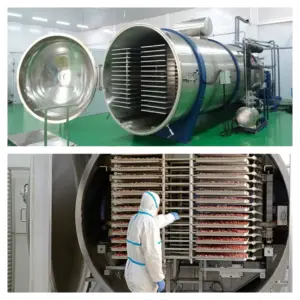
How much fresh sweet potato does 1 kg of freeze-dried take, and what happens in between?
3.8–4.3 kg of fresh roots go into every kilogram of freeze-dried yellow sweet potato, and across a full year the range runs from 3.4 kg for dense dry-season roots to 4.8 kg for wetter ones. That number is the most useful tool a buyer has for reading quotes. Every kilogram you buy carries the cost of about four kilograms of roots, the labour to peel and cut them, and a day in a freeze-dryer. When a price sits far below that arithmetic, something in the product is different, and this article shows you how to find out what.
Why does 1 kg take 3.8–4.3 kg of fresh roots?
Start from the root. A Japanese-type yellow sweet potato is about two-thirds water and one-third solids, denser than the orange-flesh type, which is part of why it tastes chestnut-sweet and dries well. On paper, removing the water from 2.8 kg of whole roots would leave 1 kg of product at 4% moisture. In practice, part of every root never reaches the dryer: the peel, the woody ends, the trims from squaring a root into dice, small pieces lost in blanching, and roots turned away at intake. Between the gate and the dryer tray, 27–35% of the received weight goes, and that is what turns 2.8 kg on paper into 3.8–4.3 kg in a working facility.
One tonne of fresh roots through the partner facility:
| Stage | Weight | What happens |
|---|---|---|
| Roots received at the gate | 1,000 kg | Japanese-type, red skin, yellow flesh, dry-season to wet-season mix |
| Peeling | −100 to −150 kg | Skin and the thin layer under it |
| Cutting, end trims, blanching | −30 to −50 kg | Woody ends, off-cuts from squaring dice and slices, small pieces lost in the blancher |
| Intake sorting and fines | the balance to 27–35% total | Weevil-damaged or chilled roots turned away; fines screened out after cutting |
| Prepared pieces on the dryer trays | 650–730 kg | Still about two-thirds water |
| Water removed in the freeze-dryer | about −420 to −470 kg | Sublimed as vapour, nothing added |
| Freeze-dried product at 3–4% moisture | 233–262 kg | = 3.8–4.3 kg fresh roots per kg |
The cut changes the yield. Slices and sticks keep more of each root; small dice lose more to squaring trims. Season changes it too: dry-season roots carry the highest dry matter and sit at the low end of the range, while roots from wet months sit near the top.
From intake to freezer: what happens to a root before it dries?
Most of the quality in a bag of freeze-dried sweet potato is decided in the first hours, long before the dryer.
- Intake. Roots arrive from the Mekong Delta and Central Highlands and are checked for size, dry matter, flesh colour and damage. Roots with weevil tunnels are turned away whole, because the damage makes the entire root bitter, not just the spot you can see. Roots are never stored below about 12 °C: chilling injury leaves a hard, brown core that no dryer can fix.
- Washing and peeling. Soil comes off in the washer, then the peel. Sweet potato is a root grown in the ground, and this is where the coliform result on the lot COA is earned.
- Cutting and rinsing. The moment a sweet potato is cut it bleeds a white latex that darkens on the cut face within minutes. Cut pieces are rinsed straight away so the latex washes off before it stains.
- Blanching at 85–90 °C for 2–3 minutes. A short blanch switches off the enzymes that turn cut sweet potato grey and brown. It is the reason FruitBuys sweet potato comes out light gold with no sulfite on the label, and the reason the pieces rehydrate cleanly later.
QA limits and the defects each step prevents are set out in freeze-dried sweet potato moisture, water activity and COA.
Why do rested roots taste like baked sweet potato without added sugar?
A sweet potato pulled from the field tastes starchy and mild. Given time to rest after harvest, the root converts part of its starch into natural sugar, and the flesh develops the deep, chestnut-sweet flavour people know from a baked Japanese sweet potato. Freeze-drying then concentrates that flavour by taking the water away.
That is why the natural sugar in freeze-dried yellow sweet potato moves between 10 and 18 g per 100 g from lot to lot: dry-season roots and well-rested roots sit at the sweeter end. It is also why no added sugar is needed for a sweet, roasted taste, which keeps the ingredient line to one word and lets your recipe cut refined sugar. If your product needs a tightly fixed sweetness, say so in the RFQ and FruitBuys plans root selection around it.
How do freezing and freeze-drying keep shape and colour?
The FruitBuys freeze-drying standard is the same across every line:
- Blast-freezing at −35 to −40 °C until the core is below −30 °C, which locks each dice and slice in its cut shape before any water leaves.
- Sublimation under deep vacuum, below 0.5 mbar, for 18–24 hours, with shelf heat held at or below 50–55 °C. The ice turns straight to vapour, leaving an open, porous structure: that is what makes the product crisp, and what lets a 5–6 mm dice rehydrate in 2–3 minutes instead of the 15–20 minutes hot-air dried sweet potato needs.
- Secondary drying down to 3–4% moisture, a clear step below the 5.0% contract limit.
- Packing in a room held at 20–24 °C and RH ≤35–40%, with every batch bagged within 20 minutes of leaving the dryer, into foil barrier bags with silica gel.
There is no frying or baking step anywhere in the line. Freeze-drying runs below browning temperatures, so it adds none of the acrylamide that frying and baking form in sweet potato.
How does the bulk lot match the sample you approved?
The sample is only useful if the container matches it. FruitBuys ties the two together in four ways:
- One locked partner facility per contract. The facility that made your approved sample makes your containers. Any change of facility needs written notice and a new pre-shipment sample for your approval before production moves. Your QA team has audit access.
- Pre-shipment sample from the packed lot. 100–200 g taken from the lot as packed, in two sealed foil pouches with desiccant: one for sensory and rehydration checks, one sealed for your laboratory. It is couriered within 24–48 hours of packing.
- Retained sample from every container lot, kept for the full shelf life of the lot, so any question is answered against the same lot and the same seal.
- Lead time you can plan around: samples in 3–5 working days, production in 20–30 days for a 20 ft container after deposit.
How do you read a quote that promises 3 kg of fresh roots per kg?
A low ratio on a quote is a claim about the product, and it can be checked with arithmetic. Take a quote that implies 3.0 kg of fresh roots per kilogram. Lose a normal 30% between gate and tray and 2.1 kg of prepared pieces remain, carrying about 0.72 kg of solids. To make 1 kg of product from 0.72 kg of solids, the finished product has to carry about 28% water. That is a semi-dried product, not a freeze-dried one at 3–4%.
When a ratio or a price looks too good, one of these is usually behind it:
| What the quote leaves out | How to check |
|---|---|
| Finished moisture well above 5% | Ask for moisture and Aw as measured numbers on the COA |
| Ratio quoted on peeled weight (3.2–3.5 kg peeled per kg is normal) | Ask whether the ratio is on whole or peeled roots |
| Hot-air drying sold as freeze-drying | Rehydrate a 5–6 mm dice in 90 °C water: freeze-dried is soft in 2–3 minutes, hot-air dried needs 15–20 |
| Added sugar, oil or carrier adding weight | Read the ingredient line: it should say “sweet potato” only |
| Young or watery roots with a pale, bland taste | Compare colour and aroma with the approved sample |
These are checks every buyer should run on every supplier, FruitBuys included. Send the ratio, moisture and ingredient line from each quote in your RFQ, and FruitBuys will put its own figures next to them on the same basis.
When another option fits better. If your goal is the lowest cost per kilogram of sweet potato solids for a dough, a soup base or a pet food, you do not need whole slices. Broken chunks or freeze-dried yellow sweet potato powder use the same roots, pack more kilograms per carton and cost less to ship.
FAQ
How many kilograms of fresh sweet potato make 1 kg of freeze-dried?
3.8–4.3 kg of fresh roots, within a full-year range of 3.4–4.8 kg depending on dry matter, season and cut.
Why is the ratio lower than for most freeze-dried fruits?
Japanese-type yellow sweet potato is about one-third solids, much denser than juicy fruits, and the root has no seed or rind. Less of its weight is water, so fewer kilograms are needed per kilogram of product.
Why is sweet potato blanched before freeze-drying?
A 2–3 minute blanch at 85–90 °C stops the enzymes that turn cut sweet potato grey and brown. It keeps the golden colour without sulfites.
Does freeze-dried sweet potato have added sugar?
No. Its sweetness comes from the root’s own sugars, which develop as harvested roots rest and are concentrated when the water is removed.
How long does freeze-drying take?
Sublimation runs 18–24 hours under deep vacuum, followed by secondary drying to 3–4% moisture. Production for a 20 ft container takes 20–30 days after deposit.
How do I know the container will match my sample?
One partner facility is locked to your contract, with change-control and audit access; a pre-shipment sample is taken from the packed lot, and a retained sample from every lot is kept for its full shelf life.



