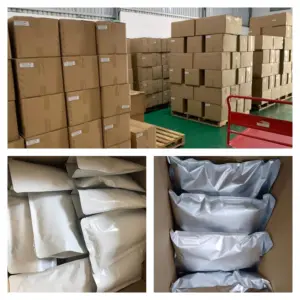
How long does freeze-dried sweet potato last, and how should it be packed to arrive crisp?
Freeze-dried sweet potato keeps 12 months at ≤25 °C and RH ≤60%, and 18–24 months in cool storage at ≤18 °C and RH ≤50%, in its original sealed foil bag with desiccant. It needs no refrigeration and ships in a standard dry container. What decides whether it arrives as crisp as it left is the packing: foil barrier bags, light vacuum, silica gel, the right carton weight for the cut and a container loaded with some headspace. A 20 ft container carries about 550 cartons, and the cut you choose decides whether that is closer to 3,850 kg or 5,500 kg of freeze-dried yellow sweet potato.
What makes the difference between 12 and 24 months?
Temperature and humidity around the bag, not the product itself. Freeze-dried sweet potato leaves the partner facility at 3–4% moisture and water activity ≤0.30, a level at which nothing grows and no preservative is needed. Its enemy is moisture creeping back in, and that happens faster in warm, humid air.
| Storage | Shelf life in the unopened foil bag | Where it fits |
|---|---|---|
| ≤25 °C, RH ≤60% | 12 months | Standard ambient dry warehouse |
| ≤18 °C, RH ≤50% | 18–24 months | Cool store; stock held beyond a year, hot-climate hubs |
A practical rule from the warehouse floor: keep cartons on pallets, off the floor and away from outside walls, where condensation forms first, and never stack heavy goods on cartons of slices. For a private-label product with a long printed date, FruitBuys runs an accelerated shelf-life study on your final retail pack as a service, so the date on the pouch is backed by your own packaging, not by the bulk bag’s.
Why foil, light vacuum and silica gel, but no nitrogen?
Each layer does one job:
- Aluminium-foil barrier bag. Light and moisture stop at the foil. Clear plastic bags let both through, and freeze-dried sweet potato will soften and lose its golden colour in them within weeks.
- Light vacuum. Drawing out most of the air makes the bag sit snug against the product, so pieces do not rub and break as cartons move.
- Food-grade silica gel, dust-free. It soaks up the small amount of moisture that every seal lets through over months at sea and in storage.
- No nitrogen flush. A nitrogen-puffed bag is a cushion of gas that gets squeezed when cartons are stacked; the pressure goes into the product and cracks slices. Light vacuum keeps the bag flat and the pieces whole.
For powder, iron-based oxygen absorbers are never used, and a desiccant and an oxygen absorber never go in the same bag. Moisture is the risk for a dry powder, and silica gel is the right tool for it.
7 kg or 10 kg per carton: how does the cut change freight per kilogram?
Every FruitBuys export carton is the same size, 58 × 28 × 34 cm, but what fits inside depends on the cut:
| Cut | Carton fill | Why |
|---|---|---|
| Dice 5–10 mm, natural chunks, granules | toward 10 kg | Small pieces settle into the gaps |
| Whole slices, sticks | toward 7 kg | Slices cannot be pressed without breaking |
That difference goes straight into your landed cost. Sea freight is charged per container, not per kilogram, so the cost of every kilogram is the container rate divided by the kilograms inside it:
Freight per kg = container freight ÷ (number of cartons × kg per carton)
Take any 20 ft rate as F. Slices at 7 kg: F ÷ 3,850 kg. Dice at 10 kg: F ÷ 5,500 kg. Whatever F is on the day you book, dice and chunks ship about 30% cheaper per kilogram, and the same container carries roughly 40% more product. Put your own freight quote into the formula to see the number for your lane.
The decision follows from your product. If the sweet potato is milled, blended, baked or hidden in a bar, buy dice or chunks. Keep whole slices for the retail packs where the shape is what the shopper pays for.
How is a container loaded: 550 cartons per 20 ft, about 1,120 per 40 ft HC?
Cartons are floor-loaded along the length of the container, 8 across and 10 deep, in layers:
| Container | Loading | Cartons | Net weight |
|---|---|---|---|
| 20 ft, 7 layers | Standard | about 550 | 3,850–5,500 kg |
| 20 ft, 6 layers | ~35 cm headspace under the roof | 480 | 3,360–4,800 kg |
| 40 ft HC, floor-loaded | Planning figure | up to about 1,120 | 7,840–11,200 kg |
| 40 ft HC, palletised | 20–24 pallets | about 760–840 | 5,320–8,400 kg |
Seven layers is the normal load and fills the container to the roof. Six layers gives up 70 cartons but leaves a gap of about 35 cm under the roof, which keeps the top layer clear of the condensation that drips from a container roof after a cold night or a tropical downpour. For a first shipment through a rainy-season port, six layers is the safer load. Palletised loading carries fewer cartons but unloads by forklift in a fraction of the time hand-unloading takes; choose by what your warehouse needs.
What can go wrong on the route, and how is it handled?
Three moments on the journey matter more than the sea leg itself:
- Summer port heat. A container standing in the sun at a hot port can reach well above outside temperature. The product does not need a reefer, but it does need to move: book the container to load and sail close together, and collect it promptly at destination.
- Container rain. Condensation inside a container can drip onto the top layer. Foil bags inside cartons protect the product; headspace and a dry container with intact seals protect the cartons.
- Customs inspection. When an inspector opens bags, they are often left open or loosely closed. Ask your broker to reseal opened bags, and check them first at receiving.
At receiving, open two or three bags from different rows and read water activity on one of them; a lot released at 3–4% moisture should be well inside the 0.30 limit. Report anything off within 14 days of devanning. The full receiving checklist is in freeze-dried sweet potato moisture, water activity and COA.
How should opened bags be handled on your line?
Bulk bags come in 1–5 kg. Pick the size that matches how fast your line or kitchen uses it: a cereal line emptying a bag into each batch takes 5 kg; a bakery dosing a few hundred grams a day takes 1 kg. Once a bag is opened, press out the air, heat-seal or clip it shut with the original desiccant inside, keep it cool and dry, and use it within 2–4 weeks for full crunch. Do not move opened bags into a refrigerator without an airtight container: cold product draws condensation the moment it comes back into warm air.
When a different pack fits better. If your destination warehouse runs warm and humid, or a single bag will be open for weeks, order 1 kg bags instead of 5 kg. FruitBuys packs them at source, in the same carton, so every bag you open is fresh. Documents and customs for the same shipment are covered in sweet potato HS code and customs.
FAQ
How long does freeze-dried sweet potato last?
12 months at ≤25 °C and RH ≤60%, and 18–24 months in cool storage at ≤18 °C and RH ≤50%, in the original unopened foil bag with desiccant.
How long does sweet potato powder last?
The same: 12 months at ≤25 °C and RH ≤60%, 18–24 months in cool storage, sealed with desiccant. Once opened, reseal it and use it within 2–4 weeks so it stays free-flowing.
Does freeze-dried sweet potato need refrigeration?
No. At water activity ≤0.30 it is shelf-stable at ambient temperature and ships in a standard dry container.
How many cartons fit in a 20 ft container?
About 550 cartons of 58 × 28 × 34 cm, or 3,850–5,500 kg net depending on the cut. A 40 ft HC carries up to about 1,120 cartons.
Why is there no nitrogen in the bags?
A nitrogen-puffed bag gets squeezed when cartons are stacked, which cracks slices. Light vacuum keeps the bag flat and the pieces whole, and silica gel handles moisture.
What happens once a bag is opened?
Press out the air, reseal it with the original desiccant, keep it cool and dry, and use it within 2–4 weeks for full crunch.
Which cut ships most efficiently?
Dice, chunks and granules pack toward 10 kg per carton against about 7 kg for slices, which lowers sea freight per kilogram by about 30%.