Freeze-Dried Strawberry Process: From Fresh Fruit to Export-Ready Product
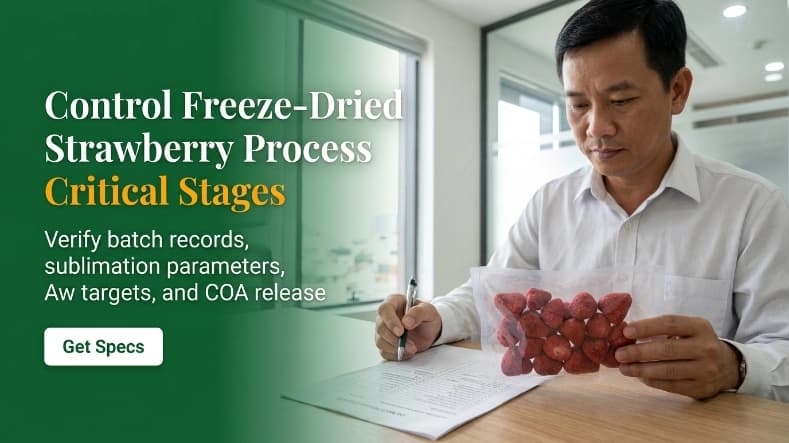
The freeze-dried strawberry process is where a good sample becomes either a repeatable B2B product or a one-time presentation piece. A buyer may see red color, crisp texture and clean aroma, but those signs do not prove raw-material selection, preparation, freezing, drying endpoint, moisture, Aw, post-drying handling, packing, COA and retained-sample control.
Importers, QA managers, procurement teams, R&D developers and private-label buyers should understand the process before approving samples or bulk release. The process matters because every step affects the finished specification the buyer receives. FruitBuys supplies freeze-dried strawberry through an Integrated Product Supply Model that aligns raw-material sourcing, qualified production partners, QC, documentation, packaging direction and export logistics coordination under one accountable relationship.
The Process Must Support the Specification
Freeze-dried strawberry should be evaluated from process flow, not only finished appearance.
Each stage must protect format, texture, moisture, Aw, color, aroma, packaging and lot release.
Buyers should request a process-control file before treating a sample as bulk-ready.
Freeze-drying is a dehydration process in which frozen water is removed by sublimation under reduced pressure. Food freeze-drying literature describes freezing, primary drying and secondary drying as key stages that influence the physical properties of the finished material. (MDPI)
For B2B strawberry buyers, that means process control is not academic. It decides whether the product matches the approved specification. A weak process file can produce inconsistent whole pieces, uneven slices, powder caking, excessive fines, soft texture or a COA that does not match the sample.
FruitBuys links the process to the current freeze-dried strawberry supplier guide. The supplier decision is not simply who can dry fruit. The real decision is who can supply one locked product with repeatable release criteria.

A practical process route should show:
| Stage | Buyer Control Point |
|---|---|
| Raw-material receiving | Maturity, defect level, origin lot and suitability |
| Sorting and washing | Defect removal and hygiene control |
| Hulling and preparation | Calyx removal, trim loss and cut accuracy |
| Freezing | Product condition before drying |
| Primary drying | Main water removal by sublimation |
| Secondary drying | Final drying and moisture endpoint |
| Unloading and sorting | Moisture exposure, defects, breakage and fines |
| Packing and sealing | Texture protection and lot traceability |
| COA release | Lot-specific proof before shipment |
The process should not be described only as “advanced technology.” The buyer needs control points.
Raw-Material Receiving and Sorting
Freeze-dried strawberry quality begins before freezing. Raw fruit maturity, defect level, size distribution, softness, bruising, microbial load and handling condition affect the finished product.
FruitBuys uses the working conversion basis:
8–10 kg selected, cleaned fresh strawberries
→ 1 kg finished freeze-dried strawberry
This conversion ratio only has meaning if the buyer knows what happens during receiving, sorting and preparation. A supplier who counts harvested fruit, selected cleaned fruit, loaded trays or dried output may report different ratios. Buyers should review fresh-to-dry conversion ratio before comparing suppliers.
Receiving control should confirm:
- Origin lot or sourcing area
- Maturity suitability
- Visible defects
- Bruising or soft fruit
- Mold risk
- Size distribution
- Rejected weight
- Selected cleaned weight
- Intended product format
FruitBuys ties this stage to Raw Material Sourcing Governance. The goal is not simply to purchase fruit. The goal is to approve fruit suitable for the final freeze-dried format.
Washing, Hulling and Format Preparation
After sorting, strawberries need washing, calyx removal and preparation. This stage affects yield, visual appearance, texture and format consistency.
Whole-fruit production needs careful handling because the finished product depends on intact structure. Slice production needs controlled thickness. Bite and chunk production needs particle-size discipline. Powder production needs a separate route because later milling changes mesh, flow, moisture behavior and label impact.

A buyer should not approve a process file unless it identifies the intended format:
Whole · Slices · Bites/Chunks · Granules · Powder · Custom SizeUse freeze-dried strawberry product formats before approving a sample. A process built for slices does not automatically approve whole-fruit retail packs. A powder process does not automatically approve inclusion pieces.
Format-preparation questions for buyers:
| Buyer Question | Why It Matters |
|---|---|
| Is the product whole, sliced, chunked or milled? | Controls drying, sorting and packing |
| What is the size or thickness target? | Controls application performance |
| How is trim loss recorded? | Supports conversion-ratio discipline |
| Are broken pieces downgraded or included? | Controls sample-to-bulk consistency |
| Is powder 100% fruit or formulated? | Controls label and application review |
This stage directly affects finished yield. A strong supplier does not hide preparation loss. It documents the basis.
Freezing Before Drying
Freezing is not a cosmetic step; it prepares the fruit structure for sublimation during drying.
Poor product condition before drying can affect shape, texture, breakage and final consistency.
Buyers should confirm that freezing is part of the controlled process route, not an undefined pre-step.
Freeze-drying begins with frozen product. The condition of the strawberry before drying affects the finished physical structure. Food freeze-drying research consistently treats freezing as a core stage before primary and secondary drying, because ice formation and product structure influence subsequent dehydration behavior. (MDPI)
The buyer does not need confidential machine settings in early RFQ discussions. The buyer does need confirmation that freezing, loading density and product format are controlled in the process route.
Important freezing-stage questions:
- Was the product frozen before drying?
- Was the intended format prepared before freezing?
- Were whole pieces, slices and chunks handled separately?
- Was the tray-loading approach suitable for the format?
- Was the product protected from excess handling before drying?

A whole strawberry, thin slice and powder-bound raw material do not share the same product-risk profile. FruitBuys treats this stage through Quality Control and qualified production-partner alignment.
Primary Drying and Secondary Drying
Primary drying removes frozen water through sublimation. Secondary drying removes additional bound water toward the final moisture target. Together, these stages control texture, dryness, structure and stability.
For this FruitBuys strawberry cluster, the working release targets are:
Moisture: 3–5%
Aw: <0.30
These values should appear in the specification and COA. They should not sit only in a conversation or sales sheet.
FDA defines water activity as a ratio related to vapor pressure and explains its role in food stability and microbial growth conditions. Aw is not the same as total moisture content. (U.S. Food and Drug Administration)
That distinction matters in process control. A product can look dry but still carry a moisture or Aw issue. A slice can feel crisp on sampling day but soften later. Powder can appear free-flowing at packing and then cake if drying, packaging or storage is weak.
A buyer should ask the supplier to confirm:
| Drying Control | Buyer Purpose |
|---|---|
| Moisture target | Confirms drying endpoint |
| Aw target | Confirms available-water control |
| Test timing | Shows when release values are measured |
| Format-specific review | Confirms whole, slice, chunk or powder route |
| Retained sample | Supports physical comparison |
| COA link | Connects process output to lot release |
Use moisture and water activity specifications before approving the process as bulk-ready.
Post-Drying Unloading and Sorting
The product is vulnerable after drying. It is light, porous and sensitive to ambient humidity. Poor post-drying handling can undo a correct drying cycle.
Unloading and sorting should control:
- Moisture pickup
- Broken pieces
- Collapsed pieces
- Dark or defective pieces
- Fines
- Powder dust
- Foreign matter
- Cross-format mixing
- Lot segregation
For whole fruit and slices, sorting protects visual yield. For chunks and granules, sorting protects particle range. For powder, post-milling control protects mesh, caking risk, flow and label identity. Low-moisture food still needs sanitation discipline.

FDA’s 2025 draft guidance on low-moisture ready-to-eat human foods addresses sanitation programs, environmental monitoring and corrective actions after pathogen contamination events, reinforcing that dryness alone is not a safety system (U.S. Food and Drug Administration). The buyer should therefore treat post-drying handling as a QA control point, not a warehouse step.
Packing, Sealing and Shelf-Life Protection
Freeze-dried strawberry packaging protects the drying result. It does not fix poor process control.

Packaging should protect against:
- Moisture ingress
- Oxygen exposure
- Aroma loss
- Breakage
- Powder caking
- Seal failure
- Carton compression
- Open-pack humidity exposure
Bulk packing and retail packing are different routes. A bulk ingredient bag needs inner-bag protection, carton strength, lot identity and storage instruction. A private-label pouch needs barrier review, seal control, label space, Nutrition Facts basis, date coding and market-route review.
For broader planning, buyers can use packaging and shelf-life control as internal navigation. Shelf life should be stated only when the product format, moisture, Aw, package barrier, seal method, storage condition and validation evidence support it. FruitBuys treats packaging as part of Quality Control, Documentation, OEM/Private Label Delivery and Export Logistics Coordination. The package file must match the process file.
COA Release and Laboratory Proof
The process is not complete until the lot is released against specification.
The COA must match the exact product, lot, format, test method and release criteria.
Buyers should not accept process claims without lot-based documentation.
A process description tells the buyer how the product should be controlled. The COA tells the buyer whether the released lot met the agreed criteria.

A freeze-dried strawberry COA should include, where agreed:
| COA Field | Buyer Purpose |
|---|---|
| Product name | Confirms product identity |
| Format | Confirms whole, slice, chunk, granule or powder route |
| Lot code | Links test results to goods |
| Moisture | Confirms drying endpoint |
| Aw | Confirms available-water control |
| Microbiology | Supports release review |
| Pesticide scope | Supports market and buyer requirements |
| Contaminant scope | Supports market and buyer requirements |
| Physical criteria | Size, mesh, breakage or fines where relevant |
| Release status | Confirms approved lot condition |
ISO/IEC 17025 is the international standard for testing and calibration laboratories, and buyers should verify that the lab scope and method match the requested product and test matrix (ISO). Use COA and laboratory testing requirements before approving a process claim as release evidence.
The Highest Risk: Process Approved Without Sample-to-Bulk Controls
The highest process risk is approving a good sample without locking the controls that reproduce it in bulk.
A hand-selected sample can hide raw-material variation, drying variation, sorting loss, breakage, fines and packaging weakness.
Buyers should convert the process into measurable sample-to-bulk criteria.
The supplier can send a strong sample after careful selection. That does not prove bulk consistency. Bulk consistency requires a golden sample, retained sample, written specification, COA scope, packaging route and change-control rule.
A sample-to-bulk process file should lock:
- Product format
- Raw-material basis
- Preparation route
- Size, thickness, particle range or mesh
- Drying endpoint
- Moisture
- Aw
- Breakage tolerance
- Fines tolerance
- Packaging structure
- COA scope
- Retained sample
- Release authority
Use sample-to-bulk consistency controls before moving from trial sample to bulk approval. FruitBuys treats the approved sample as a documented product reference, not a memory.
Application Mapping

| Buyer Type | Application | Required Format | Proof Needed | FruitBuys Delivery |
|---|---|---|---|---|
| Importer | Bulk ingredient import | Whole, slices, chunks, powder | Process flow, COA, moisture, Aw, packing list | Documentation and Export Logistics Coordination |
| QA manager | Supplier approval and lot release | Any approved format | Process control points, COA, retained sample, test method | Quality Control and Documentation |
| R&D developer | Cereal, chocolate, bakery, dairy, beverage | Application-specific format | Sample trial, size or mesh, sensory result, drying endpoint | Raw Material Sourcing Governance and Market Trial Support |
| Private-label brand | Retail pouch or powder SKU | Whole, bites, slices, powder | Process file, packaging file, Nutrition Facts basis, COA | OEM/Private Label Delivery |
| Beverage developer | Strawberry powder blend | Powder | Carrier status, mesh, caking review, moisture and Aw | Powder specification and Documentation |
| Distributor | Multi-SKU stocking | Multiple formats | SKU segregation, retained sample, lot coding, storage instruction | Documentation and shipment-readiness review |
| Logistics manager | Shipment planning | Format-specific cartons | Packing method, carton plan, COA lot identity, storage instruction | Export Logistics Coordination |
Why FruitBuys Delivers This
FruitBuys supplies freeze-dried strawberry as a configured, documented, quality-controlled product under an Integrated Product Supply Model. The buyer does not need a disconnected process description. The buyer needs a process route that ends in a released product file.
Under Raw Material Sourcing Governance, FruitBuys aligns strawberry input with maturity, defect control, intended format and application. Under Quality Control, FruitBuys connects preparation, freezing, drying endpoint, moisture, Aw, sorting, breakage, fines, powder behavior and retained sample to the approved specification.
Under Documentation, FruitBuys aligns process flow, COA, laboratory report, lot identity, packing record and release file. Under MOQ Flexibility/Market Trial Support, FruitBuys may structure sample routes for application validation where operationally supported.
Under OEM/Private Label Delivery, FruitBuys connects the process route to pack size, label inputs and finished SKU requirements. Under Export Logistics Coordination, FruitBuys aligns packing, carton configuration, storage instruction and shipment handover. The result is one supplied product, one approved process route and one release file.
Buyer Checklist
Before approving the freeze-dried strawberry process, confirm:
- Product format
- Intended application
- Raw-material receiving criteria
- Sorting and rejection basis
- Cleaned-fruit weight basis
- Hulling and preparation method
- Cut size, thickness, particle range or mesh
- Freezing step confirmation
- Drying endpoint
- Moisture target
- Aw target
- Post-drying sorting criteria
- Breakage and fines limits
- Powder carrier status where relevant
- Packaging structure
- Seal method
- Lot coding
- COA scope
- Laboratory method
- Retained sample
- Storage instruction
- Change-control trigger
- Release authority
Do not approve the process from a photo or sample only. Approve the control points.
Summary
The freeze-dried strawberry process includes raw-material receiving, sorting, washing, hulling, format preparation, freezing, primary drying, secondary drying, unloading, sorting, packing, COA review and lot release. Buyers should verify format, fresh-to-dry basis, moisture 3–5%, Aw <0.30, breakage, fines, packaging, retained sample and COA scope before bulk approval.
FruitBuys supplies freeze-dried strawberry through raw-material governance, quality control, documentation, market-trial support, OEM/private-label delivery and export logistics coordination.
FAQ
What are the main stages in the freeze-dried strawberry process?
The main stages are raw-material receiving, sorting, washing, hulling, preparation, freezing, primary drying, secondary drying, unloading, sorting, packing, COA review and lot release.
Why does the process matter to buyers?
The process controls format, texture, moisture, Aw, breakage, fines, powder caking, packaging protection and sample-to-bulk consistency.
What release targets should buyers request?
Use moisture 3–5% and Aw <0.30 as working targets, then verify them through lot-specific COA, test method, retained sample and packaging route.
Is low Aw enough to prove product safety?
No. Low Aw supports stability review, but it does not replace microbiology, sanitation controls, environmental discipline or lot-specific testing.
Does powder follow the same process control as whole fruit?
No. Powder needs extra controls for carrier status, mesh, flowability, caking risk, moisture, Aw, packaging and ingredient-statement impact.
What should be requested before bulk approval?
Request process flow, control points, format specification, moisture/Aw release values, COA scope, packaging file, retained sample and change-control rules.
Conclusion
The freeze-dried strawberry process is not only a production sequence. It is the control route that turns fresh fruit into an export-ready product with defined format, moisture, Aw, packaging, COA and sample-to-bulk consistency. Buyers should not approve a sample unless the process can support repeatable bulk release under the same specification.
Request the process flow, control points, moisture/Aw release targets, COA scope, packaging route and retained-sample plan before approving freeze-dried strawberry bulk supply.
References
- Nowak, D., & Jakubczyk, E. The Freeze-Drying of Foods — The Characteristic of the Process Course and the Effect of Its Parameters on the Physical Properties of Food Materials. Foods, 2020. DOI: 10.3390/foods9101488. (MDPI)
- U.S. Food and Drug Administration. Water Activity (aw) in Foods. FDA Inspection Technical Guide. (U.S. Food and Drug Administration)
- U.S. Food and Drug Administration. Draft Guidance for Industry: Establishing Sanitation Programs for Low-Moisture Ready-to-Eat Human Foods and Taking Corrective Actions Following a Pathogen Contamination Event. January 2025. (U.S. Food and Drug Administration)
- International Organization for Standardization. ISO 22000:2018 — Food safety management systems — Requirements for any organization in the food chain. (ISO)