Freeze-Dried Durian COA and Laboratory Testing Guide
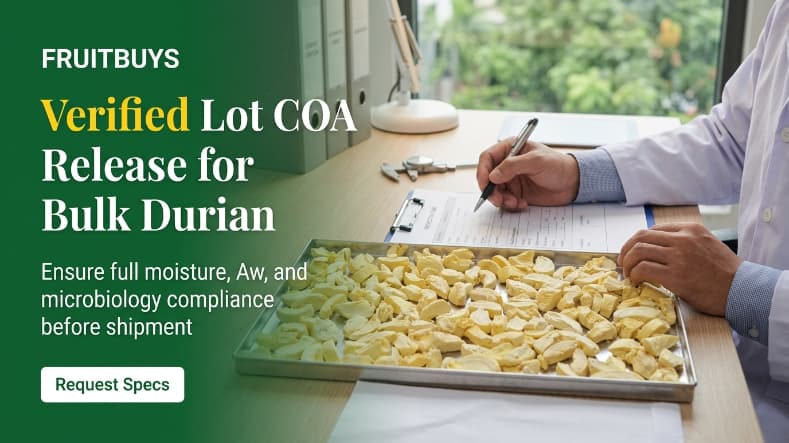
A freeze-dried durian sample can look clean, crisp and ready for a buyer meeting while the release file remains incomplete. The buyer still needs to know which lot was tested, which method applied, which limits were used, whether the COA matches the packed goods and whether certificate scope covers the real production context.
A COA does not protect the buyer unless it belongs to the exact lot under approval. Product photos, certificate logos and old lab reports cannot release a new batch. This guide gives importers, QA managers, procurement teams, distributors, R&D developers and private label buyers a practical way to review freeze-dried durian testing before sample approval or bulk release. FruitBuys treats COA and laboratory evidence as part of Documentation and Quality Control, not as paperwork pasted onto the shipment after production.
What a Freeze-Dried Durian COA Must Prove
A freeze-dried durian COA must identify the product, format, lot, test items, methods, results and acceptance limits.
It should support the exact goods under approval, not a different sample, earlier production run or unrelated certificate.
Buyers should review the COA before releasing the lot, not after the shipment file closes.
A COA, or Certificate of Analysis, serves one purpose: it connects measurable product results to a specific lot. For freeze-dried durian, the document must show more than a general “pass” status. It must let the buyer check whether the product meets the approved specification.
A usable COA should include:
| COA Field | Required Detail | Buyer Reason |
|---|---|---|
| Product name | Freeze-dried durian | Confirms document-product match |
| Product format | Cubes, bites, slices, broken pieces or powder | Prevents format mismatch |
| Lot number | Exact production lot | Connects test to goods |
| Production or packing date | Date linked to lot file | Supports traceability |
| Sample date | Date of tested sample | Shows timing of test |
| Test items | Moisture, Aw, microbiology and agreed panel | Defines scope |
| Test method | Method, instrument or lab reference | Prevents vague “tested” claims |
| Result | Numeric value or stated result | Allows comparison |
| Acceptance limit | Approved specification or buyer limit | Shows pass/fail basis |
| Laboratory or issuer | Internal QC or third-party lab | Clarifies evidence source |
| Authorized review | Signature or approval record | Confirms release responsibility |
FruitBuys should align COA review with freeze-dried durian documentation readiness and sample-to-bulk consistency for freeze-dried durian. The COA must support the product that buyer approved, not the product the supplier wishes the buyer had approved.
Why Certificate Logos Are Not Lot Evidence
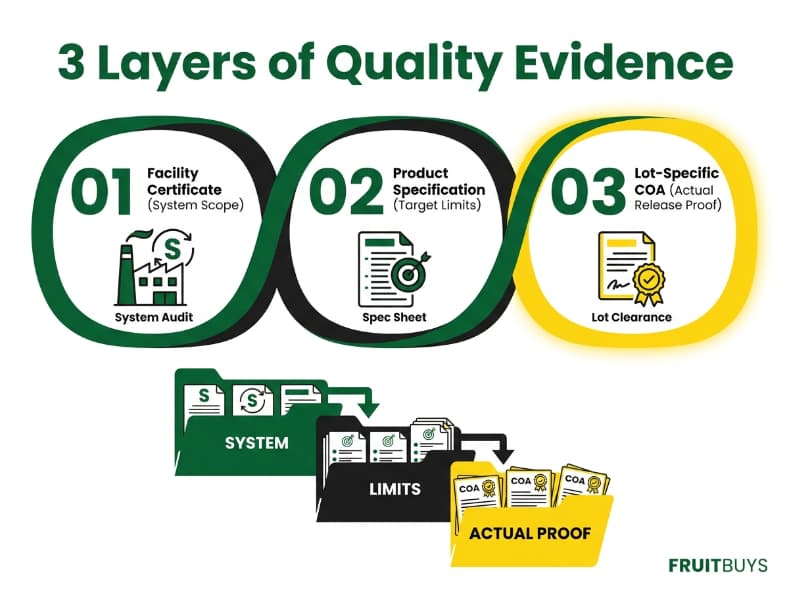
A certificate logo can indicate that a facility or management system holds a certificate under a defined scope. It does not prove that one freeze-dried durian lot passed moisture, Aw, microbiology, contaminants or nutrition testing.
Buyers must separate three layers:
| Evidence Type | What It Can Support | What It Cannot Prove Alone |
|---|---|---|
| Facility certificate | System, site or process scope | Exact lot result |
| Product specification | Target limits and buyer requirements | Actual lot compliance |
| COA or lab report | Tested result for stated sample | Future-lot compliance |
| Process photo | Visual context | Test result or certificate scope |
| Sample | Sensory and application review | Bulk conformity without records |
Codex General Principles of Food Hygiene describes food hygiene measures and food safety controls, including HACCP principles, but a hygiene system still needs product-specific verification when a lot moves to buyer approval (FAOHome).
The buyer should ask for actual certificate copies, not just logos. Each certificate must show:
- Legal entity
- Production site
- Certificate number
- Validity dates
- Standard or scheme
- Product or process scope
- Issuing body
- Any exclusions
- Relationship to the lot under review
FruitBuys should not publish HACCP, ISO 22000, BRCGS or HALAL as confirmed for freeze-dried durian unless the exact certificate scope and validity support the claim.
Physical and Technical Tests
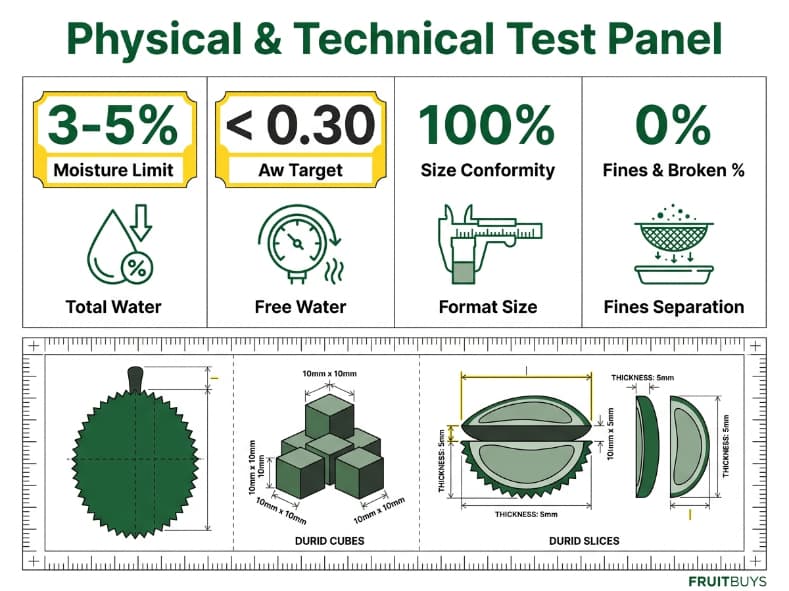
Freeze-dried durian needs physical and technical testing because format affects risk. A crisp bite, a thin slice and a powder do not need the same review. The test panel should match product form and application.
Core technical tests include:
| Test Area | Why Buyers Need It |
|---|---|
| Moisture | Confirms drying endpoint and water load |
| Aw | Confirms available water condition |
| Piece size | Supports format conformity |
| Broken pieces | Protects retail appearance and pack consistency |
| Fines | Controls powdering and application behavior |
| Mesh size | Required for powder and granules |
| Bulk density | Supports filling, dosing and formulation |
| Foreign matter inspection | Protects basic product release |
| Sensory review | Confirms color, aroma, taste and texture criteria |
For pieces, buyers should review size tolerance and broken-piece allowance through freeze-dried durian cubes, bites, slices and powder. For process context, buyers should connect test results to how freeze-dried durian is processed. Moisture and Aw require separate lines. Do not accept one number as a substitute for the other.
Moisture and Aw Testing
Moisture and Aw belong in the COA as separate values because they answer different technical questions.
Moisture measures total water, while Aw measures water availability under defined conditions.
Buyers should verify both values before approving bulk freeze-dried durian.
FDA’s water activity guidance explains that Aw relates to the vapor pressure relationship between food and water under identical conditions, and FDA notes that Aw can change with temperature. (U.S. Food and Drug Administration) ISO 18787:2017 establishes principles and requirements for determining water activity of food products within a measurement range from 0 to 1. (ISO)
The current FruitBuys working targets are:
| Parameter | Target | Release Status |
|---|---|---|
| Moisture | 3–5% | Must be confirmed by COA |
| Aw | <0.30 | Must be confirmed by COA |
The COA should show:
- Moisture method.
- Moisture result.
- Moisture acceptance range.
- Aw method or instrument basis.
- Aw result.
- Aw measurement condition.
- Lot code.
- Sampling point.
- Packaging condition at sampling.

The buyer should not approve “dry and crispy” as a technical result. Crispness can change after packing if the seal fails or the product absorbs moisture. Review freeze-dried durian moisture and Aw before accepting any stability claim.
Microbiology Panel
Freeze-dried durian is a low-moisture product, but low moisture does not remove the need for microbiology review. Post-drying handling, food-contact surfaces, air exposure, personnel practice and packaging contact can introduce risk after the dryer has done its work.
FDA’s 2025 draft guidance for low-moisture ready-to-eat foods discusses sanitation programs, preventive control expectations and corrective actions when pathogen contamination occurs; the guidance exists because dry ready-to-eat foods still need contamination prevention after processing. (U.S. Food and Drug Administration)
A practical freeze-dried durian microbiology panel may include:
| Test | Buyer Purpose |
|---|---|
| Total plate count | General hygiene indicator |
| Yeast and mold | Dry-food handling and spoilage indicator |
| E. coli | Hygiene and contamination indicator |
| Coliforms | Process and handling indicator where required |
| Salmonella | Pathogen criterion for many ready-to-eat dry foods |
| Staphylococcus aureus | Handling and hygiene indicator where required |
| Listeria monocytogenes | Application-dependent, especially for ready-to-eat environments |
The exact panel must follow buyer application, destination requirements, risk assessment and agreed specification. FruitBuys should not claim microbiology compliance without a lot-linked lab report. For the release chain, connect this section to approved sample and bulk release.
Contaminant and Residue Testing
Contaminant testing should match the destination market and risk profile. Freeze-dried durian concentrates solids because water leaves the product. That does not automatically mean every contaminant increases beyond limits, but it does mean buyers should check the correct panel instead of relying on fresh-fruit assumptions.
For EU-bound food, Commission Regulation (EU) 2023/915 sets maximum levels for certain contaminants in foodstuffs, and the annex controls the relevant contaminant categories by food group and condition. (Eur-Lex) EU pesticide residue review also needs Regulation (EC) No 396/2005 when the product or raw material falls within scope, because that regulation governs maximum residue levels for pesticides in or on food and feed of plant and animal origin. (Eur-Lex)
For freeze-dried durian, the contaminant file may need:
| Test Area | Why It Matters |
|---|---|
| Heavy metals | Destination and buyer safety review |
| Pesticide residues | Raw-material and market compliance review |
| Mycotoxins | Risk-based review if storage or raw-material concern exists |
| Sulphites | Needed if used or if buyer requires confirmation |
| Foreign matter | Physical safety and QA release |
| Oxidation indicators | Application-dependent for fat-containing durian products |
FruitBuys should align this panel with fresh-to-dry durian conversion because concentration and usable-grade definition can affect how buyers interpret results.
Nutrition Testing
Nutrition data should match the exact formula and serving basis. A rounded retail label can support preliminary analysis, but it cannot replace a controlled nutrition file for private label or destination-specific labeling.
FDA’s Food Labeling Guide explains food labeling topics such as nutrition labeling, serving sizes and declaration rules for the U.S. market, but buyers still need product-specific data that matches the actual formula and pack. (U.S. Food and Drug Administration) For EU consumer-facing food, Regulation (EU) No 1169/2011 governs food information to consumers, including mandatory information, allergen communication and nutrition declaration rules. (Eur-Lex)
Nutrition testing should clarify:
- Exact ingredient statement
- Whether the product contains only durian
- Whether powder contains carrier or anti-caking agent
- Serving size
- Market label format
- Energy
- Fat
- Saturated fat
- Carbohydrate
- Sugars
- Fiber
- Protein
- Sodium
- Potassium or minerals only where required or claimed
Powder carries extra risk. A durian powder with carrier does not share the same nutrition facts as pure freeze-dried durian powder. For powder control, link to freeze-dried durian powder specifications. For full label logic, link to freeze-dried durian Nutrition Facts development.
Certificate Scope and Market Documents
Certificate review sits beside laboratory testing, not inside it. A lab result proves a test on a sample. A certificate may support a management system, production site, process or product category. Destination documents support import and buyer file review.
For the U.S. market, FDA states that it does not approve, certify, license or otherwise sanction individual food importers, products, labels or shipments before importation. (U.S. Food and Drug Administration) FDA’s FSVP overview also states that FSVP importers are generally required to develop, maintain and follow a foreign supplier verification program for each imported food unless an exemption applies. (U.S. Food and Drug Administration)
This creates a direct buyer rule: do not write “FDA approved freeze-dried durian.” That phrasing does not fit the way FDA describes imported food oversight. The buyer should review facility registration status where applicable, prior notice responsibility, FSVP obligations and product documentation with the importer. For market-document structure, use freeze-dried durian export documents.
How to Read a Laboratory Report
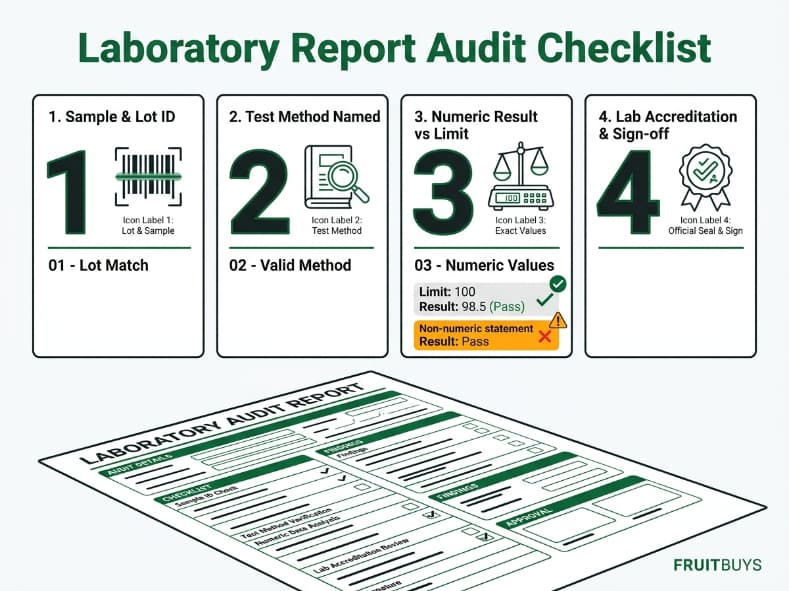
A laboratory report can look official and still fail the buyer’s decision if it does not match the product. QA should read the report from identity to method, not from “pass” to signature.
Check these fields:
| Report Field | Review Question |
|---|---|
| Client name | Does it match the supplier or production context? |
| Sample name | Does it say freeze-dried durian and the correct format? |
| Sample description | Does it match cubes, bites, slices or powder? |
| Lot code | Does it match packing list and product labels? |
| Received date | Does timing fit production and release? |
| Test date | Did testing occur before approval? |
| Method | Is the method named and relevant? |
| Result | Is the result numeric where needed? |
| Unit | Does the unit match the specification? |
| LOQ or detection limit | Does non-detect have a defined basis? |
| Acceptance limit | Is the buyer or regulatory limit stated? |
| Lab accreditation | Does scope cover the method where required? |
| Authorized sign-off | Is the report complete? |
Do not treat “not detected” as absolute zero. It means the result was not detected under the stated method, sample and reporting limit. This distinction matters for pathogens, heavy metals, residues and allergens.
Why Historical Reports Cannot Release Future Lots
A historical report can support supplier evaluation, but it cannot release a new freeze-dried durian lot.
Each harvest, cultivar, process run, format, packaging condition and lot can differ.
Buyers should require lot-specific release evidence before approving bulk goods.
A supplier may send a clean report from an earlier production batch. That report may show competence, but it does not prove the current lot. The current lot may use a different cultivar, different maturity, different piece size, different dryer load, different packing delay or different packaging structure.
The buyer should classify reports correctly:
| Report Type | Use |
|---|---|
| Historical report | Supplier screening only |
| Pre-shipment COA | Lot release support |
| Third-party lab report | Independent test evidence |
| Internal QC report | Process and release support |
| Shelf-life report | Product-pack-storage validation |
| Certificate | Site, system or scheme scope review |
FruitBuys should connect every active shipment file to lot-specific COA and retained sample comparison. The article that carries this risk deeper is sample-to-bulk consistency for freeze-dried durian.
Application Mapping
| Buyer Type | Application | Required Format | Proof Needed | FruitBuys Delivery |
|---|---|---|---|---|
| Importer | Retail snack pouch | Bites or slices | COA, microbiology, moisture, Aw, certificate scope | Lot-based Documentation and Quality Control |
| Distributor | Multi-SKU freeze-dried fruit range | Bites, slices or mixed pieces | Format tolerance, broken-piece report, release COA | Product release file and shipment alignment |
| QA manager | Supplier approval | Any format | Full lab report, methods, limits, lot identity | Documentation review and controlled release |
| R&D developer | Chocolate, bakery or dairy inclusion | Broken pieces, granules or powder | Particle size, Aw, microbiology, ingredient statement | Application-aligned product evidence |
| Private label buyer | Branded retail pouch | Cubes or bites | Nutrition data, label file, COA, seal and pack evidence | OEM/Private Label Delivery |
| Ingredient buyer | Manufacturing input | Powder or granules | Mesh, carrier declaration, contaminants, microbiology | Specification and lot document package |
For application-level decisions, use freeze-dried durian food applications. For OEM label and packaging control, use freeze-dried durian private label.

Testing in Sample-to-Bulk Control
Sample approval often focuses on taste, aroma, color and crispness. That creates a weak approval file. Bulk release needs measurable criteria.
FruitBuys should align testing through this chain:
Approved sample
→ locked specification
→ moisture and Aw limits
→ microbiology panel
→ contaminant panel where required
→ packaging specification
→ retained sample
→ bulk COA
→ lot-release decision
If a buyer approves a sample without moisture, Aw and microbiology expectations, the bulk lot has no clear technical target. The supplier may deliver a visually similar product with different technical results. That difference can trigger shelf-life issues, label delays or internal QA holds. For a practical release workflow, connect to freeze-dried durian buyer checklist
Highest-Risk Approval Error: Accepting “Pass” Without a Limit
The most dangerous COA is not always the one with a failed result. It is the one that says “pass” without showing the limit, method or sample identity.
A buyer cannot evaluate “pass” unless the document states:
- Pass against which specification
- Tested by which method
- On which sample
- From which lot
- Under which unit
- With which detection limit
- For which destination or buyer requirement
A “pass” statement without context can hide the real decision. The buyer may assume the product passed the buyer’s own requirement. The supplier may mean it passed an internal screen. Those are not the same.
FruitBuys should require numeric results where numeric control matters. Moisture, Aw, heavy metals, residues, microbial counts, mesh and bulk density should not vanish behind generic pass wording.
Why FruitBuys Delivers This
FruitBuys supplies freeze-dried durian through an Integrated Product Supply Model. COA and laboratory testing sit at the release gate because buyers do not buy a claim. They buy a finished product tied to a specification and a document set.
FruitBuys applies Quality Control by aligning moisture, Aw, format tolerance, microbiology, sensory review and retained sample comparison. FruitBuys applies Documentation by connecting COA, laboratory reports, certificate scope, ingredient statement, traceability and packing file to the exact lot. FruitBuys applies Raw Material Sourcing Governance by defining cultivar, maturity direction and raw-material suitability before testing even starts.
For private label buyers, FruitBuys applies OEM/Private Label Delivery by aligning label data, pack configuration, nutrition file and lot coding. For shipment readiness, FruitBuys applies Export Logistics Coordination by matching lot documents, packing files and carton plans before release.
The lab report is not paperwork. It is the buyer’s control gate.
Buyer Checklist
Before approving a freeze-dried durian COA or lab report, request:
- Product specification
- Correct product name and format
- Exact lot number
- Production or packing date
- Sampling date
- Sampling point
- Moisture result and method
- Aw result and method
- Microbiology panel
- Heavy-metal panel where required
- Pesticide-residue panel where required
- Nutrition file where label work requires it
- Ingredient statement
- Carrier declaration for powder
- Allergen and cross-contact statement
- Certificate copies with scope and validity
- Packaging specification
- Shelf-life support file
- Retained sample record
- Packing list alignment
- Final release approval
Do not approve a lot from certificate logos, product photos or an old COA.
Summary
A freeze-dried durian COA must identify the exact product, format, lot, test items, methods, results and acceptance limits. Moisture and Aw must appear as separate controls, and low Aw does not replace microbiology testing. Historical reports and certificate logos can support supplier screening, but they cannot release a new lot.
FruitBuys controls COA and laboratory testing through Quality Control, Documentation, Raw Material Sourcing Governance, OEM/Private Label Delivery and Export Logistics Coordination.
FAQ
What should a freeze-dried durian COA include?
It should include product name, format, lot number, sample date, test items, methods, numeric results, acceptance limits, laboratory identity and release authorization.
Does low Aw remove the need for microbiology testing?
No. Low Aw supports stability control, but dry ready-to-eat foods still require contamination prevention and microbiology review where agreed or required.
Can an old COA support a new freeze-dried durian lot?
No. An old COA can support supplier screening only. Each new lot needs its own release evidence.
What tests matter most for freeze-dried durian pieces?
Moisture, Aw, microbiology, piece size, broken pieces, foreign matter and relevant contaminants matter most for pieces.
What extra tests matter for durian powder?
Powder needs mesh, bulk density, carrier declaration, clumping review, microbiology and nutrition or ingredient verification where label work requires it.
Does FDA approve freeze-dried durian products?
No. FDA states that it does not approve, certify or license individual food products, labels or shipments before importation.
Which related article should buyers read next?
Read sample-to-bulk consistency for freeze-dried durian next if the concern is bulk release. Read freeze-dried durian documentation readiness next if the concern is import file review.
Conclusion
Request the proposed COA and laboratory panel after defining destination market, product format, application, packaging condition and lot-release criteria.
References
- U.S. Food and Drug Administration. “Water Activity (aw) in Foods.” Inspection Technical Guide, content current as of 2014. (U.S. Food and Drug Administration)
- International Organization for Standardization. “ISO 18787:2017 Foodstuffs — Determination of water activity.” 2017. (ISO)
- U.S. Food and Drug Administration. “Draft Guidance for Industry: Establishing Sanitation Programs for Low-Moisture Ready-to-Eat Human Foods and Taking Corrective Actions Following a Pathogen Contamination Event.” 2025. (U.S. Food and Drug Administration)
- Codex Alimentarius, FAO/WHO. “General Principles of Food Hygiene CXC 1-1969.” 2022 revision listed by Codex. (FAOHome)
- European Commission. “Commission Regulation (EU) 2023/915 on maximum levels for certain contaminants in food.” 2023. (Eur-Lex)
- U.S. Food and Drug Administration. “Final Rule on Foreign Supplier Verification Programs At-A-Glance.” Updated 2024. (U.S. Food and Drug Administration)
- U.S. Food and Drug Administration. “Importing Food Products into the United States.” Updated 2024. (U.S. Food and Drug Administration)