
Freeze-Dried Durian OEM and Private Label Delivery
Freeze-dried durian private label work fails when buyers start with artwork before they control the product. A clean pouch design cannot fix an undefined cultivar, vague format, missing moisture target, weak seal, unsupported shelf-life claim or incomplete label data. Private label execution begins with the finished product, then moves into packaging, label, coding, documentation and release control.
Artwork should follow the approved specification, not lead it. This guide is for importers, distributors, brand owners, retail buyers, QA teams and R&D developers who need branded freeze-dried durian pouches or ingredient packs. FruitBuys supplies the finished private label product through one accountable route: product brief, approved sample, locked specification, packaging alignment, label-data review, COA, retained sample and bulk release.
OEM Starts with a Locked Product, Not Artwork
Freeze-dried durian private label starts with product control.
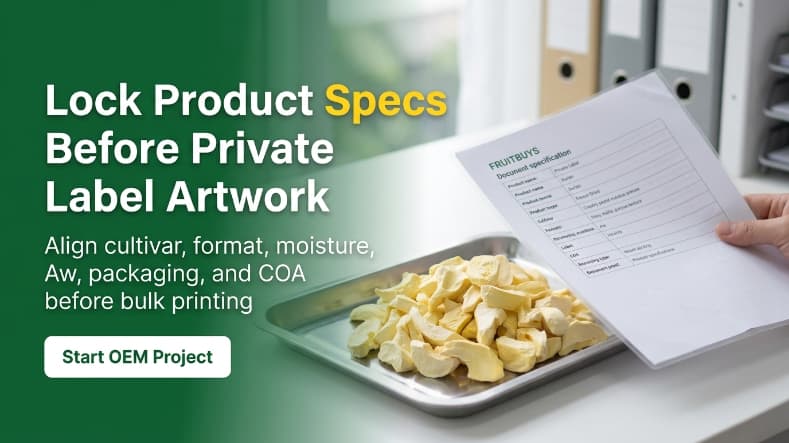
Buyers must lock cultivar, format, ingredient statement, moisture, Aw, packaging and release evidence before approving artwork.
FruitBuys aligns product, pouch, label and documentation under one supplied product relationship.
A private label buyer usually sees the product through three lenses: brand identity, consumer pack and launch timing. That order feels natural, but it creates risk. The product must define the artwork inputs. The artwork must not invent product facts.

The product brief should lock:
| Product Field | Required Decision |
|---|---|
| Product name | Freeze-dried durian |
| Cultivar | Ri6, Monthong/DONA or approved range |
| Format | Cubes, bites, slices, broken pieces or powder |
| Ingredient statement | Pure durian or declared formulation |
| Moisture target | Working target 3–5%, confirmed by COA |
| Aw target | Working target <0.30, confirmed by COA |
| Sensory criteria | Color, aroma, taste, texture and defect limits |
| Packaging | Retail pouch, bulk bag or ingredient pack |
| Destination market | Label and document scope |
| Release evidence | COA, retained sample and lot file |
Buyers should connect the product brief to Ri6 vs Monthong freeze-dried durian, freeze-dried durian cubes, bites, slices and powder and freeze-dried durian COA and laboratory testing.
Product Brief Requirements for Private Label Buyers
A private label brief should not read like a branding mood board. It should read like a control document.
FruitBuys needs the buyer to define:
- Intended channel
- Consumer pack or ingredient pack
- Target application
- Product format
- Cultivar preference
- Pack size
- Ingredient statement requirement
- Nutrition label requirement
- Destination market
- Shelf-life target
- Packaging style
- Storage instruction
- Lot-coding requirement
- Barcode and artwork responsibility
- Document review scope
- Sample approval rule
- Bulk release evidence
For application logic, use freeze-dried durian food applications. If the buyer has not defined the application, the private label brief remains incomplete.

A qualified supplier should not move artwork forward until the buyer confirms format and formula. Powder carries different label risk from bites. A product with carrier cannot use the same ingredient declaration as pure durian pieces. A retail pouch needs different evidence from a manufacturing ingredient bag.
Format Selection for Branded Durian Products
Format controls consumer experience, packaging risk and label discipline.
Bites, cubes, slices and powder require different approval criteria for size, breakage, moisture, Aw and pack handling.
Buyers should approve the exact format before pouch design or label text moves forward.
Private label buyers often choose formats by shelf appeal. That is not enough. The format also controls pack-fill behavior, breakage, product photography, nutrition basis, serving size, storage exposure and bulk consistency.
| Format | Private Label Use | Main Risk |
|---|---|---|
| Cubes | Controlled inclusion or structured pouch presentation | Edge chipping and size tolerance |
| Bites | Direct snack pouch | Irregular size and broken-piece variation |
| Slices | High visual presentation | Breakage and pack damage |
| Broken pieces | Ingredient or value-added application | Grade definition and consumer expectation |
| Powder | Bakery, beverage, dessert or ingredient pack | Mesh, carrier declaration and clumping |
A branded snack pouch should not use the same approval logic as a durian powder ingredient pack. The specification must define format, tolerance and grade allowance before the brand team finalizes pack copy.
The full format article is freeze-dried durian format and size specifications. Bulk comparison belongs in sample-to-bulk consistency for freeze-dried durian.
Retail Packaging Development
Private label packaging must protect the product and carry correct product information. A pouch that looks good but fails the seal or barrier review will damage the product before the buyer can evaluate market response.

Freeze-dried durian packaging should control:
| Packaging Function | Buyer Risk Controlled |
|---|---|
| Moisture barrier | Crispness and Aw drift |
| Seal integrity | Moisture ingress and aroma loss |
| Mechanical protection | Broken pieces and crushed slices |
| Light control | Color and sensory change risk |
| Aroma control | Loss of durian aroma or transfer to nearby goods |
| Coding space | Lot traceability and recall readiness |
| Label panel space | Required market information |
FDA explains that water activity relates to available water in food, which makes packaging control important for products where moisture exposure changes stability and texture. (U.S. Food and Drug Administration) A current freeze-drying review also notes that inadequate barrier materials, poor seals, storage conditions and physical damage can accelerate deterioration in packaged freeze-dried foods. (U.S. Food and Drug Administration)
The buyer should approve packaging through freeze-dried durian packaging and shelf-life controls. Transport protection should connect to freeze-dried durian carton and container planning.
Label Information and Nutrition Data
Private label work needs label data that matches the exact product. The label cannot borrow data from a different format, a rounded sample label, a historical product or an unverified formula.

For U.S.-bound packaged foods, FDA states that the Nutrition Facts label usually provides nutrition information based on one serving of the food, and FDA uses 2,000 calories a day as a general nutrition advice reference (U.S. Food and Drug Administration). FDA’s Food Labeling Guide also identifies FDA’s responsibility for foods sold in the United States to be safe, wholesome and properly labeled (U.S. Food and Drug Administration).
For EU consumer-facing food, Regulation (EU) No 1169/2011 governs food information to consumers, including mandatory food information and nutrition declaration requirements (U.S. Food and Drug Administration).
UAE registration review also matters because the UAE Government states that food products imported, locally produced or modified in label, ingredients or composition must be registered in the ZAD system before being handled in UAE markets (uae).
The label file should align:
| Label Field | Required Control |
|---|---|
| Product name | Must match product specification |
| Ingredient statement | Must match formula and carrier status |
| Nutrition facts | Must match format, serving and market rules |
| Allergen statement | Must reflect ingredient and facility review |
| Net weight | Must match pack configuration |
| Storage instruction | Must match product-pack-storage evidence |
| Lot code | Must match traceability system |
| Best-before code | Must match shelf-life support basis |
| Country-of-origin statement | Must match destination rules and verified data |
| Claims | Must be supported or removed |
For nutrition development, use freeze-dried durian Nutrition Facts development. For destination files, use freeze-dried durian documentation readiness.
Sample Approval and Artwork Approval Are Separate Gates
A buyer can approve the product sample and still reject the artwork. A buyer can approve the artwork and still hold the product. Treat these as separate gates.

Product sample gate
The sample gate confirms:
- Cultivar
- Format
- Sensory profile
- Moisture target
- Aw target
- Broken-piece allowance
- Packaging sample
- Retained sample
- COA expectation
Artwork gate
The artwork gate confirms:
- Product name
- Ingredient statement
- Nutrition panel
- Pack size
- Lot-coding space
- Storage instruction
- Market language
- Claims
- Barcode
- Legal responsibility where applicable
A design file cannot close a product gap. If the ingredient statement is still, the artwork should not move into final print. If the moisture and Aw targets are not linked to COA requirements, the pack should not carry an unsupported stability message. Private label approval should connect to approved sample and bulk release.
COA, Laboratory Testing and Private Label Release
A private label lot needs a COA that matches the actual packed product.
The document must identify the product, format, lot, test items, results, limits and method basis.
Buyers should review COA and laboratory scope before authorizing final packed goods.
A private label pouch increases the need for matched documents. The consumer-facing pack makes product identity visible. The COA and laboratory file must support the same product.

The COA should include:
| COA Field | Required Detail |
|---|---|
| Product name | Freeze-dried durian |
| Format | Bites, cubes, slices or powder |
| Lot number | Same as pack and packing file |
| Moisture | Numeric result and limit |
| Aw | Numeric result and limit |
| Microbiology | Agreed panel |
| Contaminants | Destination or buyer scope |
| Test method | Method or lab reference |
| Sample date | Linked to lot |
| Issuer | Internal QC or third-party laboratory |
U.S. import review also requires buyers to avoid false “FDA-approved product” language. FDA states that importers can import foods into the United States without prior sanction by FDA when relevant facilities are registered as required and prior notice is provided (U.S. Food and Drug Administration)
FDA’s importing-human-foods page also identifies food facility registration, prior notice and FSVP as core import topics (U.S. Food and Drug Administration). For the testing pathway, use freeze-dried durian COA and laboratory testing [FD-DUR-09].
Private Label Shelf-Life and Storage Claims
Shelf-life claims must connect to product, package and storage condition. A freeze-dried product does not automatically justify a broad shelf-life statement across every pouch, pack size and format.

Private label buyers should confirm:
- Product format
- Pack size
- Packaging material
- Seal condition
- Storage instruction
- Moisture and Aw results
- Microbiology status where required
- Shelf-life evidence
- Retained sample plan
- Failure endpoint
A 20 g snack pouch, a 100 g pouch and a bulk inner bag do not create the same exposure conditions. Powder also needs clumping review and opening protocol. Slices need stronger breakage control. Bites need consumer-pack consistency. The shelf-life path belongs in freeze-dried durian packaging and shelf-life controls. The final approval gate belongs in freeze-dried durian buyer checklist.
Coding, Traceability and Lot Control
Private label products need clear coding because the brand owner, importer and supplier must connect the pouch to the production lot. Coding is not decoration. It is the product’s memory.
The coding file should define:
| Coding Field | Buyer Purpose |
|---|---|
| Lot code format | Traceability |
| Best-before format | Shelf-life control |
| Production or packing date basis | Document alignment |
| Carton label | Warehouse and inspection control |
| Inner bag label | Bulk handling control |
| Retained sample code | Dispute review |
| COA lot code | Release evidence |
| Packing list lot code | Shipment file match |
A qualified supplier should align coding with freeze-dried durian export documents and sample-to-bulk consistency for freeze-dried durian. If the lot code on the pouch, carton, COA and packing list does not match, the private label file is not ready.
Application Mapping
| Buyer Type | Application | Required Format | Proof Needed | FruitBuys Delivery |
|---|---|---|---|---|
| Private label brand owner | Branded snack pouch | Bites, cubes or slices | Approved sample, artwork file, COA, pack spec, retained sample | OEM / Private Label Delivery |
| Importer | Market-ready retail SKU | Bites or cubes | Label review, destination documents, lot coding, COA | Documentation and Export Logistics Coordination |
| Distributor | Regional snack range | Bites, slices or mixed pieces | Pack consistency, carton label, storage instruction | Quality Control and shipment file alignment |
| Retail buyer | Consumer pouch approval | Bites or slices | Visual grade, pack sample, shelf-life support | Product and packaging release review |
| R&D developer | Bakery, beverage or dessert product | Powder, granules or broken pieces | Mesh, carrier status, application trial, nutrition basis | Application-aligned product development |
| QA manager | Supplier and lot approval | Any format | Specification, COA, certificate scope, retained sample | Lot-based Documentation and Quality Control |
Highest-Risk Error: Approving Artwork Before Product Evidence
The most expensive mistake in private label execution is not a weak design. It is final artwork built on unverified product data.
That error creates predictable failures:
- The product name does not match the actual format
- The ingredient statement ignores carrier status
- Nutrition values use the wrong basis
- Cultivar claim lacks raw-material support
- Shelf-life text lacks package validation
- Storage instruction lacks technical support
- Certificate logos do not match certificate scope
- Lot-coding space is missing
- Destination language review starts too late
- Bulk product does not match the approved sample
The buyer should hold artwork when the product specification is not locked. The brand team may dislike the pause. The market will punish a bad label harder. Private label should move through this sequence:
Product brief
→ application and format selection
→ approved sample
→ specification lock
→ packaging brief
→ label data review
→ artwork review
→ COA and lot-release panel
→ retained sample
→ bulk packing
→ final document handover
Why FruitBuys Delivers This
FruitBuys supplies freeze-dried durian as one finished private label product under an Integrated Product Supply Model. The buyer does not need separate growers, processors, packaging contacts, document handlers and shipping coordination with no single accountable product owner. The buyer needs one approved product, one pack file, one label-data route and one release file.
FruitBuys applies OEM/Private Label Delivery by aligning product format, pouch direction, label inputs, coding, retained sample and bulk release. FruitBuys applies Quality Control by checking moisture, Aw, sensory criteria, broken-piece tolerance and sample-to-bulk consistency. FruitBuys applies Documentation by connecting COA, nutrition basis, certificate scope, ingredient statement and destination documents to the actual lot.
FruitBuys applies Raw Material Sourcing Governance by aligning cultivar and maturity direction with the buyer’s product identity. FruitBuys applies Export Logistics Coordination by connecting carton configuration, lot code, packing file and document handover.
Private label is not design wrapped around product. Private label is product control expressed through a brand pack.
Buyer Checklist
Before approving freeze-dried durian private label production, request:
- Product application
- Cultivar or approved cultivar range
- Product format
- Size tolerance or mesh
- Ingredient statement
- Carrier declaration for powder
- Moisture target and COA requirement
- Aw target and COA requirement
- Microbiology panel
- Nutrition basis
- Pack size
- Pouch or inner bag specification
- Seal review
- Carton configuration
- Shelf-life support status
- Storage instruction
- Label copy
- Artwork proof
- Lot-coding rule
- Best-before coding rule
- Certificate scope review
- Destination document checklist
- Retained sample
- Final bulk comparison rule
No locked specification, no final artwork. No lot evidence, no packed-product release.
Summary
Freeze-dried durian private label development must start with a locked product specification, not artwork. Buyers need cultivar, format, ingredient statement, moisture, Aw, packaging, label data, nutrition basis, coding, COA, retained sample and destination document review before bulk packing.
U.S. label and import review should follow FDA labeling and import requirements, EU consumer-facing labels need food-information review under Regulation 1169/2011, and UAE products require registration review when labels, ingredients or composition apply through ZAD. FruitBuys manages private label delivery through OEM/Private Label Delivery, Quality Control, Documentation, Raw Material Sourcing Governance and Export Logistics Coordination.
FAQ
What is freeze-dried durian private label?
It is a branded freeze-dried durian product built around an approved product specification, packaging brief, label file, coding system, COA and release evidence.
Should artwork come before product approval?
No. Artwork should follow product approval. The buyer must lock format, ingredient statement, moisture, Aw, packaging and label data first.
Which format works best for private label snacks?
Bites, cubes and slices can work for snack pouches. The buyer must define size tolerance, broken-piece allowance, packaging and retained sample rules.
Can durian powder be private labeled?
Yes. Powder needs mesh, carrier declaration, clumping review, nutrition basis, microbiology and packaging protection before artwork approval.
What documents support private label release?
The release file should include specification, approved sample, COA, laboratory reports, packaging file, label data, certificate scope, retained sample and packing alignment.
Does FDA approve private label food products?
No. FDA does not pre-approve individual food products or labels before import. U.S. buyers still need registration, prior notice, labeling and importer verification review where applicable.
Which article should follow this one?
Read freeze-dried durian documentation readiness for market files, or freeze-dried durian buyer checklist for final approval.
Conclusion
Submit the private label brief after locking product format, pack size, destination market, label data, packaging condition and release evidence.
References
- U.S. Food and Drug Administration. “What’s on the Nutrition Facts Label.” Current FDA label education page. (U.S. Food and Drug Administration)
- U.S. Food and Drug Administration. “Guidance for Industry: Food Labeling Guide.” Current FDA guidance page. (U.S. Food and Drug Administration)
- U.S. Food and Drug Administration. “Importing Food Products into the United States.” Current FDA import overview. (U.S. Food and Drug Administration)
- U.S. Food and Drug Administration. “Importing Human Foods.” Current FDA import guidance page. (U.S. Food and Drug Administration)
- European Union. “Regulation (EU) No 1169/2011 on the provision of food information to consumers.” Official EU regulation text. (U.S. Food and Drug Administration)
- The Official Portal of the UAE Government. “National Food Accreditation and Registration System.” UAE ZAD registration overview. (u.ae)



