
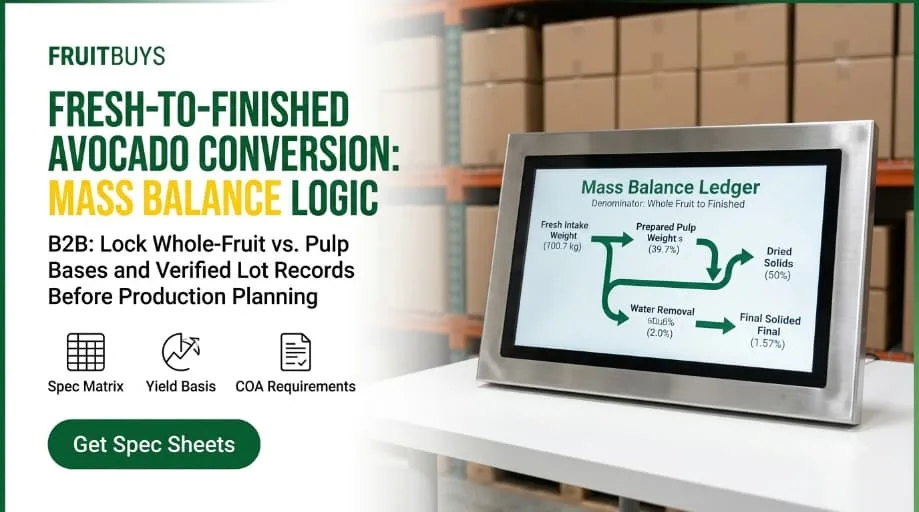
How many kilos of fresh avocado make 1 kg of freeze-dried?
6.5–8 kg of whole fresh avocado makes 1 kg of freeze-dried avocado. That ratio is the floor under every honest quote: the raw fruit in a kilogram of freeze-dried avocado costs six to eight times the price of a kilogram of fresh fruit before a single hour of freezing, drying or packing. It is also what your business gets back. Every kilogram you buy is 100% usable avocado, peeled, destoned and dried in the Central Highlands, with no peel or seed to dispose of, no freezer to run and no thaw loss at your plant. This guide shows where the weight goes, how variety and ripeness move the cost, how to test a quote in five minutes and how to present the full cost in use to your finance team.
The ratio also explains why freeze-dried avocado is a hedge, not just an ingredient. In 2026, fresh Hass prices in the US went from multi-year lows in April to supply force majeure by late May. A buyer paying spot for fresh or frozen pulp carried every swing; a buyer with an annual freeze-dried programme, packed from Central Highlands fruit at the May–September peak, paid one contract price for the year.
Why does it take 6.5–8 kg of whole fruit?
Three things leave the fruit between the orchard gate and the finished bag.
| Step | What leaves | What remains per 1 kg freeze-dried |
|---|---|---|
| Whole fresh avocado at intake | 6.5–8 kg | |
| Peeling, destoning, trimming to clean cubes | Skin, seed, bruised and uneven edges: 20–30% of 034 and Booth 7 fruit | 5.2–5.6 kg of usable flesh into the freezer |
| Freeze-drying to 2–4% moisture | About 79% of the flesh is water | 1 kg finished, with fines held at ≤5% |
The moisture alone sets a floor: green-skin avocado flesh needs about 4.6 kg to make 1 kg at 3% moisture. The rest of the gap, up to 5.2–5.6 kg, is the cutting and handling that turns soft fruit into sharp, whole cubes and slices. Seasonal swings in fruit size and ripeness are why the ratio is a range, not a single number.
Water, peel and seed: where does your money actually go?
Mostly into fruit. In a freeze-dried product, the raw material carries the largest single share of the cost, because you are paying for the flesh of six to eight whole avocados in every kilogram. Freezing, drying, packing and testing come on top.
That is also why freeze-dried avocado is efficient to ship. One kilogram replaces about 4.6 kg of frozen avocado pulp, so you move roughly 78% less weight, in a standard dry container instead of a reefer. A full 40 ft HC of freeze-dried avocado carries the equivalent of roughly 50–90 tonnes of whole fresh fruit, with no temperature logger and no freezer space waiting at the other end.
Does variety change the ratio?
Yes, in two directions, and they almost cancel out.
- 034 and Booth 7, the Central Highlands butter avocados, are large fruit with a small seed for their size. 70–80% of each fruit is usable flesh, and workers peel and destone them faster, which keeps labour per kilogram down. Their flesh holds a little more water, so the drying step takes away a larger share.
- Hass is a smaller fruit with a thicker skin and a larger seed relative to its size. Peel, seed and trim take 30–35% of the fruit, and each kilogram needs more handling. Its flesh carries more oil and less water, which pulls the drying ratio back down.
The result: both land in the same 6.5–8 kg band, with Hass toward the lower end. What decides the cost per kilogram is the raw-fruit price and the labour per kilogram, and highland butter avocado is the fruit Vietnam grows at scale. The full variety comparison is in 034 and Booth 7 vs Hass.
How do ripeness and seed size move the raw cost?
Ripeness decides how much of the flesh becomes whole pieces.
- Firm-ripe fruit is what FruitBuys cuts. The flesh is full-flavoured but dense enough to dice into clean 5 mm and 10 mm cubes, and it goes into the freezer straight after cutting.
- Overripe fruit is set aside at intake. Soft flesh smears on the blade instead of cutting, so it cannot make whole dices or slices.
- Seed size moves with variety and fruit size. Larger fruit with a small seed, the profile of 034, puts more flesh on the cutting table for every kilogram bought at the farm gate.
Across the season, fruit size and ripeness shift a little, which is why FruitBuys quotes the ratio as 6.5–8 kg and plans annual volume from stock packed at peak season, when flesh quality and fruit availability are both at their best.
How do you spot a quote that cannot be real?
Run this check on any quote:
Raw-fruit cost per kg of freeze-dried avocado = farm-gate price per kg of whole fruit × 6.5–8
Add freezing, drying, packing and testing on top. If a quote lands below the raw-fruit cost alone, something in the product has changed. Every buyer should check these three things, with us or with any supplier:
- The ingredient line. Maltodextrin, starch or vegetable oil can be blended in, especially with granules and powders. 100% freeze-dried avocado reads “avocado” and nothing else.
- The moisture on the COA. Product released at 6–8% moisture weighs more per kilogram of avocado, so you pay for water, and the pieces soften faster. FruitBuys holds ≤5.0%, typically 2.0–4.0%, with water activity ≤0.30.
- The cut and the fines. Overripe or off-grade fruit cannot dice clean, so it shows up as broken pieces and dust. Look for whole cubes and slices with fines at ≤5%.
A heat-dried product sold under a freeze-dried name also changes the economics; the light, crisp snap and the creamy melt on the tongue tell you which one you have.
What is the real cost in use for your business?
Take the comparison your finance team will make: a kilogram of FruitBuys freeze-dried avocado against the fresh or frozen avocado it replaces.
| Fresh or frozen avocado at your plant | 1 kg FruitBuys freeze-dried avocado | |
|---|---|---|
| Usable avocado | Peel, seed and trim still to remove; browned or weeping pulp after thaw | 100% usable, ready to dose |
| Labour at your plant | Peeling, destoning, cutting or thawing | None: open the bag and dose |
| Waste at your plant | Skin, seed, browned flesh | None |
| Freight | Reefer, about 4.6 kg of pulp per kg of freeze-dried equivalent | Standard dry container, 1 kg |
| Storage | Freezer space and power, temperature monitoring | Ambient: 12 months at ≤25 °C, RH ≤60%; 18–24 months in cool storage at ≤18 °C, RH ≤50% |
| Rehydrated yield | 4–4.5 kg of ready avocado with 3–3.5 parts water |
Your formula: freeze-dried price per kg + freight per kg, against (frozen pulp price × 4.6) + reefer freight + freezer storage + thaw and browning loss + labour. Fill in your own numbers and the decision makes itself, line by line. Where to dose each format and what it costs per tonne of finished product is in how to use freeze-dried avocado.
Fit note. If your product needs a fresh-cut texture, such as chilled guacamole sold refrigerated, frozen or high-pressure-processed pulp still has its place. For dry mixes, bars, cereals, smoothie blends and ambient dip bases, freeze-dried avocado delivers the same avocado with the water, peel and cold chain taken out.
Get the numbers for your volume
Send your format, annual volume and destination port, and FruitBuys returns a quote with the product specification and a container loading plan built to keep freight per kilogram down. Full specifications are on the freeze-dried avocado product page; the release limits and storage plan are in how freeze-dried avocado stays crisp, green and fresh-tasting through storage; and the full supplier checklist is in what to check before buying freeze-dried avocado in bulk.
FAQ
How much fresh avocado makes 1 kg of freeze-dried avocado?
6.5–8 kg of whole fresh avocado. Peel, seed and trim remove 20–30% of 034 and Booth 7 fruit, and drying removes about 79% of the flesh weight as water.
Why is freeze-dried avocado more expensive per kilogram than fresh?
Each kilogram carries the flesh of 6.5–8 whole avocados with the water, peel and seed removed. Per kilogram of usable avocado, and with no cold chain, the comparison is much closer than the shelf price suggests.
Does Hass give a better yield than 034 or Booth 7?
Hass flesh holds less water, but peel, seed and trim take 30–35% of the smaller fruit. 034 and Booth 7 give 70–80% usable flesh. Both land within 6.5–8 kg, with Hass toward the lower end.
How much avocado does 1 kg of freeze-dried avocado make when rehydrated?
About 4–4.5 kg of soft, spreadable avocado with 3–3.5 parts cold water.
Why is avocado powder expensive per kg?
Every kilogram of 100% freeze-dried avocado powder carries the flesh of 6.5–8 kg of whole fresh avocado, milled at low temperature so the oil stays fresh. Cheaper spray-dried powders typically carry 30–50% maltodextrin as a drying carrier, so up to half of each kilo is starch. Compare on avocado per serving; the price drivers are on the freeze-dried avocado powder product page, and the specification checks in the avocado powder buying guide.
What should I check if a quote looks too cheap?
The ingredient line for carriers or oil, the moisture on the COA against ≤5.0%, and the share of whole pieces against fines of ≤5%.
What comes with a FruitBuys quote?
The price for your format and Incoterm, the product specification and a container loading plan for your volume and destination port.



