
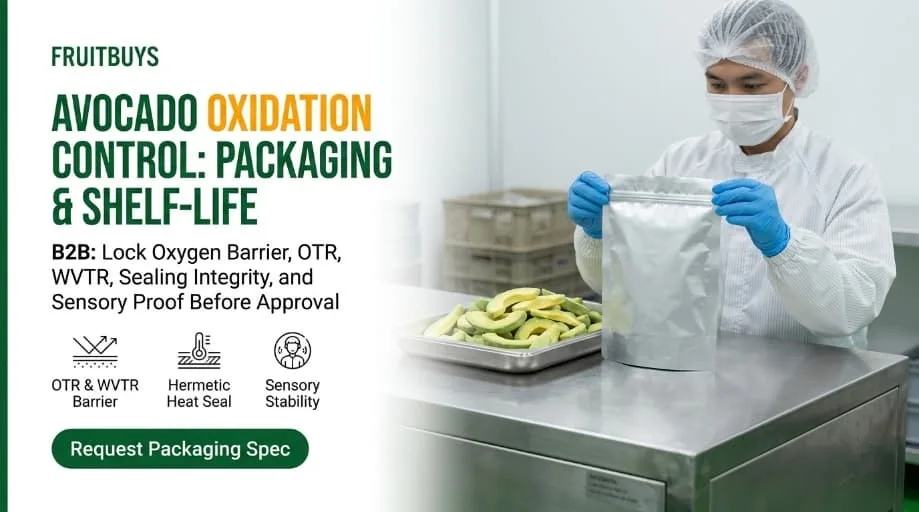
How do you keep freeze-dried avocado crisp, green and fresh-tasting for 12–24 months?
Four controls do it, and each one is set before the fruit ever reaches your warehouse: firm-ripe fruit, fast freezing straight after cutting, drying to 2–4% moisture and water activity ≤0.30, and light-proof foil with a gentle vacuum and desiccant. Together they keep freeze-dried avocado crisp, pale yellow-green and buttery for 12 months at ≤25 °C and RH ≤60%, and 18–24 months in cool storage at ≤18 °C and RH ≤50%. This guide shows your QA team what each number protects, what ships with every container, and the five checks that take two minutes when the container arrives, so you can sign off the specification with confidence.
What do moisture ≤5.0% and water activity ≤0.30 each protect?
They answer two different questions, and a good specification uses both.
- Moisture tells you how much water is left in the product. FruitBuys holds freeze-dried avocado at ≤5.0%, with a typical release of 2.0–4.0%. For your business, that means you pay for avocado, not water, and every slice snaps clean when the bag opens.
- Water activity (aw) tells you how free that remaining water is to move. At aw ≤0.30, measured to ISO 18787, there is too little free water for bacteria, yeasts or moulds to grow, and the pieces stay crisp in a sealed bag. For your formulation team, aw is also the number that predicts whether avocado stays crisp next to nuts, cereal or chocolate.
Avocado brings one more advantage here. With 44–50% fat and only 3 g sugar per 100 g, it holds far less of the sugar that makes most dried fruit pull moisture from the air. Kept sealed and dry, it stays free-flowing and crisp through the year.
Your specification at a glance
| Parameter | Specification | Typical at release | Method |
|---|---|---|---|
| Moisture | ≤5.0% | 2.0–4.0% | Gravimetric (ISO/AOAC) for the lot COA; halogen analyser for in-line release QC |
| Water activity | ≤0.30 | ≤0.30 | ISO 18787 |
| Total plate count | ≤10⁴ CFU/g | ISO 4833-1 | |
| Yeasts and moulds | ≤10² CFU/g | ISO 21527 | |
| E. coli | <10 CFU/g | ISO 16649-2 | |
| Salmonella | Not detected in 25 g | ISO 6579-1 | |
| Fines (<2 mm) | ≤5% at loading | Sieve | |
| Colour, aroma, texture | Pale yellow-green; fresh, buttery, nutty; crisp | Matches approved PSS | Sensory |
How are the crisp texture and buttery taste locked in?
Avocado’s flavour lives in its oil, so every step is built to keep that oil fresh.
- Firm-ripe fruit. FruitBuys sources 034 and Booth 7 butter avocados from the Central Highlands at firm ripeness, when the flesh is full-flavoured but still dense enough to cut into sharp cubes. Overripe fruit is set aside at intake, not dried.
- Fast freezing straight after cutting. Peeled and cut fruit goes into the freezer without waiting on the line, so the fresh colour and flavour are locked in before air can dull them.
- Drying to 2–4% moisture under vacuum. Freeze-drying removes the water at low temperature, so the fat is never cooked and the pieces keep their shape, colour and creamy melt.
- Light-proof foil, gentle vacuum and desiccant. The pieces are sealed away from light, air and humidity within the same production run. The packaging section below explains how.
Your QA team sees the result on the first pouch: a clean snap, an even pale yellow-green and a fresh, buttery aroma. For retail programmes that want shelf-life data on their own pack, FruitBuys tracks peroxide value and sensory over storage on request.
How does the packing keep pieces crisp and unbroken all the way to your plant?
Three layers work together.
- Light-proof aluminium-foil laminate bags. Foil blocks light and oxygen, the two things that age a fat-rich fruit, and keeps out humidity on a long sea voyage.
- A gentle vacuum. Drawing just enough air to sit the bag flat in the carton holds the pieces still, so slices and cubes do not rub into crumbs during loading and transit. The bags sit snug and square, so cartons pack tight with no wasted space.
- Food-grade silica gel desiccant. A dust-proof sachet in every bag holds the air inside dry for the life of the bag.
Bulk bags come in 1–5 kg inside a 5-ply export carton of 58 × 28 × 34 cm, about 550 cartons to a 20 ft container, floor-loaded in a standard dry container with no reefer. FruitBuys sizes bulk bags to one production batch, so your line opens a bag and empties it in a single run, and every other bag stays sealed until its turn. On hot routes, ask for kraft-paper lining on the container walls and a gap below the roof; both keep condensation away from the cartons through the voyage.
Which tests travel with each container?
Every full container ships with a lot COA from an independent ISO/IEC 17025 accredited laboratory: moisture, water activity, total plate count, yeasts and moulds, E. coli and Salmonella. Lead, arsenic and aflatoxin are monitored on a fixed surveillance schedule, with reports available on request.
For your destination market, FruitBuys coordinates the extra panels before the container is stuffed: pesticide multi-residue to EU or US limits, nutrition panel, Listeria, Enterobacteriaceae and ethylene oxide. Trial and LCL orders ship with a release QC report per batch, covering moisture, water activity and sensory, and independent lot testing is available for them too.
The standard export dossier goes with every shipment: commercial invoice, packing list, bill of lading, C/O Form EUR.1, phytosanitary certificate and the lot COA.
How do the PSS and retained sample keep every lot matched?
They give your team a fixed reference from approval to delivery.
- Pre-shipment sample (PSS). Before loading, FruitBuys sends 100–200 g from the packed lot in two sealed foil pouches with desiccant: one for tasting and rehydration, one kept sealed for your laboratory if you want to test it. You approve the lot against the sample you already know.
- Retained sample. A sample from every container lot is kept for its full shelf life, up to 24 months. If your team ever wants to compare a delivery with the lot that left Vietnam, the reference is there.
- One locked facility. FruitBuys runs each contract through one qualified processing facility, with written change-control and audit access. The lot you approve today is made the same way as the lot you receive next season.
How long does it keep, and what should you check when the container arrives?
Plan stock on the operating spec: 12 months at ≤25 °C and RH ≤60%, and 18–24 months in cool storage at ≤18 °C and RH ≤50%, in the original unopened foil bag with desiccant. A cool, dark store is the producer’s pro tip for avocado: it keeps the buttery note as fresh as on loading day, which is why distributors holding stock for retail through the year choose cool storage.
Temperature is the biggest lever you control. As a working rule in food storage, a fat-rich product ages about twice as fast for every 10 °C warmer, so the same sealed bag that gives 12 months in a 25 °C warehouse gives 18–24 months at 18 °C or below. For a distributor, that turns a modest cool-room cost into an extra 6–12 months to sell through, fewer short-dated pallets and room to buy a full container instead of splitting the order.
The 5-step receiving check, about two minutes per lot:
- Cartons and seals. Cartons dry and square; bag seals intact and the bag still sitting flat.
- Snap. Break a slice or cube: it should crack clean and dry.
- Colour and aroma. Even pale yellow-green and a fresh, buttery, nutty smell, matching your approved PSS.
- Water activity. Read a freshly opened pouch; it sits at or below 0.30, in line with the lot COA.
- Fines. Sieve a sample at 2 mm; fines at or below 5% confirm the pieces travelled well.
Do these within the first two weeks of arrival and record them against the lot code. Then store sealed cartons on pallets, off the floor, away from strong odours, and open bags one batch at a time.
Fit note. These controls are built for sealed bulk and retail packs. If you repack into your own retail format, choose a high-barrier foil or window pouch with a desiccant and pack in a dry room; FruitBuys can run an accelerated shelf-life study on your final pack, or pack your retail format at source so the same barrier goes all the way to the shelf.
Approve the specification with a sample in hand
Ask for a sample and your QA team gets the lot COA format, the PSS pouch pair and the specification together, ready to sign off in one review. Samples leave in 3–5 working days by express courier. Full specifications are on the freeze-dried avocado product page; how the pieces behave in mixes, bars and dips is in how to use freeze-dried avocado; the yield behind the price is in how many kilos of fresh avocado make 1 kg of freeze-dried; and the full supplier checklist is in what to check before buying freeze-dried avocado in bulk.
FAQ
How long does freeze-dried avocado last?
12 months at ≤25 °C and RH ≤60%, and 18–24 months in cool storage at ≤18 °C and RH ≤50%, in the original unopened foil bag with desiccant.
What moisture and water activity should freeze-dried avocado have?
Moisture ≤5.0%, typically 2.0–4.0% at release, and water activity ≤0.30, measured to ISO 18787.
Will the pieces arrive whole?
Yes. A gentle vacuum sits each foil bag flat in the carton and holds the pieces still through loading and transit, with fines at or below 5% at loading.
What does the lot COA cover?
Moisture, water activity, total plate count, yeasts and moulds, E. coli and Salmonella, from an independent ISO/IEC 17025 accredited laboratory, with every full container.
How should I store freeze-dried avocado?
Sealed, in a cool, dry, dark place at ≤25 °C and RH ≤60%, on pallets off the floor and away from strong odours; at ≤18 °C and RH ≤50% for stock held beyond 12 months.
What should I check when the shipment arrives?
Carton and seal condition, the snap of a piece, colour and aroma against your PSS, water activity on an opened pouch and fines at 2 mm.
Does the avocado oil stay fresh through storage?
Yes, when the bag stays sealed, cool and dark. Each step protects the natural oil: firm-ripe fruit, freezing straight after cutting, low-temperature drying, and light-proof foil with a gentle vacuum and desiccant. That holds the fresh, buttery taste for 12 months at ≤25 °C, and 18–24 months in cool storage at ≤18 °C.
Can I get shelf-life data for my retail pack?
Yes. FruitBuys tracks peroxide value and sensory over storage on request and can run an accelerated shelf-life study on your final pack format.



